A New Era of International Gangsterism
Trump, Putin, and Xi believe wholeheartedly that the strong do what they will and the weak suffer what they must.
When he described the Axis powers to the American public, President Franklin D. Roosevelt returned time and again to the notion of international gangsterism to characterize the motives, behavior, and goals of those nations America fought against in World War II. Roosevelt made clear that, beyond the high-minded aspirations outlined in the Atlantic Charter and Four Freedoms, America’s own war aims involved eradicating the scourge of international gangsterism by ridding the world of outlaw nations like Nazi Germany and Imperial Japan. America and its allies, he told an assembled Ottawa crowd in August 1943, had been forced to “call the sheriff’s posse to break up the gang in order that gangsterism may be eliminated in the community of nations.”
With his use of military force against Venezuela and war against Iran, overt coercive threats toward other nations including long-time American allies like Denmark, and assertions of unconstrained personal power to use military force wherever and whenever he sees fit, President Trump has made plain that he’s eager to inaugurate a new era of international gangsterism—this time with the United States as a gangster power alongside Vladimir Putin’s Russia and Xi Jinping’s China. Unlike Roosevelt, Trump sees America not as the leader of a global posse bringing international gangsters to heel but as a mob boss threatening America’s allies and neighbors while carving up the world with other gangster powers.
It’s a profound shift, one that stands in direct opposition to the sort of foreign policy the United States has pursued—and the sort of stable and open world it has, however imperfectly, tried to create—over the past century.
Trump’s own rhetoric and actions leave little doubt: like his America First forbears in the 1940s, Trump desires an entente horrible with the dictators of our own day that would effectively cede Europe and East Asia to Moscow and Beijing while granting the United States carte blanche to dominate the Western Hemisphere, and perhaps run riot in the Middle East, in similar fashion. The Trump administration’s conduct of foreign policy over its first fifteen months back in office makes this clear: he has lavished praise on Putin, obsequiously hosted him in Alaska, and attempted to give the Kremlin preemptive concessions while displaying hostility to Volodymyr Zelenskyy’s government in Kyiv as well as toward America’s oldest allies. Trump and a number of administration officials have leveled threats against Denmark, Colombia, Cuba, and Mexico, while Trump himself has publicly stated that Taiwan’s fate is ultimately “up to” Xi Jinping. And he’s carried out his own special military operation in Venezuela, embarked upon a murder spree against small boats in the Caribbean, and started a war with Iran for no apparent reason.
But what animates today’s international gangsterism?
First and foremost, gangster powers believe wholeheartedly in the infamous dictum found in Thucydides: the strong do what they will and the weak suffer what they must. This idea isn’t exactly might makes right; real and would-be international gangsters aren’t terribly concerned with the “right” part of the equation. It’s more akin to what Roosevelt called “the philosophy of force”—a fundamental belief in the supreme prerogative of power, unconstrained by supervening notions of morality or any other principles. Indeed, the philosophy of force is proudly amoral in the worst sense of the word, outright destructive of any semblance of morality in affairs of nations.
For international gangsters, this fundamental belief is not mere “realism,” a descriptive account of the way the world unfortunately and tragically works—a perspective found often enough in academic circles and among policymakers. It’s instead a prescriptive assertion about the way they think the world should work, the sort of world they would like to create and in which they would prefer to live.
And it’s become even more explicit since the start of the year: Trump himself now claims to possess absolute power to order the U.S. military to attack any nation in the world solely on his whim, constrained only by his own debased sense of morality—an assertion made real by his war with Iran. But in a January interview with CNN host Jake Tapper, presidential aide Stephen Miller provided perhaps the most succinct articulation of the philosophy of force that governs the Trump administration’s foreign policy: “we live in a world in which, you can talk all you want about international niceties and everything else, but we live in a world, in the real world, Jake, that is governed by strength, that is governed by force, that is governed by power. These are the iron laws of the world.”
Gangster powers further maintain that the world can and should be carved up into spheres of influence to be ruthlessly dominated by great powers as they see fit. This central tenet of international gangsterism is most glaringly obvious in Vladimir Putin’s proprietary attitude toward Eastern Europe as well as his strenuous, ongoing attempt to reduce Ukraine to vassalage. It can also be seen in the Chinese Communist Party’s claims Taiwan and much of the South China Sea—the so-called “nine dash line”—as well as the Chinese military’s encroachment on India’s northern borders.
For his part, Trump appears to agree with Putin and Xi in both policy and rhetoric. Even before his special military operation in Venezuela, Trump and a number of his advisors have mused about the use of force across Latin America and he has repeatedly made clear his own desire to retreat from Europe and Asia. Just like the original America First movement before World War II, Trump seems convinced that America can concern itself only with hegemony over its own sphere of influence in the Western Hemisphere while other gangster powers ride roughshod over the rest of humanity. Witness Trump’s absurd obsession with annexing Canada and ongoing attempts to acquire Greenland from Denmark by force or fraud, to say nothing of his transparent effort to take control of Venezuela’s oil.
Finally, gangster powers hold that territorial aggrandizement remains a legitimate objective of foreign policy—one a nation can pursue by any means necessary, including threats of military force. Putin once more provides the most blatant recent example with his formal annexation of Ukrainian territory after his invasion of the country in 2022. Likewise, Beijing has used its military to nibble away at India’s northern border and build artificial islands in the South China Sea while chronically intimating its willingness to use force against Taiwan.
Trump’s rhetoric and actions both show that he, too, considers territorial aggrandizement a valid foreign policy goal. He has repeatedly threatened to use economic coercion and military force to compel annexations of Canada, Greenland, and the Panama Canal. These statements can’t simply be dismissed as negotiating tactics, much less stabs at inflammatory humor—they’re quite ominous given their not-so-subtle openness to using gangster tactics to seize the territory of other nations. Worse, they’re damaging in and of themselves, with the president of the United States giving cover to Putin’s brutal land grab in Ukraine. Indeed, Trump heavily implied that Putin has a legitimate claim to Ukrainian territory because Russia “fought for that land and lost a lot of soldiers.”
Finally, the aggression of gangster powers should be understood as a quest for personal aggrandizement and ego inflation by gangster leaders and movements possessed by delusions of historical grandeur—not questions of national security or even ideology as commonly understood. Putin and Xi, for instance, clearly see themselves as the incarnations and redeemers of Russian and Chinese nationalism, seen most clearly in Putin’s pre-war publication of a turgid essay “On the Historical Unity of Russians and Ukrainians.” Trump, for his part, may lack similar motives. But he has a long-established penchant for slapping his name on anything and everything he possibly can (including the U.S. Institute of Peace and the Kennedy Center), and recently remarked that he wants to seize Greenland “because that’s what I feel is psychologically needed for success." His desire to dictate the next leaders of Venezuela, Iran, and Cuba also speak to Trump’s essential megalomania. For the heads of gangster powers, it’s all about them—whatever that may mean for each individual strongman.
Again, it’s critical to understand that this is the way leaders of gangster powers believe the way the world should work. Trump has made his admiration for international gangsters like Putin and Xi crystal clear, and he has made plain that on his watch America will—at best—sit back and watch as these gangster powers carve the world up between themselves, and indeed intends to do some carving of its own. Small-time international gangsters and local bullies will also undoubtedly look to take advantage of the opportunities for international racketeering available over the course of the next three years, with unscrupulous political leaders, populist firebrands, and military juntas all reviving long-dormant territorial disputes with their neighbors and possibly seeking to settle them through force.
Humanity has seen this film twice before, and on both occasions it didn’t end well for either America or the world. Let’s hope that this third iteration ends with a whimper rather than a bang—and that America returns to its senses as the moral, strategic, and practical bankruptcy inherent to a foreign policy of gangsterism becomes too obvious to ignore.
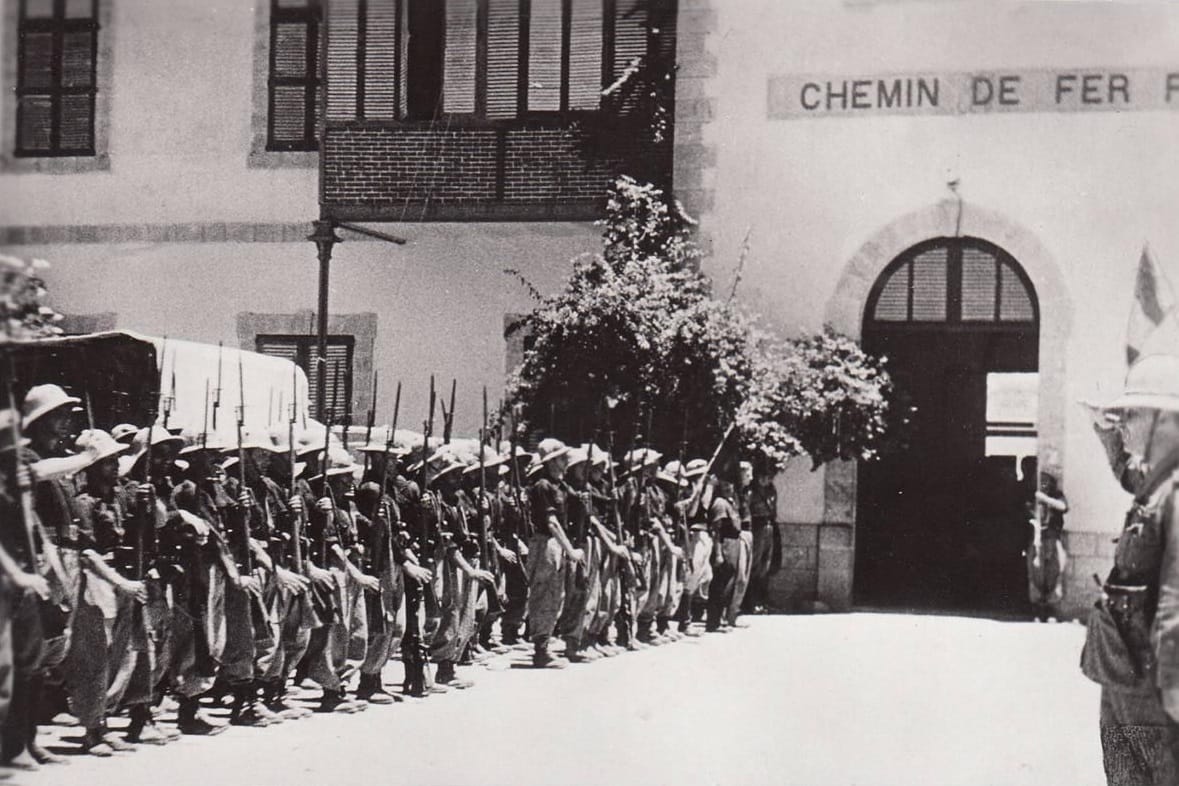
Featured image is Italian Blackshirts at Dire Dawa, Ethiopia