After a Dark Week, Americans Should Turn to Jimmy Carter’s Malaise Speech
Carter was panned at the time and long after, but has been vindicated.
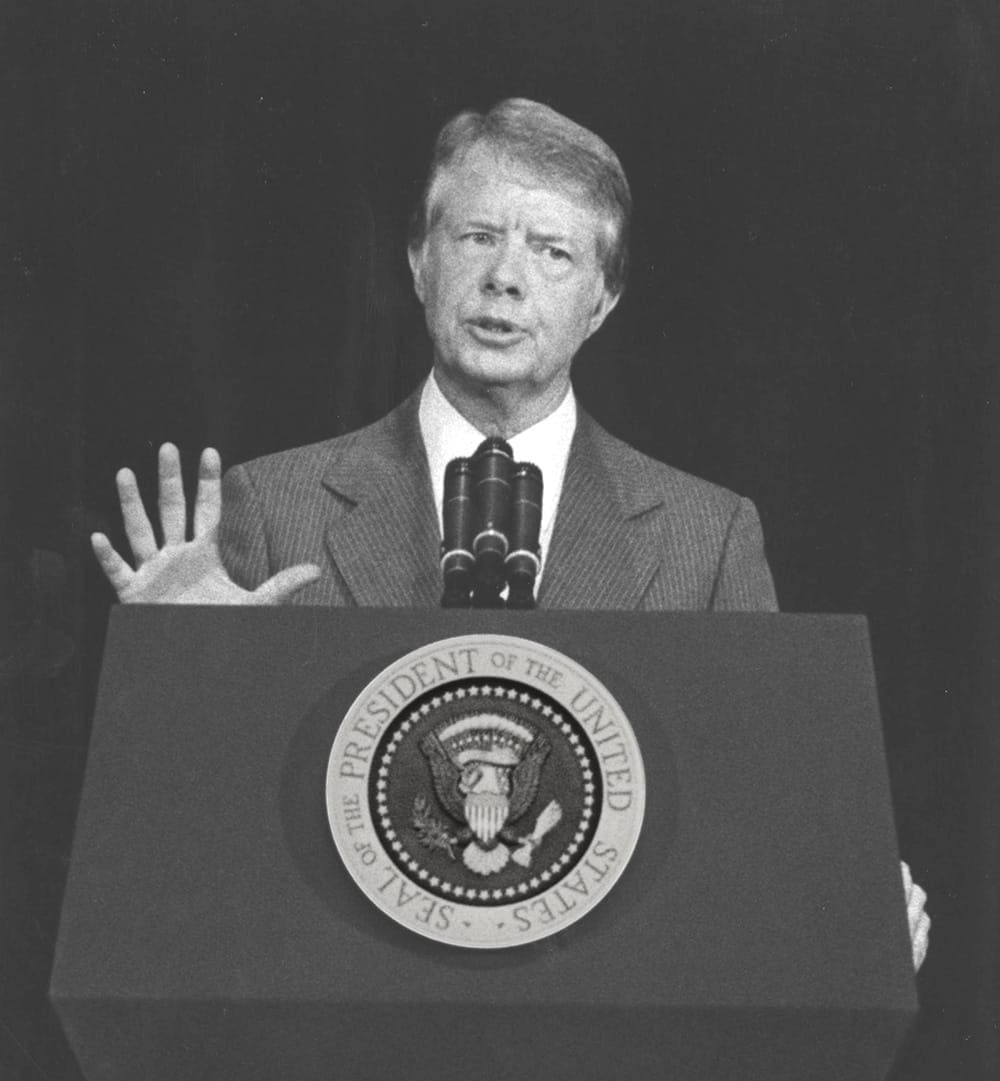
On July 15, 1979, Jimmy Carter delivered an address to the American people from the Oval Office. Formally known as A Crisis of Confidence, the address has since been memorialized as “the malaise speech,” and held up as a prime example of Carter’s morally rigid and politically inept presidency—one of the great last gasps of the miserable 1970s. Oil shortages, turbulence in the Middle East, and the lingering shadows of Watergate and the Vietnam War left Americans, in Carter’s view, morally and civically adrift. And, in what most analysts have considered a failure of a presidential speech, he told them so.
So let’s begin with an extended except from Carter’s speech:
The threat is nearly invisible in ordinary ways. It is a crisis of confidence. It is a crisis that strikes at the very heart and soul and spirit of our national will. We can see this crisis in the growing doubt about the meaning of our own lives and in the loss of a unity of purpose for our Nation. The erosion of our confidence in the future is threatening to destroy the social and the political fabric of America.
The confidence that we have always had as a people is not simply some romantic dream or a proverb in a dusty book that we read just on the Fourth of July. It is the idea which founded our Nation and has guided our development as a people. Confidence in the future has supported everything else--public institutions and private enterprise, our own families, and the very Constitution of the United States. Confidence has defined our course and has served as a link between generations. We've always believed in something called progress. We've always had a faith that the days of our children would be better than our own.
Our people are losing that faith, not only in government itself but in the ability as citizens to serve as the ultimate rulers and shapers of our democracy. As a people we know our past and we are proud of it. Our progress has been part of the living history of America, even the world. We always believed that we were part of a great movement of humanity itself called democracy, involved in the search for freedom, and that belief has always strengthened us in our purpose. But just as we are losing our confidence in the future, we are also beginning to close the door on our past.
In a nation that was proud of hard work, strong families, close-knit communities, and our faith in God, too many of us now tend to worship self-indulgence and consumption. Human identity is no longer defined by what one does, but by what one owns. But we've discovered that owning things and consuming things does not satisfy our longing for meaning. We've learned that piling up material goods cannot fill the emptiness of lives which have no confidence or purpose.
The symptoms of this crisis of the American spirit are all around us. For the first time in the history of our country a majority of our people believe that the next 5 years will be worse than the past 5 years. Two-thirds of our people do not even vote. The productivity of American workers is actually dropping, and the willingness of Americans to save for the future has fallen below that of all other people in the Western world.
As you know, there is a growing disrespect for government and for churches and for schools, the news media, and other institutions. This is not a message of happiness or reassurance, but it is the truth and it is a warning.
Today, Americans face eye-watering prices at the pump thanks to an illegal and immoral war against Iran. And the world is reeling from President Trump’s naked threat to commit a genocide against the Iranian people, psychotically posting that “a great civilization will die.” And the problems that Carter identified mostly remain. Americans distrust one another and their government. We have declining rates of political participation and civic participation. Disinformation and resentment dominate our national conversations. And we continue to turn to populist salves for our problems, both real and perceived.
What Carter did in his speech was something rare in the annals of democratic government: he confronted the people with the truth—about his own failings, about the reality of the world around them, and most importantly about themselves. Even as Americans grow, for the second time, disillusioned with a Trump presidency, we have put drapes over all the mirrors.
The American people are unhappy with Trump. They do not like this war. But they need a dose of truth right now.
The truth is that the American people twice elected Donald Trump over more qualified Democratic women. The first time, Hillary Clinton warned explicitly that he did not have the temperament to be trusted with the nuclear codes. The second time, they overlooked an insurrection, a deadly pandemic, and a campaign full of bellicose and racist rhetoric, all despite the American economy being in the midst of one of the best post-Covid recoveries in the world.
In our representative democracy, the people speak to the president, and the president speaks to the people, but, crucially, the president also speaks for the people. That idea is at the heart of the whole enterprise. We cannot pretend that Trump’s monstrous words this week don’t reflect on us. We cannot pretend that we are well as a nation. No morally healthy country would put this man in power twice—the second time after he so clearly showed us and the world who he truly is.
But what Donald Trump has always offered the American people—both his supporters and his opponents—is an easy out. The problem is always someone else, some other person who is fundamentally wicked or dangerous and worthy of our contempt. The enemy is always some evil elite and the variously stupid and cruel voters who enable them. Of course, Trump and his administration are evil, and many Americans have supported them for selfish and stupid reasons. But this is only a part of the story, not the whole. That’s the damning thing.
I consider the malaise speech a triumph in its own way, a moment of exceptional republican, Adamsian virtue that our representative government rarely provides. We have become a morally insane, civically disordered, and self-regardingly decadent country.
Americans seem to have moved most strongly against Trump in response to economic indicators and what they see as the foreign adventurism of the Iran conflict. We have still not shown a deep reckoning with the ransacking of our own public institutions, the violent domestic campaign against immigrants and non-white Americans, or the callous betrayal of our global commitments. “Not me,” we might be tempted to say. I am not responsible. But the work of popular government implicates all of us. We are individuals with agency who bear responsibility for our choices, true. But that responsibility hardly stops at the ballot box. That is a meager conception of citizenship.
Our deficit of virtue, civic health, and public purposes can be measured in more than electoral results. Nearly two-thirds of Americans report knowing only some or none of their neighbors. Over half of American adults say they “feel isolated,” according to the American Psychological Association. A majority of Americans say civility is at an all-time low in our society. These are not phenomena that can be easily cordoned off to one partisan part of the American population. They indict us all.
If we can’t rediscover a sense of the simultaneously awe-inspiring and intimate task of self-government, we will remain the country that re-elected Donald Trump. And we will continue to reap the consequences.
Featured image is President Jimmy Carter addressing Tennessee Valley Authority employees