After Trump, the Flood
On the ending of things and the need for post-diluvian politics.
Donald Trump took to the stage at Davos yesterday and made clear what keen observers of American politics already knew: the old order is dead. This past week, international relations experts like Robert Kagan and Paul Musgrave and commentators like Jonathan V. Last have all detailed how Donald Trump’s aggression against Greenland, use of unilateral military action, and repeated rebukes of our global allies have finally brought an end to the post-war international order that sustained American power for eighty years. NATO has been rendered little more than a walking corpse.
The same can be said domestically, particularly as Trump has applied federal power on American citizens in ways unseen in modern history. Nothing is as it was.
There are two realities we must take from yesterday and the weeks leading up to it. First, Donald Trump continues to behave like a man who does not envision a political future without him. Second, there is no going back to a pre-Trumpian past, meaning we must embrace new forms and ideas of politics moving forward.
Internationally, anyone hoping for a return to American-led stability is deluding themselves. Kagan captures this terrible new reality:
Americans are entering the most dangerous world they have known since World War II, one that will make the Cold War look like child's play and the post-Cold War world like paradise. In fact, this new world will look a lot like the world prior to 1945, with multiple great powers and metastasizing competition and conflict.
What is required is a fundamental paradigm shift in international politics. That means shaking off ossified thinking and neither restoring to stop-gap measures nor surrendering to Chinese or Russian demands to remake the world as they see fit. Mark Carney captured this problem in his speech at Davos:
But I'd also say that great powers can afford, for now, to go it alone. They have the market size, the military capacity and the leverage to dictate terms. Middle powers do not. But when we only negotiate bilaterally with a hegemon, we negotiate from weakness. We accept what's offered. We compete with each other to be the most accommodating.
[…]
In a world of great power rivalry, the countries in between have a choice: compete with each other for favour or to combine to create a third path with impact.
We shouldn't allow the rise of hard power to blind us to the fact that the power of legitimacy, integrity and rules will remain strong — if we choose to wield them together.
Carney is right that this is a precarious moment for every nation. As Paul Musgrave observes:
The anomaly of the Nineties—why unipolarity could last so long—has been laid to rest. Unipolarity’s over, hegemony is ended, and what’s coming next will look entirely new. The world will be poorer, and probably bloodier, for it.
So Americans must accommodate themselves to what could well be decades where we are viewed by the free nations of the world as, at best, a reckless and unreliable partner and, at worst, a kind of global villain. But Europe and its allies like Canada, Australia, and New Zealand will now have to become an independent force for freedom and democracy. This isn’t just about the build up of military capabilities. Massive diplomatic resources will need to be spent. New institutions and NGO networks will need to be established as the U.S. retreats from and defunds various projects around the world. If we want to avoid a total descent into unrestrained great power politics, Europe—backed by the traditional strengths of France, Germany, and the United Kingdom, and dynamic small economies like Ireland—and states like Japan and South Korea will all have to step up. To somewhat invert a famous Churchill quote, it will be the Old World that must fill the gap left by America.
At home, U.S. political commentators continue to obsess over hypothetical Republican “red lines” and Trump’s flagging poll numbers. This is a Manhattan Project of hopium enrichment that fundamentally misunderstands the fight we are now in.
I would contend that those Republicans in Congress who have objected to Trump’s saber rattling over Greenland have not done so any more seriously than the party did over January 6. In fact, I would say they are, on the whole, less inclined to oppose him on Greenland than they were after the Capitol insurrection and not at all inclined to oppose him on his domestic abuses.
Whatever unfolds in the North Atlantic in the coming months, I do not expect meaningful Republican defections. After all, retiring Senator Thom Tillis, one of the few to explicitly rebuke Trump’s ambition to seize Greenland, has made it clear that he would not back impeachment even in the event that the administration used “kinetic action” to impose itself on the island. This should be unsurprising considering that Republicans could not find the numbers to convict and remove Trump even after he sent an armed mob to attack and kill them. But it does stress the point. Representatives like Don Bacon, who is also retiring, can threaten impeachment all they like. I do not think Trump fears conviction, and I think he’s right.
Other Republicans have embraced Trump’s authoritarian agenda at home and abroad with such enthusiasm that it’s hard to see the party ever breaking with either Trump the man or Trumpism as a project.
Look at the behavior of some of the individuals who are best-positioned to lead the Republican Party in a post-Trump world, and you’ll see figures like Vance, Rubio, Cotton, and Lee offering full-throated defenses of Trumpism on everything from the murder of Renee Good to taking Greenland. It’s clear that none of these people imagine anything like a post-Trump politics, even if the man himself should exit the stage. Trump could well die in the Oval Office, but he’s never really leaving.
What all of the above amounts to is a president with every reason to feel confident he can hold onto power as he pleases and that, should he ever elect to step aside, his party will continue to serve and protect his interests. Donald Trump is never going to be impeached and convicted. He’s never going to jail. And the Republican Party is not going to roll back his legacy in the coming years.
That leaves the question of polling and whether Trump could become so unpopular that this spell is broken. A lot of the fixation on the polls is built on the continued belief that our crisis will be resolved shortly by a swell of public opinion. A gravitational pull will form from which Trumpism won’t be able to escape, and both his power and the willingness of Republican officials and voters to practice his brand of authoritarian politics will dissipate. There are two reasons I do not think this is going to happen anytime soon. One is the growing sense that Trump is not acting like a politician who needs to be popular.
On this front, my theory is that Trump cares about his polling numbers, insofar as he cares at all, purely out of vanity. I do not believe that he cares about the political legitimacy of his deeply unpopular and unconstitutional actions. I also do not think he intends to allow American elections to unfold in such an unfettered fashion that he will feel the full effects of this public backlash. Trump cannot cancel elections, but he can use DHS to create chaos and uncertainty in places where he would like to affect the vote.
When Professor Bethany Albertson responded to Trump’s Greenland threats by posting that “Presidents don't float policies that are opposed by the mass public 86 - 9. This is not normal,” former Obama official Brandon Friedman replied succinctly, “Dictators do.” Trump is not currently a dictator, but I think Friedman correctly identified his disposition—and his ultimate preference.
My second reason is that it’s plausible that America is just not currently capable of producing a sufficiently powerful opposition to Trump. This is an argument carried forward by Jonathan V. Last at The Bulwark.
Pointing out that Trump is down in some poll or another elides the fact that Trump has spent his entire political life underwater on a range of issues. And, as Last has pointed out, this has not resulted in either mass resistance or a corresponding willingness in congressional officials to hold him to account. To quote Last:
If Trump was an aberration and his actions did not have sufficient public support, then he would be removed from office. There are two mechanisms for doing so—impeachment and the 25th Amendment.
Trump will not be removed from office; which allows one of two conclusions. Either:
- Trump’s policies are supported by a sufficient percentage of Americans to be viable; or
- America’s constitutional order is so ossified that it no longer functions to safeguard the will of the people.
Neither of these is an alibi; either one supports the conclusion that the problem is not Trump. It is America and Americans. This is who we are. Like it or not.
You don’t have to be in full agreement with Last’s bleak assessment here to acknowledge the truths in it. We are one year into a second Trump administration, brought to power after he mounted a campaign to overturn an American election, sent an insurrectionist mob into the U.S. Capitol, and became a convicted felon. After all of this, he promised to rule more ruthlessly than ever. And we returned him to power with Republican majorities.
Trump has obliterated more than one status quo. He has ransacked our constitutional order, demolished our system of international alliances, and replaced American guarantees at home and abroad with a vicious, petty authoritarianism. But he’s also himself a sign of how our world has already changed. He is the product of an America that, whether we realized it or not, was ready to accept a rollback of civil rights, a break with full democracy, and a new role as a global bully. Trump the mortal may not be forever. But he has set our history on a new, terrible course.
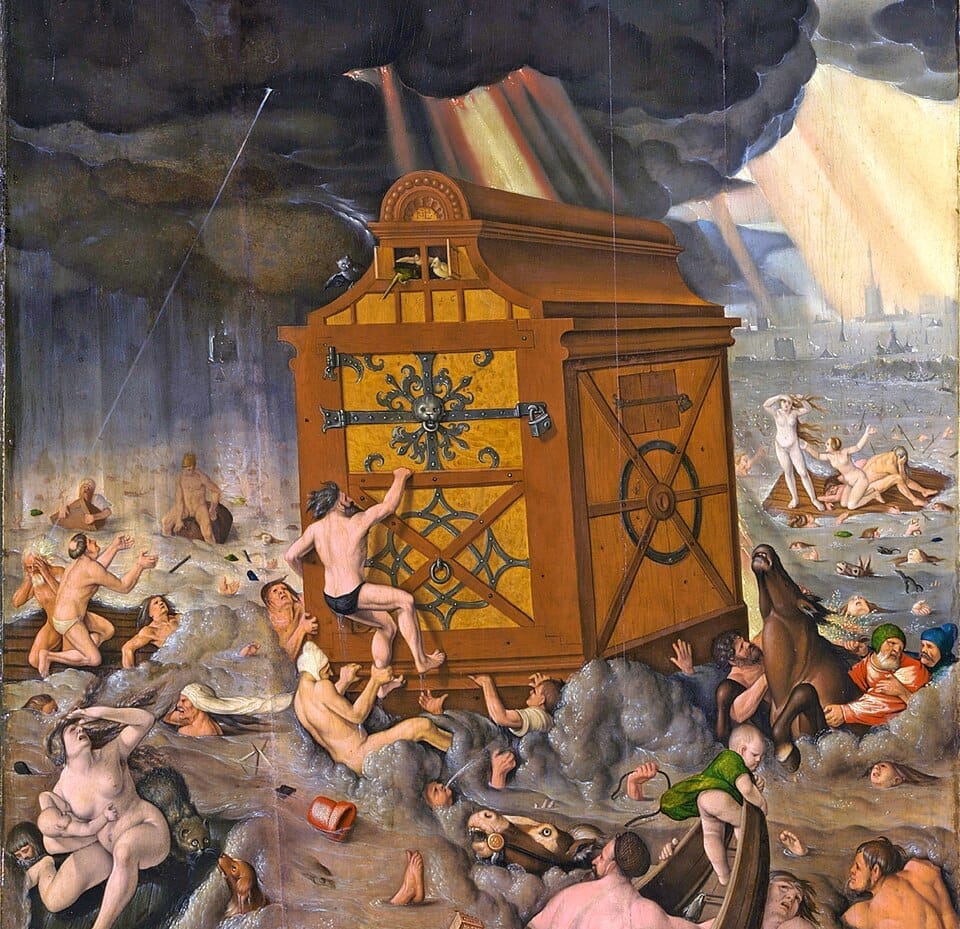
Featured image is Die Sintflut, by Hans Baldung