Amend and Reform the Pardon Clause of the Constitution in 2027
Let's teach ourselves how to say goodbye.

More than a year into Trump’s second term we are in the daily grind of Steve Bannon’s promise of flooding the zone. Trump’s chief viziers—Steven Miller, Russ Vought, and Corey Lewandowski—exercise an extraconstitutional, unaccountable role without any oversight as the multipronged head of a zombie unitary executive. They have taken a wrecking ball to lawful government by illegally ending social programs and having DHS paramilitary forces set out to murder people on the streets with impunity.
But Americans are fighting back and saying no. They are doing it from the cold streets of the Twin Cities. They go to the polls in special elections, such as the Texas State Senate 9th District which on January 31s was won by the Democrat with a thirty-one point swing over Trump’s November 2024 result. Even Fetterman may be listening in regards to firing DHS Secretary Noem.
Ten months from now will be the 120th Congress. It is likely to have a large House Democratic majority. If the double-digit swings we’ve seen in the off year elections is indicative the US Senate, so seemingly out of reach, should swing to the Democrats in the event of a landslide.
Even with Trump still in office, we will have significant levers to begin to affect the accountability and reform that must follow this regime’s nonstop crime spree. Impeachment will be on the table for Trump officials at minimum.
But we can be bolder still. Trump’s use of the constitution’s plenary grant of pardon authority to him—from all the J6’ers, to his cronies and friends, to implicit promises to administration thugs high and low—has been without precedent in scale to be sure. But the history of the pardon clause has always been fraught. Increasingly in the last few generations its abuses—from Clinton’s Marc Rich to Bush’s Iran Contra plotters—have become prominent.
Amendments may require Republican members of Congress to get on board, but they do not require the president. Pardon reform, especially if it does not have a particular partisan valence, could be a low hanging fruit for the 120th Congress to address through that mechanism.
Two amendments to the constitution
In 2027 the new Democratic House leadership should advance two amendments, one to create a fair process for issuing pardons going forward:
Pardons Clause Repeal Amendment
- Section 1: The President has no power to grant pardons and reprieves. The relevant portion of Article 2, Section 2, Clause 1 of the Constitution is repealed. Statutes, appropriations, and regulations regarding the President’s pardon and reprieves granting power are voided.
- Section 2: Congress has the power, by joint resolution, to establish—and appropriate funds for—an independent commission, agency, or other body with the power to grant pardons and reprieves.
- Section 3: Congress has the power, by joint resolution, to grant pardons and reprieves.
- Section 4: Pardons and reprieves are defined as: pardons, conditional pardons, commutations of sentence, conditional commutations of sentence, remissions of fines and forfeitures, respites, and amnesties.
- Section 5: Congress has the power to enforce, by joint resolution, the provisions of this article.
And a second one to fairly revoke problematic pardons:
Revocation of Pardons and Reprieves Amendment
- Section 1: Congress has the power, by joint resolution, to establish—and appropriate funds for—an independent commission, agency, or other body with the power to revoke pardons and reprieves issued under the President’s authority under Article 2, Section 2, Clause 1 of the Constitution.
- Section 2: Congress has the power, by joint resolution, to revoke pardons and reprieves issued under the President’s authority under Article 2, Section 2, Clause 1 of the Constitution.
- Section 3: A revocation of a pardon or reprieve has the effect of reimposing any portion of a penalty that was still owed by a living person or their estate unless the body issuing the revocation specifies a lesser penalty.
- Section 4: Pardons and reprieves are defined as: pardons, conditional pardons, commutations of sentence, conditional commutations of sentence, remissions of fines and forfeitures, respites, and amnesties.
- Section 5: Congress has the power to enforce, by joint resolution, the provisions of this article.
A system like this is more in line with what you see in US states and other countries—a professional board or commission with the authority to dispense mercy in the criminal justice system and not the whims of one person. Congress would retain authority to issue pardons as well.
Pardon reform amendments are not meant to just deal with Trump but to create a fair system going forward. Once pardon reform is on the table, the reliability of Trump’s promises of clemency for his allies drops. It can be part of a strategy to cleave apart the MAGA coalition and continue to enlarge the popular front for democracy and the rule of law. The two-thirds threshold in both Houses of Congress next year is achievable with Democratic majorities and a few forward-looking Republicans peeled off. At the state legislatures for ratification, an amendment that is pro-reform and pro limiting the powers of the current and future presidents could prove to be popular. The twenty-sixth amendment, standardizing the minimum age to vote at eighteen-years-old, was ratified in 100 days in 1971.
A return to constitutional politics
Our constitution feels fixed and unamendable now. But once the consensus on amending the constitution is moved by a successful amendment, we will have a golden opportunity to not be prisoners of our basic law but to be masters of it.
In the musical Hamilton, the song One Last Time depicts George Washington’s precedent setting refusal to rule for life, imploring us to know “how to say goodbye”. Let’s set a precedent again by saying goodbye to our old, failed constitutional elements and let constitutional reform flow like a mighty river.
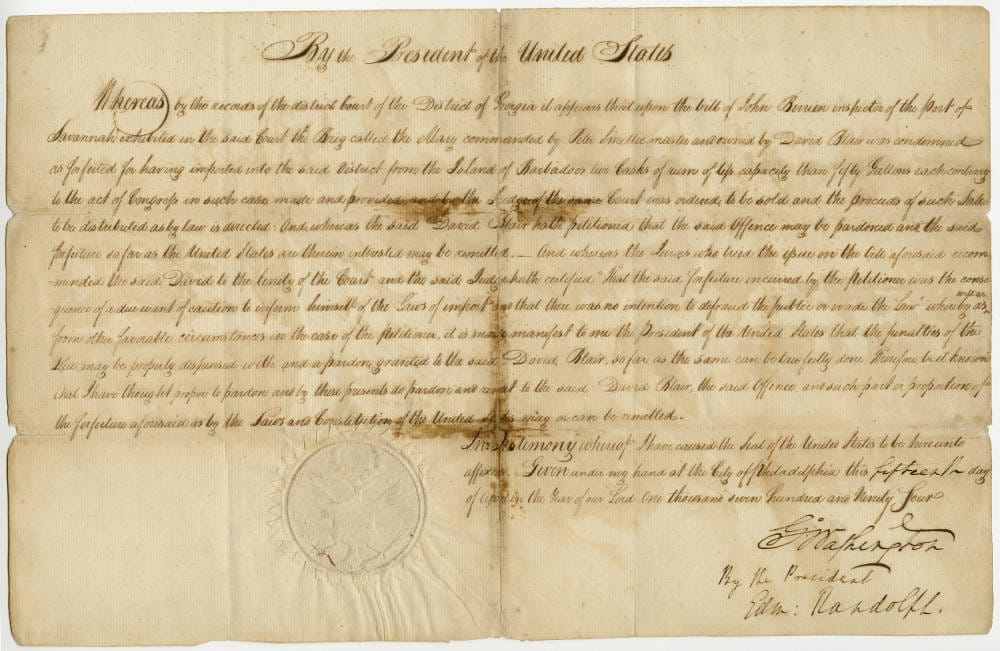
Featured image is pardon signed by George Washington