America, If You’re Listening: Denmark’s Example for Fixing Liberal Democracy
Talking to Michael Bang Peterson on Denmark's recurring process of self-examination.
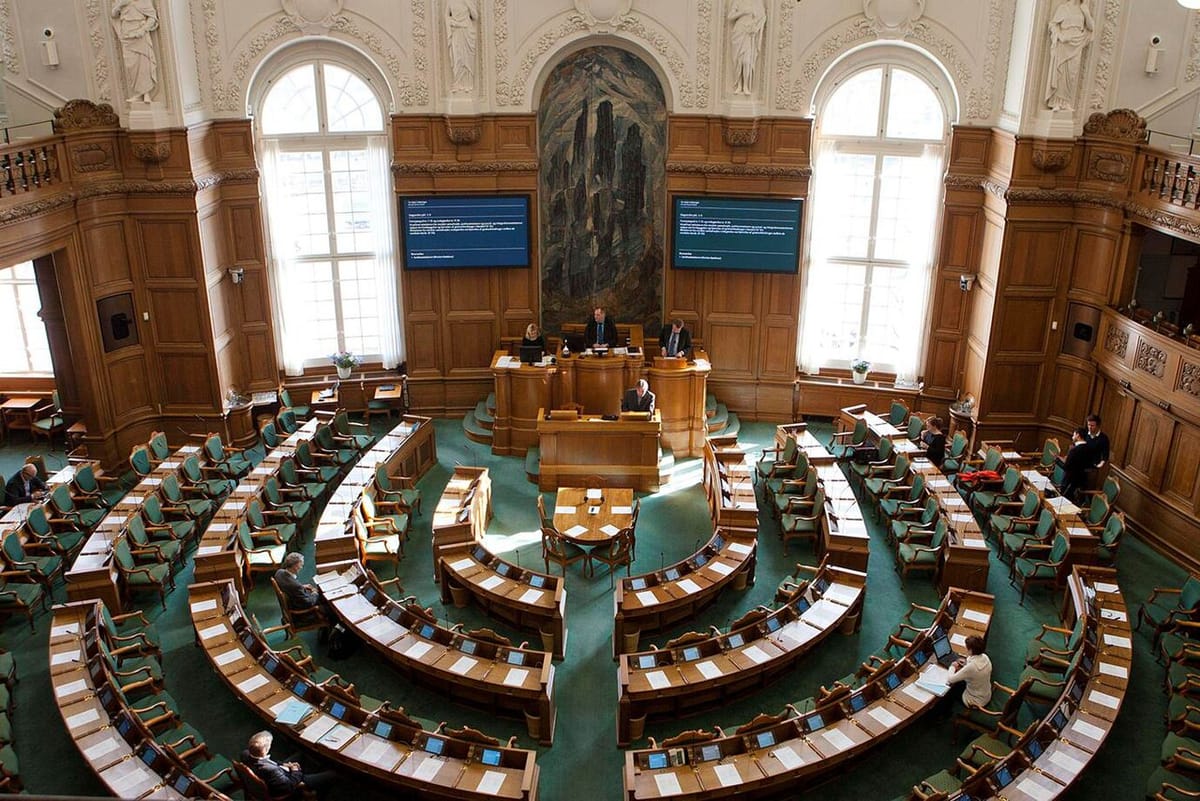
American democracy is facing its most serious crisis since the Civil War, but we have no coherent effort to do anything about it, not even to try to make sense of what's wrong. That's not the case in Nordic countries, such as Denmark—which has the world’s best liberal democracy, according to V-DEM’s last three annual Democracy Reports. There, the Danish parliament has launched a multi-year “Power and Democracy study” [project plan in English here] to analyze how Denmark’s democracy is functioning, what challenges it faces, and what can be done to improve it.
Sweden, Norway and Denmark have all conducted similar studies in the past, initially in response to the rise of mass media and declines in party membership. The current effort is being led by Michael Bang Peterson, a professor at Aarhus University, who studies the role of psychology in politics, and who was chosen for the task in light of his prominent role advising the government and speaking to the public during Covid. Liberal Currents spoke with Petersen after reviewing its initial findings to better understand the process and what made it possible.
The Nordic countries are all “high trust societies where the parliamentarians trust the research community enough to let them look into the use of power and assess whether that use is sensible or not,” Petersen said. The Danish Parliament approved the study unanimously, and researchers began with a year-and-a-half period of information-gathering via 15 workshops at Denmark universities involving more than 200 researchers “to get an overview of both the potential challenges the strengths and the knowledge base out there.”
From that they built plans for a book series—45 relatively short books, about 100 pages, “heavily edited for being readable by the general audience” providing information about topics such as interest groups, digitalization in public administration, inequality in Denmark, or the power of tech giants, that will be published through the end of 2028, followed by a final report. Along the way, “We are trying to engage in a lot of different dissemination activities. I'm spending a lot of my time talking with stakeholders all around the country, both in civil society, policymakers, the media and so forth,” Petersen said.
Three pillars of democracy
An initial volume he co-authored, "The Challenges of Danish Democracy" [in Danish], describes democracy as "a house with three pillars": citizens' empowerment, democratic will formation, and collective decision-making, which serves as a framework for approaching the project as a whole.
“If we focus on citizen empowerment, what we are arguing is that living in democratic society doesn't just mean that you have the formal rights to participate,” Petersen said. “You also as a citizen have the resources, you have the knowledge to be able to participate, that there is a range of channels in society that you can go through if you want to influence politics. And also that you have the feeling that you are in fact a citizen, that you are part of a political community that you want to engage in, where you have a sense that the community and the politicians actually want you to engage in politics. So we need to have a society where you don't just have formal participation rights, but you actually are empowered to engage in political action when you think it's important.”
Democratic will formation adds to that: “We also need to have a high-quality public political discussion that can sort of set the agenda for society, ‘Where do we as a society want to go?’” he explained. “That doesn't mean that everyone should agree with each other, but it means that everyone should be able to see what are the reasons why this is high on the agenda, what are the reasons why we're going in this particular direction.”
Finally, with the focus on collective decision-making, “We are moving beyond many traditional conceptions of democracy,” he said. “.We're arguing that in order to have a well-functioning democracy the political system actually needs to solve problems. And it needs not only to solve them in an effective way, but also in a transparent and just way.”
Challenges to citizens' empowerment
Laid out like this it might just seem like common sense, but it’s extremely useful in making sense of the challenges facing Danish democracy. To begin with, rising inequality, ethnic diversity and urban-rural polarization are all factors that erode the sense of shared community, common citizenship and public trust. None of these are as extreme as in America, but they are similar in substance, reflecting changes from a generation ago.
“Not only is there more fragmentation within society, there is also less of a sense that politicians aren’t as motivated by the common good. So these things mean that there is less a sense of citizenship. At the same time, actual participation is deteriorating, most strikingly when it comes to party membership,” which has dropped from a peak of about 30% fifty years ago to around 3% today, most of them older.
“We do see people engaging in particular political causes, like climate or if there is an is some issues in local environment,” Petersen noted. “But people are very reluctant to be engaged in politics in the way that political parties are, where they're trying to look at the whole of society and trying to strike compromises between a lot of different axes. We can also see that people are less interested in following politics than they were before—we talk of news avoidance.”
Challenges to democratic will formation
This last problem—news avoidance—in turn becomes a major problem for the second pillar, democratic will formation, and is driven in large part by digitalization. Streaming services like Netflix and HBO “have dramatically changed the information landscape in Denmark” much more than elsewhere. In the 1990s, Denmark had only two major TV channels, “And they were required by law—and still are—to also provide news and trustworthy information.” Similarly, music radio stations had hourly news shows. “So you were fed news while you were doing other things,” Petersen summed up. “Today you can completely have an entertainment diet, where you are avoiding trustworthy, important information about society.”
The problem is compounded by social media, the primary news source about politics for Danes under 35, which adds to further fragmentation. “We have young people, people not interested in politics, people with low education, they're zooming out, they're relying mainly on social media. Whereas people with a higher education, people who are older, they're still reading newspapers, they're still watching the evening news shows, and so on,” all of which “makes it much more difficult to actually have a collective will formation.”
He noted his previous research “has shown how social media discussions about politics are dominated by a very small group of individuals, sort of dominance-oriented personalities who are not oriented or not focused on letting the better argument win, but just focused on winning using intimidation tactics.” This reality has crushed early hopes that “social media platforms would create more equal, more high quality political discussions, with less barriers to enter.” Instead, “It's actually only those with an ax to grind that are willing to engage in that sphere. So as more and more political discussion moves over to social media, we're also seeing a deteriorating quality in the general public debate.”
While the above are globally common problems with some Danish characteristics, there’s a more subtle change that’s specifically Scandinavian—the shift away from what was known as the corporatist model, “a very structured way of engaging with some of the big societal interest groups like employers and employees.” In the 1990s, “Corporatism was very central in Denmark. That system has today shattered.”
It’s been replaced with “think tanks, personal lobbyists, also professional advocacy groups” which are all relatively new. “Believe it or not we didn't have professional for-hire lobbyist firms in Denmark before the turn-of-the-century. We didn't have think tanks in Denmark before the turn-of-the-century. But they play a massive role in policy formation and political discussions today.”
In some respects, this is a positive development. It’s produced “a more sort of pluralistic landscape. But it's also a landscape that is much more difficult for regular people to understand.” There’s now a class of politicians and professional political advocates, “And they all come from the same kind of backgrounds. They are essentially alike in many, many ways, and that class of people has a lot of power. It is unclear for people how they actually work. So there's a sense that the political process has become more untransparent, and there is a sense that this group of individuals do not understand the particular conditions that I as a regular person outside the big cities live in.”
In sum, Petersen said, “Even though the political process has become more pluralistic in many ways it has also become more confusing and people are reacting to that.”
Challenges to collective decision-making
This in turn feeds into another major change impacting the third pillar of collective decision-making: the emergence of what’s called “agreement-based parliamentarism.” As Petersen explains, “More and more political decision-making is sucked out of the parliament and put into the ministries, where people are making informal agreements, which are then summed up and pretty quickly go through parliament afterwards. But all of the discussions where the political parties are discussing their positions, discussing the pros and cons, the trade-offs and so on happen behind closed doors and not in the parliament.”
Again, there’s a plus and a minus. “This creates a highly effective system. There is a lot of legislation passed in Denmark. But it also adds to the sense of lack of transparency, because you do not get a sense among the public what are the positions of each of the different political parties. You only get a sense of the final compromise, and this makes it very difficult for people to hold political parties accountable.”
The second major challenge to collective decision-making is ‘A rise in a new type of problem, which is actually very, very difficult for Denmark to solve. One example is the climate crisis,” which can’t be solved by the Danish political system, because it requires a global initiative. “This can create a sense of a political system that is not effective, and in a sense it's true.”
In addition, “ Another example is with regards to the current security situation, for example the dispute over Greenland,” which is only the latest, most jarring example. “The geopolitical international order has changed dramatically because of first Russia's invasion [of Ukraine] and since then political tensions between China and the United States, meaning that great power politics is coming back. That means that in a small country like Denmark, there are a lot of things that they cannot solve that they would like to solve. We are to an extent pawns in the chess play of the larger actors.”
An imperfect response “is to align ourselves more closely with the European Union and that has happened over the last 25 years. But that also is a particular exchange of power. We are pushing a lot of decision-making power to the European Union, for protection, for being able to regulate social media companies, and so on. But that also means we have less room to maneuver as a democracy ourselves. So our problem-solving capacity is going down.”
Making sense of intertwining challenges
The above describes how the three-pillar model helps make sense of the major challenges facing Danish democracy as a whole. But as a result, “It becomes clear that all these things are intertwined, and essentially that makes it extremely complex to solve,” Petersen said, offering the following as an example.
“Politicians feel more and more burnout. According to the data we have, and at the same time they are spending a lot of time on social platforms. We hear some estimates from individual politicians that they spent like three hours each day on social platforms in connection to their professional work,” he said.
One reason is declining party membership. “Danish political parties no longer have this base that they can rely on, so they constantly need to go out and create attention to get votes on election day.” They not only need votes to get elected, but to survive as organizations. Since parties get public finances based on the number of votes they get, “To be kept alive they need to get the votes.”
Thus there’s a multi-linked shift: “Declining party membership is connected to the politicians’ own use of social platforms in order to create attention, which of course means that social platforms become a major place where political discussions happen.”
But it doesn’t stop there. “Given how much time politicians spend on trying to create attention, talk to the media, be online, then they have less resources for traditional policy work, reading reports, sitting in parliamentary committees and so forth. Because politicians lack time, they are reliant on these external lobbyists.”
The quality of their analysis may be quite good, Petersen noted, “But on the other hand, it's not clear how the rise of the importance of money in Danish politics, what that does to the overall distribution of voices in politics. What about the groups that do not necessarily have access to significant amount of resources? To what extent are they able to get heard in the political process?” Again, it’s another way that transparency, trust, and social cohesion are eroded.
“So this is just one way whereby one problem—which is declining party membership—is linked to a lot of different societal developments,” Petersen concluded.
Silver linings
While this factual survey of problems might seem daunting, it’s less so when you consider that it’s being explored with a realistic, believable intention to do something about it. “The existence of the project shows that Danish politicians care deeply about Danish democracy,” Petersen said. “This was unanimously passed in the Danish parliament. We are meeting with a parliamentary group two times each year to discuss these issues and the insights that we produce. So there is an attention to the problem from policymakers.”
In addition, “If we look at the institutional core of Danish democracy, then it's intact. There's no decline in the protection of political rights. We see no decline in the existence of free and fair elections, and so on. We have a high number of people voting in elections and so on. So a lot of things are working really well.”
Summing up, he said, “I think that it is like a supertanker that is heading in the wrong direction. All of the developments that we were looking at are sort of going in the wrong direction. But there’s still—given the resources in Danish society and the strength of its institutional core—there’s a lot of possibilities of changing the direction of that supertanker.”
It’s a lesson that others can learn from as well. “It shows that it is in fact possible to to take democracy seriously in this way, where you make a comprehensive assessment that is backed by parliament, really requested by the parliament,” he said. “It's also worth following for the concrete analysis, because as I've been saying, a lot of these problems are not unique to Denmark. I think the developments that we are describing are happening in many other places, and they are worse or farther along in many other places.”
It’s hard, if not impossible, to imagine America undertaking such a comprehensive assessment of its own democracy. But it’s hard to imagine any country needing it more. If the American government won’t do it, the Democratic Party should—in the exact same manner of providing the funding with a clear non-partisan mandate, and empowering our own experts to conduct a similarly thorough study, with robust public outreach and engagement.
Of course Republicans will denounce it. But so what? They’ve written their party out of the democratic social contract, which so clearly needs to be rebuilt. That task belongs to those who remain committed to it. And the blueprint for doing it can be taken from Denmark’s example.
Featured image is The Danish Parliament, by Johan Wessman