Don't Buy a Gun
Confrontational but nonviolent protest is more effective than the solipsistic comfort of an assault rifle.

“The only thing we have to fear is fear itself.” You know the voice, the stentorian Mid-Atlantic accent, and the line from FDR's first inaugural address in 1933. But the full sentence is infinitely more important than the catchy opening clause: “[T]he only thing we have to fear is fear itself—nameless, unreasoning, unjustified terror which paralyzes needed efforts to convert retreat into advance.” That last bit is the kicker; it turns a pithy bon mot into an argument.
“The only thing we have to fear is fear itself,” is easy enough to refute. The full sentence is not.
This speech’s thesis is actually a vital lesson about democracy, too often forgotten in those occasions where fear is most justified, like the Great Depression of which Roosevelt spoke.
The real danger of unchecked fear is that it becomes “nameless, unreasoning terror” that “paralyses” true political action—the very thing that might address the source of our fears. And what fears we now have. The first few weeks of 2026 have been agonising decades. As Trump’s fascism moulders into ever more toxic forms, murdering ordinary Americans, threatening foreign invasions, all while assaulting minorities and the rule of law that is meant to protect us, there is no shortage of terror to go around.
And when you’re afraid, it can be all too tempting to reach for a weapon.
I was watching CBC’s The National recently and listening to a political retrospective on 2025 from a panel of the program’s leading commentators. The Toronto Star’s Althia Raj said it augured poorly that the No Kings protests were not a daily feature of American life, given the cataclysmic brutality of an administration that is trying to burn the bridge of every alliance we’ve built and destroy what is left of American democracy. Affronts to the dignity of Americans and those abroad abound. Venezuelans, Canadians, Greenlandic Inuit, Danes, have all tasted bitter betrayals lately. It’s easy to understand Raj’s grievance.
And then just a few days later, Renée Nicole Good was murdered in front of her wife, and in full view of several cameras—including one held by her murderer, Immigrations and Customs Enforcement agent Jonathan Ross, who called her a “fucking bitch” as she bled out from three shots. Only the last was fatal.
Then, hours before this piece went to press, ICE murdered another Minneapolitan: VA nurse Alex Pretti was summarily executed on the 24th of January.
Good and Pretti are not ICE’s first victims. But the many camera angles on each person’s death ignited a public furore that drew attention to these other deaths and ICE’s murderous, lawless tactics that are a transparent attempt to simultaneously engage in ethnic cleansing and violently stamp out any opposition to their deeds.
It is an opposition that clearly terrifies them and has set the Trump Administration out of joint as it flails against mass, stochastic, spontaneous resistance. It amounts to the ultimate disproof of Raj’s laments: the American public has risen up and been fighting every day. Americans have already died for it, in a truly bleak symmetry with the past as we approach the 250th anniversary of this nation’s founding.
Under the pall of that gathering horror, many have rightly criticised the endless rehashing of the “don’t take the bait” cliché by Minnesota Governor Tim Walz and Minneapolis mayor Jacob Frey. For one, it suggests there’s a method to ICE’s impulsive madness. Nothing about their evils is premeditated in particular, only in general. They want to sow fear and terror, they want to ethnically cleanse our nation of non-white people, and they want to beat and murder dissidents. Not to provoke a specific response to justify legal action, but simply because this is who they are. There is no bait on the hook, merely violence red in tooth and claw.
It is condescending in the extreme for Democratic leaders to call this terror campaign ‘bait.’ The terror is the point. The broken families, shattered communities, the dead and dying, are the point. Whatever comes next is going to be as impulsive and bloody as what has gone before—not as part of any master plan, but as just another authoritarian spasm. Trump’s men on the ground mirror the reckless impulsiveness of the man himself, lurching purely on instinct.
So, how to confront that reality? Well, it’s easy to think, as some loudly proclaim on social media, that the evils of our age can only be met with force. It’s an idea at the heart of so much popular fiction: an oppressor goes too far, and then the oppressed realise they outnumber the bad guys and dramatically fight back. Heroic visions of the past often involve people with guns standing up for what they believe in. From all-women battalions of Kurdish fighters, to the Union rifles of the Civil War, to armed Black Panthers defending their neighbourhoods from the police, images abound to capture the imagination and make you go “why not me?”
Power concedes nothing without a demand, after all, and if your demand is backed by the threat of violence, so much the better. It incentivises negotiation: you can talk to the diplomats and reach a compromise, or you can deal with the people who’ve been practising at the range five nights a week on your photo.
Wasn’t Mao correct when he said all political power flowed from the barrel of a gun? You want power? Go to a gun store.
And you go there and you see it, feel it: the symbol of ultimate political power, pressed into your very hands. There it is: the judge, jury, and executioner’s power of presidents, prime ministers, cult leaders, and emperors. Ultima ratio regum, all right there for the low, low price of 150 USD per month, 0% APR. With one individual choice and one individual hit to your credit report, you can fashion a bulwark against the gathering dark.
But the consumer-driven experience here should be a clue that all is not on the up-and-up. That it’s all too easy for reasons that go beyond America’s permissive gun culture. The same kinds of people who say “if voting changed anything, they’d make it illegal” don’t seem to apply that argument to firearms, after all. Leaving aside the fact that the gathering forces of fascism are trying to criminalise the ballot for their opponents, the ease with which one can get a gun in the US should tell you that privately packing heat is already priced into the maintenance of America’s system of government. The rounding errors are measured mostly in the lives cut short by suicides and murders, not in the fits and starts of a revolution waiting to be born.
But as I mentioned earlier, the popular mythology of armed uprisings remains powerful and romantic, and it intersects with uniquely American myths as well, particularly those about the lone gun/property-owner defending their land from invasion.
Social media is so useful for selling that particular lie, of course. It surrounds you with the terror of an impossible fight against fascism while then adding that you can get a leg up on the coming horrors by getting a gun of your own. Social media excels at selling such individual solutions as quick fixes to your pain. When you’re told that genocide against your people is inevitable, getting your very own gun feels almost like a compromise in response. But there’s a lie baked into this self-soothing promise: the idea that the gun will do for you what it does for the angry, far-right “patriots.” The lie is that you’ll be allowed to use it in the same ways as them.
The frontiersman fiction about guns in this country, the idea that you defend your ‘homestead’ against marauding ‘invaders’ is a vision inextricably linked with the history of genocide against indigenous people on this continent. There is no escaping this simple fact. There is no homestead myth without it, no ‘cowboys and Indians’ games without Native Americans and First Nations people to play the foil, and no frontier to ‘defend’ without native peoples to defend it from.
This myth is also deeply linked to the idea of presumably white homeowners defending “their property” from presumably Black and brown criminals; witness every fantasy about self-defense expressed in right-wing media and you’ll find plenty of examples of the genre.
Each narrative undergirds popular narratives about the Second Amendment. In sum: guns are for white people to kill ‘marauding’ brown people.
Every fiction spewed by 2A advocates in the U.S. flows forth from this point.
When they say the Second Amendment protects the First, they mean their right to kill non-white people with impunity guards their right to say anything they please without so much as the tiniest social sanction. Any statements they make about guarding against “tyranny” should be understood in the same light. Given that soccer moms and nurses have been the ones taking bullets for exercising their First Amendment rights, while our notional 2A activists are neither seen nor heard, the argument makes itself.
So why does the yearning for an “armed resistance” endure on social media? Put simply, many on the left think that the Second Amendment is also for them. It isn’t. In theory, the Second Amendment should protect all Americans’ right to own guns equally, but it doesn’t; it’s a grim coincidence that, as all eyes are now on the Twin Cities, a St. Paul resident murdered some years ago makes the case: Philando Castile, killed at a traffic stop for announcing that he was a legal gun owner, with a handgun in his car, as the law required him to do. For this calmly delivered, pro-forma, legally required disclosure, he was murdered by a policeman.
In yet another haunting historical echo, Pretti was accused of having a firearm on his person by DHS, which was used to justify his murder. But Minnesota is a concealed carry state, and the Minneapolis Police Department has already conceded that Pretti was a licensed gun owner. Videos also conclusively prove he was not brandishing it at the officers. Once again, an archetypal Second Amendment case where agents of the state murder a law-abiding gun owner who was exercising his First Amendment rights elicits only cries of “he was a terrorist!” from the far-right.
Non-white people, liberals and leftists of all backgrounds, and anyone else who doesn’t fit the frontiersman narratives, have all taken up arms only to be literally cut down by the state, without a single peep from the NRA in defense of people who ought to be, by all rights, their fallen martyrs.
Pretti’s most powerful weapons that day were his phone and his empathy—his last act before being seized upon included trying to help a woman being attacked by CBP agents, whom he then tried to film in his last moments.
But perhaps you know all this and still believe that the only way to fight the neo-fascists who are currently creeping their way through our institutions is to be willing to hoist up the barrel of your shotgun and say “no.” It’s a tempting vision, certainly, and it makes it easy enough to ignore all the complications that ensure it won’t work the way you hoped.
The secret sauce of American gun-nuttery is that its largely white, rural, conservative exponents are wholly backed up by the very state that their Second Amendment ideology is supposed to oppose. They triumph, not because of their innate political acumen or even their marksmanship, but because the cops either look the other way or actively aid them whenever they go marauding with all their haphazard, half-drunk revenge fantasies.
If you believe in any left-of-center ideal, you will not be granted the same protection. That, alone, makes your job as a law-abiding leftist or progressive gun-owner infinitely harder. Your gun will not be allowed to be used politically in the way that, say, Kyle Rittenhouse’s was. In an age where the state wields tanks, armored vehicles, drones, helicopters, aural weapons, radar, and every firearm under the sun, this situation is untenable when measured against your solitary rifle.
That’s true of all the far-right 2A fetishists too, of course. Except, as I said, they’re in on the con. They’re not actually fighting the state.
You are being sold a lie when you are told that a gun can keep you and yours safe from fascism, and you are being told that lie by the same people who said that they own guns because the Nazis took them away from Jews, even as they themselves support latter-day Nazis and other antisemites while posting on Twitter, the ‘Oops! All CSAM!’ everything app for fascists.
What you’ll actually get is a false sense of security, and all the attendant risks of private gun ownership that will put you and everyone around you in mortal danger. Terror crowds out possibility, leaving you alone with only your fear and an arsenal all-too-easily-acquired.
I suspect, if you’re reading this far, you know what can go wrong with gun ownership. You know that a deadly weapon in the house can be more deadly to its owner or to the people they’re trying to protect. Small children who don’t know any better; suicidal loved ones who might find an easy way out in your bedside drawer; or you yourself when you don’t fully appreciate why the safety is on your gun. Above all, you probably already know that a gun in your hand makes you into a different kind of person. Someone with a hammer who is suddenly only able to see nails.
Social media is a perfect mechanism for amplifying terrorism’s intent. You stare into an abyss, made up of shaky live footage, written testimonies, and everyone else’s outrage and panic about the same. You are imbued with a deep and abiding sense of cataclysm at every turn, aided by the elementary fact that the news really is this bad. But the pinhole aperture through which social media allows you to view the world emphasizes only the most hopeless aspects of the moment. The horror, its overwhelming nature, the futility of resistance against overwhelming odds, and then, of course, the threadbare hope that just maybe there’s a solution you can buy.
But resistance in the streets is, by its nature, piecemeal. I recall a video from Charlotte of a man who pulled up to the side of a forest-lined road where he saw many other cars lined up, with their owners heckling ICE into the trees. He joined them and filmed the proceedings. He did not end fascism that day, of course, nor defeat Donald Trump. What he did was do his part, a part made more whole by the presence of dozens of his fellow citizens staring down evil and showing that they weren’t afraid.
2025 was marked by two phenomena: American elites who bent the knee despite their extraordinary power to stop Donald Trump; and the extraordinary refusal of ordinary people to do the same, despite a relative lack of power. They are the everyday American citizens who, at last, sat on grand juries and refused to indict the ham sandwich, or who exonerated individuals pettily prosecuted by Trump’s cronies. More poignant still are the armies of people who have emerged from the clockwork routines of everyday life in this country to stand up for people they don’t know, against men with guns. From Portland to Charlotte to Chicago to Los Angeles and elsewhere people have stood up—not with guns, but with phones, whistles, and the power of their own voices. And the interposition of their bodies.
What these people have done is all the more remarkable for how spontaneous it’s been. There are organised groups who go on patrol to track ICE/CBP and let them know they are being watched by the public, but so many others simply stop to join an ad hoc action on their way home from work, or some other chore or family outing. That, indeed, was how Renée Good’s last day began. She and her wife joined her neighbours to protest ICE after dropping their daughter off at school.
It is that kind of activism, even more than the well-organised sort, that terrifies this administration. All the more so after Good’s murder not only failed to dissuade people but instead inspired them, lending her name to the perfect slogan “ICE out for Good.” Ordinary people filming, whistling, shouting, and reminding ICE/CBP—like a Greek chorus perfectly tailored to each city—that they are unwelcome, evil, and despised. Their mere presence has chased away officers, sent them scurrying away (or slipping on Minnesota’s ubiquitous winter ice), and saved the lives and freedom of innocent people across this country.
The No Kings protests are vital, of course; they’re what I call ‘index protests.’ Mass manifestations whose purpose is to show attendees that their views are widespread, introduce them to each other, and then to give them multiple onramps to other, more locally involved forms of activism, rather like an index or the yellow pages of old. The daily necessity is something like the anti-ICE patrols and spontaneous uprisings that greet their predations in residential streets across the country.
What links all of these protests is their fundamentally peaceful nature: not a gun in sight that isn’t being wielded by the enemy. It is the refusal of fear that has led to such terror among the terrorists, that sends ICE agents fleeing, that leads to breathlessly outraged Truth Social posts from Trump, and that is fuelling the desire of his various viziers to escalate the situation.
To foreswear firearms is not tantamount to surrender. It is not caving to evil, nor protesting in a way that can be safely ignored. It’s abundantly clear that these unarmed protests have not been ignored, after all.
I can’t even argue against political violence as such—I wrote a lengthy essay on the ethics of punching Nazis—but I can plead for strategy and community, the very things social media seduces us away from.
Minneapolis’ resistance has been nonviolent, but it has not been business-as-usual, it has not been ignorable, and it has not been comfortable for Trump’s secret police.
I would add that part of the reason the “don’t take the bait” line is so maddening is that it almost seems to demand quiescence. There is much resistance, disruption, refusal, and community-building to be done absent macho displays of firearms, after all. It is notable, and telling, that the thing CBP murdered Renée Good and Alex Pretti for doing was observation, and not protesting per se. Documenting the depredations of these three-letter agencies amidst their siege of Minneapolis earned them a summary death penalty—and it is precisely because the administration deeply fears being watched.
The brazenness of the lies in response, from the ghoul’s gallery of soulless functionaries like Kirsti Noem and Stephen Miller, do not constitute a confident reshaping of reality by people operating from a position of strength. They’re terrified. The only move they have is to scream “terrorist!” and escalate, earning them ever diminishing returns even among conservatives. They’re buried under the weight of bad optics, public opinion, and a solidarity network built on community that has the “empathy is a sin” brigade jumping at the shadows of antifa logistical supersoldiers.
And, once again just before press time, more big news has broken: CBP’s ironically named “Commander at Large” Greg Bovino is leaving the Twin Cities, along with many of his officers. He may even be forced into early retirement. All this without a shot fired in anger at him or his assorted goons.
That is what should make you feel powerful.
By contrast, buying a gun is a ‘solution’ to the feeling of powerlessness and helplessness doomscrolling can saddle you with; it provides the illusion of control, the feeling that one is doing something by “bearing witness” to endlessly looped atrocities on cell phone video. But there are local activist groups who could use the time and energy you spend at the range, or who need resources that gun money could be better spent on. Even as individual solutions go, exercise and self-defence training will work wonders for both your mental health and for your ability to fend off overconfident attackers.
This is a quality of social media that we all tend to underestimate. Social media is good at convincing you to lard your every private whim and taste with overwhelming political importance. Guns, unfortunately, are no exception, with one too many social media users openly extolling their virtues as essential revolutionary tools to people who have no business picking up a gun, or whose real talents are better applied elsewhere in a movement.
Meanwhile, the actual fight for freedom is playing out on our streets. The fact that one side is unarmed looks and feels unfair; but private arms will not overwhelm people with access to the full faith and credit of militarised police and the actual military. What you have to fear is not the state per se but the nameless, unreasoning terror it seeks to impose on you; that is to be resolutely resisted as a precondition to resisting everything else, with clarity of purpose and dignity.
With full awareness that events are rapidly evolving and some of what I write here might be out of date the day these words are published, it’s worth looking at the fact that the last year in the United States of America has been characterised by successful nonviolent resistance that has turned Donald Trump’s strengths into sucking wounds.
There remains a long road ahead, to be sure. The past year has felt like a century. But we are seeing many signs that the sheer scale of both nimbly organised and passionately spontaneous anti-ICE protests is getting under the skin of this Administration. Even CBP’s ironically named “Commander-at-Large” Greg Bovino admitted that his foes in the Twin Cities have “great communications.” It’s noteworthy that of all the things Minnesotans have taught America about resistance, guns are not part of the equation. Indeed, the lack of a suicidal armed revolt is driving the federal government mad; how else to explain the right’s quixotic ranting about extremist “gangs of wine moms”? If this wasn’t so effective, they wouldn’t be trying to do everything in their power to tarnish Renée Good and Alex Pretti’s names; they wouldn’t be trying so hard to cast peaceful protest as an insurrection.
Stepping away from the temptations of arming yourself is not about “taking bait,” but about respecting yourself and your community.
It is a selfish, fearful individualism that underpins the myth of the gun in America, a myth thoroughly alien to this moment of truly collective, spontaneous resistance. It is a moment that is not so much about individual heroism as standing together as a community in the face of terror. Not a battalion of rifles, but of phones; faceless, nameless people with voices that they’re raising against seemingly unfathomable power that has proven itself even more cowardly than we thought.
If you find that your doomscrolling is scaring you so intensely that you’re seriously considering arming yourself when you’ve never owned a gun in your life, you’re not a hunter, and you’ve never had a recreational or nerdy interest in firearms, it might just be time to log off for a while.
Go to a protest; go to an anti-ICE training; train to be a legal observer. The people who are already there will have some leads for you on what you can do to help.
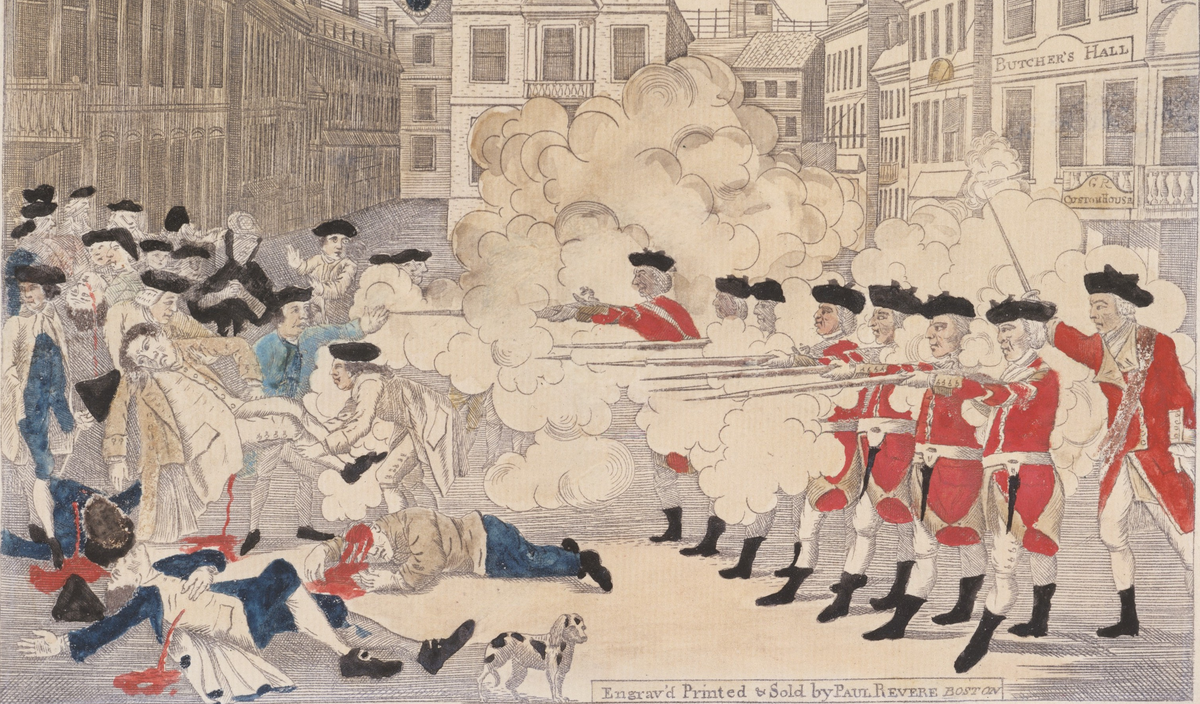
Featured image is "The Boston Massacre," Paul Revere 1770. Cropped.