FDR’s Four Freedoms and the Second Bill of Rights
The social welfare state, winning World War II, and building the liberal order after Trump.

President Franklin Roosevelt’s 1941 and 1944 State of Union addresses shared a similar format. Both spent the first three-quarters or so dealing with the war situation and the US response to it. And both outlined an aggressive program of social policies to deal with staggering economic inequality wrought by the Industrial Revolution and the Great Depression.
The Four Freedoms Speech, delivered on January 6, 1941 for the State of the Union, came during the darkest days of World War II. Germany had completed a vast conquest of Europe. Britain by the winter of 1940-41 was under daily German aerial bombardment and was widely expected to fall to the Nazis. The US was not directly in the war yet.[1]
The Four Freedoms part came just before the speech’s closing lines. They were 1) Freedom of speech and expression, 2) Freedom of worship, 3) Freedom from want, and 4) Freedom from fear. Norman Rockwell painted a tribute to the Freedoms, beginning his gradual conversion to painting social justice art that culminated 20 years later.
Somewhat forgotten was that a few paragraphs earlier, FDR outlined an extensive domestic program: 1) Equality of opportunity for youth and for others, 2) Jobs for those who can work, 3) Security for those who need it, 4) The ending of special privilege for the few, 5) The preservation of civil liberties for all, and 6) The enjoyment of the fruits of scientific progress in a wider and constantly rising standard of living. He goes on with specifics: 1) Increase in old age pensions, 2) Increase unemployment insurance, 3) Increase in “opportunities” for adequate medical care, 4) Increase opportunities for “gainful” employment.
By January 1944, the Nazis and their Axis allies Italy and Japan were headed to defeat[2]. The Second Bill of Rights, again towards the end of the speech dominated by war specific measures, outlined firmly positive social welfare rights that would make a squishy Democrat like Fetterman cry foul and go on Fox News: 1) Right to a good job, 2) Right to good income “to provide adequate food and clothing and recreation”, 3) Farmer’s right to a fair income, 4) Businesses' freedom from unfair competition and monopolies, 4) Right to decent housing, 5) Right to Healthcare “to achieve and enjoy good health”, 6) More old age pensions, and unemployment and workers’ compensation insurance, and the 7) Right to a good education.
[T]rue individual freedom cannot exist without economic security and independence . . . In our day these economic truths have become accepted as self-evident . . . All these rights spell security. And after the war is won we must . . . move forward in the implementation of these rights . . . For unless there is security here at home there cannot be lasting peace . . . Our fighting men abroad and their families at home expect such a program and have the right to insist upon it.[3]
Today’s mere liberals and the Greatest Generation
These social guarantees are remarkably familiar to us today, though we have struggled to fully realize them. Despite these bouts of reform—FDR’s cousin Teddy’s earlier Square Deal, FDR’s wider New Deal, the Fair Deal, the Great Society, and the ACA—the delays and setbacks have been large and vexing over the decades.
If one wants to understand liberalism as a philosophical tradition, you could start with Locke, Mill, and John Rawls, among a great many other thinkers.[4]. The rigor of Rawls’ political philosophy concepts of justice as fairness and the original position have no doubt improved and shaped my approach to public policy thinking.
But liberalism for the Greatest Generation was about “heads and hearts.”[5] Their outlook was a response to a system that left so many destitute in their old age, impoverished those unable to work, put the sick out on the street, and that left so much of the world’s bounty in the hands of a narrow few. Their hearts were gnawed at by this lack of justice as fairness.
The old and new adversaries
In the years after World War II, right-wing thinkers like Ayn Rand and Hayek flattered the haves-a-lot. They learned that their wealth was good and that the government should do next-to-nothing to help the mass of their fellow humans. Nixon cravenly began the Long Southern Strategy, capturing the neo-Confederate vote that LBJ left behind with the Civil Rights and Voting Rights Acts. Reagan told us about welfare queens and government doing anything to help those people was the problem[6].
Conservatives and libertarians alike nurtured dreams of rolling back every pro-consumer reform since Teddy Roosevelt’s Square Deal. Now Russ Vought works that agenda every day. They fancy that one’s station is determined by hard work alone. Jamelle Bouie called this a child’s way of thinking, then apologized to children for implying they were stupid[7].
The ideology of MAGA has advanced well beyond the respectable veneer of Hayek and Rand. Lack of ideological consistency is more than made up for in sheer depravity and creepiness. The CEO Monarchists, Dark Enlightenment, and Neo-Reactionary Movement (NRx) are mostly rehashed ideologies with faddish terms. Then there are the straight-up fascists and Nazis like Nick Fuentes’ Groypers who dominate the apparatchik ranks of Heritage. In the fascist musings of Stephen Miller, Fuentes, and Trump, Nazi is not so much an insult as it is simply a description of their ideas. Certain people have immutable characteristics, impliedly Untermenschen[8]. Many others—such as trans people, the disabled, and our undocumented neighbors—are Lebensunwertes Leben[9].
When you see a centenarian veteran of World War II, know that they fought in terrible places like the Kasserine Pass, the Ardennes, Bataan, and Corregidor against those who wanted to impose that same evil—industrial genocide on an unfathomable scale.
No end but victory[10]
The fight against tyranny and the social democratic reforms embodied in the Four Freedoms and Second Bill of Rights must be our guide to the future days which we seek to make secure[11]. Our great project must be an aggressive social welfare and pro-democracy agenda.
The list of social programs that need attention is familiar enough to any liberal—universal healthcare, food assistance for the poor (SNAP), housing, education at all levels, etc.
Much of the reason we don’t have the welfare state of many other democracies[12] are the many veto points and inefficiencies stemming from our uniquely dysfunctional form of two-party presidentialism. I’ve written about this recently along with many others on these pages and elsewhere who are advocating for multipartyism via proportional representation. The American imperial presidency is incompatible with our democratic life and must be brought to heel and even turned into a prime minister (as I have advocated as well).
Freedom means the supremacy of human rights everywhere[13]
When we get the chance, we must flood the zone[14] with reform to entrench democracy, break the back of the thermostatic cycle, and end what Lee Drutman called the Doom Loop. By law we can create an independent US Prosecution Service to replace the POTUS controlled DOJ and abolish and replace ICE and USBP. Reform the pardon power by law[15] and term-limit and expand the size of SCOTUS. Make DC and Puerto Rico[16] states, enfranchising millions of Americans. Discard our dysfunctional two-partyism and enact proportional representation.
Once the body politic had gotten the sweet taste of constitutional reform go after wholesale revisions of the constitution to neuter the imperial presidency, make it a prime minister, and entrench American multiparty parliamentary democracy for all time.
Embrace the fight
Liberalism is not merely tolerance alone or some conciliatory centrism. This form of politics offered by the consultant class is a suicide pact. Groypers, fascists, and Nazis—who would destroy the freedoms of any one of the least of these our brothers and sisters[17]—welcome partnerships with dupes like this.
Liberalism is best when it’s a fighting faith. Liberalism is in the fight for humanity, for the supremacy of human rights everywhere. Our deeds echo through history in the place names where bodies were put on the line with their fellows—at the Edmund Pettus Bridge, in front of the Wilson White House with the women who were jailed and tortured for holding votes for women signs, at the Stonewall Inn, at lunch counter sit-ins in Charlotte, North Carolina, in front of the Pentagon to end the Vietnam War, and with Renee Good in Minneapolis. When war was made against slavers, fascists, and Nazis—regimes who would have smashed any one of us to bits—men and women put their bodies and young lives on the line. At the Little Round Top and the Angle, at the Falaise Pocket and in the frozen town of Bastogne, and flying with unconquered bravery at the Battle of Midway.
Look out for one another and embrace the fight.
[1] Partially because of the US devotion to neutrality in domestic politics, but mainly due to the complete inability of the small US armed forces to provide any meaningful expeditionary force.
[2] Though those last couple dozen months would see the worst loss of life, kamikaze warfare, and the full discovery of the regimes’ monstrous atrocities.
[3] I don’t at all forget or whitewash FDR’s failures, in particular regarding civil rights and the interment of Japanese Americans before and during the war. It is worth noting that the New Deal began the process of minorities coalescing into the Democratic party camp.
[4] And many new ones.
[5] From the closing lines of the Four Freedoms Speech.
[6] There were glimmers here and there of the GOP as a “normal” center-right post-war party. One that accepted the basic need for the welfare state and well-regulated markets. A swirl of names and concepts like Eisenhower, Jack Kemp, Nixon and the EPA, and George H.W. Bush raising taxes comes to mind. But exceptions here prove the rule.
[7] My 12-year-old son confirms; that is a stupid idea.
[8] Nazi German for “sub human”
[9] Nazi German for “life unworthy of life”
[10] I have taken the liberty of modernizing one of the last four words from the Four Freedoms Speech. “But” instead of “Save”.
[11] Intro to the sentence in the Four Freedoms speech introducing the Four Freedoms.
[12] Even ones with a more right-wing politics (looking at you UK and France)
[13] Third from the last sentence of the Four Freedoms Speech.
[14] Forgive me for using a terrible man’s (Steve Bannon) apt term.
[15] It is assumed that the Pardon Power is un-amenable to legislative control. I’m not convinced that there aren’t legitimate legal arguments to be made to the contrary. In any case, the pardon power, along with the Executive Vesting Clause and Presidentialism, should be removed from the constitution.
[16] For Puerto Rico only after a binding referendum that has never happened before. AOC has sponsored a good path forward here and I look forward to seeing it introduced in the next Congress.
[17] Italics are a paraphrase from multiple parts of Matthew 25:31-46, usually titled the Parable of the Sheep and the Goats or occasionally the Judgement of the Nations.
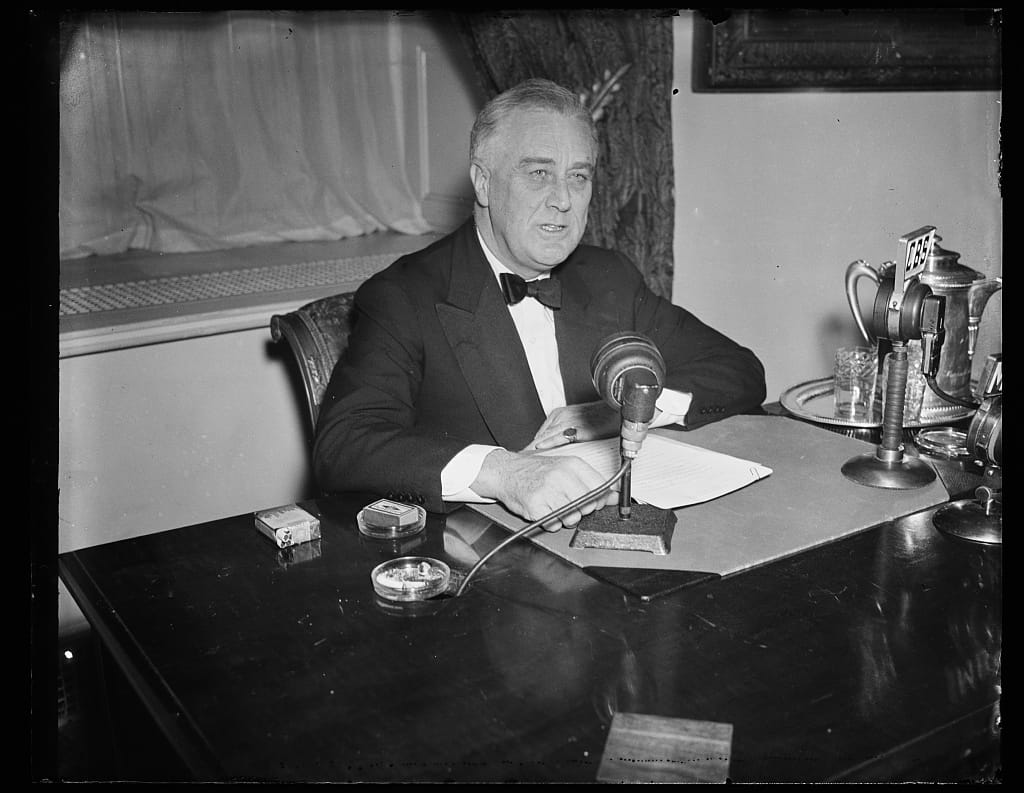
Featured image is FDR Radio Broadcast, by Harris & Ewing