Feeble Criticism of War With Iran Echoes the Lead-Up to War With Iraq
We need to take a firm stand against this reckless and pointless war, not fixate on whether or not it was done the "right way."
The case against the current war with Iran is so overwhelming as to hardly need articulation. The war is illegal, unprovoked, unethical, strategically blinkered, and likely to further destabilize the region. It is a direct result of President Trump’s gratuitous shredding of former President Obama’s 2015 deal with Iran, which had constrained Iran’s nuclear program.
Nonetheless, many Democrats and liberal commentators have adopted a feckless, procedural critique of Trump’s aggression. Senate Minority Leader Chuck Schumer faulted Trump for not providing details about the Iranian threat and called on Secretary of State Marco Rubio to “be straight with Congress and the American people about the objectives of these strikes and what comes next.” House Minority Leader Hakeem Jeffries called on the Trump administration to “explain itself,” “clearly define the national security objective” at hand, and “seek authorization for the preemptive use of military force” from Congress before going any further.
The New York Times editors opined that Trump’s “goals are ill-defined” and that “he has failed to line up the international and domestic support that would be necessary to maximize the chances of a successful outcome.” They failed to make a stance against the war per se, arguing that “a responsible American president could make a plausible argument for further action against Iran” if it clearly explained its strategy, sought approval from Congress, and rallied allied support.
The Washington Post editors took an even weaker position, refusing to say whether or not the attacks are a bad idea. Like the Times, they called for Trump to “better convey his plans to the nation,” and criticized him for not amassing “sufficient stocks of missiles and defensive interceptors to sustain a prolonged air campaign.” They called for Trump to “think through the endgame,” as if he ever does that. The Post even suggested that freedom for Iranians cannot be accomplished without “U.S. boots on the ground.”
These criticisms (if they even merit that term) are narrow, tactical, and counter-productive. They imagine that a reasonable, justifiable war with Iran exists somewhere in space, waiting to be articulated. They entertain the fantasy that there’s a reasonable version of Trump capable of thinking through such an operation. Finally, they cede the rhetorical ground to Trump by admitting that one could wage unprovoked war on Iran “the right way” with better planning, multi-lateral support, and a smarter communications strategy. Check these boxes, the critics imply, and Trump’s war might be justified.
We have been here before. A look back at the lead-up to the 2003 Iraq War shows that many politicians and intellectuals fell into the same pitfalls: a focus on means rather than ends, a refusal to take firm positions against reckless, unnecessary wars, a fixation on image and rather than substance.
The Iraq precedent
From 2002–2003, as the George W. Bush administration sought to take the United States to war with Iraq, many Democrats, liberal commentators, and some Republicans made similar mistakes as The Times, The Post, and other procedural critics of the Iran strikes.
Figures like Secretary of State Colin Powell, Senators Chuck Hagel and Joe Biden, the editorial boards of major newspapers, and influential former-policymakers focused their criticism on how Bush was taking the country to war. There was a “right way to change a regime,” as former Secretary of State James Baker put it, and it wasn’t unilateral preventive war. They called on Bush to make his case to the American people, to clarify his reasons for war, to rally a coalition at the UN, to plan adequately for occupation and reconstruction, and to attempt weapons inspections one more time. As I argued in my book on the origins of the Iraq War, these figures agreed to a war of choice if it was done “multilaterally, procedurally, responsibly.”
Democratic foreign policy experts played directly into this discourse. The titles of their op-eds speak to their approach. Democratic presidential hopeful Wesley Clark implored “Let’s Wait to Attack.” Newsweek writer Fareed Zakaria suggested “Invade Iraq, But Bring Friends.” Former Secretary of Defense William Cohen wrote of “The Real Case Against Iraq,” arguing that the United States should invade with a large coalition to enforce UN resolutions. Propounding that “You Gotta Have Friends,” Thomas Friedman similarly argued that: “Our national interest is best served now by taking on Saddam with as many allies, and as much U.N. cover, as possible.”
Former National Security Advisor Zbigniew Brzezinski advised: “If it is to be war, it should be conducted in a manner that legitimizes U.S. global hegemony and, at the same time, contributes to a more responsible system of international security.” By acting alone, the United States would look like a “global gangster.” Even former National Security Advisor Brent Scowcroft’s prescient appraisal of the war conceded that the failure of inspections could “provide the persuasive casus belli which many claim we do not now have.”
These critics myopically focused on means rather than ends. They refused to take a stance on whether the United States could disarm or contain Iraq without war. They continued to give Bush the benefit of the doubt that he would plan adequately for the occupation, despite evidence at the time that he was neglecting this task. Their arguments also allowed Bush to set the terms of public debate as regime change the right or wrong way, rather than weighing arguments for containment and deterrence. Worst of all, they ignored the evidence that Bush and his top advisors were fixated on war and had no intentions of genuinely pursuing alternative means of disarming Iraq.
This mentality led powerful people who had serious reservations about invading Iraq to forfeit their leverage in opposing Bush’s war. The greatest failure was in Congress. Democratic leaders such as Joe Biden, Richard Gephardt, and John Kerry asked sound tactical questions about the pending war but neglecting the strategic picture. Showing his disagreement with Bush’s means but not his ends, Kerry affirmed that “regime change in Iraq is a worthy goal” and noted that “legitimacy in the conduct of war” would be enhanced by multilateralism and a better presentation of the evidence on Iraq’s weapons of mass destruction (WMD).
The Democratic leadership therefore agreed to an October 2002 resolution that authorized the use of force “defend the national security of the United States against the continuing threat posed by Iraq” and “to enforce all relevant United Nations Security Council resolutions regarding Iraq.” In so doing, they signed away their leverage by giving Bush this authorization before he had even attempted a new round of weapons inspections or sought UN approval.
They did this in large part because their critiques of the Iraq War focused on ensuring multilateral support, planning for the aftermath, and making a better public case rather than on the deeper questions. While the majority of House Democrats and two-fifths of Senate Democrats voted against the 2002 authorization, the leadership’s capitulation hamstrung any further efforts to pull the United States back from war and rendered their later protestations moot.
Even some Democrats who tried to put more constraints on Bush fell into the same trap. Congressman Brad Sherman, for example, proposed an alternative authorization that permitted the use of force after the president certified Saddam’s non-compliance with inspections. Sherman contended that if the United States went to war under this resolution, “We do so with considerably more international support and considerably more domestic support than we would have otherwise.”
But this was still an argument about means, not ends, that put undue trust in Bush’s willingness to seek alternatives to war. A more effective resolution would have required Bush to get explicit UN Security Council authorization to use force, but this was eschewed by the Democratic leadership.
Preoccupation with means and procedures likewise shaped British Prime Minister Tony Blair and Secretary of State Colin Powell’s handling of Iraq policy. In April 2002, Blair promised Bush that he would support war if the United States worked to shape public opinion, went to the UN for approval, and paid more attention to the Israel-Palestine crisis. Powell similarly pressed Bush in August of 2002 to resist Cheney and Rumsfeld’s pleas for immediate strikes on Iraq in favor of a more well-planned, multilateral, UN-approved war. In return, Powell said he would support the war if these measures failed to disarm Iraq.
Powell and Blair told Bush that if inspections and pressure prompted Saddam Hussein to cooperate with inspectors, then Bush must accept that there would be no war. But they made these pledges despite a total lack of evidence that Bush and the Cabinet’s war hawks were willing to entertain any outcome in Iraq besides war.
Bush went through the motions of pursuing a “responsible” war of regime change in Iraq by orchestrating a UN resolution to reinsert inspectors into Iraq, gaining Congressional authorization for war in October 2002, and giving numerous speeches laying out the case for war. He also agreed to reinsert inspectors into Iraq in December 2002. It was obvious, however, that Bush was doing this to smooth the path to war. His administration, after all, was full of hawks who had been pressing for war with Iraq well before 9/11.
Moreover, Bush and his team had zero faith that inspections would work. Inspections chief Hans Blix reports that Cheney told him “we will not hesitate to discredit you” if the UN contradicted U.S. intelligence assessments. The British Ambassador to the United States warned Blair that Bush was “with the hawks,” who believed “inspections were a distrusted instrument” and that the UN was “not to be trusted.” Bush officials also publicly disparaged inspections, with Cheney asserting in one speech that “A return of the inspectors would provide no assurance whatsoever of his compliance…On the contrary, there is a great danger that it would provide false comfort that Saddam was somehow back in the box.”
The Bush administration defined success in the inspections not as finding and destroying Iraqi WMD programs, but as Saddam showing his changed intentions with perfect compliance. In a logic trap they did not attempt to hide, they simultaneously argued that he was incapable of change. As Bush stated in November 2002, “inspections will not result in a disarmed Iraq unless the Iraqi regime fully cooperates…History has shown that when Iraq’s leaders stall inspections and impede the progress, it means they have something to hide.” When the inspectors failed to find significant evidence of ongoing Iraqi WMD production, the Bush administration rapidly decided that Saddam must still be obstructing inspections and that war was inevitable.
The open rigging of the inspections game should have prompted the Democratic leadership and assorted pundits to challenge the war head-on. Many Democrats, such as Biden and Tom Daschle, criticized Bush in the months before the invasion for “rushing to war.” Biden called for Bush to pursue a second UN Security Council resolution that would explicitly authorize force to disarm Hussein, framing this as a way to do regime change responsibly and multilaterally. Even at the last second, their critiques focused on means and timing, not the wisdom and justice of this war. As Biden put it a mere week before the invasion: “Saddam has to go. I support that goal.”
Consequently, whether it was in Congress, the inner circles of policy-making, or the public discourse, the people who had the most institutional power to check Bush’s rush to war failed because they refused to address fundamental moral and strategic questions. They instead fixated on means, appearances, and procedures and ignored that the hawks wanted this war, just as the Trump administration does not want a peaceful solution to the Iran problem. They not only surrendered their leverage but allowed the hawks to focus public debate on how to achieve regime change rather than whether this was wise, necessary, and ethical. As the United States plunges into another reckless war in the Middle East, all too many people in positions of influence are making the same mistakes.
Have we learned anything?
In their response to Trump’s war, the New York Times editorial board laments “that Trump is not treating war as the grave matter that it is.” The truth, however, is that the Times and many other commentators are not treating this war with the requisite gravity either. They are indulging the illusion that bad decisions, if executed transparently and via the proper procedures, can yield good outcomes.
There are better options available. Kamala Harris, for instance, issued an unambiguous statement: “I am opposed to a regime-change war in Iran, and our troops are being put in harm’s way for the sake of Trump’s war of choice.” It is “unwise, unjustified, and not supported by the American people.” Harris has it right: stalwart opposition to Trump’s goals, not merely his means and his shoddy “case” for war, is the proper posture toward this war of aggression.
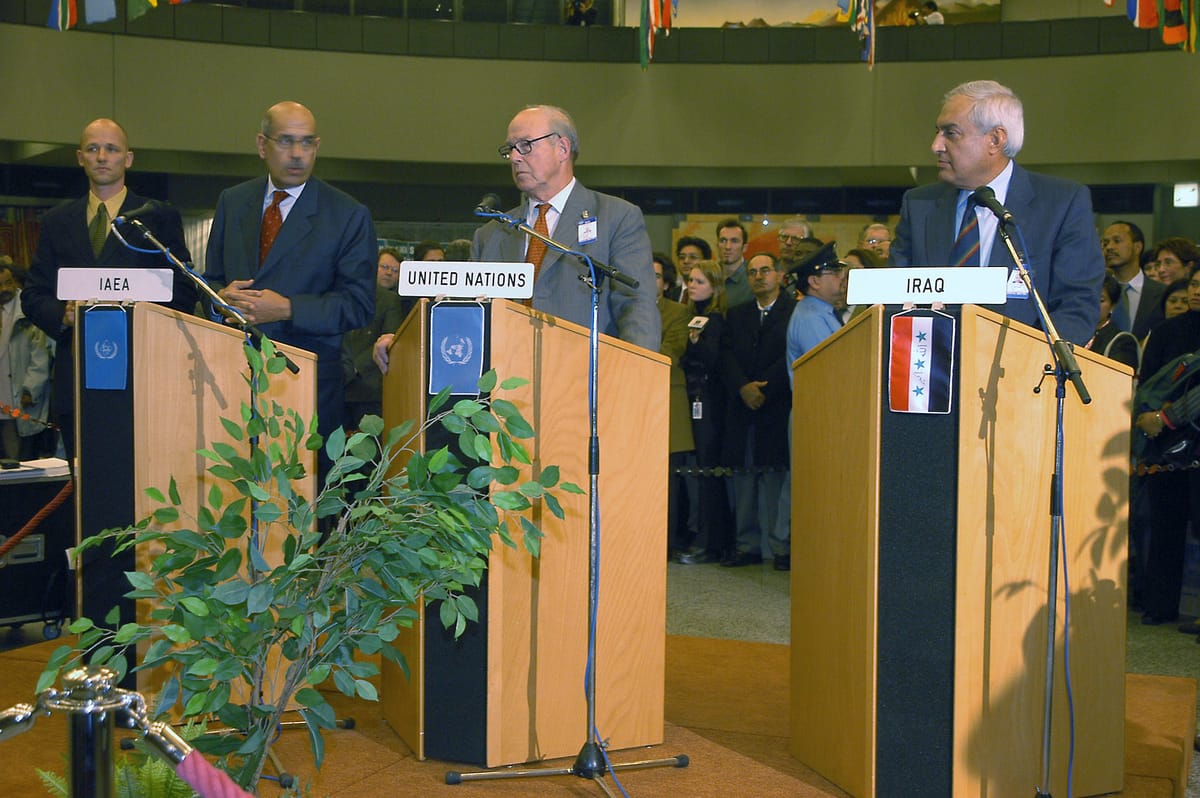
Featured image is IAEA Director General Dr Mohamed Elbaradei, Executive Chair of UNMOVIC Dr Hans Blix and Special Advisor to the Iraqi President, Dr Amir Hamoudi Al Saadi, in 2002, by Dean Calma