Gambling on War
An insider made hundreds of thousands betting just before Maduro was kidnapped. This kind of behavior is becoming normalized.

As I write this, one of the topmost bets on Polymarket’s home page is the question: “US forces invade Iran by…?” and the options of March 14 and March 31. Scroll down a bit and another popular bet is ongoing: “Will the US acquire part of Greenland in 2026?” (odds are down to 16%). Others on the page include “Russia x Ukraine ceasefire by end of 2026?”, “US anti-cartel ground operation in Mexico by March 31?” and, simply, “Next country US strikes — Somalia or Syria?”
Alongside the outcomes of sports games, the Academy Awards, and how well Bitcoin is doing, betting platforms like Polymarket and Kalshi routinely feature bets on how world conflicts will resolve, or whether new ones will emerge, often within a certain timeframe. As these gambling platforms have exploded in popularity in recent years, the apparent hunger for things to bet on appears to be so insatiable that there now exists a thriving cottage industry of influencers tracking foreign policy, distant wars, and other horrific aspects of geopolitics to help people place their bets smartly. On Kalshi, you could bet on whether the mass starvation in Gaza would be characterized as a famine. According to Polymarket, Cuba is due for a US strike sooner than later, and many thousands are waiting for the blood to be spilled so they can collect.
Beyond the feeling that all this is macabre and even immoral, though, there are even deeper concerns regarding what all this means for how foreign policy actually operates today, and how any citizenry, but particularly that of the United States, is able to conceptualize what is happening when they financialize everything, even the tides of war.
Kalshi co-founder and CEO Tarek Mansour famously said last year at the Future of Global Markets conference that their plan is to “financialize everything and create a tradable asset out of any difference in opinion.” Thus far, this is proving to be true, as billions of dollars flow through these platforms each month, and their bets are showing up via partnerships at the Golden Globes, and with CNN and CNBC to help shape how they deliver the news. While it’s unclear if their legal status will be sustainable, for now they are classified not as gambling platforms but as proper financial markets, meaning they are exempt from gambling regulations, and as derivatives, meaning you need not worry about insider trading.
Most notoriously, to date, was the case of the US operation to kidnap Nicolás Maduro in Venezuela, as someone on Polymarket only hours beforehand placed massive bets on such an occurrence. We don’t know who it was, but basically everyone accepts that it was surely someone with prior knowledge of the operation; they made more than $400,000.
Meanwhile, on Polymarket, some bets regarding the world’s most troubling affairs are met with disclaimers, like this one for “Middle East Markets”:
The promise of prediction markets is to harness the wisdom of the crowd to create accurate, unbiased forecasts for the most important events to society. That ability is particularly invaluable in gut-wrenching times like today. After discussing with those directly affected by the attacks, who had dozens of questions, we realized that prediction markets could give them the answers they needed in ways TV news and 𝕏 could not.
This defense may convince some, but it suggests a rupture in how foreign policy is treated on the world stage, and within America specifically. These markets are designed to cater to everyone so they can bet on anything, without any of the regulatory protections that affect gambling and stock trading alike. At any time, these markets can be hijacked by people with knowledge that no one else has access to, allowing them to fleece anyone else with less information. All the while, the platforms themselves take their cut.
A recent study has found that legal sports gambling is tied to significant increases in bankruptcy and debt, alongside a sharp decrease in credit scores. Nonetheless, Polymarket and Kalshi are even more accessible, as you usually need to be 21 to bet on sports, but only 18 to bet on these platforms. These apps are thoughtfully gamified, and each bet is flattened, so that reality itself is flattened: you place a dollar on a Bulls game, another on mass starvation in Sudan, then another on Best Actress. It all happens within moments, and blurs together. It’s all just a little burst of risk.
It’s not insignificant to note that the president’s son, Donald Trump Jr., is an adviser to both Polymarket and Kalshi, and an investor in the former. As the federal government has shown its willingness to cozy up to the industry, it has legitimized what would otherwise be under greater scrutiny. An obvious emerging concern is the further corruption of the markets themselves by those in positions of power, and even more, those individuals guiding political outcomes according to their bets.
More abstractly, though, betting markets featuring foreign policy decisions, specifically those regarding wars and conflicts, risks eroding public discourse. It may be easy enough already for some to, say, discuss Russia and Ukraine in terms reminiscent of sports betting, as one team versus another. Adding appified bets, about everything from the war’s outcome to the number of airstrikes in a given period, seems to calcify these tendencies into something utterly unserious and alienated from real life. Gambling is about high risks and high rewards, and this is not typically how precarious issues in foreign policy are imagined.
As these worlds come together, consequences and implications — blowback — are cast aside. Everything is relegated to odds, up to and including widespread human suffering. This promises a weaker policy realm, an amoral gambling culture, and a diffused sense of reality itself on an international scale.
At the very least, the federal government and other institutions of accountability ought to advocate for and implement strict regulation, if not on betting markets at large then at least as regarding matters of geopolitics. As long as the Trump administration is in charge, the opposite is more likely to occur, and if I were playing the odds, I’d bet that the outcome will worsen our collective sense of humanity.
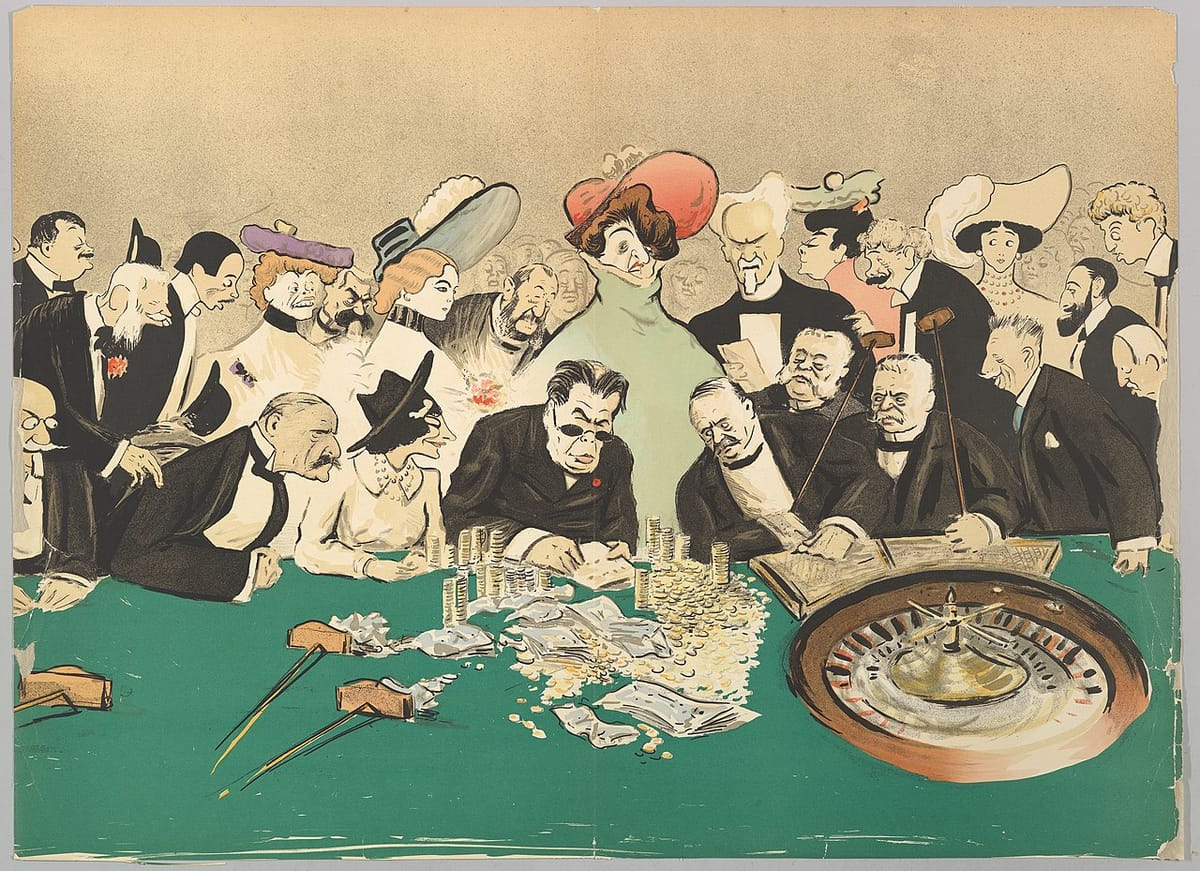
Featured image is La Roulette in the Casino, by Georges Goursat Sem