How to Divide Large Numbers in Your Head
We need to get our minds around our millions, billions, and trillions.


When you see a measurement or a dollar figure that is in the millions, billions, or trillions, what sense does your mind make of it?
Most of us will recognize that a trillion is larger than a billion and a billion larger than a million. But beyond that I would venture that few of us draw much meaning out of large numbers. For example, say that it is proposed to spend $1 trillion to achieve a goal such as the provision of clean energy. Whether that proposal is worthy or not pivots on how much a trillion is, and judging such a proposal is the task of everyone who could be eligible to vote. So if we can improve our facility with large numbers, we can be more confident and thus effective in speaking about the worthiness of public investments.
One path toward evaluating a proposal would start from knowing that U.S. GDP—the total income of Americans in a year—is about 30 trillion dollars. The proposal to spend $1 trillion could then be recognized as a proposal to spend 1/30th of GDP, meaning 1/30th of Americans’ income in a year, and that may mean something to the hearer. Another, similar path would compare the proposal to the federal government’s total spending, which is $7 trillion per year, and so the proposal would spend 1/7 th of one year’s federal budget.
Smaller proposals however could not be meaningfully compared to GDP or to federal revenue. Is a proposal to spend $1 billion-with-a-b on a particular goal worthwhile? If one merely knows a billion is smaller than a trillion, then how does one draw any useful meaning out of the comparison of $1 billion to $30 trillion? “It’s a fraction of GDP” isn’t enough to help us speak confidently and persuasively about whether $1 billion is a reasonable amount to spend on accomplishing any one particular goal.
Here is where better mental handling of large numbers can start improving the situation. If we can remember that a trillion is a thousand billions, and a billion is a thousand millions, and a million is a thousand thousands, then we can start to do better. For example, we could now say confidently that $1 billion is one thirty-thousandth of a year’s national income, or one seven-thousandth of a year’s federal spending. And while we might now ask how well we really understand fractions, I would say thousandths and thousands are potentially relatable numbers, while trillions or billions or millions are not.
A second path toward evaluating a proposal would start by dividing the proposal amount by the population of the country, to find the amount per person. The U.S. population today is about one third of a billion—let’s commit that number to memory. And now let’s consider a proposal that the government should spend $1 trillion. To get the amount per person, we take the “$1” and divide it by the one third, and we take the “trillion” and divide it by the billion. To divide by one third is the same as to multiply by three—remember that, too. So we have $1 times 3 is $3, and we have a trillion divided by a billion is a thousand. Therefore the proposal is to spend an average of three thousand dollars per person—that’s it, that’s what a trillion dollars is in today’s big America. Three thousand dollars per person is a very understandable number—most everyone will attribute a meaning to the amount of three thousand dollars—and the discourse about the proposal can advance from there.
Here are two ways we might train our minds to do this arithmetic. One is to memorize the six possible division problems. Let’s use T for trillion, B for billion, M for million, and K for thousand, as is often done. A trillion divided by a billion is a thousand: T ÷ B = K. A trillion divided by a million is a million: T ÷ M = M. And a trillion divided by a thousand is a billion: T ÷ K = B. Then, a billion divided by a million is a thousand: B ÷ M = K. And a billion divided by a thousand is a million: B ÷ K = M. Finally, a million divided by a thousand is a thousand: M ÷ K = K.
Those six problems and answers are easily displayed in a multiplication table of the same kind you would have memorized in third grade. At age eight, you were asked to memorize every possible multiplication problem involving the numbers 1 to 12. Perhaps at your current age you can manage this much lesser task:
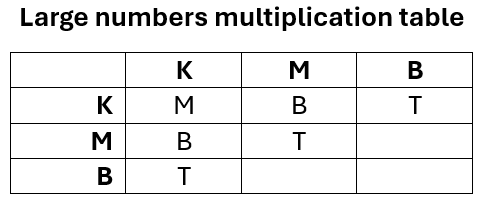
With these skills in hand, what’s the amount spent per person if the U.S. Congress wants to spend $5 million, smart guy? Ooh. Actually this one seems tougher, because it asks you to divide $5 million by one-third billion, so it’s $5 times 3 and then M divided by B—the smaller number divided by the larger. Since B divided by M is a thousand, M divided by B would be one thousandth. The answer is 15 thousandths of a dollar! One cent is 10 thousandths of a dollar, so this is a proposal to spend 1.5 cents per person.
The second, possibly better brain-training method is to remember the sequence thousand, million, billion, trillion, and just assign them the numbers 1, 2, 3, 4. Then you can multiply or divide them by simply adding or subtracting. What is a thousand times a thousand? 1 + 1 = 2, so, a million. What is a million divided by a billion? 2 − 3 = −1, so, a thousandth—because in this method negative 1 is a thousandth, negative 2 a millionth, negative 3 a billionth, and negative 4 a trillionth. So say that your city government wants to spend $1 billion, and there are 2 million people in the city. First divide the $1 by the 2, getting one half, then for the billion divided by the million you just have 3 − 2 = 1, meaning a thousand. Putting them together, you know it is a plan to spend half of a thousand dollars, which is to say $500, per person. Where $1 billion being spent by the city is a literally incomprehensible amount—and thus might seem like too much—$500 per person is a readily meaningful figure, and might well feel like an amount worth spending.
You should play around with these methods for a while. It won’t take long at all to master at least one of them, and thereafter you’ll have it at hand forever. Not only will you start to quickly take meaning from large numbers that you see in your feed, but you’ll actually be more confident about that meaning than you’d be if you used a calculator. For a calculator will want to know how many zeroes there are in a million or billion or trillion, and it will want you to type in exactly that number of zeroes, and you make typos as we all do. But after a few minutes of practice, one time, you will never get T ÷ B wrong again. And with experience you’ll be able to sling around million and billion and trillion in the flow of your conversations as they're needed. Our collective competence in budgetary matters will be up substantially, and even under dictatorship, that can matter.
Featured image is "Allegory of Arithmetic" painted by Laurent de La Hyre (© Ad Meskens / Wikimedia Commons).