I Worked in Operation Allies Welcome. Americans Must Not Betray Our Afghan Allies.
The government is committing a grave betrayal of people who risked their lives to help it.
On November 26th, 2025, 29-year-old Rahmanullah Lakanwal allegedly shot and killed two members of the National Guard in a surprise attack in Washington, D.C. Lakanwal arrived in the U.S. four years prior through Operation Allies Welcome (OAW), a humanitarian program that helped resettle Afghans after the U.S. military withdrawal and the subsequent Taliban takeover of Kabul in September 2021.
Immediately after the shooting, President Trump said he wanted to re-examine all Afghan nationals who arrived in the U.S. under the Biden administration. Secretary of State Marco Rubio announced on X that “President Trump’s State Department has paused visa issuance for ALL individuals traveling on Afghan passports.” Republicans followed in lockstep to blame the shooting on the vetting process conducted at OAW. Republican senator Marsha Blackburn wrote on X, "Operation Allies Welcome" was the result of Joe Biden's plan to make illegal legal.” A few days later, the Office of the DNI posted,” From day one, @DNIGabbard & @NCTCKent have been clear: The Biden Administration created a massive, avoidable national security threat by waving through hundreds of thousands of Afghans with virtually NO vetting under Operation Allies Welcome.”
Now, the lives of tens of thousands of Afghans who were awaiting approval to enter the United States legally are jeopardized. At a shadow hearing in Washington, D.C., on Wednesday, February 11th, witnesses testified that over 60,000 Afghans are stranded in about ninety countries around the world. Moreover, one former colleague told me that Afghans who successfully resettled in the U.S., regardless of their legal status, are expressing fear of an uncertain future.
I am not surprised by the administration’s callous actions and the anti-immigrant rhetoric parroted by members of the GOP, but I am no less disgusted. I helped process thousands of these Afghans during Operation Allies Welcome. I know from personal experience that this is a population who risked their lives working with the United States government. People who, if they returned to Afghanistan, would likely be targeted by the Taliban. Now, that same government is turning its back on them in a grave act of betrayal. It is time for all Americans across party lines to take action to ensure that the U.S. keeps its promise.
There were two phases of OAW: I worked in phase one from December 2021 to January 2022, and then in phase two from March 2022 until August 2022. A majority of my work consisted of consulting independent departures (Afghans who had family ties in a specific area and did not want to be relocated in a different city through a resettlement agency), and working at a daycare while parents participated in cultural orientation classes. Every single conversation I had was done with the help of an interpreter, many of whom also worked with the U.S. in Afghanistan in some capacity.
It would be impossible for me to detail every interaction I had with Afghan evacuees, but I can summarize the general feelings and attitudes I encountered. With the help of my interpreters, I spoke with men and women who expressed trepidation, exhaustion, frustration, despair, and hope. The language barrier and the added hurdle of constantly wearing N95 facemasks did not alleviate the weight of these conversations. And heavy they were. Every individual had a story to tell. I consulted husbands who wanted nothing but to see their wives and children who were already living in the U.S., brothers who wanted to be reunited with their siblings and extended family, families who did not want to be separated from each other, and young fathers expressing concern about caring for their children who had severe health issues. Throughout all of these encounters were the very real expressions of human emotion. Tears cascaded down faces, voices cracked, and hands trembled. I will never forget the sound of one mother’s sigh of relief when I told her that she and her family were going to be resettled in the same city as their relatives.
One element I did not expect throughout these encounters was a sense of urgency. Almost every man I met expressed a desire to be resettled as soon as possible so that they could make money and provide for their families, and several young women expressed a longing to continue pursuing their education. At the foundation of these yearnings was an apparent positive outlook on the American Dream. The notion that the United States is a place in which anyone can succeed if they work hard enough was conveyed in almost every conversation. In fact, I had never heard this outlook repeated as often as I did from anyone else before or since.
None of these anecdotes should be a prerequisite for accepting our Afghan allies into the U.S. and for them to receive the benefits the government promised them. I shouldn’t have to try and convince the American public that pluralistic societies are stronger, or list the several positive effects that immigrants have on their communities, or explain how thorough the vetting process was (although it bears reminding that Lakwal was vetted under the Trump administration when he applied for asylum, so I’m not entirely sure what they’re trying to accomplish by using him as an example). They don’t need to be perfect; they need our help.
During phase two of OAW, Afghan evacuees arrived in waves. With each new arrival, my colleagues and I greeted them with cheers and waved mini American flags as they entered our facility. For each family I met with, I would end our conversation by telling them, “I am not happy you had to leave, but I am happy I can now call you my neighbor.” Now, the Trump administration seems to want nothing to do with them. Even before the shooting in Washington, D.C., the Trump admin was taking steps that were nothing short of abandonment. On day one of his second term, Trump signed an executive order banning refugees from entering the country. In May 2025, Krisi Noem said that Afghans no longer need Temporary Protected Status (TPS), and that it was safe for them to go back to Afghanistan. The following month, in June, ICE began detaining Afghans at their asylum hearings.
Try to imagine it for yourself: You are forced to flee your home after working with a foreign government who told you they'd usher in a new era of democracy. They told you that if you helped them, they would help you. Now, you’re thousands of miles away in a processing facility. The workers there welcome you with open arms and try their best to assist you, but even with their help, the daunting task of resettlement is only just beginning. Then, only a few years later, a new administration tells you they no longer want you here.
Mohommad Nazeer Paktyawal did not have to imagine this. On March 13th, 2026, ICE detained the 41-year-old while preparing to drop his children off at school in Richardson, Texas.. Less than 24 hours later, the father of six, and an Afghan special forces soldier who worked alongside U.S. soldiers for over a decade, died in ICE custody. His cause of death is currently unknown, but according to his wife, he suffered from asthma. When she tried to give his inhaler to officers, they did not accept it.
It’s not lost on me that it was the GOP who spearheaded the war in Afghanistan. I vividly remember the popular, jingoist attitude that portrayed anyone who opposed the invasion as a traitor to the nation, a betrayer. Ironically, if Trump and his Republican backers get their way, they will forever cement the United States as a betrayer of its allies.
We are currently failing the Afghan community, but it doesn’t have to be this way. One suggestion I have is to support the efforts of several organizations that are advocating on behalf of Afghans. Some organizations are Afghan Evac, Afghans for a Better Tomorrow, and No One Left Behind. They’re working tirelessly, on multiple fronts, to make sure that Afghans are protected and able to prosper. More Americans need to highlight their work, and additionally, to listen to community leaders. We owe it to our Afghan allies.
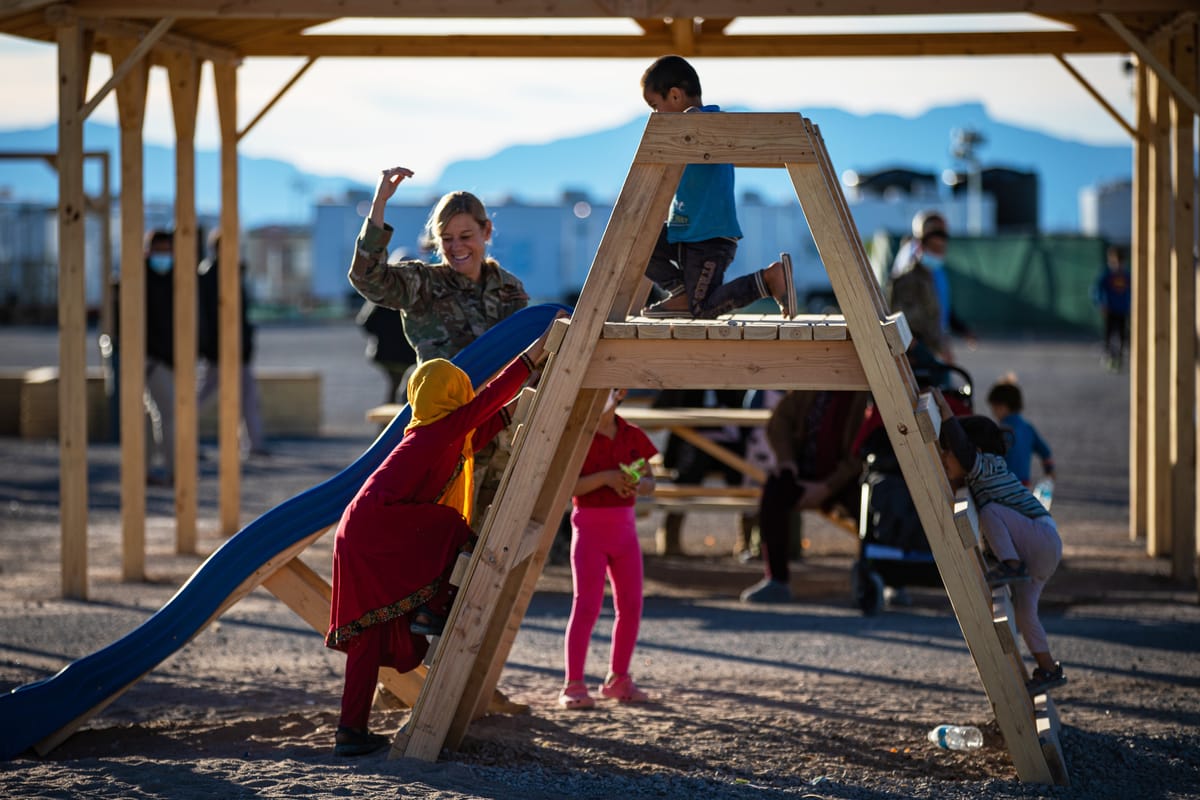
Featured image is Col. Meredith Seeley, Task Force Holloman vice commander, plays with Afghan evacuees at Aman Omid Village on Holloman Air Force Base, New Mexico, by Army Private First Class Anthony Sanchez