International Relations Is Not a Morality Play: What to Expect From the War With Iran
The Trump administration has no plan and no path to a good outcome.
"If the U.S. ends up withdrawing” from the Iran nuclear deal, I wrote in March 2017, “it sets the Middle East on a path to two possible futures: (1) A nuclear Iran. (2) War. Both are much worse than the status quo." Nine years later, America launched a war on Iran.
I knew those were the only two options because nuclear technology is decades old, and the only way to really prevent a country from getting it is if they choose not to. Iran borders nuclear-armed Pakistan, and has a long-running adversarial relationship with nuclear-armed Israel and America—plus the Iranians saw the U.S. negotiate with North Korea, which has nukes, while attacking Iraq, which didn’t—so they have reason to want a bomb. Sabotage, cyberattacks, killing nuclear scientists, and limited military action could set back Iran’s nuclear development, while paradoxically increasing its incentive to establish a deterrent. The only lasting way to prevent Iran from going nuclear was convincing this regime to give it up, or forcibly replace them with a regime that will.
The 2015 nuclear deal, more formally known as the Joint Comprehensive Plan of Action (JCPOA), restricted Iran’s nuclear activities. It was the painstakingly negotiated, highly detailed result of over a decade of diplomacy. The international community, backed by UN Security Council resolutions, sanctioned Iran for years, offering history’s tightest nuclear deal as an alternative. Iran eventually agreed, and the U.S., U.K., France, Germany, Russia, China, and the E.U. all signed. Three years later, Iran was following it—but Trump broke it anyway, saying that “maximum pressure” would get a “better deal.”
It predictably didn’t. Iran was under less pressure than before JCPOA, since most of the world didn’t reimpose sanctions when the U.S. broke an agreement they wanted to keep.
Trump reneging on the Iran nuclear deal closed off the diplomatic path. Iranians who opposed the JCPOA and argued that the United States couldn’t be trusted won the domestic argument. Especially with Trump back in power, America cannot credibly promise that pressure will stop if Iran makes concessions. Talks between Iran and Trump officials unsurprisingly went nowhere, and now the U.S. is attacking Iran, with Iran’s nuclear program one of the main justifications.
I’m not recounting this to claim I had a unique insight, but to show how clear it was. Many people saw it, and quite a few spoke up. I bet there are tons in and outside of the arms control, nuclear, and national security communities feeling a frustrated, angry version of vindication.
Another Middle East war
Many observers will note parallels to the 2003 Iraq war, with the U.S. launching an unprovoked assault on a Middle Eastern government while denouncing an “evil” regime pursuing weapons of mass destruction it does not currently have. But the differences are striking.
In accordance with the Constitution, George W. Bush sought and got Congressional authorization before attacking Iraq. Bipartisan majorities in both houses approved, including prominent Democratic Senators John Kerry and Hillary Clinton.
Trump launched this war on Iran without getting or even seeking Congressional approval. That builds on other military actions this term—including a two-month air war against the Houthis in Yemen, attacks on Iran’s nuclear program last year, an ongoing bombing campaign against alleged drug trafficking boats in the Caribbean and Eastern Pacific, and a special forces operation that removed Venezuelan president Nicolas Maduro—all conducted without Congress, with some featuring egregious violations of both U.S. and international law.
Under the War Powers Act, the president can launch military action without Congress in the event of “a national emergency created by attack upon the United States, its territories or possessions, or its armed forces.” That clearly hasn’t happened with Iran. But even if there is a national emergency, the president has 60 days to get Congressional approval, and without it has 30 more days to withdraw.
Trump and Congressional Republicans already weakened that standard in his first term, when he vetoed a War Powers resolution demanding an end to direct support for Saudi Arabia’s bombing campaign in Yemen, and MAGA Republicans prevented a bipartisan attempt to override it. That effectively flipped the rules from the president needs Congressional approval and must withdraw without it to Congress must pass a bill telling the president to stop military action and needs a supermajority to make him.
The trend of increasing presidential power at the expense of Congress did not start with Trump, but this attack on Iran brings it to new heights, with the legislature not even consulted on a highly consequential use of one of its core responsibilities. And it’s working, because the Republican-led House and Senate are apparently fine with that.
The Bush administration spent over a year making the case for war to the American people and the world. It was a misleading case—Iraq was not close to nuclear weapons like they said, Saddam Hussein wasn’t involved in 9/11 like some of them at least implied, the invading forces weren’t widely “greeted as liberators” like they predicted—and people can debate if the White House knew this was false and consciously lied, or believed most of it and were catastrophically wrong (I lean the latter). But whatever your answer, the point here is they made the case, and the American people approved. The month before the U.S.-led invasion, Pew surveys found that 66% supported military force against Iraq, including 52% of Democrats, while only 26% did not.
By contrast, a University of Maryland Critical Issues poll from early February this year found that only 21% of Americans favor an attack on Iran—including only 40% of Republicans—while 49% of Americans were opposed (30% said they don't know).
Trump launching a war without popular support, or even trying to make a public case, shows contempt for democracy and the American people. And for the extensive research showing that countries do better in wars when they have public support, while widespread public opposition makes it harder to sustain the effort needed to accomplish ambitious goals.
Bush built a 49-country “coalition of the willing” to invade Iraq, with the U.K., Australia, and Poland contributing forces to the invasion. France and Turkey were among the many countries opposed, the war strained the Western alliance and the international system, but the coalition brought some burden sharing and a degree of international support. Then two months after invading, the U.S. and U.K. got a UN Security Council Resolution authorizing the occupation, and more countries sent troops.
For Trump’s Iran attack, it’s just the U.S. and Israel, both under leaders much of the world despises. A few countries have offered verbal support—namely Australia and Canada, who denounced Iran’s nuclear pursuits—but the U.K. and other allies are distancing themselves from the U.S. effort, and many states around the world are outright opposed. Whatever comes after this assault, the U.S. will have a hard time rallying others to help manage the problems.
The Bush administration’s planning for Iraq was highly flawed, with numerous problems in execution. But there was a plan. America’s stated goal was replacing Saddam Hussein’s despotic rule with a democracy, and Bush deployed a large ground force to do it.
I thought the war was a bad idea—my first attempt at serious writing is an undergrad thesis called “The Bush Doctrine and International Law.”—and think subsequent events have shown that (unfortunately). But whatever you think of the invasion of Iraq, the aftermath likely would’ve been worse without the occupation force and effort to set up an elected government.
Collapsing the regime without building something in its place could’ve resulted in the multi-sided mess of the Syrian civil war, the power vacuum of post-Gaddafi Libya, or an ISIS-captured state.
Iran is bigger than Iraq, with almost four times the area, and at 91 million people, more than three times the population of Iraq when the U.S. invaded in 2003. And Iran is more geostrategically important, with proxies throughout the Middle East, a mutual assistance relationship with Russia—which is too occupied with Ukraine to help at the moment, but will be a long-term opponent of any U.S.-friendly regime change—and a major oil supplier to China.
The Trump administration appears to have no long-term plan, no sense of what the U.S. ultimately aims to achieve, and no answer to what happens after the American-Israeli assault. The president is talking about regime change, and missiles are flying at government targets, but there’s no ground force ready to take control if it falls.
Airstrikes have never caused regime change on their own. The closest this century was Libya 2011, where the U.S. and NATO airpower helped overthrow Muamar Gaddafi. But that was intervention in a civil war, where rebel groups already controlled some territory, and after airstrikes weakened regime military capabilities, local rebels killed Gaddafi. Since then, Libya has become a festering problem, with terrible conditions for people there, cross-border terrorist attacks, and mass migration at levels difficult to manage.
Iran does not have an active armed rebellion. The government recently put down anti-regime demonstrations with extreme violence, killing perhaps tens of thousands, and blacking out the internet to obscure it from the world. Many Iranians who might’ve risen up against a regime weakened by foreign attack, who have organized opposition networks, and worked for a freer, more equal, democratic future are among the dead.
Breaking is easy, building is hard
Whether or not the American-Israeli air war can collapse the Iranian government, it will do a lot of damage. In the “12 Day War” last June, Israel showed that Iran has minimal air defense and limited retaliatory capabilities. With its allies Hezbollah and Hamas severely weakened through war with Israel, Iran lost its biggest deterrent. In the 12 Day War, Israel and the United States intercepted most of Iran’s missiles and drones, with Jordan, the UAE, and Saudi Arabia knocking down or reporting Iranian projectiles that crossed their airspace. Israeli strikes got through, some of them destroying Iranian missiles and launchers.
The United States has a lot more aerial capabilities than Israel, and this air campaign is already larger, hitting at least 13 cities, including a variety of locations in and around Tehran. The Iranian military is taking serious damage. Some strikes killed Supreme Leader Ayatollah Ali Khamenei, a significant change no matter what comes next.
But will the clerical regime hold on to power, with new leaders stepping up? That seems the case for now, though this could be the opening days of a campaign that goes on for weeks. Will the government collapse or get overthrown? Or will another faction within the multifaceted Iranian state take control?
A pre-war CIA assessment predicted that killing Khamenei would likely lead to Revolutionary Guard hardliners taking over. Whether or not that’s right—or if it’s right in the short term, but an overwhelming air campaign manages to dislodge the military hardliner government—there’s little chance a stable democratic state arises from this chaos, let alone one friendly to America and Israel.
On the lower end, it could play out like a bigger version of the 12 Day War, with waves of American and Israeli strikes damaging and destroying Iranian military, government, and economic infrastructure, killing some senior figures, then stopping with the regime still intact, while Trump lies by claiming that the military action achieved more than it did, and demands a peace prize for ending a war he started.
Or it could go considerably further, with the U.S. and Israel following up on regime change talk and trying to overthrow the government from afar.
Iran’s retaliatory attacks have hit Israel, Jordan, Saudi Arabia, Kuwait, Bahrain, Qatar, and the UAE, though the damage appears limited. They’ve targeted some U.S. military installations, but firing at commercial airports, a shopping mall and other civilian targets in the UAE betrays an inability to do serious damage to Iran’s military antagonists. The 12 Day War saw many of Iran’s missiles fired or destroyed, and the opening salvos of this war further reduced Iran’s capacity. They might be able to get some shots through and do some damage, but not nearly enough to make the U.S. and Israel stop before they want to.
Iran still has asymmetric options, including a weakened but still dangerous network of allied militias in Yemen, Iraq, and elsewhere. America heavily bombed the Houthis in Yemen last spring, after the group attacked Red Sea shipping to pressure Israel to end its attack on Gaza. After nearly two months, the U.S. stopped, with Trump officials lying that they forced the Houthis into a comprehensive deal. The group attacked shipping again in the summer.
Iran’s biggest card might be disrupting commercial shipping through the Strait of Hormuz, a narrow point at the end of the Gulf through which about 20% of the world’s daily oil flows. Militarily closing the Strait—i.e. preventing U.S. Navy access to it—would be difficult, but Iran doesn’t need that for an economic impact. Hostilities make ships afraid to sail, and insurance companies refuse to cover the risk, even if nothing’s getting hit. Commercial traffic through the Strait of Hormuz is already down 70%, and Oman reports an attack on a tanker.
If that keeps up, it’ll increase global energy costs, adding to inflationary pressure. That’s another factor weighing against Trump sustaining a prolonged military campaign beyond what Iran can weather.
The Iranian regime is awful. Its foreign policy is violently disruptive throughout the region, its nuclear program is a threat to global stability, and it recently massacred thousands of protesters to maintain repressive theocratic rule.
But international relations is not a morality play. The most relevant question is not “is this government bad?” or “do they deserve it?” The most relevant question is “will this use of military force make things better, enough to be worth the death and suffering it’ll impose?”
It’s hard to see how this will.
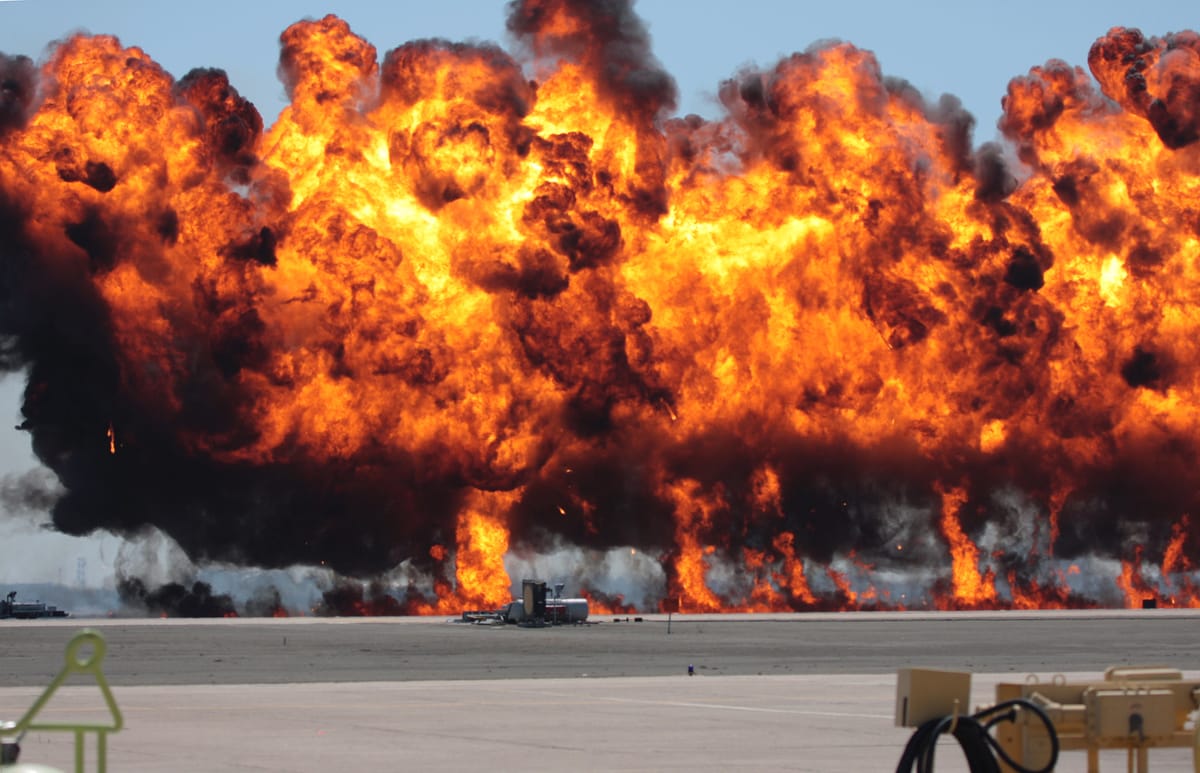
Featured image is Wall of Fire from the Marine Air-Ground Task Force demonstration, by Nathan Rupert