It Was Fascism All Along
A response to Toby Buckle.
Toby Buckle’s “It Wasn’t Fascism All Along” is exactly the kind of argument worth engaging directly. It is a serious argument that seeks to address a real epistemic problem, which is the impulse to flatten all right-of-center politics into a single undifferentiated mass. There are real differences between the different brands of conservatism in practice, and it matters—not least because we must understand our opponent, so that we may successfully confront and defeat our opponent. And ultimately, we both agree that at this current moment, there is nothing to redeem or to save in the conservative project—fascism has won the argument within the right decisively.
But unfortunately, I just cannot accept his core argument—that distinguishing conservatism from fascism is a more accurate theoretical framework for understanding right-wing politics, and thus, a better framework for opposing it. I deeply and vociferously disagree. While on the surface, they are distinct ideologies, with different forms of praxis, this fundamentally obscures the structural logic that ties the right-wing project together, and we must address this logic to understand what we face, and how we must fight it. Because the distinction is not merely false, it is false in a way that risks repeating the same cycle.
I, the author, am a Black trans woman. This is not merely an autobiographical fact—it informs my experiences, and thus, my analysis. Buckle accurately identifies the hierarchical frameworks involved. But he errs in separating them into discrete ideological boxes; they are in fact different strands of a unified, cohesive ideological project that has aimed at the eradication of people like me for centuries. As such, understanding the exact distinction between conservatism and fascism is critical to understanding what we face, and critical to organizing around that understanding, as opposed to an idealized version of the conservative project that said project has never consistently adhered to.
“Conservatism” as intellectualization of societal default
Buckle opens his piece by asking what conservatism is, and looks to Michael Freeden’s morphological framework, which looks not at ideologies based on their temporal, contingent attributes, but by their core concepts, their underlying rationale (Freeden 1996). But the question that immediately comes to mind is—why does conservatism have core concepts at all?
As it turns out, “conservative ideology,” as an intellectual framework, is not as old as it may appear. While there have been various pre-modern intellectual defenses of hierarchy—Plato’s Republic, Aquinas’s Summa Theologica, Filmer’s Patriarcha—those were, in many cases, responses to pre-modern attacks on hierarchy: Athenian democracy, egalitarian heretic movements like the Cathars and Waldensians, and the English Civil War period that provided the seedbed of the natural rights frameworks of the Enlightenment. And these challenges were rare; for most of recorded history, the social order was assumed. Natural. There didn’t need to be a conservative defense of feudalism. There didn’t need to be a conservative defense of the subjugation of women. That is merely how the world was, and any challenges could easily be suppressed—a burned heretic here, a drowned “witch” there.
But it was only in modernity where “conservatism” became synthesized into a coherent ideology.
Edmund Burke didn’t write Reflections on the Revolution in France in 1790 because he coincidentally felt that an intellectual defense of hierarchy needed to be written. He wrote it in direct response to the radical nature of the French Revolution, which asserted something even more existential than the American Revolution, which challenged a particular king, and a particular relationship. It asserted that the entire social order was in fact not natural and thus could be overthrown by the people on the grounds of natural rights. Conservatism as an ideological framework emerges not ex nihilo, but in the process of the defense of its underlying structures.
The same holds true for each instance of exploitative social order. Racial ideology—the idea of Black intellectual inferiority, the legal slavery regime, the assertion of slavery as divine—emanates only after abolitionism gains strength. Prior to this, defenses of slavery were ad-hoc, non-systematic, and rare, and often even presented as a necessary evil that would be phased out at some point in the future. After abolitionism, an entire intellectual framework emerges to naturalize it, justify it, and even sanctify it, via the “Curse of Ham” concept (which was in fact an 18th- and 19th-century fabrication) (Haynes 2002)—an intellectual framework that persisted into Jim Crow, and into white supremacist politics that has shaped every era of American politics since. Gender essentialism produced, intensified, and systematized theories of female biological inferiority, arguments about “natural” social roles and “complementarity,” and pseudo-scientific psychology about women’s ambition being dangerous in response to the demands of first-wave feminism (Russett 1989). Again, we see an intellectual defense of an oppressive social order emerge as that order is challenged. Heteronormativity as a social framework emerges as queerness becomes more visible. The word “homosexual” was coined in 1869; prior to then, queerness simply wasn’t socially organized and self-articulated enough to be responded to systematically, as opposed to suppressed piecemeal (Katz 1995). By 1886, the process of “naturalization” has proceeded to where von Krafft-Ebing is defining homosexuality as a “perversion” that departs from “natural reproduction” (Krafft-Ebing 1886), which just happens to be the exact same as the “Biblical” models of family structure framing marriage as always and forever having been one cisgender man and one cisgender woman.
Once again, in a consistent pattern, the ideological framework doesn’t exist until the underlying repression is challenged. Conservatism doesn’t merely exist to defend the hierarchical social order—the hierarchical social order produces conservatism to defend itself against liberal and egalitarian attacks on its components. Thus, someone like Burke isn’t a founder of conservative thought—he is simply one of the first to defend it.
Why does this matter? Because it undermines the core idea that frames fascism and conservatism as distinct epistemic currents. In reality, conservatism and fascism are simply working towards the same ends—the defense of the hierarchical and patriarchal social order—with different means, at different temperatures.
Freeden misapplied
Buckle’s engagement with Freeden is the strongest and most sophisticated part of his argument, and it thus deserves a serious response. In contrast with crude and rightfully criticized economic reductionism, or the “sum of policy commitments” model which doesn’t fully describe how those commitments can be taken up or dropped—Freeden’s morphological model, which focuses on the core rationales for ideology, provides a more robust framework for examining ideology (Freeden 1996). It provides a clear view into how conservatives can hold contradictory policy positions at different timeframes, while still being recognizably conservative. It illuminates how fascists can sound populist—even to the point of appropriating the word “socialism”—one moment, and ruthlessly hierarchical the next. Ideology isn’t merely a list of policy positions—it is a moral and epistemic commitment from which the policy positions flow.
And this is where Buckle misapplies the framework.
When Buckle uses the morphological model to compare conservatism’s core concepts versus fascism’s, he falls into the same trap that Freeden’s framework should prevent. It examines the ideologies in a given temporal space and takes that snapshot to be the core concepts of those ideologies. But this is largely looking at means, not ends. Freeden’s framework ultimately seeks to ask, and answer: “What are the end-goals of this ideological framework? What values and interests does it seek to serve? And how have the means by which the framework pursues its goals changed in response to social, political, and material conditions?”
Thus, it can be expected that an ideological project’s language, foregrounds, symbols, and enemies can and will shift depending on the political environment, and its relative strength against other contenders, as well as any potential threats. So what is constant? The terminal values of the project.
This has an analogue within the liberal-left project. Liberalism and socialism, as both Buckle and Freeden assert, are distinct ideologies and distinct political projects. But liberal parties and governments accepted, absorbed, and implemented a wide swath of socialist measures—from welfare, to progressive taxation, to publicly funded healthcare—while not themselves becoming fully socialist. How did this happen? Because there is an immense amount of overlap between the terminal goals of liberalism, and the terminal goals of socialism. Both ideologies are fundamentally siblings of the Enlightenment, and both sought to secure individual freedom, from different angles—political freedom versus material freedom. The socialist-liberal synthesis is natural, and in fact should be reinforced and reaffirmed, despite its epistemic split in the 20th century.
So what are the implications for Buckle’s thesis? Simple: just as liberalism and socialism are fundamentally pointed towards the same ends, so are conservatism and fascism. And Buckle himself concedes the case. Buckle identifies the core concepts of conservatism as the defense of an “extra-human order”—a social hierarchy that exists beyond human construction, and must be protected from being tampered with—and those of fascism as “nation, race, masculinity, violence, and mythic past.” These are framed as distinct. But the question then becomes: what does that social hierarchy entail, exactly? What is the conservative project conserving? In short, the oppressive hierarchies of gender, race, class, and sexuality. It need not be explained how readily those map onto what fascism is organized around.
The “extra-human” social order of conservatism becomes the mythic, idealized past of fascism, to be imposed through national palingenesis, cleansed of the “corruption” of democracy, liberalism, feminism, racial justice, and queer liberation. The difference is not goals—it is urgency. Conservatism changes its means regularly—going from divine right to natural law to free market economics to family values—but it always, always asserts the reality of a supposedly natural social order that cannot be challenged by egalitarian conceptions. But what Buckle misses is that the seemingly distinct core concepts of fascism are actually means, not ends.
The violence exists not merely because fascists love violence, but because they believe it is needed to defend national “integrity.” Racial rebirth is simply a response to the “pollution” of the idealized nation via cosmopolitanism. Hyper-masculinity is a response to the encroachment of feminism and queerness upon the “traditional family.”
And here we see the core misapplication of Freeden—Buckle correctly points out the change in conservative instrumentality but fails to point out fascist instrumentality, because the latter, unlike the former, relies on what fascists say about themselves, as opposed to what they do. Once again, the difference isn’t goals, it’s urgency. And in the case of violence, fascism is designed to produce mass mobilization on behalf of hierarchy; thus, it is compelled to produce valorization and justification for that violence.
Mussolini needs to glorify violence because fascism needs its adherents to be able to perform violence on its behalf (Mussolini 1932). But just as wartime propaganda by itself says little about a government’s values, Mussolini’s emphasis on violence says little about what a “stable” fascist society would look like. When we look at what fascism is attempting to do in reality, what it is fighting for, it is always along the same lines. Men over women. Racial majorities over racial minorities. Heterosexuality over queerness. Boss over worker. Or in short—the same hierarchical framework conservatism seeks to uphold.
We know what that looks like in practice—Franco’s Spain and Salazar’s Portugal.
Buckle uses Freeden to separate conservatism and fascism as epistemic frameworks. But when properly applying Freeden’s own framework—ideologies defined by their terminal goals, with their instrumental concepts shifting as conditions demand—the conclusion is the polar opposite. Far from describing two distinct intellectual currents that sometimes share points of overlap, the analysis describes a single ideological project seeking different means to defend the social order against liberal attacks, switching those means up as necessary dependent on the time and place. If conservatism is the project at medium temperatures, fascism is the same project with the heat turned to max.
Conservatism as velvet glove, fascism as mailed fist
Buckle’s definition of conservatism is, as I noted earlier, more sophisticated than most. Going beyond the idea of conservatives just being racist, or just being sexist, or just being queerphobic, or just being class warriors for the bourgeoisie, Buckle frames them as defending a “natural” social order that exists prior to human action, and thus impervious to legitimate challenge. But this is not merely an academic exercise.
I must once again reiterate that I am a Black trans woman. The social order that exposes me to a greater risk of state violence is not a different project from the social order that is currently legislating my gender out of legal existence. They are both elements of the same structure, which defends itself along multiple dimensions simultaneously, at different levels of urgency, and through different mechanisms depending on what each dimension of the hierarchy currently requires. When I read Buckle’s description of the extra-human order—naturalized, presented as inevitable, requiring defense against those who would tamper with it—I am reading the operating logic of the violence being done to me and those like me right now. The “extra-human order” that asserts its social categories are “natural,” or even “God-given,” is not some mere abstraction but has very real material implications. It asserts that my Blackness is inferior to whiteness. It asserts not just that my womanhood is inferior to manhood, but it asserts my womanhood isn’t real to begin with. It asserts that my queerness is inferior to straightness. It asserts that my economic position is inferior to that of the rich. And when those assertions are challenged, then it produces ideology in its own defense—gender essentialism contra feminism, heteronormativity contra queerness, race science contra abolitionism. They are real and living hierarchies, that generate their own defenses when attacked.
Now, what is fascism defending? It defends the mythical, idealized conception of the nation, to be reborn through violence. But what does that palingenesis look like in practice? Once again, male dominance, racial hierarchy, queer criminalization, class dominance. In short, those same hierarchies, but stripped of the intellectuality, and simply imposed through violence (Paxton 2004).
If conservatism is a velvet glove, fascism is the mailed fist it conceals.
One of the most powerful case studies of this—and one that is more than merely academic to me—is the American South, and the development of its racial repression through slavery, emancipation, Reconstruction, Jim Crow, and civil rights. The racial ideology that developed in response to abolitionism, when faced with existential political challenge, transformed to meet the new conditions. First, via secession and taking up arms against the Union in response to the election of Lincoln. Then, even upon defeat, the white power structure adopted tactics that were arguably proto-fascist in nature—mass mobilization, paramilitary violence in the form of the KKK and others, political terrorism directed at Black people, and the destruction of nascent democratic institutions that threatened to transform the social order of the South (Foner 1988). And Freeden’s framework would predict this—as democracy proved insufficient to preserve the racist social order, violence and terrorism became the fallback.
Once Reconstruction was defeated and Jim Crow was secure, what happened next was also instructive. The Klan still existed, but was not fully mobilized and could pivot to national politics. Violence became structural and institutional—a lynching here, a beating there, but the extra-legal violence returned to a steady state. Most of the work was done by law, economic pressure, and social custom. With the threat defeated, the hierarchy stabilized. The temperature came down, which permitted the fiction of national unity that conveniently forgot the Black people sacrificed to achieve it. But the goal did not change.
Thus, we see the pattern—the hierarchical power structure oscillates between “high temperature” and “low temperature” modes depending on current political conditions, and more saliently, current political threats. And the key is that the mass mobilization does not keep itself going even after the threat is gone—it shifts back into the structural mode, where the violence is now distributed against the subaltern populations, as opposed to directed against threats against the social order. Violence is not an end in itself, it is a means to maintain power.
One could argue that this is mixing up outcomes versus internal logic. That the South cycled between terroristic violence and institutionalized violence because fascism and conservatism co-existed in the same body politic and could be deployed as needed. But this further proves the case, in that the two operating modes co-exist, and are brought out in response to particular social and material conditions and then deemphasized in response to a change in those conditions. It is the argument that the bad cop and the good cop have nothing to do with each other.
The postwar settlement and the intersectional trigger
If the relationship between conservatism and fascism is what I’ve argued—the same hierarchical project cycling between “hot” and “warm” operating modes depending on the level of threat—then the postwar period presents an apparent challenge to the thesis. After all, a liberal-socialist coalition united to defeat fascism. Conservatism moderated and made its peace with social democratic welfare states. Center-right parties not only operated within liberal democratic frameworks but actively sought to lock the far right out of power. The postwar settlement would seem to undermine my thesis, because the center-right and far-right did appear to be in conflict for a long time.
But the broader context tells a far different story. In reality, the postwar settlement didn’t defeat the hierarchy—it subsidized it.
This is not to take away from the massive, momentous achievements of postwar social democracy. This is not to deny the immense material impact of the New Deal, the NHS, and the welfare state. But we also cannot ignore who benefited from these measures. The new middle classes of the West were structurally dependent on the continued exploitation of women and minorities, with the benefits largely accruing to white men. The GI Bill mostly excluded Black people (Katznelson 2005). Women were fired en masse, despite often being more productive, to make way for returning male workers. Labor rights were restricted. Nascent queer cultures that emerged during the war were suppressed (Bérubé 1990). Redlining destroyed Black neighborhoods in the North, while Jim Crow crushed Black people in the South. In short—the social order was able to make concessions in one area to preserve the overall structure. Once again, we find ourselves in a “low temperature” era, where the social order is largely secure, with working class white men made stakeholders in this order, at the expense of everyone else.
And how and why did this arrangement unravel? Liberal and social democratic parties followed their terminal ends closer to conclusion. Civil rights for Black people, coupled with the use of state power to undermine segregation. More systematic anti-poverty legislation that covered women, the disabled, and minorities more comprehensively. Freer and more open immigration, reversing the immigration restrictionism of past decades. Second-wave feminism that more directly challenged the social elements of male power. A louder and prouder queer rights movement. And all of this led the white working class, especially white working-class men, to align with the reactionary elites, often with violence. A Gallup poll taken the day after the 1970 Kent State massacre—in which National Guardsmen shot unarmed student protesters, killing four—found that fifty-eight percent of Americans blamed the students for their own deaths, against only eleven percent who blamed the Guard (Perlstein 2008). Just four days later, construction workers in New York City attacked antiwar protesters in the Hard Hat Riot, beating dozens of students while police largely stood aside; Nixon subsequently hosted the union leadership at the White House and later rewarded their organizer with the post of Secretary of Labor (Kuhn 2020).
And beyond this, the nature of the challenge changes. The challenge to reactionary power itself becomes more systematic. We see the concept of intersectionality take hold, in both formal and informal ways, which begins the process of seeing hierarchy as a set of interlocking oppressions, to be challenged all at once (Crenshaw 1989). And thus, the timeline of right-wing radicalization dovetails precisely with the timeline of the steadily condensing intersectional challenge. The 1990s through the 2020s are a history of a fascist movement emerging in response to the challenge to hierarchy becoming more comprehensive and more universal.
Previous challenges were vigorously opposed by the social order but were also manageable by the social order. First-wave feminism wanted the vote, but accepted subjugation in the home. The labor movement wanted a greater share of the wealth but wanted the social prerogatives of the white male laborer upheld. Even the Civil Rights Movement, as transformative as it was, initially left gender and sexuality largely untouched (and some leaders, like Carmichael, were violently sexist) (Wallace 1978; Washington 1979). Similar to a set of overlapping bulkheads on a ship, one or several could be destroyed without compromising the structure’s integrity.
What changed? Simply that the challenges stopped being separable. Second and third wave feminism built a framework that linked gendered oppression to racial oppression and capitalist exploitation (hooks 1984). Queer liberation connected sexuality and gender identity to gendered oppression. Critical race theory connected racial hierarchy, extractive structures, and political power, as well as popularized these ideas for the masses (Crenshaw et al. 1995). And trans liberation arguably makes the most existential attack of all—that gender itself is another “extra-human” framework, not derived solely from nature, but socially constructed to serve the patriarchal social order (Butler 1990).
The hierarchical social order cannot sustain this. It is not merely that these challenges are happening all at once—it is that they are happening as a coherent counter-narrative, that attacks all sections of the ideological underpinnings of that order. Unlike before, giving ground in one area does not create stability, it simply creates leverage for the next challenge, and the next, and the next. And in particular, if trans liberation is conceded, then the social order, built on the idea of this “extra-human,” “natural” set of constructs, loses coherence entirely.
But one might ask—trans recognition has been a feature of Western legal regimes for decades. Why now?
Simple—because trans recognition was always deeply conditional on adhering to patriarchal norms. Someone assigned male at birth may gain legal recognition as a woman—if she performs heteronormativity, assimilates to heterosexual womanhood as completely as possible (not merely in the sense of “passing,” but in the sense that not being heterosexual was often a disqualifier for treatment), is able to pass the gauntlet of tests to “prove” her womanhood, is willing to give up most or all of her pre-existing social networks, and is able to go through the gauntlet of difficult legal processes (Stryker 2008). This is a process that doesn’t challenge the hierarchy, it upholds it by creating a class of exceptions that sharpen the rule. And as we’ve seen, even those concessions can be quickly withdrawn when the temperature goes up.
What truly changed is that trans people, as a subaltern class, began demanding recognition on their own terms, and began challenging the social order, not merely asking to assimilate to it. And the implications of this demand are a fundamental threat to the hierarchy—the end of gender as a biological given that structures a naturalistic social order. And this demand arrived in tandem with an entire intersectional package, which demanded that all the oppressive hierarchies be overturned, all at once. In short, there was no way to moderate. No way to keep the temperature down—so it went up.
That’s why the seeming collapse of “reasonable” conservatism is difficult to answer by simply citing the contingent factors—conservative exhaustion, fascist energy, etc. I argue that it was structural—that conservatism abandoned moderation, because moderation could no longer serve conservative interests. The “death of conservatism” is merely the death of pretense.
The fascist wolf was always there. It has merely shed its sheepskin garb.
Left-wing versus right-wing moderation
The argument I have developed throughout this piece rests on a specific structural prediction—whenever modernity produces democratic or egalitarian challenges to a social order built on hierarchies that are presented as “natural,” you will get, on some level, a convergent fascist response, and this is consistent across cultures. Whereas, if fascism were a distinct ideology with a distinct epistemic framework, it would look very different in different cultures. But as we see with Imperial Japan, this is not the case.
Japanese ultranationalism in the 1930s arrived at functionally identical structures to European fascism through an entirely independent cultural trajectory. The symbolism is different—the cult of the Emperor instead of Aryan racialism, bushido instead of Roman nostalgia, pan-Asian dominance as a challenge to the West—but the structure is nearly identical. A masculinity cult emphasizing an obsession with war. An aggrieved superiority complex coupled with deep humiliation (victims of Western imperialism against Japan’s rightful mastery of Asia). Same ideological architecture, same structural dynamic, different cultural milieu (Maruyama 1963). Regardless of socio-cultural context, the patriarchal social order produces a fascist response when challenged.
We also see this convergence in a non-fascist context. Once again, we look to the example of Marxism versus social democracy. While diverging deeply and durably on means and methods (often to mutual detriment), social democracy was able to become a stable, distinct ideology because it managed to achieve socialist goals, at least to an extent. Welfare states were really built. Labor rights were really established. Universal suffrage was really achieved. Part of the retrenchment of these achievements was because social democracy (as well as revolutionary socialism in Russia and China) compromised with reactionary social orders, instead of defeating them. But those achievements also made the truly revolutionary form less necessary. Moderate socialism actually did deliver for the parts of the working class it was aimed at, and even Marxists largely acknowledge this (Bernstein 1899; Berman 2006).
Moderation did not work in this way for conservatism. Every concession it made only made space for the rest. Racial equality begat feminism begat disabled rights begat gay rights begat trans rights. The cordon sanitaire was built on an implicit bargain—that liberal democracy would not overturn the social order too much. But the oppressive social order generates its own defenses, because it generates its own resistance. Social democracy for white men only was unsustainable, because everyone else would resist that arrangement. Empowerment for straight women only is unsustainable, because queer people would resist. Gay rights but not trans rights are unsustainable, because trans people would resist that arrangement. The conservative social order had two choices—merely fade into history, perhaps meekly asking not to raise taxes too much, or use violence and extra-legal chicanery to reestablish that social order. As in every other case, it has chosen the latter, because the fascist wolf has always been there.
Closing
Despite my objections to his framing, Buckle articulates a vision I find compelling—fascism confined to a thirty-five percent share of the electorate, loud and angry, but ultimately politically ineffective. And ultimately, we both agree that the center-right is not coming back and should not be mourned.
But getting there is the problem.
Buckle frames the task as building an unassailable liberal coalition—strong enough to permanently wall off fascism. But in my view, this does not go far enough, and is not durable enough. This assumes that fascism is an external ideological virus, as opposed to a defensive response to an oppressive social order under siege. Fascism is not just blackshirts or red hats. It is also the father who rages over his trans daughter. It is the incel who feels entitled to a wife because he is a man. It is the small business owner who chafes at paying overtime. The emotional, terminal core of fascism is power that is told “no.” Thus, the war against fascism must be a war against conservative hierarchy, because they are fundamentally one and the same, and to recognize this means to realize that “moderate conservatism” was always a lie, and that our winning political coalition and winning political strategies must be directed towards making those hierarchies politically and socially unviable. The risk is that liberalism continue to be bitten by the proverbial scorpion—allowing the right-wing to be a legitimate participant in a democracy it is fundamentally aligned against, until it has the opportunity to destroy that democracy.
To be clear—I am not saying that every conservative politician is a fascist. I am not saying every conservative voter is a fascist. I am not saying that Thatcher is the same as Trump, or that liberal democratic norms were never held by any right-wing figure. But I am saying that conservatism on a structural level held these norms contingently—contingent on hierarchy being viable within democratic institutional norms and frameworks. When it wasn’t, the norms went with them, quickly and comprehensively. The genuine center-right democrats are thrown out of their parties. The institutionalists are sidelined. Mattis and Kelly give way to Hegseth. Pence gives way to Vance.
And I want to add—people like me tended to see this all along. We were victimized by conservatism long before we were victimized by fascism. We were never fooled by the sheepskin, because the wolf was preying on us all along.
Buckle is right that the future belongs to liberals or fascists—but this was always the case. Moderate conservatism was never a stable third force, it was simply entrenched power that could afford to keep the temperature low, that could keep the structural violence at a background level as opposed to a fever pitch. The question was always when the temperature would rise. Now that it has, the only way forward is to build a coalition not around restoring the conditions that made moderate conservatism possible, but around dismantling the hierarchy that made fascism inevitable.
That is a harder and more transformative project than Buckle’s. But it is the only project that will build the world we want to live in.
Bibliography
Bernstein, Eduard. Evolutionary Socialism. Independent Labour Party, 1899.
Berman, Sheri. The Primacy of Politics: Social Democracy and the Making of Europe’s Twentieth Century. Cambridge University Press, 2006.
Bérubé, Allan. Coming Out Under Fire: The History of Gay Men and Women in World War II. Free Press, 1990.
Burke, Edmund. Reflections on the Revolution in France. J. Dodsley, 1790.
Butler, Judith. Gender Trouble: Feminism and the Subversion of Identity. Routledge, 1990.
Crenshaw, Kimberlé. “Demarginalizing the Intersection of Race and Sex: A Black Feminist Critique of Antidiscrimination Doctrine, Feminist Theory and Antiracist Politics.” University of Chicago Legal Forum 1989, no. 1 (1989): 139–167.
Crenshaw, Kimberlé, Neil Gotanda, Gary Peller, and Kendall Thomas, eds. Critical Race Theory: The Key Writings That Formed the Movement. New Press, 1995.
Foner, Eric. Reconstruction: America’s Unfinished Revolution, 1863–1877. Harper & Row, 1988.
Freeden, Michael. Ideologies and Political Theory: A Conceptual Approach. Oxford University Press, 1996.
Haynes, Stephen R. Noah’s Curse: The Biblical Justification of American Slavery. Oxford University Press, 2002.
hooks, bell. Feminist Theory: From Margin to Center. South End Press, 1984.
Katznelson, Ira. When Affirmative Action Was White: An Untold History of Racial Inequality in Twentieth-Century America. W. W. Norton, 2005.
Katz, Jonathan Ned. The Invention of Heterosexuality. Dutton, 1995.
Krafft-Ebing, Richard von. Psychopathia Sexualis. F. A. Davis, 1886.
Maruyama, Masao. Thought and Behaviour in Modern Japanese Politics. Oxford University Press, 1963.
Mussolini, Benito. “The Doctrine of Fascism.” 1932.
Paxton, Robert O. The Anatomy of Fascism. Knopf, 2004.
Perlstein, Rick. Nixonland: The Rise of a President and the Fracturing of America. Scribner, 2008.
Kuhn, David Paul. The Hardhat Riot: Nixon, New York City, and the Dawn of the White Working-Class Revolution. Oxford University Press, 2020.
Russett, Cynthia Eagle. Sexual Science: The Victorian Construction of Womanhood. Harvard University Press, 1989.
Wallace, Michele. Black Macho and the Myth of the Superwoman. Dial Press, 1978.
Washington, Cynthia. “We Started from Different Ends of the Spectrum.” Southern Exposure 4, no. 4 (1979): 14–15.
Stryker, Susan. Transgender History. Seal Press, 2008.
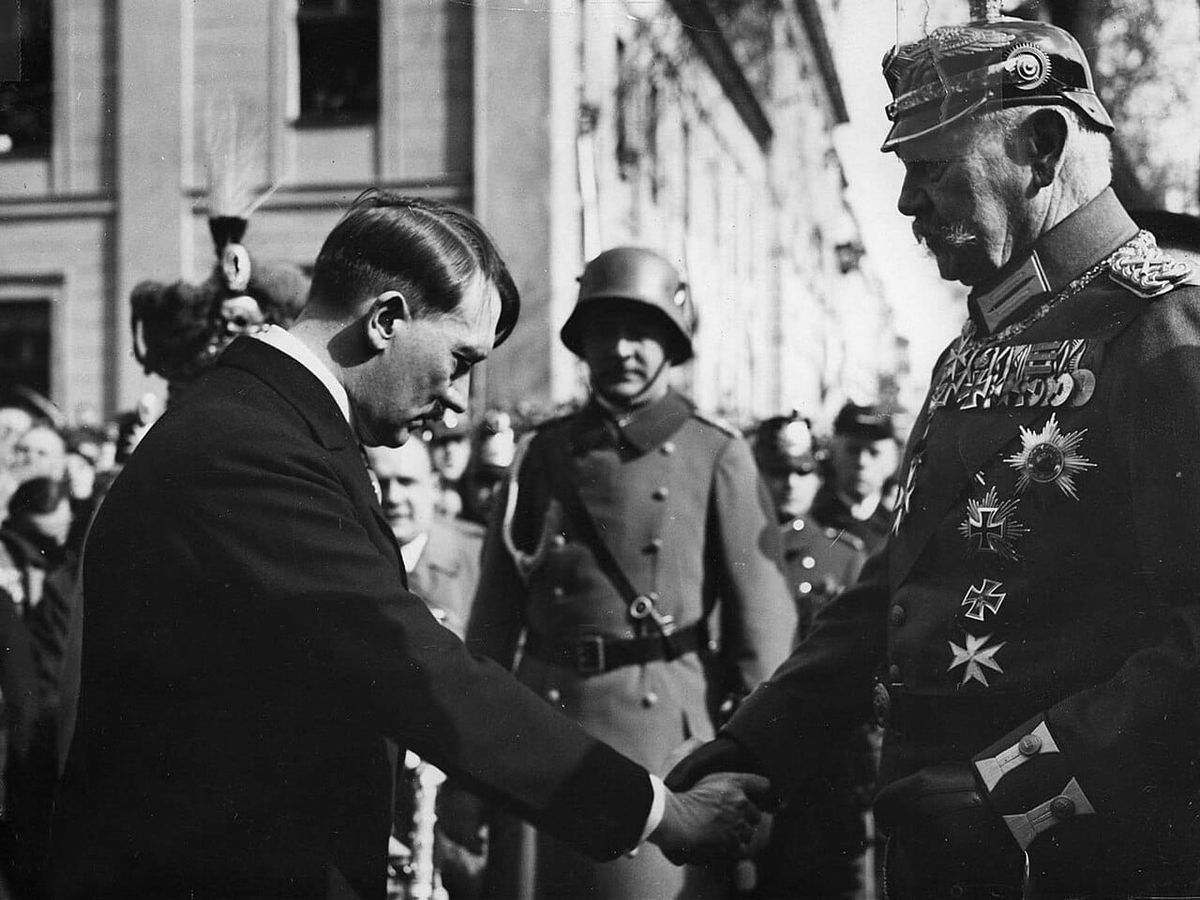
Featured image is Reich Chancellor Adolf Hitler shakes hand of Reich President Paul von Hindenburg on Potsdam Day, by Theo Eisenhart