It Wasn't Fascism All Along
Conservatism was a distinct ideology but it is dead and it is not coming back.
The President of the United States recently compared his territorial expansion plans, favourably, to Nazi wars of conquest. His administration asserts the right of its paramilitary arm to detain any person, at any time, for any reason. Officials openly say that criticisms of state murders will be met with more murders. The world’s richest man uses his new media megaphone to daily promote white supremacist conspiracy theories.
Despite endless obfuscation, sanitizing, and sanewashing from the mainstream media, the debate on if we’re living though a resurgence of fascism is now over. And, honestly, it’s been over for some time. We are.
This does not mean that, as many have vaguely assumed, our new reality is a ‘post-liberal’ one. There are still plenty of liberals—more, arguably. The ideology that has utterly failed is conservatism; the center right has ceased to exist across the world, its institutions taken over by fascists, its voters pledging allegiance to a new flag. There are, increasingly, only two teams—a progressive liberal one, and a far-right one, with little in between and everyone else forced to pick a side.
Now we’re here, there can be a tendency to project the present onto the past. A ‘two-teams politics’ feels fairly intuitive for us, so it's easy to assume it was ever thus. But I’m not sure that’s right: the world has changed a lot and our landscapes of belief are shaped very differently.
Two types of flattening out
My view is that conservatism is meaningfully distinct from fascism. They have some similarities (both are regressive ideologies), and can sometimes pursue similar policies (both Trump and Bush started new wars in the middle east), but are ultimately different families of political beliefs. I do not subscribe to either, I do not think either are good—indeed, I think both proceed from profoundly mistaken assumptions about the world—but, in my head at least, they are not the same thing.
There is an instinct to ‘flatten out’ the distinction between them that can take one of two forms. The first is the centrist impulse to deny the threat: this isn’t really fascism, conservatives have just lost patience with social justice, liberal disrespect, and being ignored. Those who vote for far right parties “aren’t unreasonable, they’re desperate” as British reactionary centrist John Rentoul put it. Politicians like Trump don’t really mean it, they’re just playing to the crowd.
The first problem with this is it doesn’t make any sense. Something clearly has changed, beyond just tone and tenor. If Trump is performing for the crowd, they must want the thing he is performing. If the crowd had ‘legitimate concerns’ there would come a moment where they realised these weren't being met. The ‘they don’t mean it’ narrative consists of disparate claims, incompatible with each other, and untethered from any of the known facts of the era. Not to mention it’s morally heinous. We shouldn’t recast vicious bigots doing incredible harm to vulnerable people as sympathetic ‘desperate’ sorts. Or demand we empathise with the abuser—and blame the abused.
The second flattening out I am more sympathetic to. This goes the other way: it’s not that the fascists are actually riled up conservatives, rather the people we assumed were conservatives were fascists all along. Our current moment is one of unmasking, or an inevitable conclusion, rather than a substantive change. This way of seeing things—for obvious enough reasons—is more common on the left.
This is also a ‘flattening out’ story. What is being claimed here is that fascism, conservatism, neoliberalism (and sometimes even regular liberalism!) are all different defenses of the same thing. Or perhaps evolutions in the trajectory of a thing, namely capitalism.
I call this narrative:
Fascism as the final boss of capitalism
Let's start with what this gets right: Developed countries are very unequal, and growing more so. This is simultaneously a massive inefficiency, a grave moral failing, and a structural factor destabilizing their political systems.
Socialists are quite correct to point to opportunity costs—the countless billions squandered by elites on luxury consumption, or conspicuous displays of wealth, would raise human welfare far more if spent on healthcare or affordable housing. They are also correct about the moral costs (contrary to many of its critics, socialism is not a purely materialist, ‘bread and butter’ doctrine, it has a strong ethical component)—the unequal respect for persons, the diminishing of the creativity, community, and spirituality, the theft of moments of spontaneous joy, that necessarily come with being subject to economic relations of domination.
To this we might add inequality’s political implications: As Elizabeth Anderson famously argued, economic inequality reduces the ability of people to experience others as equals, to have relations with them on equal terms, and hence to function as citizens. Empirically, inequality seems to correlate with both reduced social trust, and reduced trust in institutions.
What I don’t think is happening is a simple ‘bottom up’ process in which 'economic anxiety’ causes racism among the less affluent (or drives them into the arms of demagogues). The data just doesn’t support that. The MAGA movement is a cross-class coalition, but those who buy in at the bottom are far more motivated by social concerns than economic. The relation between the economic structure and the fascist resurgence is better thought of as ‘top-down and middle out’—many in the elite have come to reject social norms against overt bigotry, limits on their ability to humiliate those below them, and self-consciously joined a project to do away with them. In this they have been joined by many ‘aspirational humiliators’; men, for instance, who are angry that women are no longer their automatic social inferiors.
Contrary to the left assertion that progressive liberals don’t take account of economics, I think many of us increasingly do. And we’re more or less agreed on a lot of this. Where I think socialists (broadly defined) can go wrong, and start saying things that are neither true or strategically useful, is when they start defining all other ideologies by their relation to this unequal economic structure.
In its most extreme form, this bifurcates the ideological world into capitalist and anti-capitalist creeds. The economic structure is the root of all evil, but there are various attempts to defend it and dress it up. It’s all conservatism essentially, and what is being conserved is capitalism. Libertarian, or neoliberal, ideology is a fairly direct way of defending the indefensible, social conservatism a ‘bait and switch’ method in which minorities are scapegoated for the costs of capitalism, liberalism a sanctimonious, preachy, waffly way—one that pretends to be your friend, but isn’t.
Fascism then is the final, most brutal approach. When all else fails, the billionaires unleash the demons of the old world upon us, forcing an eschatological ‘socialism or barbarism’ choice. The other capitalist ideologies will either overtly or tacitly side with the far-right, to preserve the system they were built to uphold.
We might start by noting that this is not at all what is happening. “Liberals will always side with fascism over socialism, because facism protects capital” it is claimed. But both historically and today liberals never do this (conservatives often do). Nor, for that matter, do fascists always protect the interests of business elites—think of Trump’s tariffs. And to the great disappointment of apocalypticists everywhere, we are not faced with a choice between two dramatic pivots from liberalism. Rather, countries around the world are balkanising into ‘normie progressive liberal’ and ‘unhinged internet fascist’ factions.
What I just rejected here is an extreme form—most socialists do not go this far. Corey Robin for instance does not have a purely economic view of conservatism—indeed there is a certain amount to commend in his model. But he is also a strong left critic of contemporary liberalism. In his writing he seems angry at liberals like Hillary Clinton far more than he is at conservatives, or even fascists. (In the early days of the Trump era he would compare Hillary to Joseph McCarthy and Trump, preposterously, to Jimmy Cater)
Hence, Robin can often fall into a ‘fascism as the final boss of capitalism’ narrative, that he should know better than. Continually reverting back to a worldview in which (neo) liberalism is the real enemy. Both he, and many of those on the anti-liberal left, have found it a profound challenge to incorporate our current circumstance into their frameworks. ‘By their fruits shall ye know them” and the fruits of this worldview have been, at best, mixed: They have matured over the era, but it has been work for them to understand Trump as meaningfully distinct from prior conservatives, work for them to understand liberalism as the lesser evil, work to accept that there would not be an eschatological socialism or barbarism choice. They’ve had to continually wrestle with the fundamentals of their worldview. Would it not be better to have a framework one did not have to fight?
On a more theoretical level, the tendency to define ideologies by their relation to capitalism (or the economic structure) is, in my view, the wrong starting point. It gets some things right, some things wrong, but this isn’t how we should think about what political ideologies are.
Genres of political thinking
The political views we hold are influenced by our material circumstances, but are not purely an emergent property of them. There are socialist millionaires and homeless neoliberals (I’ve talked to both!). Moreover, we hold strong options on many things that are only tangentially related to economics. Political beliefs are, well, beliefs. Ideas we hold that we can choose to pick up or set aside.
Another way—probably the most common way—of thinking about political ideologies is that they’re defined by the sum of their policy commitments. So conservatives have usually argued in favour of privatisation, less regulation, and free markets, hence that is what conservatism is. This, in turn, is then reduced to a line on a graph (the left vs right spectrum), or sometimes two (a ‘social’ vs ‘economic’ axis is a common way of dividing the space). From this perspective, fascism is conservatism, but more so. What you get if you move a bit further down the line.
And yet, this model creaks uneasily when placed onto reality. Conservatives, we might note, are not always on the side of free markets (and against state intervention). After having opposed the creation of robust welfare states under FDR and Atlee, the centre right came to broadly accept them for the next generation. This ‘post war consensus’ then fell apart with the Reagan and Thatcher revolutions, but even the conservatism since has not stuck to a uniform economic doctrine: George Bush (the second), never lived up to the label of ‘compassionate conservative’ but wasn’t afraid to spend big on the federal level. The American right has wailed about the deficit when out of office, then run it up without qualms when in power.
In their rare self-reflective moments, conservatives themselves have recognised this flexibility. British Tory politician Ian Gilmour wrote in 1978 “In the past, conservatives ‘trimmed’ in favour of the state and against laissez-faire. Today, they ‘trim’ against the state and in favour of the individual”.
To make sense of this you have to ask why political ideologies took the positions they did. Liberals, socialists, and conservatives had a rough agreement on the economy in the post war years, but it came undone because they supported it for different reasons.
In a similar vein, many have drawn comparisons between the Iraq war and Trump's recent illegal aggression against Iran. It is, to put it mildly, a point against both American conservatism and fascism that they are very comfortable launching wars of choice. But even here, the motivation is quite different. Protesting against the Iraq war as a teenager was one of my first political actions. As a lifelong opponent of the project, I think I can say without being thought to excuse it that there was some theory of what the venture was supposed to achieve. The desire to create new democracies was sincere enough. As was the vision of ‘rouge states’ being brought into an international order seen as a natural default. There is nothing like that with Iran. Not even the pretense of it. They are doing what they are doing because they enjoy using violence and see it as a good thing, and end in itself.
It is the ‘reasons why’ that best define an ideology. To take a different case, there are many factions in socialism, many complex theories, and many internal debates. But all—roughly—share a set of values to which they appeal, what ideological theorists call ‘core concepts’. Socialism is always concerned about equality (and critiquing inequality) for example. These core concepts are both the goals of an ideology and the framework through which it interprets the world. If you keep asking a socialist why, you’ll eventually get to ‘because it makes us more equal’, or ‘it raises people’s welfare’ (welfare is another socialist core concept, the others are the constitutive nature of the human relationship, human nature as active, and history as the arena of (ultimately) beneficial change). These conceptual themes also form the ‘toolkit’ practitioners of the ideology use—often subconsciously. When doing political analysis, a socialist might start by asking how a particular issue relates to structural inequality, or people’s labour.
An ideology is at once these ‘core concepts’, a broader set of arguments, and a range of policy positions. Taken as a whole, it creates a recognisable pattern, the pathways through which direct and shape the political thought of those who subscribe to it—from abstract values to concrete policies and back again. Indeed, that is one of the functions of political ideologies—to serve as a bridge between thought and action. (In this, and my description of conservatism, I’m taking a model developed by ideological theorist Michael Freeden in the 90s and updating and modernising it in some ways.)
So while ideologies aren’t just values, it is useful to start there when defining them. Liberals, for instance, also do not neatly categorize as either pro or anti capitalist, having taken a range of positions. What is consistently true of them is they—as the name implies—care about liberty or freedom (the other liberal core concepts are individuality, the common good, rationality, progress, and, in some permutations, pluralism and universality). In some cases liberals have seen free markets as promoting freedom, in others they have supported welfare states as doing the same—both FDR and UK reformers relied heavily on the idea that destitution or poor health limited the freedom of citizens. Today, liberals tend to see a mixed economy (some public, some private) as allowing the most freedom overall.
By analogy, when considering what genre a movie belongs to, we don’t look at the specific details, but its broader themes. A ‘rom-com’ will have both a romance arc and comedic elements, for instance. There is considerable variation in a genre, subgenres within it, as well as edge cases and overlap (No Country for Old Men draws on both the western and noir genres), but we can still generally categorize a movie: Maid in Manhattan is a rom-com, Unforgiven is a western. Map that over as a rough analogue: ideologies are genres of political thinking.
From this perspective, we can see more clearly what is going wrong with the ‘fascism as the final boss of capitalism’ narrative. It’s an example of the ‘mirror image fallacy’—socialists are assuming that because equality is a core concept of theirs, defending inequality (and hence capitalism) must be a central and defining commitment of their opponents.
But it isn’t. Their competitor ideologies simply do not hold the same concerns, but in reverse. (While they will often end up defending capitalism, only a ‘pure’ libertarianism has an ‘in principle’ commitment to an individual, property rights based regime—and pure libertarians, as we shall see, are rare). This is a very common fallacy that trips political commentators of all types up: ideologies can ‘mirror’ each other, but more commonly they do not. They have different concerns, different ways of thinking, and give more or less salience to different values.
Compare the socialist and liberal core concepts described above to the fascist core. Fascism is an ideology like any other. If you strip it of the mystique we often coat it in, it will yield to this analysis. Its central conceptual themes are: the state, the nation (understood in terms of both race and culture), masculinity, violence, and (the restoration of) a mythic past.
Notice what isn’t there—anything that directly relates to economic organisation. The socialist core is very much geared towards a critique of capitalism. Liberalism’s central themes allow more flexibility, but it is still clearly interested in economic structures—in rationally understanding them, or thinking about the common good, or individual choice. Fascism simply isn’t.
And you see this in practice: Fascists just don’t care about economics. To them, it’s entirely secondary to the project of racial domination. They can sound vaguely ‘populist’ and anti-corporate at times, ruthlessly capitalist at others. But in reality they’re neither. Both are means to attain power in order to enact a deranged project of rebirthing the racial nation. Their economic vision is usually hopelessly incoherent; the Nazis had a notion of pure, agrarian German settlers in farmsteads in their new ‘living space’, but also aggressively industrialized for war. Ask a Trumpist what sort of economy they want and you’ll get a similar mish-mash.
In practice, fascists—both in their original manifestation and today—have found that the quickest route to power is some combination of bullying and bribing business elites, so that’s what they’ve gone with. But the values of the businessman seem small and tawdry to them. Nothing compared to the glory of a nation reborn. Wealth, infrastructure, and technology are useful things to have for wiping out large sections of your own population, but if poverty is the cost of racial purity they’ll make that trade every time.
In one of the first attempts to formulate the doctrine, Mussolini wrote “Fascism believes now and always in sanctity and heroism, that is to say in acts in which no economic motive—remote or immediate—is at work.” The purpose of life was violent purification, not profit: “War alone keys up all human energies to their maximum tension and sets the seal of nobility on those peoples who have the courage to face it.”
This seems strange from the perspective of progressive ideologies because it's just not how we think. An individualist liberal who wants free markets and an old-school socialist who does not might seem like polar opposites. But both think the economy is an important part of politics. Both care about rationally finding the best structures to promote human welfare and flourishing. Both assume the moral equality of persons. Fascists don’t care about any of that.
Again, ideologies are not ‘mirrors’ of each other; they care about different things. Far from being a type of capitalism, fascism sees capital as a tool in its quest for a violently purified nation. It will ally with the billionaires as a stepping stone to power, but once there will dominate them, force their acquiesce to the new regime, shake them down for bribes, humiliate them, and overtly go against their interests. The ends of fascism are economic ruin and, again, they simply don’t care.
Conservatives do. While they can be quite radical at times, they do not seek the overthrow of all existing orders. And yet, mainline conservatism is also not defined by commitment to policies of privatisation. They are not as dismissive of economics as fascists, but, as we have seen, have shifted positions considerably through the generations. What then are their core conceptual themes if neither those of the liberal, or those of the fascist? Put simply, if not capitalism, what is conservatism conserving?
The law beneath all law
Another reason many are suspicious of a distinction between conservatism and fascism is they worry that this casts the former as too gentle and genteel a thing. People who pine for a pre-Trump conservatism are, ironically, often nostalgic for something that never existed.
‘What happened to a Burkian conservatism that respects existing institutions?’ Is a question often asked. But the more one thinks about it, the more one wonders if such a thing ever existed at all. Sure, it’s always floated around as a potential definition. In academia it was given its definitive expression by no less a scholar than Samuel Huntingdon. And you can find snippets in popular culture that speak to it. One of Jordan Peterson’s ‘rules for life’, for instance, is “Do not carelessly denigrate social institutions”
But were the Reagan and Thatcher revolutions primarily concerned with preserving existing institutions? Or ensuring a careful, thoughtful pace of change? The American administrative state is an existing institution, it may not be perfect, but it is an established part of the governance of the country. Yet conservatives have almost uniformly sought radical reform, many to rip it out root and branch, without a thought for Burkian notions of tradition, gradual change, and avoidance of unforeseen consequences.
This is sometimes framed as a paradox—why do conservatives not follow their ideology?—but it’s actually just a poor definition. Existing institutions are not a core conservative concept, nor is tradition, or gradual change. Conservatives can believe in these things, but they are not at the heart of the belief system.
Hierarchy is often offered as an alternative—conservatives want to conserve systems of domination relating to race, gender, class and economics. Among the public-facing commentary that does attempt to integrate academic insights, at least on the left this is the most common answer. The Reactionary Mind, by Corey Robin (mentioned above), has been a key text for many. It’s a pre-Trump era book (2011) that broadly works around a hierarchy model of conservatism, the creed being typified by the claim "that some are fit, and thus ought, to rule others"
This does a little better, but without at least further nuance, falls to some of the same problems. The administrative state is, after all, a form of hierarchy, as is the EU, or a corporation making employees sit through a DEI training. Conservatives can take decidedly ‘anti-system’ positions on occasion. This is factored in by saying conservatives value hierarchy when it is held by those who they deem to be the natural wielders of it. But, then they also seem to disagree on who exactly this is. This account would also seem to rule out a ‘business club’ conservative who is sincerely not a bigot, which doesn’t seem quite right.
So what is it? Conservatism is deeply concerned with the social order, specifically it is concerned with upholding those parts of the social order that are extra-human in their origin. This is the first, and most significant, conservative core concept. The belief that there are aspects of how society is ordered that are beyond our control, that we did not make and cannot change. Underlying rules that we may deviate from, but only to our detriment. We can, however, recognise them—they are permanent, predictable, and preservable.
Back in the day, this extra human order would find its origin point in God, in divine right to rule and the cascading ranks of society below that. This was natural, inevitable, everyone had a place that was given to them, and everyone knew their place. Challenging this, thinking outside of it was a pernicious deviation.
But even this was not simply a defense of existing institutions, or even existing hierarchies. Consider the disdain with which aristocrats have almost always regarded ‘new money’ in a transitional economy. In Pride and Prejudice, when Lady Catherine De Bourgh challenges Elizabeth's right to marry Mr Darcy, her concern would seem to be—and most modern readers would assume is—that she is not as rich. But Elizabeth understands what is actually bothering her and answers it directly; “In marrying your nephew, I should not consider myself as quitting that sphere. He is a gentleman; I am a gentleman’s daughter; so far we are equal”. In other words, both are members of the landed aristocracy, the extra-human social order is in no way being challenged. Lady Catherine’s retort is also telling; Elizabeth may be, but her uncle makes his money in trade.
A large urban mercantilist class was a well-established part of England's economy for centuries, and the industrial revolution in its second generation, when Austin wrote. Nonetheless, Lady Cathrine feels that these hierarchies are not legitimate in the way that hers (the rural landed gentry) is. And she feels this quite strongly “are the shades of Pemberly to be thus polluted?” She’s portrayed as something of a ridiculous figure, but is still clearly reflecting real sentiments.
This, in a nutshell, is conservatism: The ideology does care about upholding the social order, but only those parts of it that are considered extra-human in origin, man-made deviations from that are to be disdained, rejected, or even purged. This will necessarily involve an insistence on hierarchy at times (one assumes Lady Catherine would be horrified at the notion that her servants were her moral equals), but is not quite reducible to it.
The world of course moves on, the great wheel turns. Today, a British aristocrat might sniff around a tech magnate for favors, or eagerly and fawningly ask for access to their social circles, not the other way around. But the idea of an extra-human social order remained, attaching itself to different objects.
In the early part of the twentieth century this became supposedly immutable characteristics of human nature such as incentives, competitiveness, acquisitiveness. Towards the middle conservatism started showing an interest in using economic language to express its core concepts, borrowing heavily from libertarian ideas about free markets, individual rational choice, and the perniciousness to government intervention.
This then became how the idea of a fundamental order would be communicated—“that of ‘scientific’ economic laws ostensibly endowed with universal validity.” A reformulation of the conservative core that reached its zenith in the collapse of the ‘post-war consensus’ and the counter revolutions of Reagan and Thatcher. The latter, for instance, defined her movement as opposed to “the illusion that basic economic laws can be suspended.” The claims of socialists that “Government can be a universal provider, and yet society stay free and prosperous” were, to her, in defiance of ‘laws’ about human society that we could not change.
An objection to this model is that conservatives regularly switch what this underlying order is imagined to be. But this is only a problem if we imagine ideologies must be strictly logically coherent at all times—they aren’t. Rather, they must have a psychological and emotional compatibility. Their moving parts must move together. Conservatism is clearly quite flexible with what it imagines this order to be, but also insists that it—or even the belief in it—is absolutely necessary. The ideology is often quite open about this. “Conservatives”, Roger Scruton wrote “believe that people are motivated by attachments rather than by abstract arguments… Hence they understand the need for a story, and the danger of living without one. Whether the story is literally true is another matter.”
The ideology is both stranger and stupider than commonly supposed: conservatism, in the final analysis, isn’t conserving any actual order, it is conserving the idea of an underlying order.
Many of the adjacent (or secondary) conservative concepts of the Reagan and Thatcher era flow from this core. They would talk frequently of fairness, a much thinner concept than liberal universality, meaning only that the outcomes of the extra human structure are normative: If the free market is the best we can do, and it rewards some and deprives others, that is fair. Responsibility, or ‘individual responsibility’ also became a common (if secondary), theme, understood simply as one accepting these outcomes: if the market doesn’t reward you, you have only yourself to blame.
All this is tied back to another expression of the extra-human order which was retained from older forms of conservatism: that human nature was, in some fundamental sense, set and unchangeable. Thatcher’s Conservative Manifesto of 1979 was a vision of a society of individual responsibility where “hard work pays” and “Success is rewarded”, which was understood as “working with the grain of human nature”.
None of this is simple loyalty to the status quo. Conservatism is not an ideology opposed to change, indeed it is a framework centrally concerned with it. All of the great “thick” ideological traditions of the western world—conservatism, socialism, liberalism—found their defining set of core concepts in the middle-to-late 19th century. And this is not an accident, it is the time when the rate of technological change became too fast to deny. One generation radically removed from the next. Prior to that, things had moved, but much less observably. People had understood the process of change as one of cycles—day to night, the seasons, even states were imagined to rise and fall in certain repeating patterns. Modern ideologies are attempts to understand and direct the rapid change we all live with. Conservatism included—it is not a relic of the old world, but one attempt to process the new.
This is the next conservative core concept; organic change. Change is good when it is natural, when it occurs within the extra-human framework. Thatcher welcomed new industry, and intellectuals talked of spontaneous change and spontaneous order. Equally conservatives can be very radical in reforming or destroying institutions that fall outside of that order. As Thatcher and Reagan alike went after unions and the welfare state.
Conservatives live in a dualistic moral universe; those structures, institutions, and individuals that conform to the extra-human order, and those that do not. Again, it is not that one cannot violate these natural laws, just that one cannot change them—if you step outside of them, there will always be (negative) consequences. Improving society then is about bringing strays back into the ‘natural’ order. Unlike liberalism or socialism which imagine (positive) change as charting new ground, this is conceptualised as a return. (It is for this reason we can say it is a regressive ideology). Not a return to the past, but a return to the principles that underlay all human endeavors. In Thatcher's case, the fundamental economic ‘laws’ that her country had strayed from, and needed to be aggressively changed to get back to.
When conservatives see their society as broadly in conformity with the extra-human order, they become inert. Conservative thinker F. J. C. Hearnshaw proclaimed in 1929, without irony, “It is commonly sufficient for practical purposes if conservatives, without saying anything, just sit and think, or even if they merely sit.” This is where our understanding of ‘small c’, Burkean conservatism comes from, but this is arguably not its most common manifestation. And, even when it does take this more passive posture, that is not defining of the ideology, we are merely seeing the dormant form of something potentially much more radical and dangerous. The bear when it is hibernating.
From this follows a limited vision of the political. The state is merely a backstop to the basic rules that structure human societies. This is a much more radical curtailment than the liberal limiting of government to protect individual rights and freedoms. Collective decision making is bounded by the possible, as Michael Freeden wrote, “concerned with the maintenance of those rules that protect the extra-human order, with its organic processes of change, from tampering with by individual or social agents.” This sharply differentiates the ideology from liberalism or socialism, or even fascism for that matter. Both people, and the structures they might build, are profoundly reduced in their potentialities, the result is “a marginalization of politics understood as a deliberative and purposive human activity”—what is a central domain in every other great ideological tradition exists only in an emaciated form.
Those rules that the state should enforce are not just those of the market however—even for conservatives who rely heavily on this rhetoric it is not all that their project is about. The extra-human order manifests in other ways. One recurring one is gender. Many forms of conservatism imagine that one of the ways human nature is fixed is that men and women have different capacities and personality types, and hence society should be structured differently for them.
In response to first wave feminism and the sexual revolution, American conservative Christians formulated “biblical” models of womanhood. When gay marriage began to gain traction as as political cause, it became important to assert that marriage had always meant ‘one man, one woman’. They also will look to psychology and biology as potential validators of core gendered personality types.
All this is, to put it bluntly, false. Marriage has not always meant that (it has not always meant that even within the bible, see Deuteronomy 21:15 which allows a man to have two wives), family has taken many forms, as has our understanding of homosexuality. But in response to liberals asserting something, conservatism will conjure up an opposing vision and claim that its creation is timeless, and the liberal conception (of gender, marriage, sexuality, etc) is in fact a deviation from what this term has always meant.
This is, for our purposes, the final conservative core concept: A mirroring quality—it will pick up ideas from liberalism and create an alternative conception of that concept and an alternative history for it. Conservatism is not reducible to this sort of reactionary opposition (when it decides to oppose and mirror is structured by its other core concepts), but it is a part of it.
This model of conservatism allows us to resolve another ‘paradox’ liberals tend to perceive in it: Conservatives will claim to care about individual rights and freedoms, but then behave in very authoritarian ways. Taking conservatism to be primarily about the extra-human order however, there is no contradiction; the state is concerned with maintaining this order. In some cases this is enforcing economic laws, in others, gender roles. Change must be managed; when individuals or institutions start down the wrong path they must be returned to the right one, but when things are proceeding naturally, they are to be left alone. Accordingly, the ‘mirror image’ may swivel to pick up any number of progressive threats, from the welfare state, to feminism, to acceptance of queer people.
This is a dangerous software to have running in one's head. It makes you closed minded, unimaginative, uncaring for others, small, and limited. It also just isn’t true: If there is an extra-human order, it is well beyond our ability to perceive. The historical stories conservatism tends to tell are, almost uniformly, poor projections. Conservatism is a false and pernicious creed.
It also isn’t fascism.
Conservatives divide the world into what must be conserved and what must be brought back. To the fascist, it all must all be made anew. Conservatism is a project of managed and directed change, fascism of rebirth. A conservative wants to preserve some parts of the existing order and reform others, a fascist wants to overturn all of it. Every institution must be brought low and made to show their submission to, their complicity in, the new order.
Similarly, conservatives may be violent, fascists must be violent. That violence is necessary is a core claim for them in a way it isn’t for even quite radical conservatives. For these reasons conservatives can exist within democracy, fascists cannot. They will compete within it, but cannot accept it as legitimate, or even as a pragmatic compromise. As soon as they have the power, they will seek to destroy it.
While conservatives are often racists, race is not absolutely core to the ideology in the way it is for a fascist. Conservatives have often been very complicit in unholding systems of domination (and may indeed see such systems as part of the ‘natural’ social order they seek to preserve). Fascism imagines a racial people reborn; the ancient primitive, but noble Germania of Tacitus restored, the age of the pure, white, settlers of the American West somehow brought back.
For this it will seek to purge all elements of the society which cannot be accommodated in this fantasy. Conservatives are not as motivated by individual rights as liberals, or welfare as socialists, and their commitment to the moral equality of persons is, at best, dubious. But they do have some limiting principles. As bad as Reagan and Thatcher were, they did want to preserve and protect the private sector, they were part of an international order they cared about. They did want economic growth. Conservatives care about economics—not in a benevolent way, not even in a sensible way, but they care about it. Fascists don’t. They’re utterly unrestrained by such things.
So why did conservatism fold so fast?
And this is what makes any explanation hard isn’t it? However one thinks of conservatism, what the hell happened to it? Even if you go with an ‘unveiling’ model, in which it was fascism all along, why now? Why was the mask so suddenly and dramatically dropped?
I think this is a question on which a lot more work needs to be done. Conservatives, even conservatives who opposed Trump, have not supplied many good answers—it is not, to put it bluntly, a self-reflective ideology. Conservative ‘theory’ is explicating the extra-human order, theorising outside of that, including theorising about itself, is usually rejected. Hence, “The mere intention to spin out a theory of conservatism is somehow an unconservative impulse”, as Clinton Rossiter put it.
I’d like to see more study of conservatism's collapse, especially from a liberal perspective. Especially, especially, from a progressive liberal perspective that views traditional conservatism as an ugly and stupid thing. Given that the creed usually does not self-theorize, most work on it is done either by centrist liberals whose instinct is to frame it as a more reasonable and rational thing than it is. Or by the socialist (or socialist adjacent) left, who enjoy the takedowns of liberalism so much that they become intrigued by its public intellectuals in a way that is less critical study, and more intellectual crush (memorably parodied by John Ganz). A proper post mortem will require more sober (and less impressionable!) critics.
With all that said, I think we can sketch out a few starting points that make the sudden conservative collapse more intuitive.
First, it’s not as if fascism ever went away, it was just less visible for a while. The tail end of the twentieth century saw the introduction of a strange set of contradictory elite norms that both prohibited overt, public bigotry, but also accusations of bigotry. Calling a fellow elite a fascist was not the done thing. Even in popular culture, comparing someone to Hilter was considered a sure sign someone was not to be taken seriously. The result was to obfuscate the landscape of belief: it became easy to imagine that this great ideological foe had been vanquished, or at least relegated to the utter fringes of society.
But the predators were always there, lurking in the mists created by our genteel conversational norms. Elon Musk’s grandfather, Joshua Haldeman moved to South Africa in 1950, just as apartheid started to be enforced, the family left the country a few years before it fell. Multiple generations had ties to neo-nazi movements. Musk is still deeply angry about the loss of white rule in Africa, and his vision for the US, UK, and Europe is overtly driven by white supremacy.
Likewise, the gender and racial neuroses that arose in the US South following the civil war, and were used to justify one-party, authoritarian, racial terror states, for several generations could also be considered an early form of American Fascism. American white evangelical Christianity has always had fascistic elements that imagine the country irretrievably lost to sin, impurity, and liberal perversions—and requiring a violent purging.
Also, in considering conservatism's collapse, we should not fall into the persistent trap of not affording agency to the fascists, of seeing them as either a reaction or a force of nature. Trump’s 2016 primary win did not just happen—it was the capstone of a decade of hard work by a radicalising activist base to discipline and replace the leadership of the Republican Party. Fascists have fought—and fought hard—to undermine conservatism from within. A recent example is the revelations that Steve Bannon worked closely with (UK far right leader) Nigel Farage and (soon to the UK PM) Boris Johnson to bring down the government of (conservative PM) Theresa May.
And it's not as if there are no continuities. New management at a firm will invariably retain some practices of their predecessors. The Trump faction, after briefly flirting with redistribution, has ultimately proved happy to retain the ‘cut taxes on the rich’ approach (although in other areas like tariffs broke decisively with a ‘neo-liberal’ model). As mentioned, they’ve also launched a war in the middle east, albeit for different reasons (a fascist fascination with violence, rather than a conservative desire to bring rogue elements back into the international order).
Finally, the fact that fascism’s sudden rise was so shocking, so counter-expectational, to so many, itself became a source of strength. The story of the last ten years seems to violate the known constants of our political universe. Its primary character, Trump, appears then to exist outside of them. People talk of the man as a sort of political wizard. Being inconceivable makes it feel inevitable.
A great deal of fascism’s power came from, and comes from, maintaining this illusion. If Trump is a political wizard, all you can do is cower before him, as the conservative old guard did. If fascism’s rise reflects some spiritual movement in the great unwashed volk of the world, all one can do is reconcile oneself to it, as reactionary centrists have done.
A lot of this is no more complicated than people allying themselves to a perceived winner. After the insurrection of January 6th, many in the press did cover events with a degree of responsibility: media outlets reported that Trump’s lies were lies, without attempting to split the difference. After his 2024 win, many institutions just rolled over. The difference is in 2020 he was on his way out, weak, and rejected. The commitment of many conservatives and centrists to democracy, and even to their own ideology, was—it turns out—contingent on those things being in power
One has to wonder how deep conservative commitments actually ran in the tail end of the pre-Trump era. Liberals—at least some of us—proved they actually believed in their creed. Fascists have always assumed that we don’t. That anti-racism, for instance, was entirely a sort of elite social posturing. That individual rights were a piety no one would actually put their body on the line for. Fascism has always thought—I think correctly—that a key strength of the ideology is that people often assume its adherents don’t really mean it. As Stephen Miller declared "Our enemies cannot comprehend our strength, our determination, our resolve, our passion."
There’s likely a few reasons for their underestimating liberal resolve: For one thing, they tend to perceive liberalism as female, and hence equate it with weakness. For another, I think there’s a mirroring (we really believe it, so they don’t). I do wonder though if part of it is fascists were used to dealing with conservatives and conservatives didn’t really believe it. For them anti-racism was a social nicety, individual rights were a piety, even seemingly core commitments like free trade, guns, or states rights where preferences they would not, when push came to shove, sacrifice for. (We’ve seen republican congressmen walk sideways on all of these at the behest of fascists). I think fascists took elite conservatives' measure nicely, operating on an assumption that they would hiss but not fight. Events rarely proved them wrong. They then assumed the same would be true of liberals, and have been left unsure when we proved very much the opposite.
Was this then the state of conservatism as fascism took over? Dead dogma, not living truth, to use J S Mill’s words. Sure, conservatives fought liberals hard enough, but did so without real cost or consequence to them personally. Obama era liberalism never sought to reform institutions to get round right intransigence, or impose real penalties on their criminality in the Bush era.
This would be nothing new. In Europe's wars of religion, there were plenty of politicians who would aggressively insist on their preferred variant of Christianity, often at real cost to the state and those beneath them, then quickly convert the minute it was advantageous for them personally to do so. People can ‘convert’ from one ideology to another for equally pragmatic reasons. In a more secular age we should probably expect people to do so - just as those before us would shed their religion to marry, to join a new club, to rise in the hierarchy, or just to get on with their lives without molestation from those above them.
What’s interesting about pre-Trump conservatism is not that it had such pragmatists, but that it seemed to have only had such pragmatists. Early modern Protestantism and Catholicism had their hacks, but they also had plenty of powerful adherents who would - and did - literally die for their faith. I think in past eras there really were passionate conservatives - those who would fight for social orders they saw as legitimate. Lady Catherine would have taken an economic hit to protect the role of the landed gentry, Thatcher would have taken real risks for her version of capitalism.
Contemporary conservatism, not so much. There are a few honourable exceptions of course - those who decided to back liberalism over fascism have been some of our best soldiers - but the vast majority not only went along, but actively ‘converted’ to the new creed.
If that was the case, then the ideology was in a very weak position indeed. Projecting strength, but vulnerable enough a common cold would finish it off. Belief systems need true believers if they are to survive. All this should profoundly caution us against vague notions of resetting the ideological world to the pre-Trump era.
Living without conservatism
If there was a thing called conservatism and now there is not, what do we do now? When we come to this question, thinkers across the spectrum can—in an excellent irony—let nostalgia for an idealised past lead them into vague sweeping statements and impractical visions.
“We need a normal center right party” is a refrain from many democrats. Liberals are expected—somehow—to revive their ideological enemy. But I think we all feel the implausibility of that. Conservatism is not merely dead, fascism has paraded the body around, peeled off its face, and is wearing it as a mask for its own amusement as it does a demented little dance.
Many have a strong instinct that if fascism is ever fully defeated conservatism will rise from the ashes. That some people will always yearn for a Great Chain of Being and something will scratch that itch. Maybe. I’m honestly skeptical, I think we can assume deep physiological constants that are actually just ideas people are taught. Often taught subconsciously, through social structures and how we use language, but taught nonetheless. But I don’t know the future. There could be some successor ideology, but it will be its own thing, fundamentally not in continuity with what has come before. And even then, I would caution against simply assuming that there will be.
Likewise, conservatism used to play a role in protecting liberal democracy. Particularly in the EU where mainline parties would maintain a ‘cordon sanitaire’ against the far right. But the day is dead. That consensus is gone. We can’t reset our institutions and ideological map to 2015—nor should we want to, 2016 follows 2015! Others imagine that conservatism is a necessary element of any political system—the ying to liberalism’s yang. “A party of order or stability, and a party of progress or reform, are both necessary elements of a healthy state of political life” Mill wrote in On Liberty. It’s a nice thought, but how often has it described political reality in the subsequent century and a half? Conservatism has usually not been anything of the kind. An ongoing dialectic between reformers and institutionalists is an appealing vision, and it's tempting to see it as a baseline to which we must return, but it has very rarely reflected our actual political divides.
I think there is a feeling that there will always be a force resembling conservatism, so it is our responsibility to ensure it’s a mostly benign thing. The assumption itself is a conservative one that liberals have no reason to accept. Ideologies, like empires, rise and fall, there is no law of nature that dictates a certain balance.
Nor can we just live with fascism, of course. But our goal should be to recruit people to liberalism, not to resurrect the center right. There are a lot of people on the periphery of the Trump movement who can be talked out of it, or who are apathetic who can be activated. But I don’t think it makes any sense to try and talk them into an ideology I don’t subscribe to simply to maintain some cosmic sense of political balance that never really existed here on earth. I am a liberal. I am most able to argue for liberalism because I think it is true.
There is a tendency to assume that high polarization means even polarization. But there is nothing about two bitterly opposed teams that necessitates they be of the same size. There is a radicalised core to the MAGA movement that, one has to assume, isn’t going away anytime soon, but there are also enough who are potentially persuadable they could be rendered a national minority for the foreseeable future.
What if—and this is me being optimistic, but just imagine with me for a minute—across developed countries polarization stayed, but the contours changed to 70/30 rather than 50/50? In this world, fascism would still exist, but be unable to win national elections. In theory, there’s nothing implausible about this—many countries have had long, generational stretches of a dominant faction. Even in the US our closely divided national electorate is a modern phenomenon, barely pre-dating the current century.
In this world, various types of progressives—liberals, greens, socialists—would cooperate in keeping fascism walled off and shut out. The national direction would be a conversation between them—not order vs progress as Mill would have it, but incremental progress vs radical.
It would be a strange world, at once much more progressive, but also ever on guard. Of strong political beliefs, with no middle at all. The monsters would no longer be hidden by the mists of civility and consensus, but caged and on display for all to see. Progressives would surely descend quickly into rivalries and factions, but remain united in a new cordon sanitaire. Siding, or even sympathising, with the fascists would be the ultimate political sin. At once squabbling captains, steering their ships of state into more progressive waters, and jailers, united in maintaining the institutional bars around predators ever trying to escape them.
It’s a long way from our world to that one, but I can at least imagine it, and imagine a path there. I cannot imagine how we as liberals (or socialists for that matter) can resurrect an ideology we do not share and that seems to have run its course. Let us not be, well, conservatives, attempting to return to an idealised version of the past. Our elites keep attempting to foist the corpse of the centre right upon us, but it's clear no one else actually wants that. Crying about the loss of the middle ground is already becoming cliche, dated, and frankly a little embarrassing. I can quite easily imagine a world without conservatism and it seems, to me at least, to be a better one.
Mainline conservatism is dying. In the US and UK at least, it is dead.This has been destabilizing to be sure, but let us not waste too much sympathy on it. It caused many harms and ignored many more. We should not fight for a creed that could not fight for itself. It was, in the final pass, not one half of the human political spirit, but one set of ideas amongst many. A wily opportunist that lasted longer than most, before a rapid, ignominious demise. The future will belong to either liberals or fascists.
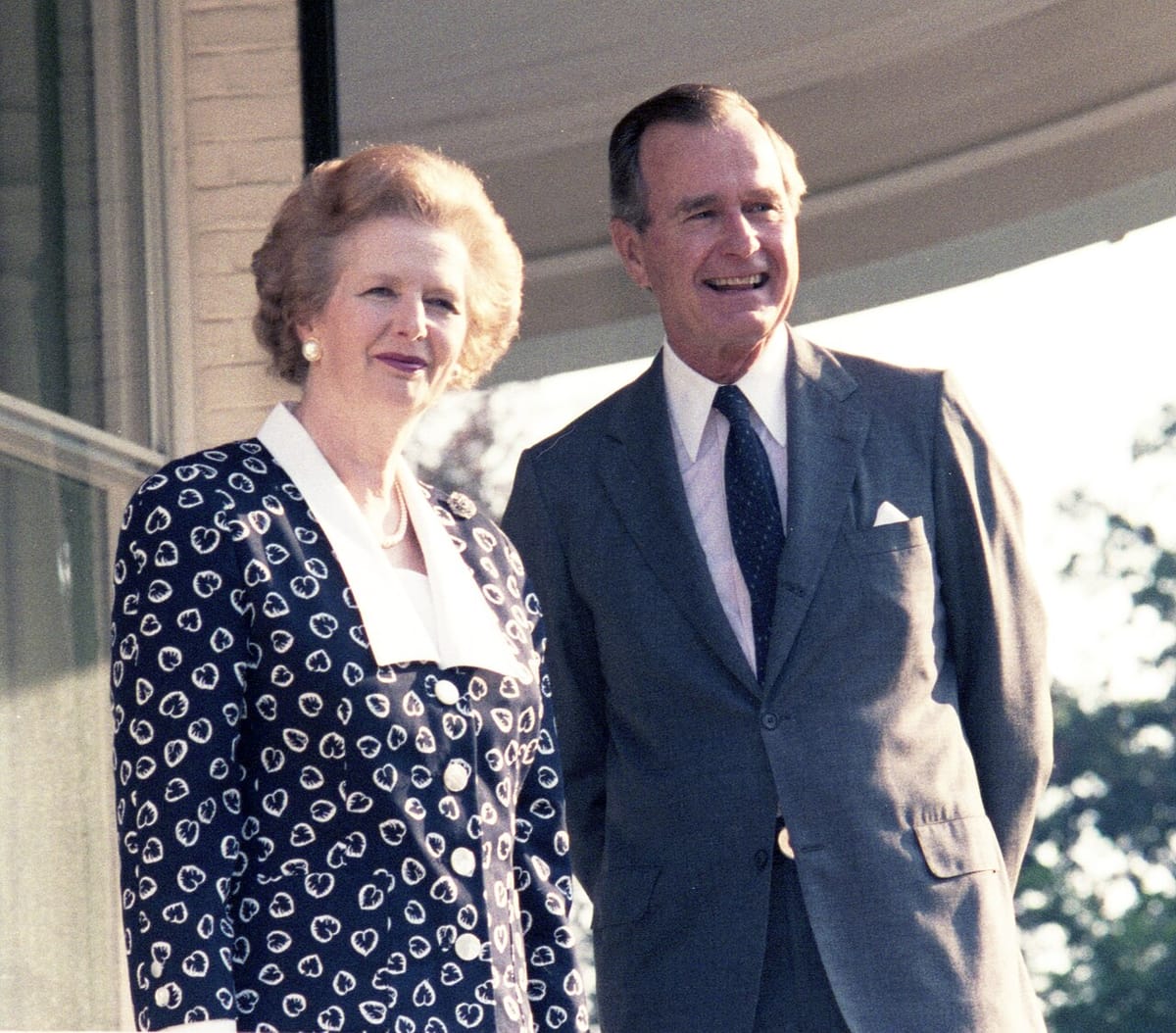
Featured imagei s George H. W. Bush and Margaret Thatcher in 1987