
Liberalism Did Not Fail, Conservatism Did
We are moving from an ideologically multipolar world, to a bipolar one.
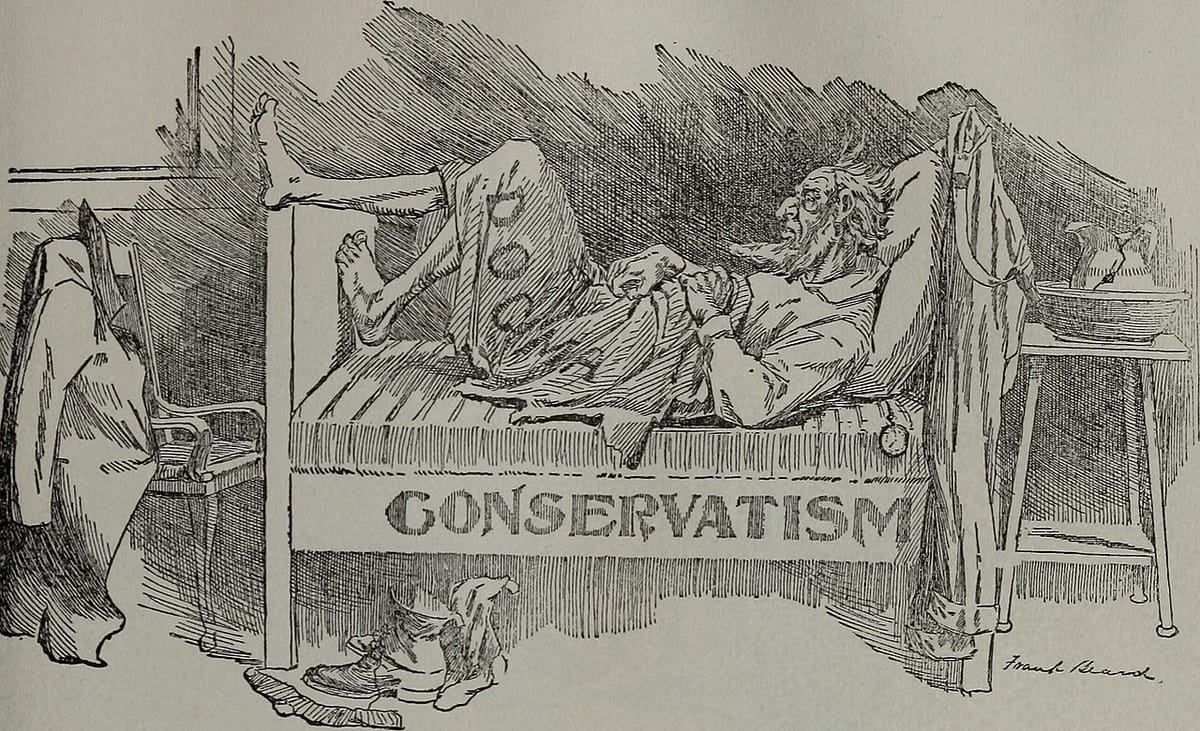
Why has liberalism failed? That seems to be the great question of our age. One day it was a secure hegemonic force, it is claimed. The next, it was gone, an ascendant fascism filling the void in a ‘post-liberal’ world. ‘Why do people find the new right so much more compelling than you?,’ we liberals are asked with an accusatory air.
Yet while an ideological displacement can seem to be the case in the big picture, it’s rarely true for any individual: You can find examples in the chattering classes of centrist ‘classical liberals’ who’ve become pure fascist apologists, but among electorates it’s very rare. I can’t think of any normie progressive liberals I know who’ve gone over to the other side. Hillary/Biden primary voter to Trump just isn’t a thing, not at any scale at least.
Indeed, regular liberals seem to be radicalizing. The Democratic primary base very much wants their leaders to fight. This is not a few fringe academics, but vast swaths of American society. Far from being a spent force, the ‘resistance’ has mobilized people on a scale virtually without precedent in American political history. Ordinary liberals have shown extraordinary courage protesting ICE brutality.
It is not mainline liberalism that has lost adherents; it’s everyone else. Across the world the center-right has disappeared, virtually overnight. Anti-Trump Republicans are now just a small part of the Democratic coalition. France’s traditional right has been entirely displaced by the far-right National Rally. Britain’s Tories, once a poster child of sensible-sort conservatism, are on a track to electoral oblivion and unashamedly pledging their allegiance to global fascism. One could say the same of libertarianism: State parties in the US are openly fascistic. Most of the residual are, more or less, just progressive liberals with an individualist bent.
For all the premature obituaries, liberalism is probably stronger now than it was a decade ago—in terms of both raw numbers of believers, and the strength of their belief. Being in a fight for your literal life does that. What can be said is we’ve lost the race to cannibalize the corpse of conservatism.
Liberalism never was hegemonic, neither as an ideology or a set of political structures. There never was uniform belief in core liberal values. Rather, liberalism sometimes served as something of an ideological lingua franca: A conservative in the ‘90s, arguing for creationism in schools for instance, might say children should be ‘taught the debate’ and ‘free to make up their own minds.’ It’s not that they believed in reasoned debate and intellectual freedom, this was simply a useful rhetoric for them at the time. Now, they increasingly prefer to make their case solely in their own language.
Liberalism has lost the illusion of controlling the heavens, while actually gaining followers here on Earth. The world is going through a great ideological realignment, but it is better visualized as ‘consolidation’ rather than a ‘sudden shift’.
By analogy, prior to World War 1 the geopolitical map was multipolar—there were many ‘great powers’, such as England, France, Germany, or Austria-Hungary. After World War 2 there were really only two: The United States and Soviet Union. Some great powers had simply ceased to exist (Austria-Hungary), some fell directly under the power of another, and some became junior partners in a ‘team’ led by another (Britain to the United States). Once the process reached a certain point, it took on a logic of its own—if the enemy bloc is consolidating, yours must too. Less powerful countries usually decided to pick a side.
Prior to the twin shocks of Brexit and Trump’s 2016 win, the landscape of political belief was multipolar. Numerous distinct ideological groups existed more or less on their own terms—libertarians, mainline conservatives, the far-right, liberals, socialists, greens, feminists, and so on.
Now they’re consolidating into two ‘great powers’—unlike the Cold War, the conflict between them is as much within countries as between them. Nonetheless, two great gravity wells have opened up. In almost every developed democracy, every ideological group is getting pulled into the orbit of one or the other.
Resurgent fascism has almost fully absorbed the center-right, and made their institutions subordinate to itself. Likewise with libertarianism. People often point to the variety in ‘post liberal’ thought and, sure, you can find all sorts of zany ideas there—from tech-bro babble, to integralists (catholic theocrats), to manosphere types, to scientific racists, and so on. But at the end of the day, they are all part of—and subordinate to—the MAGA movement. We shouldn’t take them too seriously as statements of principle; they’re better understood as attempts to recruit different sections of society into the same thing.
On the liberal side, consolidation has been slower, but nonetheless forced by the logic of events. A reasonably stark divide at the start of the era between ‘liberals’ and ‘the left’ has, despite mutual sniping and distrust, slowly been closing. On policy, everyone is more or less agreed on an egalitarian, pro-LBGT, pro-environment direction of travel.
In the United States at least, the left remains part of the Democratic Party, with Mamdani’s victory in particular serving as an important ‘proof of concept’ for an ‘inside’ strategy. It was also noted by many commentators that it validated a coalitional compromise (advocated by yours truly among others). Namely, that the left would abandon voting abstention, and ‘reaction narratives’ that blamed liberalism for fascism, in exchange for more progressive policy and a greater leadership role in the party. Most ordinary progressives—liberal and left—are self-consciously de-prioritizing factionalism; they want to fight fascism, everything else comes second.
Finally, ‘thin’ ideologies that focus on a specific set of issues have also had to choose a side. If you’re a feminist, you’re now on the liberal team by default. Before the Trump era the ‘anti-vax’ worldview was reasonably divided between left and right. Now it's on team fascist. It’s not that there aren’t differences within these teams, but there are two key anchoring points that everything else must orientate around. Cultural products like movies, music, even food get coded to a side. Even major world religions are getting pulled into their orbits.
Contrary to the narrative of a sudden switch from liberalism, in terms of popular belief the teams are often more or less the same size. In America, each now directly aligns to a political party, and both reliably claim mid-40’s to low-50’s in the national popular vote. In the UK, the teams are fractured between parties, but the ‘left bloc’ and ‘right bloc’ are roughly the same in terms of number of voters (and also moderately stable). Most EU democracies seem to be moving towards something similar.
The most significant attempt to maintain a ‘non-aligned’ position (to continue the Cold War metaphor) is what I call reactionary centrism: The view that fascism’s resurgence is a reaction to the excess of social liberalism (a backlash to woke), that we must moderate and offer policy compromises in order to win back voters and reestablish some sort of social consensus. Despite considerable elite support, this faction has really struggled for the simple reason that no one else seems to want it. In the US, its attempts to control the Democratic Party are checked by primary electorates who want to fight. In the UK, where it has seized the Labour Party, voters simply went elsewhere.
I don’t know the future for reactionary centrism. I can tell you it isn’t making converts, I can also tell you there’s a real unthinking fanaticism there—quite at odds with their ‘sensible sorts’ personas. Their response to being wrong again and again is to lash out at liberals. That's where a lot of these narratives of ‘liberalism failing, or a ‘post-liberal’ world come from. But they’re grounded in a picture of a ‘sudden switch’ that just didn’t happen. Consolidation, us moving to an ideologically bipolar world, fits the facts much better.
And in being truer to our circumstances, it makes them feel more manageable. Reactionary centrists would have us believe that the great unwashed volk of the world never really bought our effeminate decadence. They went along with our effete notions of bodily autonomy, free life choices, women working, and acceptance of gay people for a bit. But then one day woke up deciding they’d had enough of all that.
To the liberal mind, attempting to believe this feels jarring. Were we that wrong the whole time? Fascism’s resurgence becomes incomprehensible and unopposable. A great judgment sent down upon us. A demon cleansing the world in fire at the end of days. All one can do is prostrate oneself before it. “I’m sorry—I repent of ‘trans-ideology’ and forcing it ‘down the throats’ of the ‘real,’ red-blooded people of the land."
But millions of people did not, in fact, go to bed reluctant liberals and wake up fascists. Rather, many who were never liberal to begin with, who never liked liberals, and whose coexistence with liberals was always temporary, strategic, and contingent, decided that they were no longer willing to live alongside us. From this perspective, the problem is catastrophic, but at least conceptualizable. Fascism is terrifying, but terrestrial.
If we are entering a bipolar world, that simplifies our strategy considerably: We must unite our own coalition and oppose the enemy one. We are in a fight across countries, across institutions, and across all levels of society. War must be waged on all fronts. There is no point trying to find a middle ground with fascism; rather we should aim for positions that are broadly acceptable to everyone in the liberal team.
Liberalism is not weaker than it was before. Instead, it is our opponents are more unified, more radicalized, and no longer willing to live alongside us. We find ourselves as the other pole, the leaders of the free world in a quite literal sense. Our circumstances are dire, but perfectly explicable.
Featured image is A Short Bed and a Narrow Blanket


_(14784377442).jpg?ref=liberalcurrents.com)