Mamdani Teaches Us How to Speak the Language of Illegitimacy
How should the next Democratic government act on the belief that Trump's second term was lawless and illegitimate?
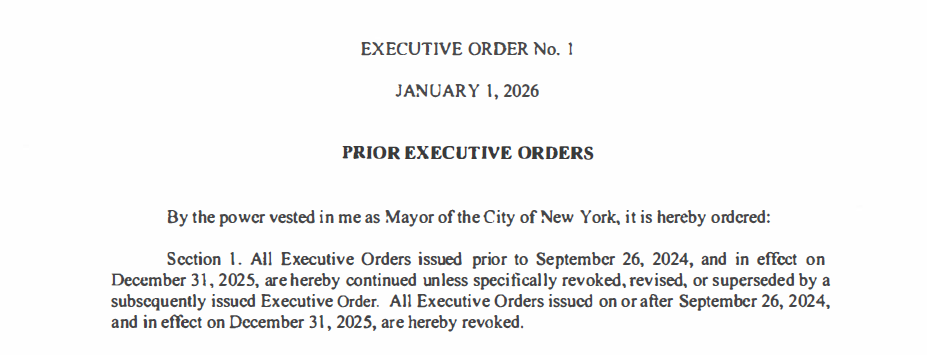
As you may have heard, Zohran Mamdani is now officially the mayor of New York. The winner of the 2025 mayoral election, Mamdani took his oath of office at midnight on New Year's Day. He succeeded Eric Adams, whose four years as mayor were marked throughout by scandal and corruption. And Mamdani wasted little time repudiating Adams's legacy. His first official act as mayor, Executive Order 1, revoked every single executive order that Adams had made from September 26, 2024 through to the end of his term (save only for those made under certain emergency powers).
Why September 26, 2024? That was the day Adams was indicted on bribery charges (among others) by a federal grand jury in the Southern District of New York. These charges were ultimately dismissed the following year, at the request of the Justice Department—or more specifically at the request of then-acting Deputy Attorney General Emil Bove, who ordered prosecutors to dismiss the charges in a memo on February 10, 2025. Bove's memo echoed Adams's claims that the Biden DOJ had unfairly targeted him because of his stance on immigration. Several career prosecutors at SDNY, including the acting U.S. Attorney, resigned in protest rather than follow Bove's orders.
The whole thing stunk. At the time of the indictment itself, there were calls for Adams to resign. Those calls only grew after Bove's memo, when it seemed that Adams had reached some sort of corrupt bargain with President Donald Trump. Adams did not resign; neither did New York Governor Kathy Hochul heed calls to remove him from office, either at the time of the indictment or after Bove's memo and the ensuing firestorm. Instead, the city just limped along with a plainly compromised mayor for the last year-plus of his term.
Enter Mayor Mamdani. His Executive Order 1 did not just revoke some of Adams's orders because Mamdani disagreed with their substance. That is normal enough: at the federal level, for example, there are a number of issues—mostly politically charged, “culture war” stuff—where policy shifts back and forth every time the White House changes hands from one party to another. President Ronald Reagan's “Mexico City” policy, which forbids giving foreign aid money to any organization that “perform[s] or actively promote[s] abortion,” is probably the most famous example: it has been rescinded by every subsequent Democratic administration, and then reinstated by each Republican President. But Mamdani went further. He revoked all of Adams's orders after his indictment, not because of anything about the substance of the orders but just because it was Adams who issued them.
In other words, Mamdani has asserted that Adams was not really mayor for those fourteen months. Governor Hochul may have declined to remove Adams from office at the time. But Mayor Mamdani, so far as his powers permit him, is going to act as though the last 461 days of the Adams Administration simply didn't happen. He considers Adams to have become illegitimate after his indictment: he had no right to hold office and exercise the powers thereof, notwithstanding that he did in fact continue to do so. Thus his actions as mayor during this time are likewise illegitimate, and we should no longer recognize them as valid. Executive Order 1 does not say any of this in so many words, but its structure clearly reflects this view of things.
Gee, I wonder if there are any other illegitimate office-holders who should be treated this way?
Back in 2021, I was saying that, in an ideal world, I would have liked to see Donald Trump's presidency annulled: his every act as president made null and void, as if it had never happened. To do this properly, of course, would have required a constitutional amendment, a sovereign act by the People themselves. President Joe Biden could have done what Mamdani just did, and revoked all of Trump's executive orders wholesale. But he had no power to take the acts of legislation Trump signed off the books, let alone to remove the (life-tenured) federal judges he had appointed from office.
In fact, Biden did not do anything like what Mamdani has just done. He did not adopt anything like the position that Trump had been an illegitimate president. The transition was an entirely ordinary one. There were the usual partisan shifts in executive policy. And of course he fired most of Trump's political appointees within the executive branch, as is entirely routine during every cross-party presidential transition. But Biden took no action premised on the view that Trump had lacked the right to use the powers of the presidency—that his actions as president had been void. Trump had been a bad president, in Biden's view, even a very bad president. But he had been president.
This approach was hardly unique to Biden. Democrats have repeatedly avoided attacking the legitimacy of Republican presidents for the entire twenty-first century. Both of those presidents, recall, were initially “elected” despite getting fewer votes than their Democratic opponents. It had been over a century since this theoretical quirk of our election system—the Electoral College—had actually resulted in a minority-rule president. And both of those Republican presidents had an additional reason to doubt their legitimacy as well. George W. Bush may well have lost Florida, and therefore the election, were it not for the Supreme Court's nakedly partisan decision in Bush v. Gore. And, although there has never been conclusive proof of this (in large part due to Trump's successful obstruction of the Mueller investigation during his first term), it seems clear enough that Trump was colluding with Vladimir Putin's Russia in 2016 to commit various crimes to sabotage Hillary Clinton's campaign.
Twice in a generation, Democrats were asked to accept being ruled over by a Republican whose legitimacy was highly questionable to say the least. And twice, they did. They deliberately refused to attack either Bush or Trump as illegitimate, wary of the damage this would do to the constitutional order as a whole. It is understandable why they made that calculation, though it is hard to say that the decision looks good in hindsight. But this approach simply will not do anymore. Trump's second term is already an existential threat to the constitutional order. Whatever we would hope to preserve by acquiescing to his illegitimate rule is already gone.
There is another important difference between the present moment and the circumstances of 2000 and 2016. Those Republican presidents may have been morally or democratically illegitimate. But they were, without much ambiguity, the lawful presidents. Today, however, Trump is legally illegitimate as well as morally. Section Three of the Fourteenth Amendment, adopted in the wake of the Civil War, forbids anyone from holding office ever again who (1) took an oath of office to support the Constitution, but then (2) broke that oath by engaging in rebellion or insurrection. Of course this was written with the case of the Confederacy—a rebellion supported by many former federal officials—in mind.
But Trump took an oath to defend the Constitution as president. And he launched an insurrection on January 6th, 2021, seeking to overthrow the constitutional order and retain power for himself notwithstanding his loss in the November 2020 election. We all saw it happen. The implication is plain: Trump is a usurper. He is not, right now, the lawful president, because the same law that creates the office of president also disqualifies Trump from holding any office, high or low. He is a lawless president, not only in that many of his actions in office are illegal (like, say, invading Venezuela without a scrap of congressional authorization to kidnap President Nicholas Maduro), but because it is illegal for him to be president in the first place. Every action he purports to take as president is ultra vires, beyond the scope of his powers, because he has no just powers. If Democrats are faithful to the Constitution, we cannot help but tell the truth about this.
And, as Mamdani shows us, it is not enough just to say that Trump is illegitimate. We need to be thinking about the implications. We need to be thinking about how Democrats can use their powers, now and in the future, to deny that Trump has a legitimate right to rule—just as Mamdani has denied that Adams had the right to rule after his indictment. Some of these conversations might concern the present: how recognition of Trump's illegitimacy should inform the fight against him right now.
But we should also be looking to the future. Assume that national politics continues more or less as normal for the next few years, and that—since Trump is hideously unpopular, as well as illegitimate—Democrats win both the 2026 midterms and the 2028 presidential election by comfortable margins. In January 2029, then, we will take control of the federal government. How should that next Democratic government act on the belief that Trump's second term was lawless and illegitimate?
The model of Mamdani's Executive Order 1 is a start. It is simple enough for the new president to revoke every executive order Trump issued in his second term. This ought to include the twelve orders he issued in the last two weeks of his first term, since his disqualification from office began on January 6th itself. Now, executive orders by the President of the United States are a bit different from those by the Mayor of New York City. For starters, there are far more of them: Mamdani's order only rescinded nine orders over a span of fourteen months; Trump issued 225 orders just in 2025. And many of those orders do important work organizing various aspects of the executive branch. If the new president were to rescind all of Trump's executive orders, they might feel the need to ratify or re-issue a few of them that were substantively good and load-bearing.
But we can go further. I said that it would have taken a constitutional amendment to annul Trump's first term. It's not obvious that the same is true of his second term. After all, the second term is already unconstitutional. And Congress has authority to enforce the Fourteenth Amendment. Could you, then, declare every action Trump took in his second term—every executive order, every signature on legislation or on a judicial commission—void by simple legislation? I don't see why not. Indeed, it may not even be necessary. If Trump is already illegitimate, then his actions are already void. All that would be needed would be official recognition of this fact, which could come in a joint congressional resolution, or maybe even in a decree by the president. If I were president in 2029, I would be sorely tempted to announce that, in my view, every judge Trump had commissioned in the last four years—like, say, Judge Emil Bove of the Third Circuit Court of Appeals—was not really a judge.
Such an action, whether done by legislation, resolution, or executive decree, would be wholly unprecedented. But the very business of having an unlawful and illegitimate president is unprecedented. That reality demands that Democrats get comfortable speaking the language of legitimacy. Mamdani has given us an example of what that can look like. We should follow his lead.
Featured image is "Executive Order no. 1," Office of the Mayor of New York City 2026. Cropped.