Minnesota's False Spring
Even with troop withdrawals, Minnesotans aren’t packing up snow shovels, nor ICE whistles.

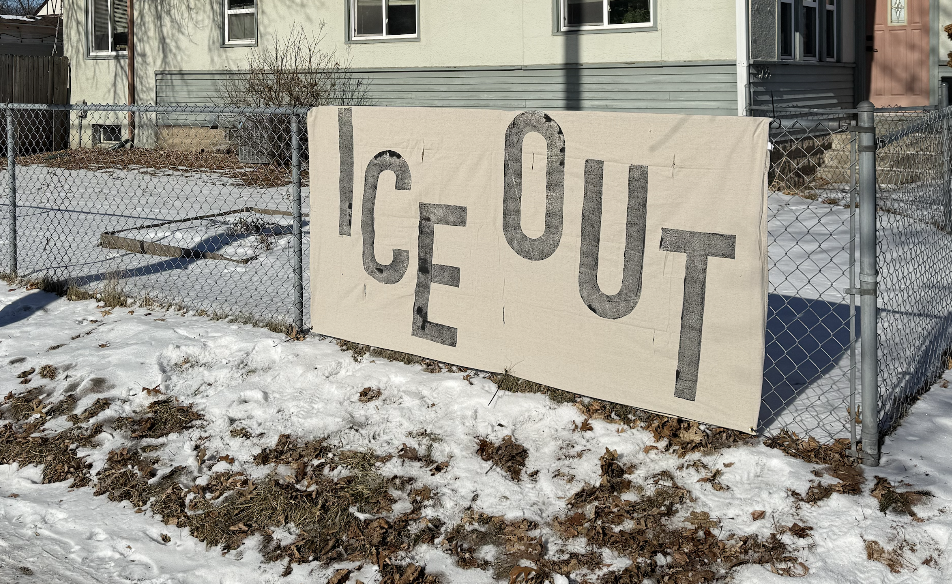
It’s false spring here in Minnesota.
The sun is shining, the temps are rising above freezing, most of the snow is melting, and it feels like winter could one day—some day!—transition into warmer days ahead.
But as Minnesotans enjoy the moment, we know that we’re not out of the winter yet, not really. More cold and snow are surely still to come.
Similar reticence abounds across the Twin Cities metro for DHS Border Czar Tom Homan’s politically timed announcement that the ICE Surge will be ending. “A significant drawdown has already been underway this week and will continue to the next week,” he said, even though abductions continued through the day and days following.
After the announcement, Le Monde in France declared “Two people dead, thousands arrested, two cities shaken, and Donald Trump defeated.”
But for Minneapolis and the surrounding communities, it’s not quite a cause célèbre. Minnesota isn’t packing up snow shovels, nor ICE whistles.
It’s likely the seasonal conditioning that also has many in Minneapolis deeply understanding that, while some ICE agents may be leaving (or in some cases just quitting because they’re not getting paid), the consequences of the occupation will be with us for some time regardless.
Whether or not you believe DHS Border Czar Homan about a drawdown or the endeavor’s outcomes, the I.C.E. occupation—a paramilitary siege now over two months past the beginning of its overwhelming surge—has metastasized into a humanitarian crisis. We’ve entered what Dara Moskowitz so rightly and eloquently identified as an economic blockade:
What do you know about cities inside economic blockades? I know about the Prussian siege of Paris, when the trapped Parisians had to roast their zoo elephants. I know about the Dutch Hunger Winter, when the Nazis were, as ever, acting like Nazis and starving babies and everyone.
Now I know what an economic blockade looks like today.
Troop drawdown or not, temperature warm-up aside, Minneapolis continues through into an economic winter.
An initial report by the City of Minneapolis estimates 76,200 Minneapolis residents are now experiencing food insecurity, lost wages total an estimated $47 million, plus $81 million in restaurant and small business revenue losses and more. One restaurant staple in my neighborhood predicted its own financial hit would be a $20,000 loss—the number grew to a $100,000 loss, as a large amount of neighborhood focus shifted to meal deliveries for people too afraid to leave their homes for over a month.
The financial numbers, of course, only capture part of the ICE occupation story, and what it’s done to the city of Minneapolis residents and businesses.
Wednesday’s opinion section in the Minnesota Star Tribune, the region’s largest news outlet, published an open letter from many independent businesses that succinctly share what’s happened to our city’s human infrastructure:
Small businesses have had employees taken from our parking lots while coming to work, not to be heard from since.
Some vulnerable employees are understandably staying home to avoid these scenarios, or risking kidnapping to pay rent, put food on the table and care for their families.
Some small business owners continue paying these valued employees so they don’t lose their housing and become even more at-risk.
Some small business owners are arranging for employees to get rides to and from work each day to help ensure they are not kidnapped.
I cannot imagine that any one of the signatories would give up their whistles because of Homan’s press conference; too much has already happened in this ongoing fascist takeover that rising temps and targeted talking points won’t thaw.
Mischief Toy Store, for example, were targeted with chilling bureaucratic intimidation when they were visited by I.C.E. agents who hand-delivered an audit by DHS hours after owners criticized the President on national TV.
Jamie Schwesnedl, co-owner of Moon Palace Books with wife Angela Schwesnedl, who submitted the open letter to the Star Tribune, recently flustered CNN’s Jake Tapper by saying, “Our city has been invaded by masked gunmen kidnapping family members, friends, and neighbors of ours to send them to concentration camps.”
Tapper bristled at the loaded term “concentration camps”, rebutting that the phrase conjures something specific. The pushback led Schwesnedl to point out that the Whipple Building is located at Fort Snelling, an actual venue for the extermination of Native Americans through the 1800’s (it’s also unceremoniously the site of America’s largest public execution under Andrew Jackson, a Trump favorite).
Since the Tapper’s contention, several reports from around the country have highlighted the inhumane conditions in I.C.E. camps that have led to mass sickness and even deaths among the masses of abducted people concentrated in the facilities. An Irish detainee released this week directly described the location of his detention as a “modern-day concentration camp.”
ICE may be saying there’s a draw down of agent numbers in Minnesota, but they’re spending billions on acquiring more property for similar detention centers.
Despite the supposed drawdown in troops, as the camps continue and ICE agents still patrol for “agitators”, the resistances will surely continue, at least from those people at their own parent patrols, food deliveries, street blockades and more.
But we're also hitting some imposed limits. As mutual aid continues into a new ”neighborism”, the multiplier effects of workforce freezing and uncertainty have deeply impacted the economics of the Twin Cities. Ad hoc mutual aid is not financially sustainable long term. People are giving it their all: I’ve heard anecdotes from more than one person about the gastro-intestinal effects of vastly increasing the amount of ethnic food in their otherwise bland diet.
The present reality of Minnesota cities is that we can be hopeful, but still understand that the abductions will still happen to fill the camps. The weather is sunnier, the ICE numbers may be going down, but we’re still not out of it.
Since the surge, I’ve been thinking about the Berlin of the musical Cabaret. For decades, Minneapolis (and yes the Twin City of St. Paul) served as a regional arts and cultural outpost for anyone looking to live an open and creative life beyond the confinements of their small town upbringing.
In the grand finale of Cabaret—the Bob Fosse and Liza Minnelli film version—a weary and defeated master of ceremonies returns to the stage to perform “Wilkommen”, the Kit Kat Klub’s famous opening number.
Back at the film’s intro, for the grand kickoff of the musical, the Emcee (Joel Grey) makes haughty and bawdy promises about the wonderful refuge that the bohemian cultural scene can provide, singing “Welcome!” in a pluralistic mix of German, French, and English.
The finale’s reprise, however, delivers a tone shift. Tense, weary, deflated, the Emcee once again says, pointedly, without exclamation, “Where are your troubles now? Forgotten. I told you so. We have no troubles here. Here life is beautiful.” They then conclude, “Auf Wiedersehen. A bientot.” The spotlight pans towards the packed crowd as the camera view warps through the rounded glass to reveal Nazis have ominously taken over the front row of the club.
Minneapolis today, even with brighter actual skies and purported metaphorical skies with the news of I.C.E’s surge draw down, has its own similar weary ‘the show goes on’ approach to its own newfound community scenes.
The lineage of Cabaret started with English-American writer Christopher Isherwood’s 1939 novel Goodbye to Berlin. Like the rest of the book’s grappling with an arts and cultural outposts shift into the everyday of authoritarianism, the final paragraphs remain as relevant as ever:
To-day the sun is brilliantly shining; it is quite mild and warm. I go out for my last morning walk, without an overcoat or hat. The sun shines, and Hitler is master of this city. The sun shines, and dozens of my friends—my pupils at the Workers' School, the men and women I met at the I.A.Н.— are in prison, possibly dead. But it isn't of them that I am thinking—the clear-headed ones, the purposeful, the heroic; they recognized and accepted the risks. I am thinking of poor Rudi, in his absurd Russian blouse. Rudi's make-believe, story-book game has become earnest; the Nazis will play it with him. The Nazis won't laugh at him; they'll take him on trust for what he pretended to be. Perhaps at this very moment Rudi is being tortured to death.
I catch sight of my face in the mirror of a shop, and am horrified to see that I am smiling. You can't help smiling, in such beautiful weather. The trams are going up and down the Kleiststrasse, just as usual. They, and the people on the pavement, and the tea cosy dome of the Nollendorfplatz station have an air of curious familiarity, of striking resemblance to something one remembers as normal and pleasant in the past-like a very good photograph.
No. Even now I can't altogether believe that any of this has really happened...
In Minnesota, the sun is also brilliantly shining; it is quite mild and warm. The abductions continue, the camps continue, our show goes on with resistance and a little more weariness.
We’re still in the deep of winter until our neighbors are free and ICE is no longer.
Featured image is by the author