No Ordinary Time
Eleanor Roosevelt remains a striking example of the struggle against authoritarianism in dark times.
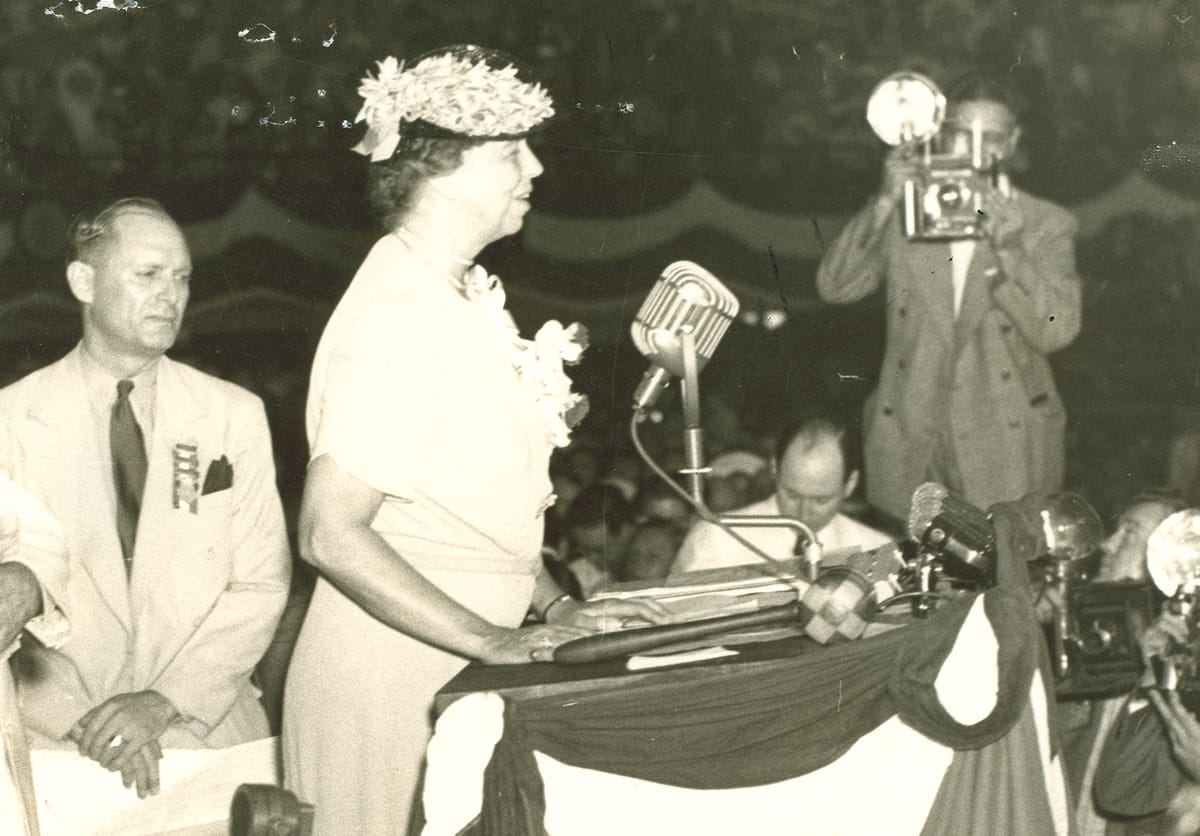
We cannot tell from day to day what may come. This is no ordinary time. No time for weighing anything, except what we can best do for the country as a whole. And that rests, that responsibility on each and every one of us as individuals.
First Lady and humanitarian Eleanor Roosevelt spoke these prescient words at the tense 1940 Democratic Party convention, where the future and democracy itself seemed to be in the balance. While the delegates hotly debated whether FDR should be granted an unprecedented third term, other fissures within the party became increasingly visible. The White supremacist southern wing sought to undo the New Deal legacy, while progressives pushed for greater reforms and looked on with horror as the Nazis marched through Europe. Eleanor was asked to speak to quell tensions, and her speech, given as fascism threatened the future of democracy on both sides of the Atlantic, still echoes decades later.
I have long been fascinated by the Roosevelts. Specifically, the lives of the core trio, Presidents Theodore, Franklin, and their niece/wife, Eleanor. To non-history nerds, this interest has at times seemed odd. What did I, a New Yorker born in Washington Heights to a multiracial family, have in common with members of New York's old money elite who shaped much of the 20th century? Not much, but what we lack in overlapping experiences, we make up for in shared ideals.
Serving as a bridge between the Progressive Era, the New Deal, and the burgeoning Civil Rights Movement, Roosevelt used her unique position to challenge entrenched racial, gender, and political norms. While her husband preached the Four Freedoms, she built relationships with Black civil rights leaders, such as Mary McLeod Bethune and A. Phillip Randolph, to ensure these freedoms applied to all Americans. I credit studying the Roosevelts with helping mold me into a social democrat. I wasn't the first. Joseph Lash, a former student radical who became a mentee of Eleanor Roosevelt, wrote in his diary that the first lady “personifies my belief and faith in the social democratic way instead of the communist.”
These days, that sense of affection is often tinged with sadness. It was indifference that Eleanor dedicated much of her life to fighting. Yet many of the institutions she once championed have fallen short. The Democrats, formerly the party of Four Freedoms, are deeply divided while right-wing reactionaries run amok. The civil rights laws that I once took for granted are now under threat. Abroad, the picture is equally gloomy. After the horrors of WWII, Eleanor, as a delegate to the UN, chaired the committee that drafted the Universal Declaration of Human Rights. This document is the basis for our modern international humanitarian law, a document whose intentions feel increasingly detached from the current moment.
A few days before what would have been her 141st birthday, a fragile ceasefire and hostage deal claiming to end the war in Gaza was announced. While Trump and other leaders were quick to congratulate themselves, they've been far less eager to take any meaningful steps towards stopping the flow of blood in the land. Any accountability for the crimes committed by Hamas on October 7th or Israel's subsequent response, which has been described as genocide by human rights organizations, remains elusive. The same could sadly be said for other global conflicts, such as Sudan or Haiti, where the evidence of atrocities is irrefutable yet has not inspired significant action either from the general public or international bodies. In this context, losing faith altogether can feel like a rational response. However, despair, while very appealing and real, does not meet the demands of this moment.
Despair will not stop the siege on the rule of law or stop the seemingly endless suffering caused by our callous politics. Eleanor knew this firsthand. Weeks before her address to the DNC, the battle of France had ended in defeat, and Britain retreated from the continent, fearing they’d be next. At the time, the Nazis looked unstoppable, and as we know now, the worst had yet to come. But as she told the audience at the DNC, living in ‘No Ordinary Time’ demands a renewed commitment to our core values.
Looking at her body of work, it’s not difficult to imagine what she’d be doing right now. A passionate advocate for refugees, she’d join everyday Americans in opposing ICE’s assault on immigrant communities. Having been the US’s first delegate to the UN Commission on Human Rights, she’d be appalled by the current administration's isolationism. A co-founder of Americans for Democratic Action, she’d demand that Democrats find their spine. Just as she evolved on civil rights, if alive today, I’d hope that Eleanor would evolve from her early hawkishness to standing with Palestinian and Israeli peacebuilders in their pursuit of a shared future. Throughout her life, Eleanor built alliances to advance the rights of workers, women, and minorities. We must build inclusive progressive coalitions to fight the shared threat of authoritarianism, both at home and abroad.
Despite my cynicism, well-earned by any observer of this political moment, I still strive for a better world because the alternative is far worse. It means resigning myself to a future in which the callousness we see today becomes normal, in which the gains previous generations fought and died for are dismantled in one fell swoop. As we face a new generation of authoritarians, perhaps we can learn a thing or two from the struggles of people like Eleanor.
Featured image is "Eleanor Roosevelt addresses Democratic National Convention, Chicago, Illinois. July 18, 1940," 1940.