Promoting a New Segregation
The Trump administration wants to make anti-Black racism great again.
The Trump administration wants to make anti-Black racism great again. The MAGA movement has always evoked nostalgia for a mythical pre-civil rights America where racial and gender hierarchies went unquestioned. Many of MAGA’s forebears—including the Heritage Foundation—laid the groundwork with decades of curated discourse that recast desegregation as anti-white racism. To succeed, this revisionist project required a cultural common sense that expects inequality and a corresponding legal regime that protects white male over-representation. Trump is delivering.
In December, the Department of Justice (DOJ) published a rule ending disparate-impact liability. The change eliminates one of the few remaining tools for federal agencies to protect Black rights. Not to be outdone, Equal Employment and Opportunity Commission (EEOC) Chair Andrea Lucas posted a video urging white male “victims” of discrimination to contact the EEOC about their claims. Vice President JD Vance reposted the clip and in a separate tweet called DEI “a deliberate program of discrimination against white men.” The remark came days before Vance, alongside some of the country’s leading white nationalists, rehearsed Klan talking points when he refused to apologize for being white at Turning Point USA’s annual AmericaFest. Vance embodies and stokes the white male grievance that animates MAGA’s racial politics. Which helps to explain why the GOP now fuses myths of white male victimhood with censorship that erases decades of academic scholarship detailing how Black Americans—not white men—face systemic discrimination in America.
Flowing straight from Project 2025, the DOJ’s assault on disparate impact furthers this fusion disabling the federal government’s capacity to even name as discrimination the decisions that reproduce and entrench inequality. Akin to the voter suppression that spiked after the Supreme Court gutted the Voting Rights Act in 2013, the end of disparate impact invites the revival of old-school techniques to deny racially marginalized groups equal opportunity. For decades, disparate impact has offered a modest mechanism to detect and challenge policies that unjustifiably harm communities of color—by design or through ignorance. The basic logic is that decisionmakers should avoid policies that reproduce historical modes of exclusion and exploitation—particularly when those policies further no legitimate business or educational goal. If we are committed to overcoming America’s apartheid past, disparate impact remains critical because contemporary racial discrimination is often covert and hard to detect.
But consistent with Trump’s segregationist agenda, federal officials can no longer employ disparate impact to challenge policies, practices, and pollutants that harm Black communities. The upshot is legal protection for the municipal leaders and petrochemical companies that profit off of “Cancer Alley,” an 85-mile stretch of land in Louisiana that local Black residents have called “death row.” The same applies to the public officials who should be cleaning up the “illegal dumping in [Houston’s] Black and Latino neighborhoods” and providing basic sanitation services to a “majority-Black community . . . long . . . exposed to raw sewage” following decades of municipal inaction and neglect.
Earlier this year, Trump foreshadowed the new DOJ rule when he disparaged disparate impact as a “pernicious movement” designed to destroy America’s commitment to equal opportunity and meritocracy. The Heritage Foundation and allied organizations like the Pacific Legal Foundation use similar language to decry integrationist admissions practices as “pernicious, morally repugnant racial discrimination” and “a new species of racial discrimination.”
The DOJ’s rationale for eliminating disparate impact furthers this revisionist project. In a press release announcing the rule change, the DOJ alleged that “the prior disparate-impact rule fostered the very thing the Civil Rights Act of 1964 prohibited.” The Washington Post editorial board applauded the DOJ and deepened the caricature by claiming disparate impact encouraged “racial preferences.” The allegations would have been news to Presidents John F. Kennedy and Lyndon Johnson, the former of whom introduced the bill and the later of whom signed it into law. In a 1963 speech introducing Title VI, Kennedy proclaimed that “[s]imple Justice requires that public funds . . . not be spent in any fashion which encourages, entrenches, subsidizes, or results in discrimination.” Two years’ later, Johson praised the bill’s expansive vision of equality during a Howard University commencement address: “We seek not just freedom but opportunity. We seek not just legal equity but human ability, not just equality as a right and a theory but equality as a fact and equality as a result.”
The DOJ and Washington Post Editorial Board treat disparate impact’s attention to effects as some “woke” distortion of civil rights law. Here again, history belies their claims. Within a year of its passage, and consistent with both Presidents’ vision, federal agencies that enforce Title VI adopted “disparate impact” regulations prohibiting “criteria or methods of administration which have the effect of subjecting individuals to discrimination.” The following year, separate regulations prohibited practices having “the effect of defeating or substantially impairing accomplishment of the objectives of the program.” A focus on effects furthered Congress’ civil rights agenda because intentional discrimination is easy to conceal and because not all racial harms are intended. As an example of the former, after Johnson signed the 1964 Civil Rights Act, Duke Power adopted employment tests that were unrelated to job requirements but limited Black mobility. The Supreme Court ruled that these tests were unlawful under the Civil Rights Act’s employment provision.
Today’s fight over disparate impact reveals how far today’s Republican party—and cheerleaders like the Washington Post Editorial Board—have strayed from the civil rights consensus that characterized much of the past half century. Last spring, legal scholar Susan Carle explained that “moderate Republican conservatives” coalesced around disparate impact as a business-friendly approach to civil rights. Carle detailed that far from encouraging “preferences,” disparate impact “helps U.S. business by encouraging best employment practices through which the most meritorious candidates win the competition for job opportunities.” This tracks President Nixon’s support for many of the inclusionary policies Trump derides as “illegal DEI.”
Employment discrimination against white workers likely occurs in isolated incidents. But the demographics of American workplaces, gold-standard studies of workplace discrimination, and the EEOC’s own data belie the idea that white Americans experience systematic discrimination. These data all show the opposite of the Trump Administration’s fact-free claims. Using EEOC data, workplace demographers note that progress on desegregating American workplaces essentially stopped in the 1980s. Workplaces are re-segregating with Black and Latino Americans overly concentrated in lower-wage industries. A recent audit study, which sent 80,000 fake resumes to the 100 top employers found that the white candidates were called back 9.5% more often than an identical Black peer. Black Americans face significant labor market discrimination, even when formal credentials are evenly matched.
Against this backdrop, the DOJ’s decision to eliminate disparate impact clarifies what rightwing attacks on affirmative action have always been about. The goal is to limit the capacity for civil rights to yield Black equality; and never about meritocracy or equal opportunity. Were merit an actual concern, Trump and company would celebrate disparate impact as a modest tool to spot and correct practices that reward inherited advantage and insider status over ability and potential. But for an administration embodied by white incompetence and mediocrity, gestures to merit were just another dog whistle. Just as in 1954 and 1964 and the decades since, segregation is the point.
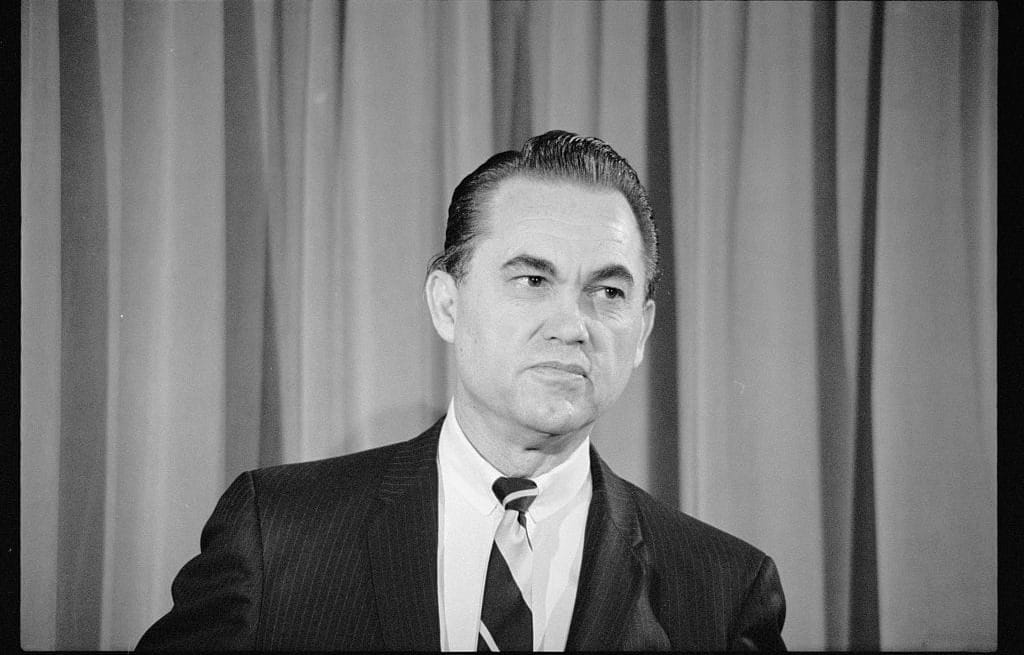
Featured image is Ex-Governor Wallace of Alabama news conference - stating he is a presidential canidate [i.e., candidate] on the 3rd party ticket