Return of the Silver Shirts
In ICE's invasion of Minneapolis, an echo of a dark past.
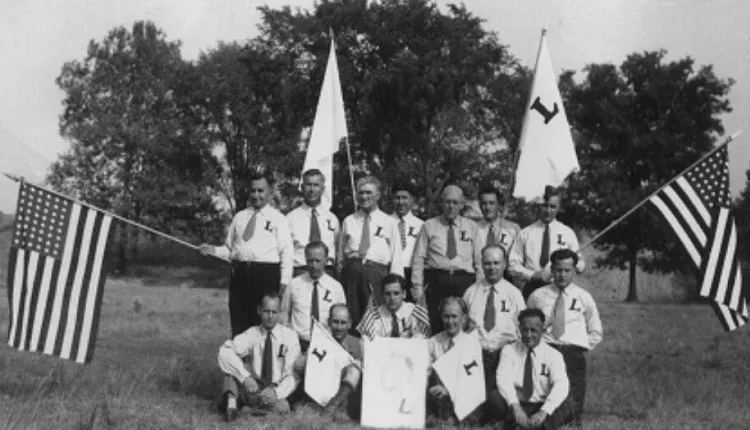
Early on a Friday evening in July 1938, several hundred concerned Minneapolitans streamed into a rented auditorium for what had been promoted as a gathering of “Christian American Patriots.” In a formal letter of invitation, the meeting’s organizers had called for “united action” against “the alien forces that are seeking to undermine our constitutional government, take away our right of free speech, and deprive us of our liberty.” By way of providing more specific instruction, the featured orator, a “national field marshal” named Roy Zachary, devoted a portion of his two-hour diatribe to urging his audience to “combat the Jewish conspiracy…through the organization of vigilante groups in every community to take whatever action is necessary.”
While Zachary served as the face and voice of the rally, its ultimate leader was one William Dudley Pelley, who had converted from the mainline Protestant faith of his minister father and former YMCA employers to fervent belief in the Nazism of Adolf Hitler. Soon after Hitler’s consolidation of power in 1933, Pelley had established a homegrown fascist group called the Silver Legion. It was more commonly known as the Silver Shirts, a reference to the rank-and-file’s trademark apparel.
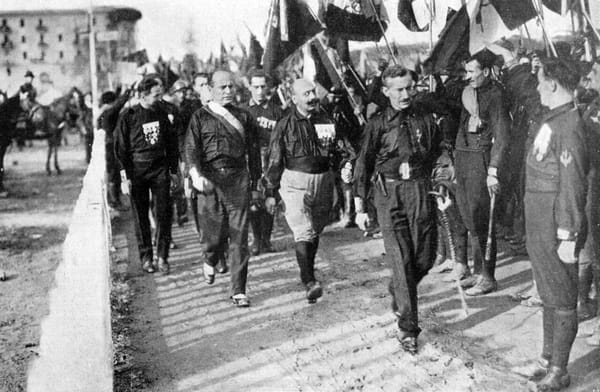
Both the name and the attire purposely honored Pelley’s inspiration—the Brownshirts, a paramilitary force that Hitler had deployed over the dozen years leading to his seizure of dictatorial control. Hitler himself had modeled the Brownshirts (formal name Sturmabteilung, meaning “Assault Division”) on Benito Mussolini’s Blackshirts, the bully boys of his fascist insurgency in Italy. By whatever name or hue, the operating mode of all these groups was the same, assembling and deploying an armed unit under the sole control of the strongman that could intimidate political opponents, religious minorities, and the official military and law-enforcement bodies of a weakened state.
To an America hollowed out by the Great Depression, Pelley proposed a social safety net that he dubbed “Christian economics” for white gentiles only. He identified the scapegoats for the growing economic misery by pointing to Jews, Blacks, and the New Deal liberalism of Franklin D. Roosevelt. In his quest for allies, Pelley had been busily reaching out to the Ku Klux Klan and the German American Bund.
As a nationwide movement, the Silver Shirts never mustered more than about 15,000 members, far from the several million Pelley claimed. Yet in Minneapolis, a city with sizable reservoirs of racism and antisemitism, the group found an enthusiastic following, and not just among a destabilized and desperate white working class. The audience at Zachary’s speech on that summer’s evening included the president of the Minneapolis school board, the head of the city’s Real Estate Board, the leader of the local industrial association, and assorted doctors, dentists, teachers, ministers, and small-business owners.
Minneapolis should have taken the threat posed by the Silver Shirts more seriously than it did. The Ku Klux Klan had briefly surged there in the 1920s, earning enough respectability to even sponsor a float in the University of Minnesota’s homecoming parade. During a bitter and protracted strike in 1934 by truck drivers seeking union recognition, the industrial association (then known as the Citizens Alliance) hired goon squads that were given free rein by the police. Two years later, a young reporter for the Minneapolis Journal named Arnold Sevareid infiltrated meetings where the Silver Shirts were mobilizing local support. To the indignation of Sevareid—later to become famous under his middle name of Eric as a CBS News correspondent—his editor revised Sevareid’s series of investigative articles into bemused features, treating the Silver Shirts as a band of looney-tune conspiracists deserving of chuckles rather than alarm.
With the American entry into World War II and the federal prosecution of Pelley for sedition, the Silver Shirts seemed to vanish from the Minneapolis scene. In fact, a very similar program of pseudo-populism and ethnic cleansing reappeared even during the war years in the person of Gerald L.K. Smith, a minister who founded the America First political party. Smith’s vision of Christian Nationalism included sending Black Americans to Africa and putting American Jews into quarantine camps until they died off without further propagating the species. Among Smith’s early advocates in Minneapolis was Ernest Lundeen, a U.S. senator who delivered and disseminated speeches written by a Nazi agent. After Lundeen’s death in a plane crash, his widow Norma took over as a key Smith supporter.
All of this history might appear irrelevant to the Minneapolis that most Americans have come to know. After Hubert Humphrey won the city’s mayoralty in 1945 on a civil rights platform and pushed through laws against employment and housing discrimination, Minneapolis became famous not as a hotbed of bigotry but as a beacon of progress against it. With a couple of brief exceptions in periods of conservative backlash, a straight line runs from Humphrey through liberal, inclusive successors like Arthur Naftalin, Don Fraser, Sharon Sayles Belton, R.T. Rybak, and the current occupant of City Hall, Jacob Frey.
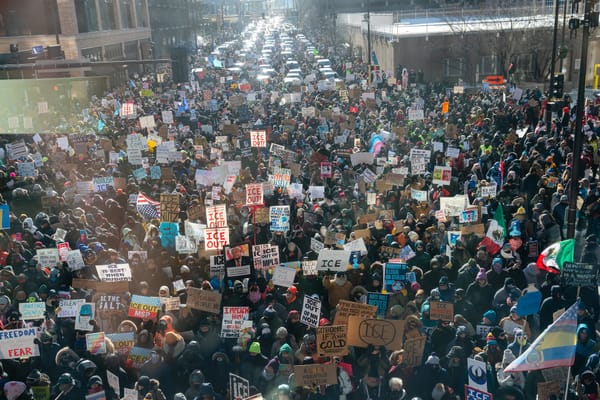
Tragically, however, a straight line also runs from William Pelley’s Silver Shirts and Gerald L.K. Smith’s America Firsters to the ICE forces unleashed on Minneapolis by Donald Trump, Stephen Miller, and Kristi Noem. Their version of ICE bears less resemblance to the federal agency formed under the George W. Bush administration than to exactly what Pelley yearned to produce: a paramilitary unit accountable only to a dictator. The exercise of ICE power in Minneapolis may have reached its ghastly apogee with Jonathan Ross’s murder of Renee Nicole Good, but that killing was foretold by the numerous examples in the preceding weeks and months of ICE agents brutalizing protesters and falsely arresting American citizens in Minneapolis, Chicago, and Los Angeles, among other cities.
These actions gave the lie to ICE’s superhero propaganda about defending the homeland from pedophiles, drug dealers, and human traffickers. Rather, ICE intends to make Minneapolis the test case for what Pelley and Smith literally prayed for decades ago—an America purged of its demographically “impure” elements. The logical outcome of ICE’s siege is the fear that now grips Minneapolis immigrants, even those with U.S. citizenship, about sending their kids to school, going to work, buying groceries, or seeing a doctor when they’re sick.
It is intolerable to a Pelley or Smith or Trump that a city that was once nearly entirely white, Protestant, and Northern European could transform into a polyglot hub with large Somali, Mexican, Hmong, and Vietnamese populations. It is intolerable to MAGA that liberals and progressives hold nearly every elected office of consequence in Minnesota, and that they have vociferously—sometimes profanely—rejected white solidarity to defend minority communities. It is intolerable to MAGA that civil society continues to thrive in Minneapolis through liberal religious congregations, vigorous labor unions, vibrant ward politics, and engaged neighborhood associations—the very groups that have mounted the sustained, nonviolent opposition to ICE’s invasion. It is intolerable to MAGA that Minneapolis never chose Pelley’s way or Smith’s way, and now rejects the MAGA way.
And what is intolerable to Trump, Miller, and Noem must be destroyed. It must be destroyed by their modern-day Silver Shirts, set loose by a right-wing regime that Pelley and Smith anticipated. When Ross shot Good, he shot her in the face—not merely to kill her but to obliterate her, to desecrate her, much as the Mississippi lynch mob disfigured Emmett Till. As students of civil rights history know, Till’s mother, Mamie, flipped that repugnant script, insisting that photos be taken and published of her child’s ravaged face. The video that Ross himself shot, a genuine ICE snuff film, may play the same role, with its denouement of the killer saying to his victim, “Fucking bitch.”
One of the Minneapolitans who fought against Pelley’s Silver Shirts more than 85 years ago was a Jewish lawyer named Sam Scheiner, who gathered intelligence about such right-wing extremists. Even in the subsequent decades, when Minneapolis changed for the better in so many ways, Scheiner refused to take any victory laps. “The haters never go away,” he often told his daughter Susan. “They just hide.”
Until, of course, they don’t feel the need to hide any longer.
Bibliography
Freedman, Samuel G. Into the Bright Sunshine: Young Hubert Humphrey and the Fight for Civil Rights. New York, NY, United States of America: Oxford University Press, 2023.
Jeansonne, Glen. Gerald L.K. Smith, minister of hate. Baton Rouge: Louisiana State University Press, 1997.