
Editor's Notes: "The Indian Question" Shows That No One Is Safe From White Nationalism
That is the entire point.
What will replace U.S. global leadership after the Trump-accelerated American decline is not a rising China, but multipolar chaos.

President Donald Trump visited China, prompting thoughts of a global transition of power. The trip comes amidst America’s ongoing hegemonic suicide, as Trump is creating chaos at home, alienating allies abroad, damaging domestic and international institutions, egregiously violating U.S. and international law, breaking the U.S.-led system of open trade, and trashing U.S. credibility in ways that will be difficult, perhaps impossible to reverse. Trump is throwing away many of the things that made America the world’s premier power, and as the United States declines, China has the most to gain.
The biggest factor is Trump’s horribly misguided Iran war, an unnecessary act of aggression that casts today’s America as more akin to Putin’s Russia than to Eisenhower, Reagan, or Obama’s United States. In prompting Iran to close the Strait of Hormuz—through which over 100 ships a day carrying oil, natural gas, fertilizer, and other essential commodities flowed freely before the war—and apparently having no idea how to fix the situation, Trump forfeited America’s position as the guarantor of freedom of navigation and global commerce.
Meanwhile, China has been rising—economically, technologically, militarily—and looking to many countries like a more attractive option merely by being consistent compared to the now volatile, unreliable, and combative United States.
On May 13, Trump went to meet Chinese leader Xi Jinping and spoke very positively of him, clearly taken in by Xi's displays of authoritarian pomp. By contrast, Xi warned of a “Thucydides Trap”—the supposed inevitable conflict between a rising and an established power—and told Trump to stay out of the Taiwan issue. Trump went pursuing concessions on trade and deals for American businesses, and practically begged Xi for help opening the Strait of Hormuz. He got none of that.
Shortly after, Xi is scheduled to host Russian leader Vladimir Putin. The Trump and Putin visits have Xi looking like the most powerful person in the world.
But just because America is declining and China is rising does not mean China is poised to take over as global leader. Instead, what will replace U.S. global leadership after the Trump-accelerated American decline is nothing.
The U.S. military has the world’s biggest budget by far, the most advanced large weapons systems and platforms, and a globe-spanning network of bases. Via aircraft carriers, satellites, a large missile arsenal, and an unrivaled logistics network, America can project hard power to a degree and with a speed no one else is close to matching.
China doesn’t have anything like that. Though China is now the world’s second-largest military spender and is advancing in missiles, drones, cyber capabilities, and artificial intelligence, it still spends hundreds of billions less than America annually. The Stockholm International Peace Research Institute (SIPRI) estimated China’s military budget at $336 billion in 2025, compared to $954 billion for the United States. The U.S. has been spending a lot more for decades, and most of the stuff it bought still works.
As disastrous as Trump’s Iran war may be, it nevertheless features the U.S. military bringing a massive amount of combat power half way around the world, gaining control of Iran’s skies, and bombing targets at will. In January this year, U.S. special operations forces removed Venezuelan leader Nicolas Maduro. Earlier in the 21st century, the U.S. helped overthrow the leader of Libya, conducted mostly successful global campaigns against ISIS and Al Qaeda, and invaded both Iraq and Afghanistan, occupying both countries for years or decades. And the U.S. did all of this while maintaining sizable forces in Europe that deter Russia and in east Asia that deter China and North Korea.
Whatever anyone’s opinions of those actions, the U.S. had the hard power to do it.
China does not. It’s an open question if the Chinese military could invade and occupy Taiwan, an island about 120 kilometers off China’s coast. The biggest things they’ve done this century is crush democracy in Hong Kong—which was more of a police action than military invasion—and gain a little territory in the Himalayas from border clashes with India. China has few bases outside its own country, only three aircraft carriers—one more than the U.K., and a fraction of America’s eleven—and has never demonstrated an ability to project hard power further than its immediate neighbors.
In the event of war with the United States, China has no chance of invading and occupying Washington DC, or even America’s Pacific coast. Their whole plan is area denial—preparing to engage U.S. forces in a costly, protracted effort that makes the cost of America crossing the Pacific and intervening in a conflict over Taiwan so high that the U.S. stays out.
China has not intervened anywhere militarily to protect an ally, end local hostilities, force regime change, enforce international law, or anything else. Maybe they don’t want to, and some in the world presumably prefer that to American interventionism. But either way, China couldn’t. While they’ve increased participation in U.N. peacekeeping in the 21st century—with 2,274 Chinese troops participating in missions as of 2024, the 10th largest contribution—they lack the capabilities for something much larger. If the United States abandons the Middle East, leaving behind chaos, there’s no chance China could come in and create stability.
Though China has growing international economic and diplomatic influence, China’s military now and in the near future has the capabilities of a large regional power, not a world-spanning superpower. It could not possibly replace America as the guarantor of freedom of navigation, enforcer of nuclear non-proliferation, or other global security roles.
In addition to military might, another source of American global power that remains larger than China’s is economics and finance. America’s 2025 GDP was $30.77 trillion while China’s was $19.6 trillion. The total market capitalization of China’s Shanghai Composite Index (SSE), accounting for over 2,300 companies, is about $10 trillion. The market cap of the S&P, an index of 500 large American companies, is over $60 trillion. Earlier predictions that China would overtake the U.S. as the world’s largest economy before 2030 are at best premature.
The U.S. dollar is the world’s reserve currency. This facilitates global commerce, making participating countries more prosperous, and gives America special advantages. Reserve currency status keeps the U.S. government’s borrowing costs low, and enables greater flexibility to print money. Most international transfers go through the U.S.-controlled SWIFT system, giving the U.S. the ability to observe transactions and impose sanctions.
The U.S. currency is sometimes called the “petrodollar” for its role in energy markets, but oil is only one of the important global assets priced in dollars. Many commodities are, as are expensive international products such as passenger jets. And the biggest dollar-denominated market of all is financial assets.
A main reason the world is not about to move on to the Chinese yuan—or the euro, pound, yen, or any non-dollar currency—is there simply aren’t enough places to put the money. As a 2022 European Commission study found, a large majority of global assets with the safest AAA rating, the sort that big institutional investors such as pension funds are allowed to accumulate, are denominated in U.S. dollars. If countries sold off U.S. bonds, stocks, and currency, there aren't enough assets denominated in Chinese, European, Japanese, etc. currency to absorb the resulting funds.
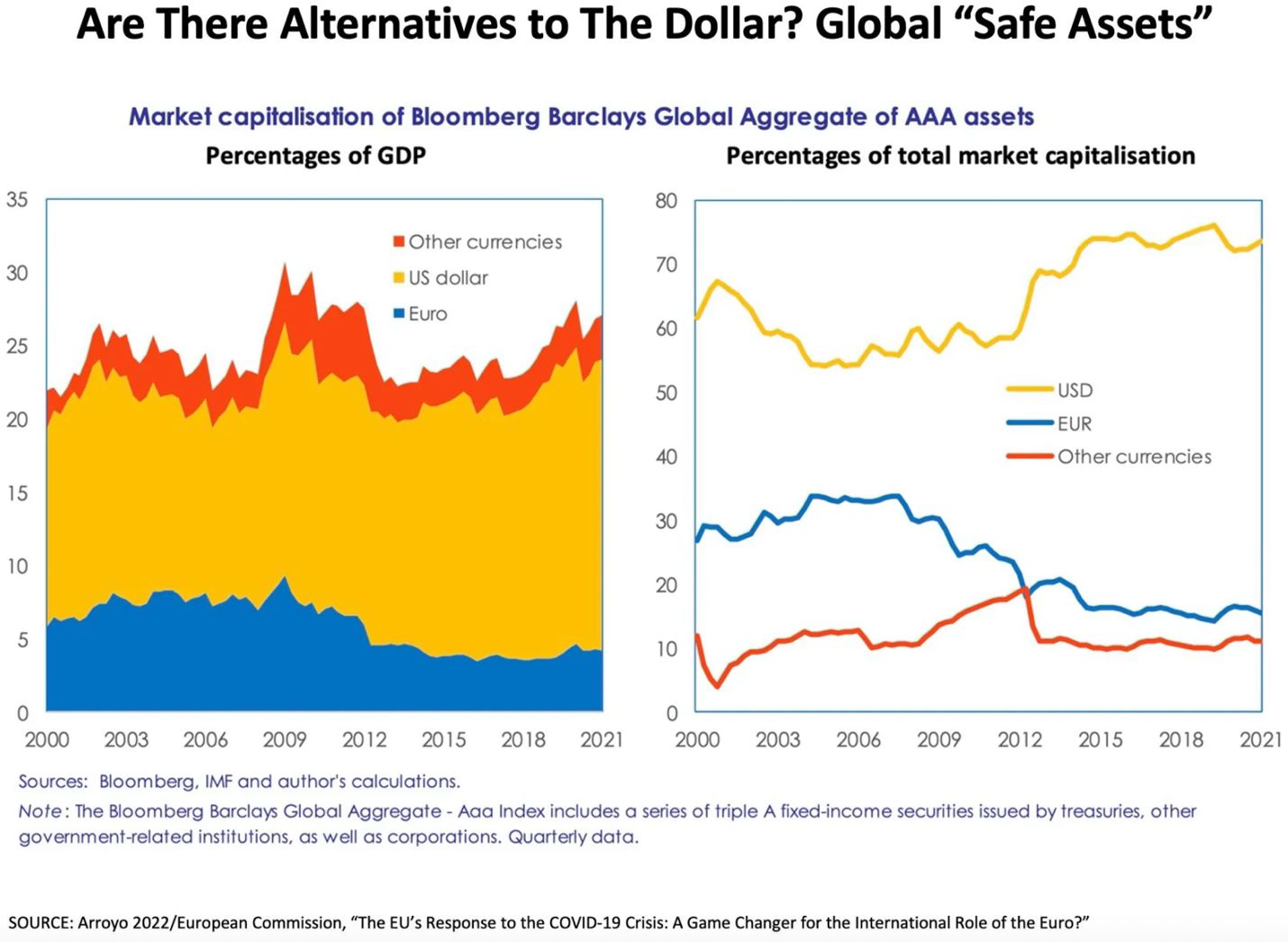
The Trump chaos has prompted some wariness of dollar-denominated assets, and a bit of movement away from them. But that money has mostly gone into gold, not to assets denominated in other currencies. As of October 2025, non-U.S. central banks are holding more in gold (about $4 trillion) than U.S. Treasuries (about $3.9 trillion), and together they account for a little over half of all central bank holdings.
The last time gold accounted for more than U.S. Treasuries was in the mid-1990s. In the mid-1980s, over half of non-U.S. central bank holdings were in gold. So while one could interpret gold surpassing the dollar again as a sign that America’s post-Cold War “unipolar moment” is over, that doesn’t mean China is rising to global financial dominance.
Consider currency reserves. As of early 2025, U.S. dollar holdings accounted for about 57.74% of official foreign exchange reserves. Euro holdings accounted for 20.06%. Chinese yuan holdings accounted for only 2.12%. China isn’t taking over global finance any time soon.
China has advanced in the 21st century, growing its economy, building a larger military, and gaining influence via investment and diplomacy. The country is a gigantic market, attractive to businesses around the world, and the government uses that for leverage. China’s ambitious Belt and Road initiative has built ports and other infrastructure in Sri Lanka, Djibouti, Peru, and elsewhere, and secured various resource deals in Asia, Africa, and South America. Chinese intelligence has an extensive global network, and Chinese hackers have penetrated government and corporate systems in the U.S., Canada, Australia, India, and more. In 2016, China founded the Asian Infrastructure Investment Bank to partially rival the World Bank, whose president has always been an American.
But all that marks China as globally competitive, not dominant. And to assume China will continue to rise unabated requires ignoring its growing internal problems.
Most notably, China’s population is rapidly aging. The bill for the One Child Policy—a measure designed to avoid unmanageable population growth, which lasted from 1980-2016—is coming due. Birth rates remain low despite government efforts to increase them. There won’t be enough working age people in China to support the growing number of retirees, and medical advances keeping people alive longer compound the problem. That means not only an insufficient number of workers, but potential shortages of soldiers as well.
Xi is aging too. After ending term limits and making himself leader for life, he’s the most powerful person in China since Mao. But he’s 72, has consolidated power in his inner circle, and it’s going to be a challenge to transition to new leaders after he steps down or dies.
The combination of an aging leader and population means if China is going to make a play for Taiwan, the window to so may be closing. And if they try, it could be damagingly costly, similar to Russia attacking Ukraine or the U.S. attacking Iran. Even if China opts for a blockade-and-squeeze strategy instead of an invasion, it would disrupt trade and stock markets, likely causing economic damage in China and elsewhere.
Though still run by something called the Communist Party, the Chinese economy has been state-managed capitalism for years. The Party has maintained unchallenged power in part by delivering strong, nearly uninterrupted economic growth. But it’s easier for a developing country to catch up—such as by boosting exports, or adopting technology invented elsewhere—than for a developed country to maintain a lead. And if China runs into economic problems, the government could face domestic unrest. Even assuming they stay in power, it would at least take more resources to suppress dissent, resources China can’t use to advance its interests abroad.
Much as the West overestimated the Soviet Union in the 1970s and ‘80s by discounting its internal problems, outside observers may be overestimating China’s ability to keep rising. Authoritarians don’t have fewer domestic problems than other political systems, they’re just better at hiding it.
The United States achieved and maintained international leadership—becoming world historically wealthy and powerful in the process—primarily via voluntary, mutually beneficial relationships rather than armed conquest. Many countries formed alliances with the United States, gaining greater security and prosperity. Others, with the exception of rogue states like North Korea, still got relative stability and opportunities for economic growth. In exchange, they accepted America’s military supremacy, and its special role in international institutions (the UN headquarters in New York, the dollar as reserve currency, U.S. bases in various countries, etc). This made the United States’ don’t-call-it-an-empire more stable than past international systems, with a Pax Americana that has seen the longest period without great power war in modern history.
When the British Empire declined, the result was not the global reign of rising powers Germany and Japan, but a series of wars that ended with the United States and Soviet Union in a bipolar geopolitical face off. When the Roman Empire fell, the result was not a widespread flowering, but a prolonged period of conflict and poverty that saw various powers trying to recreate what they lost.
Similarly, the world now isn’t trading the American Century for a Chinese one. It’s changing into something like the more chaotic multilateral system that prevailed in the first half of the 20th century, an era of world wars and economic depression. The United States has become a declining, destabilizing force, but China is in no position to provide stability, and might not even want to. And this is happening as climate change increasingly adds stressors to the system. It all adds up to something incredibly dangerous.
Featured image is one of many iterations of a meme
Sign up for the newsletter and get our latest stories delivered straight to your inbox.