
The Badge Is a Burden Not a Privilege
The power of state violence comes with the obligation to uphold a higher standard, not permission to excuse a lower one.
This can’t go on. Homeland Security is running roughshod over our republic, kidnapping our neighbors and killing our friends. Contra the capitulations of leaders who simply are not ready for this moment, Immigration and Customs Enforcement is a state terrorist organization wearing the skinsuit of a law enforcement agency while inflicting a nightmare. Real law enforcement seems all but AWOL, leaving regular Americans to fend for themselves. So far, those regular Americans have proven themselves heroic, selfless, and self-disciplined. Models of citizenship. But how long can that last in the face of escalating and increasingly insulting state violence?
American policing needs a revival. And to understand why, we need to talk about violence.
The thing about violence is that it’s irrevocable. When a bullet leaves a gun, there’s no force under heaven that can draw it back. When someone dies, there’s no hope of resurrection, no lamentation that can call them up from the grave, no argument that can change death’s mind. For most of our existence as a species, human beings have been ruled by one law above all others: Truth belongs to the most violent. “The strong do what they will and the weak suffer what they must,” as the current vice president, or any of his coequal orcs of the Crank Regime might tweet.
That’s why the monopoly on force is one of the most vital innovations of the modern state. Violence may be the history of most of our species, but it can’t be all of us doing it. No, you can’t challenge your neighbor to a duel to settle your property line or cut the hand off a kid who steals an Amazon package off your porch. We are not orcs. We trade the right to wage violence on others to the state in exchange for a reasonable guarantee of fair, impartial arbitration of disputes by courts, and agents of the law who will only use violence when absolutely necessary to enforce that law. In other words, we trade personal violence for civilization. But that trade leaves the citizen essentially powerless before the state. Not exactly ideal, but necessary to keep the light on, and keep away the nightmare phantasms of Hobbes or the ghost of serfdom.
The thing about violence is that it’s also inevitable. Frank Miller’s train is always on time. There will always be coyotes cackling just beyond the firelight, the Donalds Trump and Stephens Miller lurking at the edges, waiting for an opportunity to slip into our towns and remake them in their own perverted image. Much of what it takes to prevent that is up to the electorate—we have a responsibility to answer the bell—but when the time comes, when the people fail to match the values of the liberal republic with the actions required to maintain it, we need good, tin-star marshals willing to meet that long, black train on the platform. Alone, if necessary.
That requires cops who understand and believe in the project and people who put that power in their hands. Police who know that law enforcement is more than a tin star or brass shield on their chest, because when agents of the state’s monopoly on force misuse that power, law enforcement transforms from necessity to nightmare. The essential powerlessness of the citizen is laid bare.
“Bare” is a good word. It describes exactly how it feels to watch an agent of the state execute someone’s mother in her car. Rather like how it feels to watch a badge kneel on the neck of a man for nine minutes until his heart stops. To know they’re destroying innocent lives and the fabric of society while you pay their bills leaves you raw, scraped bare, and hatefully sad.
The people of Minneapolis must feel like their city has suddenly transformed from Midwestern metro to the main character of American history. Agents of the Department of Homeland Security have ripped the violent fantasies right out of the hungry imagination of shadow president Stephen Miller and plastered them onto the streets of the Twin Cities. After weeks of kidnapping, murder, and terror, it’s clear that their mission is not law enforcement, but the enforcement of these fantasies upon the flesh of any vulnerable person of color they can find, or any person at all who stands up to them.
Five years since the murder of George Floyd by the coward Derek Chauvin, it feels like Frank Miller’s train has pulled into the station. The intolerable irony is that the murderer stepping off the platform is the one wearing the badge.
But someone still needs to be there to meet him. Whether he has a badge or not, the duty the law owes to the people requires action. After persistent and colorful persuasion, justice came for Derek Chauvin, but faced with the complete depravity of ICE and Homeland Security, where are the police now? The relations between local cops and federal authorities may never have been lower than they are today, and it’s clear that law enforcement agencies have been less than enthusiastic about Homeland Security’s activities in their jurisdictions, but they are still not meeting the moment.
Ask Arnoldo Bazan. In October, unidentified immigration agents illegally choked and beat the 16-year-old Houston high schooler, along with his father. They eventually deported the father, and in what has become the noxious, perverted ritual of this administration, went on to slander Arnoldo. They claim that he assaulted them. Worse and more bizarre still, they confiscated his phone, which he later geolocated inside an automated kiosk where the agents had fenced it.
To be clear:
Secret police beat, choked, and detained a child on his way to school in front of his father, whom they also assaulted and later deported. They then sold that child’s phone for a fistful of dollars. All of this was illegal. Much of it was captured in a viral video. More of it was captured on Arnoldo’s phone, which he recovered. When he and his mother took this to the local police, they told him there was nothing they could do. They wouldn’t even accept the police report.
American policing needs a revival. I cannot emphasize enough that I mean this in a spiritual sense. A little old-time liberal religion; or at least a moral reckoning.
There’s no doubt policing has a troubled history in this country, and not just recently. From corrupt constabularies in the early republic to semi-legal marshals of the frontier territories to the slave catchers turned Klansmen turned sheriff’s deputies of the so-called “Redeemer” South—the profession is rife with historical humiliations and awful origin stories. Too often law enforcement turns its power disproportionately toward the poor, the marginal, and the chronically underserved when the real need is for the powerful to know the law applies equally to them, even if they have historically avoided its reach. If we are to keep this republic, it will require agents to enforce the people's laws. But the profession needs real fixing.
Democracy, ultimately, depends on our faith in each other. It requires us to trust that we can, despite all odds, build a good republic. And we need police who believe the same thing. The badge can’t be a shield to hide behind when accountability comes knocking. It can’t be a wall of silence and inaction protecting the mighty from the people’s justice. It’s a shining burden you carry into dark places where those who wish to do harm to others hide. You pin it to your chest with the understanding that it comes with the obligation to uphold a higher standard, not permission to excuse a lower one.
No civilian should be excused for executing innocent people under a fig leaf of fear. Nor should a soldier, for that matter. Neither should a cop. And when the violence comes, police must do their duty without fear or favor.
We must make believers out of badges.
That this even needs to be said is already a deep shame for American democracy, only made deeper by the extent to which it has long been true. Too many people no longer believe reform is even possible. They turn to apathetic acquiescence or elaborate plans to replace policing with an endless series of adjacent services and functions, many of which would be wonderful, and most of which amount to police with a different name.
But reforms are possible. That’s what a republic is for. History selected for it because a republic contains the maximum amount of dynamism without spinning itself apart.
These reforms can be specific and quite radical:
We could remove qualified immunity. We could hold police unions, departments, or pension funds themselves directly responsible for the payment of misconduct settlements against their officers. We could ban firearms from patrol officers in departments with a brutality problem.
We could even take the step of re-professionalizing them. That is, adopting national standards and structures that include a ban on police unions, a single agency accountable to each state, a professional-managerial detective class with cultural separation from the patrol class, and a paradigm of civilian leadership based on existing civ-mil relations, to summarize the argument of this excellent piece by Dr. Sean Burns that should be far more widely read. Essentially: we could treat them how military members are actually treated, instead of just letting them dress in operator cosplay.
All of that would be great. It would help a lot. But I suspect it wouldn’t be sufficient. Revival is what policing needs, and revival is a matter of the heart. The badge is a burden, not a privilege. We have long lived in an era of elite impunity, which has always contained a strain of impunity, even explicit immunity, for misbehaving cops. We’ve finally reached the threshold of a cascade failure. The weight of the burden is too heavy to bear while the power of privilege is so easy to wield. It must be corrected for the system to survive. If a republic is a container that can hold the maximum amount of dynamism without shattering, this kind of dark privilege must be expelled.
That requires commitment to liberal values. Being willing to face down the full force of irrevocable, inevitable violence, to carry the bright light of the law into the mouth of darkness, to confront Frank Miller’s train, requires people who give a shit. Fixing the system on paper and fixing the hearts of those who operate it must be part of the same project.
This revival can’t wait any longer.
On January 24th, a cold Saturday morning in Minneapolis, Homeland Security agents with badges and guns and the full blessing of the White House seized, beat, pistol whipped, and finally, executed a man on his knees in broad daylight. Seconds before, he had been calmly directing traffic around a snarl those very agents created. The day before, tens of thousands of everyday Americans had taken to the streets downtown to protest the presence of these agents in their cities. He was likely among them. Less than twelve hours had passed. The video flew across the screens of people all across the world within minutes, even as those same agents allegedly detained multiple witnesses and confiscated their phones.
Alex Pretti was his name. He was a 37-year-old nurse with the VA with no criminal record. The video is unbearable. Unspeakable. There is and can be no justification for it. American law enforcement has always been troubled, but what Homeland Security is doing all across this country now recalls better the behavior of lynch mobs, if lynch mobs were personally deputized by the President of the United States. Reading the accounts from those brave Americans on the ground reads more like survivor accounts of the Tulsa race massacre.
Police can’t hide from this anymore. Stern press conferences from chiefs and sheriffs aren’t good enough. The coyotes cackling just beyond the firelight are now playing the fiddle and dancing in the embers; the time for accommodation and cowardice is long over. The entire republic hinges on legal consequences for these men, at a minimum. We need Gary Cooper and his tin star. He might be alone at first. He may have to beg for deputies to help in the firefight—and some of us must pick up that mantle too. But the violent men taking over our cities need to know a marshal is out there. And he’s utterly unwilling to leave town.
If you don’t understand, I can’t explain it to you. Glory to the martyrs who defend the republic.
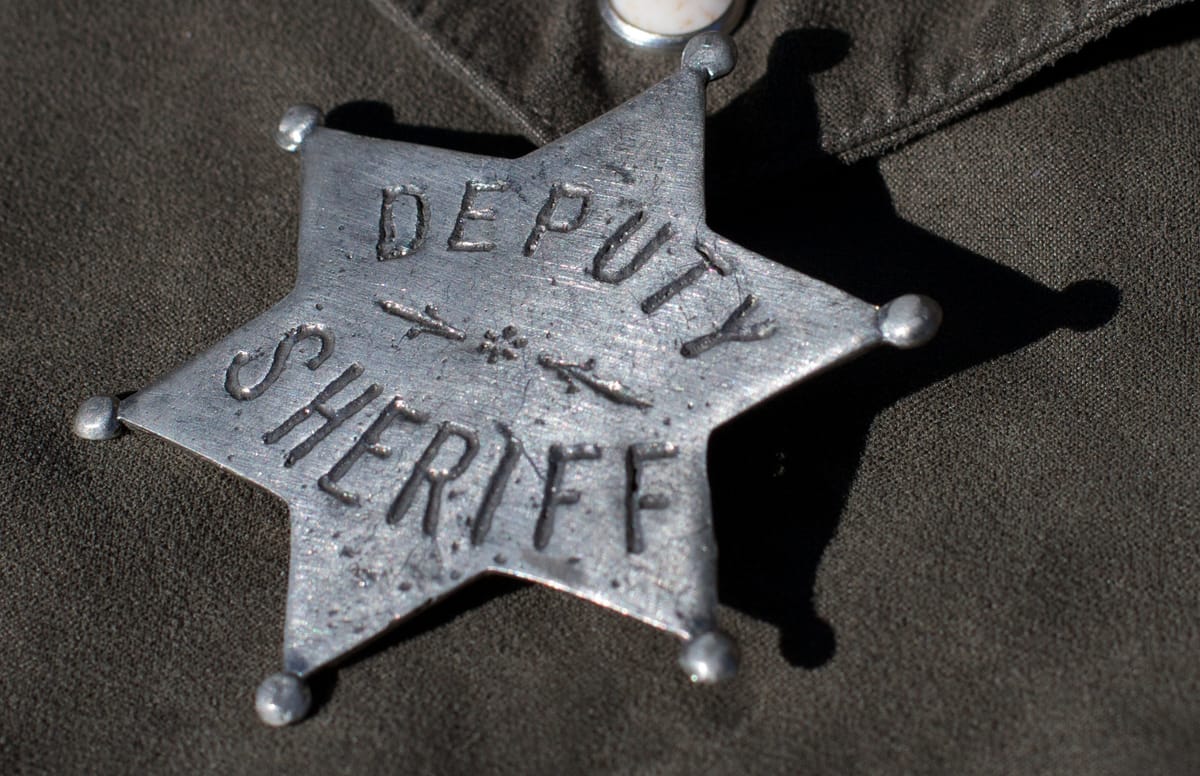
Featured image is "I Appointed Me Deputy," CC-BY-SA 4.0 Alan Levine


_croped.jpg?ref=liberalcurrents.com)