The Rules-Based Order Is Dead. Good.
The rules-based order was a polite fiction based in a fundamental misunderstanding of contemporary geopolitics.

In his first year in office, Donald Trump has declared a desire to annex Canada. He has repeatedly mulled invading Greenland. He has launched strikes on Iran and Venezuela and endorsed a new Monroe Doctrine for the Americas. He has dispatched his Vice President and Secretary of Defense to excoriate Europe and cozy up to Russia. He has pivoted away from free trade and towards mercantilism and ever-shifting tariffs. According to many commentators, the rules-based order that has been the object of American foreign policy for decades is under the most serious assault in its history—an assault led by its creator. The rules-based order has guaranteed world security and prosperity, we are told, and it is the responsibility of any reasonable person to defend that order and rebuild it after Trump is gone.
None of this is true. The rules-based order is not a strategic concept that has guided American policy since 1945. The rules-based order is a recent invention that emerged during the War on Terror. The rules-based order is a fatally flawed construct that contained basic tensions that Donald Trump has merely brought to a head. If we are to forge a new global order that can stand against a new age of imperialism, we need to consign the rules-based order to the trash.
To understand why, we need to understand the actual history of the rules-based order, not the phantom histories its proponents provide. Per CSS researcher Boas Lieberherr, the concept of the rules-based order "entered official political discourse in 2008" in a speech by Australian PM Kevin Rudd; it then appeared in the Australian Defense White Paper in 2009; in 2010 American Secretary of State Hilary Clinton used it public comment, and from there it spread across the American and Western foreign policy establishments—the Google ngram below shows its rather explosive growth in this period, as well as its absolute absence from the world prior to the end of the 1990s.
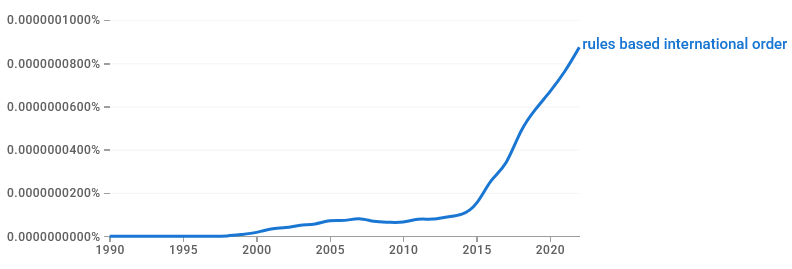
As Lieberherr notes, different official documents define the rules-based order in different terms—some placing heavy weight on the United Nations, others on vaguer "evolving norms," others on American primacy. As an intellectual construct, the rules-based order is something of a changeling: a child with no parents and no fixed definition.
The history
Nevertheless, I will offer an attempt at an intellectual history of the term and its development over time in the face of a changing global situation. And I will start with what the rules-based order has always implicitly defined itself against: the neoconservative adventurism of George W. Bush. This vision, clearly articulated in the 2002 National Security Strategy, was of stark ideological conflict: freedom vs. terrorism. "The allies of terror are the enemies of civilization," it reads; meanwhile "democracy and economic openness... are the best foundations for domestic stability and international order." While the 2002 NSS made reference to the UN and other institutions of international law, in practice the Bush administration ignored or went around them, embracing American unilateralism—invading Iraq without UN sanction and building a worldwide network of torture and assassination to fight "radical Islamic terrorism." This was the neocon world: a vision of ideological struggle, backed by crusading American force of arms, divorced from the institutions of international law.
Moving beneath the surface in this period was another framework, however. Thomas Barnett began giving a PowerPoint presentation to various military and intelligence officials after 9/11. It became informally known as "The Briefing" because of its popularity and ubiquity; he later turned it into an essay for Esquire in 2003 and then a book, The Pentagon's New Map, in 2004; he also delivered the briefing on C-SPAN on multiple occasions. The man got around, in other words.
Barnett did not see a world divided by ideological struggle between freedom and its enemies. He saw a world divided between functional countries of the "Core" that accepted globalization, free trade, and effective rule of law, and a dysfunctional "Gap" characterized by weak states that rejected the rules. Terrorist groups emerged from the Gap to trouble the Core. Notably, Barnett saw China and Russia as in analogous situations to the United States—largely functional countries troubled by insurgencies in their "gaps" of the Xinjiang and the Caucasus.
We are now in a position to understand why "the rules-based order" emerged when it did. By 2008, the glossy dream of Bush's crusades had curdled into long wars of occupation with no end in sight. Thus, a new consensus emerged, one that I see as defined by two major changes and one unspoken continuity.
First, it backed away from "global ideological struggle." The new consensus rejected the heavily values-laden world of the neoconservatives and embraced Barnett's vision of a world defined by a far more minimal set of rules:
- Free-ish trade
- No foreign aggression
- Not too much internal repression
As long as you met those minimal rules, you could be welcomed into the rules-based order. As S.C.M. Paine put it, "Join the party, follow the rules, you'll make money, right?"
Second, it backed away from Bush's aggressive interventionism. No longer was America attempting to spread democracy at the point of a gun. America intervened in Libya and Syria, but only via airstrikes and in the face of grotesque civilian atrocities; we fought ISIS, but they were recognized by the world as moral monsters. Your run-of-the-mill authoritarian, as long as they accepted the minimalist rules noted above, was safe from American power.
Third, while it rejected Bush-era unilateral aggression, it embraced Bush-era American unaccountability. Barack Obama did not launch any major ground wars. Nevertheless, he did nothing to reduce the freedom of action enjoyed by America—in particular, an arbitrary freedom of action, largely unbound by either Congress at home or international law abroad. In other words, the "rules" amounted to little more than the president's voluntary restraint on American power.
The rules-based order was put into practice with the "reset" with Russia, mirrored in Angela Merkel's "ostpolitik" and the construction of the Nordstream pipelines. Later, America embraced Saudi Arabia and Israel as the pillars of Middle East security with the Abraham Accords. Perhaps most consequentially, the Western world pursued a constant deepening of trade and economic ties with China.
The idea, I suppose, was that democracies and authoritarians could all get busy getting rich together, occasionally working on joint challenges like climate change or failing states in that troublesome "Gap." Authoritarian regimes would rein in their worst excesses, and so would America. There would be no more of that volatile ideological conflict that had caused so much woe.
The offer is rejected
Then of course Vladimir Putin went and invaded Ukraine, first seizing Crimea in 2014, then fomenting a long-running civil war, before finally launching a full-scale invasion in 2022. China abandoned "one country, two systems" to brutally crush democracy in Hong Kong, continued its bullying in the South China Sea, and commenced a rapid military build-up aimed at seizing Taiwan. Neither country seemed much interested in the delightful offer Western foreign policy had made them.
Thus the concept of "revisionist" powers had to be added to the intellectual repertoire of the rules-based order. Nations like China and Russia wish to revise the rules of the road, as against our nice stable status quo. They want more territory, more vassals, more power. They're the aggressors, not us. They're the reason the rules-based order started stumbling.
Now it seems that Trump is hammering the final nail in the coffin. He has attacked traditional American allies, flouted international law—for instance, in the recent kidnapping of a sovereign head of state—and, after again threatening a potential invasion of NATO ally Greenland, he has pivoted to a direct confrontation with Iran without bothering to make the case to the American people or Congress, never mind our allies. In prosecuting its war with Gaza, Israel seems less interested in peace than with the steady annexation or subjugation of the Palestinian territories.
We have left behind a world divided between a rules-abiding "Core" and a lawless "Gap" and entered an age of renewed imperialism, colonialism, and conquest. This ambition is shared, in practice, by the Russian Federation and the People's Republic of China.
Trump might be the gravedigger of the rules-based order. He is also its final expression. A basic tension at the heart of the rules-based order is that it was not, quite, a commitment to the actual black-letter rules of international law. The "rules" were always really more of a vibe. America did not bind itself to the institutions of international law, such as the United Nations or the International Criminal Court. We criticized those institutions... but also did nothing to reform or replace or supplant them. The "rules" of the RBO were always whatever the American president wanted them to be. The heart of the "rules-based order," in other words, was a sovereign not bound by any rules. This was never a stable equilibrium.
An ideological brawl
The rules-based order is dead.
Here's the question: did it ever exist to begin with? It always clearly rankled Russian and Chinese thinkers to be described as "revisionist." From their perspective, it was America that is revising the world order—trespassing in their front yard, meddling in their internal affairs with these Western notions of freedom and democracy. They are merely defending their traditional prerogatives against American revision—according to them.
Here's the thing: they're right. The rules-based order is not just a failed normative vision. It was never an accurate picture of the world to begin with. The fundamental intellectual sin of the rules-based order was the refusal to see a world that continues to be, as it was in the 20th century, animated by values—our values as well as the values of our adversaries.
At some point, foreign policy analysts decided that the rules-based order was not merely an intellectual framework built to manage a post-ideological world. It was an objective reality, and indeed had been the consistent object of American foreign policy since 1945. For instance, the 2016 RAND report "Understanding the Current International Order" glosses 1950's NSC-68 as oriented around "the goal of a more ordered international system" and "international institutions, norms, and rules that would stabilize world politics and thus safeguard U.S. interests." This is a pretty substantial twisting of NSC-68, which is framed in terms of "a basic conflict between the idea of freedom under a government of laws, and the idea of slavery under the grim oligarchy of the Kremlin." NSC-68 is not dedicated to rules in the abstract: it is dedicated to freedom, which rules subserve.
But for years we pretended that values had no impact in world affairs. Consider. What rules, exactly, "revisionist" powers intended to "revise" was always a bit murky. Were they mad about the terms of trade? Did they have concerns about intellectual property law? Or perhaps a difference of opinion about carbon credits? No! They want to redraw the map with the sword! They want to cripple liberal democracies within internal fifth columns!
Why is this? Unlike the communists, they are not committed to a worldwide revolution. Like the communists, however, they are consumed by the perception of threat—in this case, the threat of liberal ideas. This perception is correct. Since 1776, the idea of freedom—the idea of democracy—has been perceived as a mortal threat by the autocrats of the world. And they were right! Revolutions followed in Haiti, across Latin America, in France, and in the decades that followed across Europe. The Soviet Union imploded not because of force of arms but because the red dream could no longer compare to liberal reality.
This perception of threat has driven our opponents' policy. It is not an accident that Russia's aggression against Ukraine began when they threw out their illiberal dictator and moved towards liberal democracy. China has no economic or security interest in crushing Hong Kong or Taiwan. As Putin's rule is threatened by the example of a free Slavic country like Ukraine, the Chinese Communist Party's rule is threatened by the example of a free Chinese nation like Taiwan.
In other words, there is nothing we can do to mitigate that perception of threat. Regardless of our foreign policy, as long as we are free, our example will be a threat to authoritarians around the world. Authoritarians fear, more than anything, that one day their own people will demand freedom, and men who thought they were kings will find themselves dangling upside down from a gas station. There is no prospect of avoiding this: we are entering a new era of global ideological struggle; indeed, we have been in such an era for some time now.
The fundamental conflict today is not between "order" and "chaos." Nor is it between capitalism and communism. It is between two visions of the human future: freedom and authoritarianism. Today's authoritarians are diverse: some are theocratic, others communist, others kleptocratic. What unites them is what has always united authoritarians: a vision of a world organized around patriarchal values, nationalist supremacy, elite corruption, and mass exclusion. This is another way of saying: what unites authoritarians is the fear of freedom, little more.
Consider. The extent to which Russia has made itself dependent on China is somewhat baffling. But then, the invasion of Ukraine itself is a bit baffling: why is Russia pursuing actions that are so manifestly destructive of its national power and welfare? But the answer was always staring us in the face. Russia fears vassalizing itself to an authoritarian China less than it does opening itself to a democratic West. One of these threatens its domestic authoritarianism, the other does not.
This emerging authoritarian international is characterized by alliances between authoritarian groups in different countries. American conservatives decamp to Hungary with government support; Russian money flows into European far-right parties and Russian hackers prop up American Republicans; Chinese spies work to destabilize Canadian politics; white supremacist terrorists take their tactics and inspirations from a worldwide list of examples. These alliances are shifting and tactical; sometimes they involve direct government action, other times coordination between out-of-power authoritarian groups, other times simply ideological exchange and cross-pollination.
The battle lines between freedom and authoritarianism do not run neatly along national borders. This is not late Cold War I with its well-defined blocs and ossified rules of the game. Rather, we are in a situation more like the interwar period: a trans-national ideological brawl with battle lines that run straight through domestic politics. Authoritarian political movements across borders and with disparate access to state power recognize their ideological common cause and work together to forward it.
It is time that those of us who still believe in freedom under law do the same. This has implications for how we think about foreign policy. Here is a vision of the profession of foreign policy, rather akin to the profession of highway engineers. Regardless of who comes to power in Washington, there is an objective national interest, which can be served in a technocratic, professional, politically neutral way. This is no longer tenable. The global ideological struggle I have spoken of is already inside the gates. American politics is divided between a party that believes in attacking our allies, oppressing our citizens, and undermining our Constitution, all in favor of an authoritarian vision of the world, and a party that believes in delivering peace and prosperity through liberal democracy at home and abroad.
If we want to build that world of peace and prosperity, we need to do it ourselves—at home and abroad. There is no one else. We must discard the empty concept of empty rules and embrace a demanding conception of freedom.
Featured image is Vladimir Putin, by the World Economic Forum