The Far Right’s Mission of ‘Protecting Minors’ From Online Porn Broke the Internet
A new censorship infrastructure is being built right out in public.

The U.S. Supreme Court upheld a controversial Texas law requiring age verification to access online pornography. Enacted by the Republican supermajority in the Texas legislature in 2023 and aggressively defended by Attorney General Ken Paxton, the court’s 6–3 decision against stakeholders in the online adult industry marked a significant shift in how the state may regulate access to lawful speech online.
Free Speech Coalition et al. v. Paxton pitted the American Civil Liberties Union and private appellate attorneys—representing companies such as Aylo, WebGroup Czech Republic, and the adult industry trade group Free Speech Coalition—against the state of Texas. Aylo, a Montreal-based company, owns Pornhub and a network of adult websites that have long been a target of religious conservatives, far-right activists, and a diverse coalition of anti-porn movements. WebGroup Czech Republic operates sites like XVideos.
To describe the high court’s ruling as merely “controversial,” however, understates what is at stake. Texas House Bill 1181 is presented as a child-protection measure. But it is part of a political project—one that seeks to normalize identity-gated access to lawful speech and to expand state power over digital life under the moral cover of protecting minors. Justice Clarence Thomas, writing for the high court’s conservative majority, rejected a clear argument that mandatory age verification constitutes a content-based restriction.
Thomas characterized the Texas law as imposing only an “incidental burden” on adults’ First Amendment rights, dismissing concerns about privacy, anonymity, and bodily autonomy raised by the plaintiffs. That framing is clear. Age verification laws are not narrow; they are the groundwork for a new infrastructure.
Once built, such systems are easily repurposed to censor disfavored groups. The danger is not only in restricting access to online pornography but in establishing a precedent for government-mandated checks.
Proponents of the law obscured this reality by treating legal pornography as an exceptional category of speech—one uniquely undeserving of constitutional concern. Justice Thomas’s opinion leans heavily on this assumption, including a direct citation of a widely circulated and controversial 2020 New York Times opinion column by Nicholas Kristof, “The Children of Pornhub.” Kristof highlighted genuine cases of non-consensual intimate imagery (NCII) and child sexual abuse material (CSAM) that appeared on the platform, prompting deserved scrutiny of Pornhub’s historical moderation failures—they are documented.
Kristof’s account—and the high court’s reliance on it—lacked critical context. It failed to meaningfully engage with how the legally operating adult industry functions, how consent and record-keeping laws are enforced, or how abuse and exploitation are present in every sector of mainstream entertainment digital media. These problems are not unique to pornography, nor do blanket access restrictions solve them.
Pornhub and other platforms have implemented significant reforms, including banning unverified video uploads and strengthening consent verification requirements. These measures are imperfect, but they reflect ongoing industry responses to real harms—responses that are notably absent from the court’s analysis. By contrast, the age verification regime upheld in Paxton relies on outdated technological assumptions and ignores the ease with which such systems can be circumvented. Virtual private networks (VPNs) render state-level age verification laws largely ineffective as tools of access control. This is not incidental—it is systemic. If any moderately tech-literate user can bypass a law, its primary function shifts from protection to signaling and surveillance. The law restricts speech not by preventing access, but by imposing friction, risk, and data collection on those who comply. Indiana Attorney General Todd Rokita’s recent lawsuit against Aylo illustrates this paradigm. Rokita argues that VPNs undermine compliance with Indiana’s age-gating requirements, despite virtual private networks being legal nationwide and are widely recognized as a privacy tool. Aylo, like other companies facing similar laws, has responded by blocking access entirely in jurisdictions rather than subjecting users to privacy risks.
Todd Rokita is seeking to make privacy infrastructure itself illegal—pushing toward a hostile regulatory environment in which anonymity online becomes suspect by default. This is not about protecting minors. It is clear that expanding the state’s capacity to monitor, categorize, and control users’ digital behavior.
In the scenario of age verification laws proving challenging to circumvent through the means of a VPN or a proxy, either because these tools are made illegal or some othe reason, then these laws would be tantamount to a de facto ban on adult content or material considered as "pornographic" and disfavored expression by the state. Luckily, the United States is not at that point—yet. But as the prohibitionist tendency of previous bans on behaviors and content have proven, any ban would drive the rise of an illicit market that is unregulated, ripe for abuse and other illegal conduct.
The implications also extend so far beyond online pornography. Age-assurance requirements are rapidly expanding across many social media platforms, gaming, and device ecosystems. Advocates such as social psychologist Jonathan Haidt—who submitted an amicus brief supporting Texas’s law—have called for broad bans on social media use by minors, policies already adopted in countries like Australia. As with porn, these restrictions are trivial to bypass, yet they succeed in habituating the public to identity-gated access to speech. This pattern is not accidental. Authoritarian systems frequently advance surveillance.
Once the infrastructure is in place, it can be extended to political dissent, LGBTQ+ expression, and other forms of lawful but disfavored speech. History offers up no shortage of examples. The Russian Federation provides a particularly stark case. Over the past few decades, the Kremlin has dramatically expanded both digital surveillance and repression of LGBTQ+ expression—two developments that reinforce one another.
As of late 2025, policymakers associated with the Civic Chamber of the Russian Federation are reviewing proposals to require age verification for all content restricted to users over 18, including online gambling, violent video games, specific social media platforms, LGBTQ+ content, pornography, and sexual content.
The lesson for liberal democracies should be obvious. Systems built to “protect children” do not remain confined to that purpose. They become tools of governance, enforcement, and exclusion. The opposition to mandatory age verification is not opposition to protecting minors. There is a recognition that symbolic harm reduction, when paired with broad state power, often produces the opposite result. Legal adult users remain surveilled, marginalized communities are disproportionately harmed, and children are less safe.
The threat posed by age verification is not moral decay, but the normalization of a permission-based internet—one in which access to speech depends on who you are, not what you say.
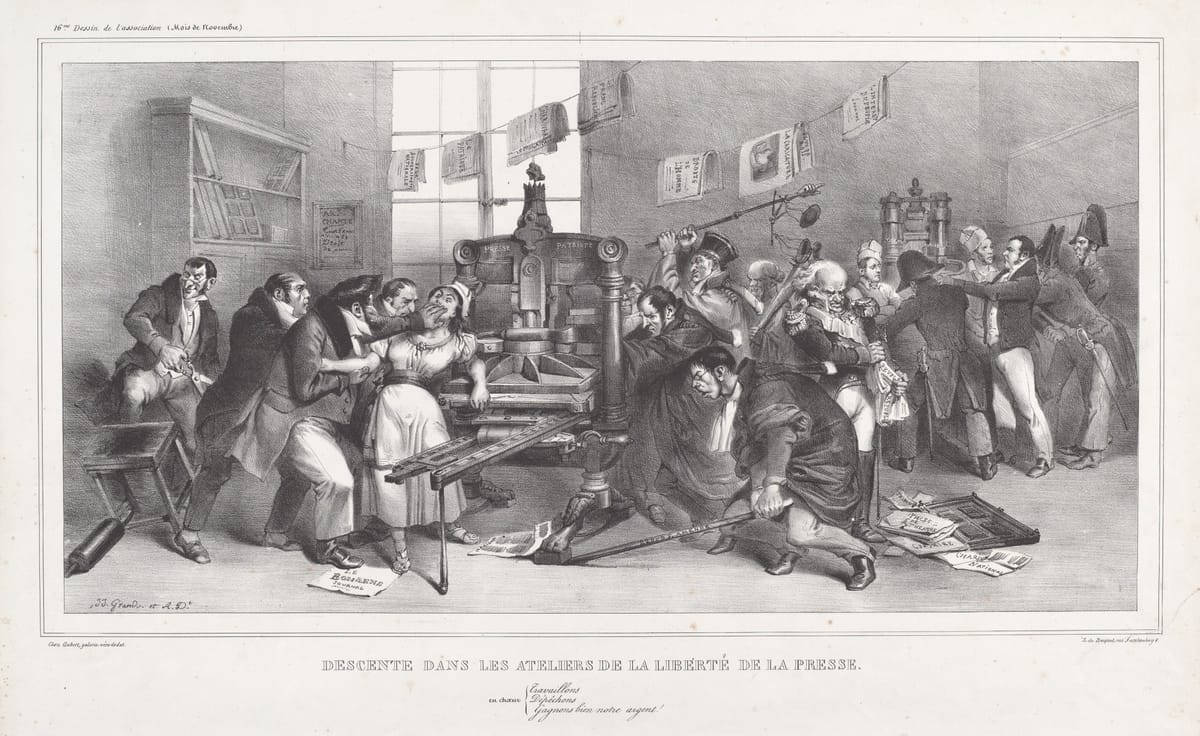
Featured image is Raid on the Workshops of the Freedom of the Press, by Jean-Ignace-Isidore Grandville and Auguste Desperet