The Great Replacement of Conservative Ideology
The Great Replacement unites the factions of conservatism like "fusionism" never could.
It’s an article of faith for never-Trump conservatives that Trump is not a conservative. But history and tradition are against them. In his 200-year historical survey, Conservatism: The Fight for a Tradition, Edmund Fawcett shows that conservatism has always had a hardline camp fiercely opposed to liberal modernity and a “liberal conservative” camp that seeks to triumph via adaptation. Most Republican Party elites have been part of this tradition as well. During the Cold War, the disparate elements they spoke for were united by “fusionism”—a fire and ice cocktail of libertarianism and social conservatism held together with anti-Communism.
In post-WWII America, conservatives faced three threats: the ascendancy of New Deal liberalism, the threat of global communism, and the ongoing process of modernization that was eroding traditional practices, institutions and norms. Hardline conservatives saw all three as facets of one big conspiracy, usually with Jews as chief villains.
Fusionism strove to articulate a more respectable account. Libertarianism was fusionism’s counter to the New Deal, social conservatism its counter to evolving social change, and anti-Communism its umbrella faith—one that even New Deal liberals had to agree to, to varying degrees.
A main concern of fusionism was to explain and justify itself in terms that liberals would take seriously. But in doing so, it earned hardliners' scorn, as David Austin Walsh describes in Taking America Back: The Conservative Movement and the Far Right. Yet fusionism could never truly get rid of hardline conservatives. They were vital for its success. From Joe McCarthy to best-selling books like None Dare Call It Treason to Pat Robertson’s The New World Order and his Christian Coalition to Rush Limbaugh and his millions of ditto-heads, the fusionist generals of post-WWII conservatism repeatedly relied on hardliner troops to win their battles on the ground.
Yet winning those battles repeatedly failed to deliver what was promised. Elites got much richer, but 19th-century social relations couldn't be restored, and the end of the Cold War removed the global boogeyman that helped unite all the factions. The War on Terror promised a new boogeyman, but the promise quickly turned sour. The triple failure of the Iraq War quagmire-turned-horror show, the Katrina disaster, and the financial crash bringing on the Great Recession left every faction stunned, and no one credible to carry the old banner. Into this wreckage stepped untainted outsider Donald Trump to pick up the pieces, and put them back together in different, hardline way, no longer constrained by any vestiges of the New Deal era.
As a life-long transactional businessman, the putting back together process was entirely contingent for Trump. Not so the choices on offer. His inaugural 2015 campaign speech, casting Mexican immigrants as a horde of rapist, drug-dealing criminals sent by Mexico—a deliberate invasion—fit perfectly within the framework of hard right Great Replacement Theory, a European import which is now doing a much better job of weaving things together than fusionism ever did. While it delusionally posits a replacement of people—a genocide—what’s actually happening is a great replacement of conservative ideology itself.
Technically, Great Replacement Theory is just one variant of a broader family of conspiratorial narratives descended from the 1973 novel The Camp of The Saints, as researcher James Scaminaci III outlined in a 2020 article, Battle With Bullets: Advancing a Vision of Civil War.
“In its simplest form, the [book’s] narrative holds that the ‘White race’ faces extinction, ‘replacement,’ or ‘genocide’ due to high non-White birth and immigration rates (or non-White empowerment), and that patriots’ task is to ‘Repel the barbarians,’ as Breitbart News summarized the book’s message,” he wrote.
(White women’s task, of course, is to pump out babies. If they’d just do their job, none of this would happen).
The “Camp of the Saints worldview,” as Scaminaci described it to me in a followup story, allows different variations, some explicitly antisemitic, others not, but all involving treacherous or at best weak-willed elites. One variant was popularized in Europe by French conspiracy theorist Renaud Camus in his 2011 book Le Grand Remplacement. “The great replacement is very simple,” Camus has said. “You have one people, and in the space of a generation you have a different people.”
The replacement of people is pure paranoid fantasy. But the replacement of ideology is not. As I noted in 2021, “If ‘invading hordes of immigrants’ are the enemy, and falling white birthrates are key to the problem, then the right’s misogynist agenda and its xenophobic agenda are much more tightly linked than ever before.” The Great Replacement likewise unites these agendas with Christian nationalism, which fuses Christian and American identities into a macho vision of national identity. Fusionist rhetoric aside, these are the three major electoral facets of American conservatism, as described by Angie Maxwell and Todd Shields in The Long Southern Strategy, and they’re much more tightly unified via the Great Replacement Theory than they ever were via fusionism. Controlling women's bodies is now both a religious and national security concern—indeed it's a matter of civilizational life or death. It goes without saying this means different things for white women vs. others. “What’s more, the practical need to suppress voters of color becomes a central ingredient,” I noted. Tucker Carlson in particular devoted a great deal of energy to weaving GOP voter fraud conspiracy narratives into the picture. From his perch at Fox News, Carlson attributed the "Great Replacement" to Democrats' quest for "more obedient voters" to support their nefarious agenda.
Fast forward to today, and vast swathes of Trump’s agenda cohere within this framework. Recently, Trump "truthed" what’s clearly a Great Replacement theory video titled "The Democratic Open Borders Plan to Entrench Single-Party Rule." Historian Seth Cotlar commented:
Note the various policy areas covered in that video—the census, voting systems, sanctuary city laws, anti-welfare, and anti-DEI initiatives. Miller's 'Camp of the Saints' white nationalism is the ideological glue that holds much of the Trumpian policy agenda (such as it is) together.
Implicit in all this—though sometimes explicit as well—is obsession with the decline in white birthrates, which Musk has warned "will end civilization." In less of a panic mode, falling birthrates can be problematic, particularly in terms of maintaining economic vitality as retiree numbers climb. It’s a worldwide problem with other downsides as well—for an overview, see Alice Evans' Why Fertility Is Collapsing Globally. But America as a long-time magnet for immigrants is exceptionally impervious to the falling birthrate threat—or at least was, until Trump’s war on immigrants.
The Camp of the Saints worldview simply assumes that immigrants can’t contribute to society, to civilization. They can only destroy it—a view more credible in Europe, where it was born, than in America, a nation of immigrants from before its formation. Nonetheless, it’s entered the GOP mainstream, and reshaped conservative ideology.
While multiple vectors were involved, particularly via social media, none reached more people more consistently and directly than the aforementioned Tucker Carlson. A 2022 New York Times analysis of his programming, spanning 1150 episodes from Nov 2016 through 2021, gives a clear sense of how the worldview he promoted hangs together, how it represents a new incarnation of an age-old hard right worldview, and what continuities remain.
The Times begins by noting a dominant fearful narrative: "‘They' want to control and then destroy 'you.'” They found Carlson mentioned the “ruling class” in more than 800 shows and warned that the country—and sometimes civilization itself—was falling apart because of ruling class policies in nearly 600 shows. This is a classic hard right way of lumping together liberal conservative and liberal elites, simultaneously disowning any past responsibility.
Then things get historically specific. Introducing the sampling of more than 400 shows referencing the Great Replacement Theory itself, the Times notes a malignant shift—from “they want to control you” to “they want to destroy you and your way of life,” and that one way of doing this is by importing third world immigrants to replace you with more “obedient voters.” They also found that “shifting gender roles” and falling birthrates were mentioned in more than 200 episodes and that Carlson discussed anti-white discrimination and minimized racism against people of color in at least 600 episodes.
The gender roles/birthrate themes tie into the Great Replacement three ways: they’re anti-traditional policies imposed by nefarious controlling elites, that weaken the country and open the door to “replacement.” Some such themes are ancient, but their prominence is new.
This hardly exhausts what The Great Replacement is about, or how it came to prominence. Steve Bannon’s promotion of it via Breitbart was one vector. Another was the complex synergies of conspiracist discourse that collectively undermined trust in news sources and experts who might burst the conspiracists’ epistemic bubble. But it suffices as a starting point to see how a hard right recasting of conservative ideology has taken hold, and why it’s so unlikely to be dislodged. Liberals may continue to believe in liberal conservatism, giving them airtime, money and endless praise. But conservatives themselves want no part of them. Blood and soil will do just fine.
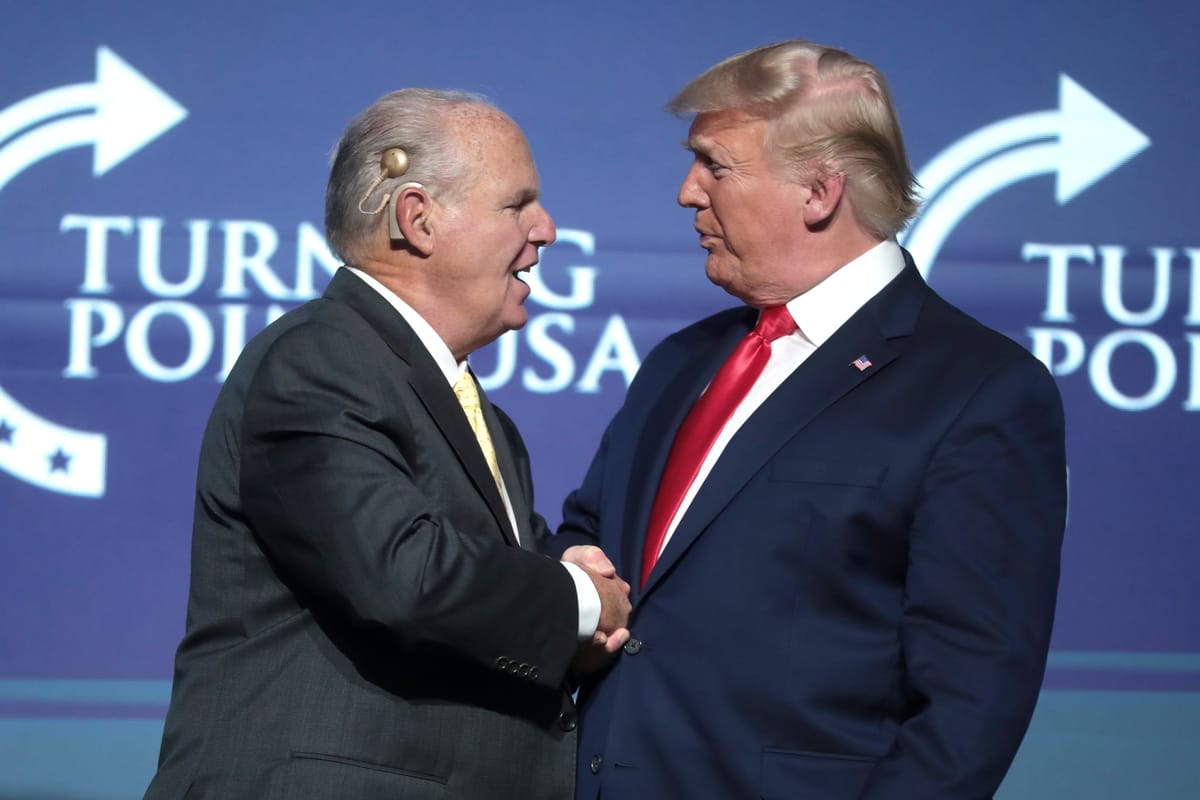
Featured image is Rush Limbaugh and Donald Trump, by Gage Skidmore