The Liberal Conscience Must Be Fostered With Accurate History
A knowledge of the injustices of the past and the reasons for their occurrence is vital to the development of a liberal conscience.
The Tutson ordeal
Samuel and Hannah Tutson were up from slavery. Born in captivity in the antebellum world of chains and whips, they both survived what the head-strong Hannah called the ‘‘red times’’ of slavery. This, let us never forget, referred to that inglorious period in world history when millions of people in the American South were subjected to what the French call ‘‘une vie sanglante’’(a bloody life). At any time, in any manner, and for any reason, slaves could be snuffed out of this world in the most gruesome way imaginable. While serving as an enslaved ‘house boy’ in the prosperous Georgia plantation of Jabez Bowen, a West-African slave by the name ‘Robert’ recalled seeing a black maidservant being executed for accidentally spilling gravy on her head mistress. Another diner dragged the young woman ‘‘outside and slit her throat, almost decapitating her, then casually returned to finish his meal.’’ The historian Sean M. Kelley writes that ‘‘the murder went unpunished’’ and ‘‘the memory would haunt Robert for the rest of his life,'’ (American Slavers, p. 387). Many other bondsmen were tormented by the orgy of violence they witnessed and experienced, on a sometimes daily basis.
When freedom from legal bondage finally arrived, some African-Americans were caught off guard by the intensification of violence against them. Some freedmen believed, not unreasonably one might add, that with honest work and diligence they would be left alone. With the passage of the Homestead Act granting a select number of former slaves access to partitioned land, the Tutsons were able to save enough money to buy a 160-acre tract of land in Gainesville, Florida. The couple grew cotton and raised livestock on their land, and when not employed in the service of others, Hannah in particular was able to work from home as a washerwoman. Jealous at their success, white neighbors regularly taunted them and pressured them to leave. Each time, the couple refused. After several warnings to leave their land, their white neighbors conspired to have them removed by force (I Saw Death Coming, pp. 28, 76).
In May 1871, the Klu-Klux-Klan barged into their home at night. Obscured by blackened faces, the night riders snatched 10-month-old Mary from her mother’s arms, and threw her across the room. They then drove Samuel outside the house, stripped him, and tied him to a tree. They dragged Hannah a quarter mile away from her home and tied her to a ping tree. While her husband was mercilessly whipped and stomped, Hannah was raped. One of the assailants was the deputy sheriff of the town, who poured liquor on her and made her beg for her life. They whipped her ‘‘from the crown of my head to the soles of my feet,’’ degrading her so thoroughly that a prolapsed uterus was in all likelihood the outcome (I Saw Death, p. 129).
While the adult Tutsons were being savaged, their ten-year-old daughter took the rest of the family—her little brother and the possibly concussed baby of the family—to a nearby field, ‘‘plying the baby with gooseberries to prevent her from crying,’’ lest the cries might lead the men back to them. The family reunited in the morning, all alive, but severely wounded, both psychologically and physically. Despite their brave eagerness to hold on to their land after this horrific nightmare, the family was eventually forced to leave for St. Johns County, never to be seen again in that part of Florida (I Saw Death, p. 81).
The Tutsons were fortunate to come out of this episode alive. Some night-time ‘visits’ erased entire blood lines. When the Klan visited the Nichols family home in Jackson County, Florida, they set out to brutalize the men of the house, Matthew and Matthew Nichols Jr. As they were preparing to drag the father and son to an execution site, Matt’s wife, Maria, ran out to defend her family with every word and gesture she could muster. The night riders repelled her efforts and killed the entire family a mile or so from their home. Each member of the family had their throat slit, but the Klan reserved their special fury for Maria, the impudent woman of the house. Her throat was ‘‘cut from ear to ear’’ and her ‘‘hair torn out by the roots.’’ (I Saw Death p. 62) It was in this brutal manner—by the sharp edge of a knife—that the Nichols family met their untimely end.
The Gaslighting of the Short Family
In December 1945, the Short family moved into their new home in Fontana, California. O’Day Short and his wife Helen were black southerners who joined the great migration out of the South in hopes of providing a better life for their two children, nine-year-old Barry and seven-year-old Carol Ann. A few days after they moved in, they received a visit from the deputy sheriff, Cornelius Carlson, urging them to leave the area. After a few more of those hostile visits, including a few nasty stares and some strong language from neighbors, the surrounding white community decided to take drastic action. On Sunday, December 16, 1945 just as O’Day and his family were settling back home after a long day at church, the home blew up (Ours Was The Shining Future, p. 108).
‘As O’Day entered the dark house, he picked up a kerosene lamp in the living room and struck a match to light it. At virtually the same moment, a massive explosion rocked the house…the explosion blew O’Day from the living room into the yard and lit his clothes on fire.
O’Day got back on his feet, and ran back into the decimated home to save his family. Helen, face half-burned and hair all gone, managed to extinguish the fire on the children. Neighbors drove the screaming family to the nearest hospital, where all except O’Day died the next day. O’Day was in hospital for a full five weeks. He would live long enough to mark the end of the police inquest into this terrorist attack. The man in charge of the investigation, the same deputy sheriff who had previously paid the Short family several ‘courtesy’ visits, declared the explosion an accident. O’Day died that very same day (Ours Was The Shining Future, p. 109).
There Was No Sanctuary, There Was No Place Really Safe
Between the Tutson family ordeal in 1871 and the murder of the Short family in 1945, 74 years had gone by. And yet to many black people in the booming post-war America, the passage of so long a time had not brought real progress. It seemed like the nation was morally frozen in time. If anything, some victims of terrorism could not shake the impression that in some ways things had gotten worse. After so many years of struggle, one could still hear black people lamenting the fact that ‘‘there was no sanctuary, there was no place really safe.’’ Those were the words of former Secretary of State, Condoleezza Rice, recounting her childhood experience growing up in Birmingham, Alabama. Rice was 8 years old when a loud noise interrupted the family’s Sunday service. The sound was the noise of a bomb exploding at the Sixteenth Street Baptist Church across town. The bomb was planted by the local Ku-Klux-Klan and resulted in the death of four girls. The youngest, Denise McNair, was a playmate of the future stateswoman. The events of September 15th, 1963, along with the assasination of John F. Kennedy two months later, galvanized the nation to push through the 1964 Civil Rights Act.
The Birmingham bombing is rightly remembered today as a turning point in civil rights history. It should, however, be noted that 16th Baptist wasn’t the only church targeted by terrorists, nor was it the only place of worship that came under attack by racists. James Pruitt was eighteen years old and working as a janitor at Temple Beth-El in Birmingham, Alabama, when after a routine sweep he found nearly five dozen sticks of dynamite stuffed in a bag (enough to level the synagogue). Thankfully, the fuses had been extinguished by the time Pruitt arrived, possibly by the rain. Such remarkable stories, including the oral testimony of men like Mr. Pruitt, are fading away from record due to both a lack of interest and funding. In recent years, the public has grown impatient with stories of oppression. The Trump administration in particular has sought to cut funding for ‘woke’ initiatives to remember these histories.
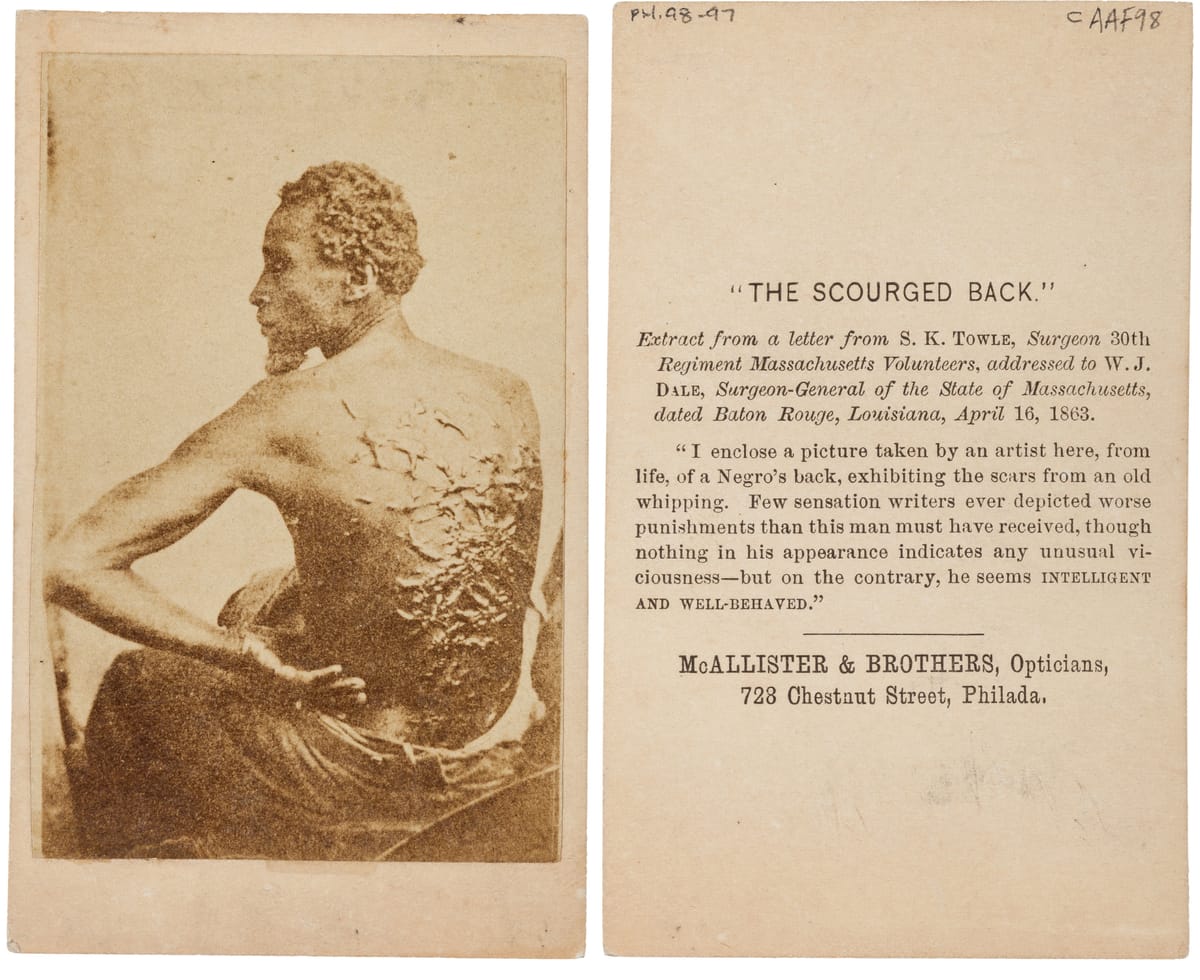
As the philosopher Judith Shklar argues in her essay on the vice of cruelty, perhaps the best way to approach the experience of the victims of the past is ‘‘simply to write the history of the victims and victimizers as truthfully and accurately as possible.’’ That, she explains, ‘‘may well be the most useful and enduring accomplishment.’’ (Ordinary Vices, p. 23) That is partly why it is important for liberals to push back against attempts to erase, distort, or sanitize the history of the United States. The public must see and know the meaning of the scars on Mr. Peter/Gordon’s ‘scourged back’. When liberals hear that the President is displeased with the Smithsonian and other museums for an ‘‘excessive’’ focus on ‘‘how bad Slavery was,’’ when they read that the administration has asked parks and other recreational venues and centers of culture to censor or remove displays of the history of slavery and Jim Crow in the U.S, they should be greatly disturbed.
Intent on changing the image of the country from one primarily remembered for ‘‘how unaccomplished the downtrodden have been’’ to one which has an ‘‘unparalleled legacy of advancing liberty, individual rights, and human happiness,’’ the Trump administration has ordered the National Park Service to remove an exhibit at the President’s House in Philadelphia honoring the lives of the nine slaves who were held in captivity by George Washington himself. In the state of Florida, a place that is still haunted by the blood that was spilled to keep families like the Tutsons and the Nichols from wealth and power, the Department of Education has banned AP African American Studies for its lack ‘‘educational value’’ and ‘‘historical accuracy.’’ Meanwhile, the descendants of slaves and their allies continue to yearn for greater public exposure to the full breadth of the African-American experience. ‘‘I pray to God they never get rid of this history,’’ a man recently told the Atlantic’s Clint Smith, ‘‘We as a Black race went through so much, and they’re trying to erase that.’’
A knowledge of the injustices of the past and the reasons for their occurrence is vital to the development of a liberal conscience. Such a conscience views cruelty as a great evil and a direct threat to the flourishing of individuals in society. There is no easier path to a repetition of the horrors of the past than gross ignorance of history and its morally weighty lessons. The 19-year-old man who burned a synagogue in Jackson, Mississippi, along with the political influencers who spread ignorant lies about Jews, the history of the Holocaust, and World War II, are the products of a failure to take cruelty seriously.
The attempt by certain right-wing ideologues to reframe the public’s understanding of the past serves a nakedly ideological purpose: to appease the conscience, excuse injustice, glorify violence, and advance a romantic view of the nation as racially pure, morally untouchable, and worthy of the most violent patriotic devotion. It is an attempt, in short, to fashion an authoritarian mind. The suffering of people like the Tutsons, Nichols, Shorts, and others must never be forgotten. Their stories must be told and the pain they endured magnified, so that the next generation of leaders can grow up with a broadly liberal constitutional conscience.
Featured image is "Carte de Visite portrait of Gordon, 'The Scourged Back,'" McAllister & Brothers 1863.