The Liberal Currents Canon, or Some Good Books



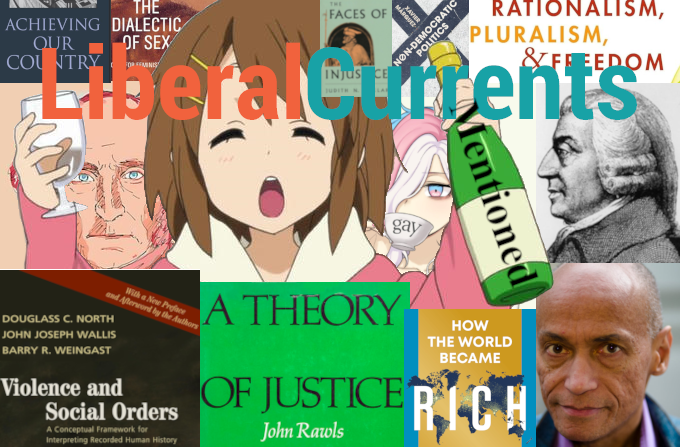
From time to time we get asked for recommended reading. The topics vary, but given the nature of Liberal Currents there are certainly recurring themes. By the same token, there are a few books that a number of us have read and talked about together, and are relatively well known among our community, the kind of thing you might find in recurring jokes we make. The idea of putting together a comprehensive list of such books has been floated more than once.
Rather than coming up with a Complete Liberal Currents Canon, we thought it might be more fun to do it as a draft.
Seven of us participated: Editor-in-Chief Adam Gurri, Associate Editors Samantha Hancox-Li, Paul Crider, Adrian Rutt, Caitlin M. Green, and Jason Briggeman, and AV Editor Trent Nelson. Our order was randomized up front and then fixed for five rounds.
What follows then is a list of thirty-five books on topics in philosophy, social science, history, and culture. Some of it might properly be called a canon of works that have influenced our community overall. Many are simply good books that are worth your time.
First round
Samantha: 1. Violence and Social Orders, by Douglass C. North, John Joseph Wallis, and Barry R. Weingast. A book that fundamentally reframed how I think about society, history, and economics. Rather than assuming a modern state, and asking about that state's relation to its people, it begins with the problem of violence. It reframes history, by focusing on the "great break" of the Industrial Revolution—measurable in the economic data—rather than portraying history as either a steady state or a steady progress. It reframes liberalism as an overall social order penetrating into all social organizations and personal lives rather than some specific list of rights. Dry as dust, though. Can't recommend it enough.
Paul: 2. The Life and Times of Frederick Douglass is his third autobiography, written in its final form after seven decades of a life spanning chattel slavery, the Civil War, Reconstruction, and the beginnings of Jim Crow. LTFD is written as an autobiography, yet each chapter is carefully crafted to convey some idea of Douglass's political philosophy and worldview, to the extent that it should be understood as a work of political theory. Liberals should read LTFD because Douglass defends a liberalism (not his word choice) that takes its own universalist ideals of freedom and equality truly seriously, even as these ideals are haggled and fought over within a pragmatist politics.
Adrian: 3. Richard Rorty, Achieving Our Country: Leftist Thought in Twentieth-Century America. If you think that over the last fifty or so years the left (broadly construed) has increasingly focused on identity and cultural critique at the expense of on-the-ground reforms, this book is for you. It offers a comprehensive critique of the conflation between leftist philosophy and leftist politics, arguing instead that while philosophy can inform politics, they remain distinct. The book also underscores the need to reclaim a sense of national pride. Most people don’t hate the United States; they simply want it to genuinely embody its stated ideals of life, liberty, and the pursuit of happiness. No blurb can do this short book justice. Just read it. And read it again.
Adam: 4. A Different Democracy, by Steven L. Taylor, Matthew S. Shugart, Arend Lijphart, and Bernard Grofman. A book that every American should read, especially now that present circumstances may force us to seriously rethink our institutional arrangements in the near future. No one can truly understand their own political system unless they understand the alternatives. Too often the only alternatives really considered are the different arrangements our own country has had in our own history. This book is enormously comparative, looking at 31 different stable democracies, but centering on a comparison with America specifically. It highlights what is truly different from what is simply less common, as well as what is not particularly special. I especially like how well it highlights the choices that were made at the constitutional convention because they had zero points of comparison to go on themselves.
Caitlin: 5. Albert O. Hirschman, Rhetoric of Reaction. A book like this is a classic for a reason. Being a person in this world means constantly being bombarded by messaging from political figures, pundits, news, and other organizations, and I am a firm believer that the best way to keep your head on through all of that is to learn how to decipher and resist manipulation. RoR is a fantastic keystone for this practice because it takes something that happens all the time and gives us a name for it. The three theses of reactionary rhetoric outlined in this work are everywhere, and when you find them you have permission to recognize them for what they are: attempts to derail rather than pursue debate. And then you can finally be free from the pressure reactionaries put on you to constantly be engaging and replying to their bad-faith rejoinders.
Jason: 6. Ibram X. Kendi, Stamped from the Beginning. The Republican Party has chosen allegiance to a rich kid as a pathway to establishing themselves above others in a social competition for status, like a pack of boys might do in fifth grade. This means that bigotry has effectively become their chief value, and they’re showing every day that they’ll sacrifice most all other values to it. Liberal Currents is a U.S.-based publication, and practically situating ourselves to this moment in time is an urgent task for Americans. Given what people are already taught about U.S. history in school, what one book would you add? This is my choice. Kendi builds, and orients us within, a perspective that we need. If you have a sense or feeling that you shouldn't read this book, overcome it.
Trent: 7. Political Hysteria In America: The Democratic Capacity for Repression, by Murray B. Levin. An important read in which Professor Levin uses the first American Red Scare to illustrate the ways in which elites use fear tactics and cultivated hysteria to undercut potential socio-political movements. While Levin concludes by noting that there are other ways that American democracy diffuses different cultural and political movements—through cooption, for example—many circumstances such as the satanic panic in the 80s, as well as the current trans panic, illustrate the value of appraising Professor Levin’s work again.
Second round
Samantha: 8. How the World Became Rich, by Mark Koyama and Jared Rubin. The clearest single book on economic history I've read. In particular, it reframes the basic questions of economic history in terms that cut through a great deal of haze: why did the Industrial Revolution happen in Europe specifically, at this time specifically? Why did it happen in England specifically? And why didn't it happen in China a thousand years earlier? It then reviews nearly every going academic theory, explaining each of them in surprisingly even-handed terms. An essential introduction to one of the most important questions of world history.
Paul: 9. Development as Freedom, by Amartya Sen. In this approachable volume Sen argues that freedom as political process and comprehensive social outcomes are non-reducible to one another but jointly necessary for a genuine human freedom. Thus democracy is necessary whether or not material prosperity can be achieved by benign dictatorship, and liberal procedural rights alone are insufficient if they don't meet the comprehensive welfare needs of all persons in society. Also a great introduction to the capabilities approach.
Adrian: 10. Michael Oakeshott, Rationalism in Politics and Other Essays. In contrast to Rorty and his Achieving Our Country, Oakeshott is typically labeled a conservative, but labels here obscure more than they clarify. Oakeshott argues that excessive reliance on abstract principles and theoretical blueprints undermines practical wisdom and tradition-based experience, a point that any liberal can appreciate and accommodate. As we learn more about ourselves, society, and the universe, it’s tempting to believe that more can, at least theoretically, be controlled. Oakeshott’s essays serve as a brilliantly written reminder that politics demands more than rational planning; practical judgment is often the key.
Adam: 11. Non-Democratic Politics, by Xavier Márquez. Just as you can’t really understand your country’s democratic system without understanding alternative forms of democracy, you can’t really understand democracy per se without understanding the alternatives. Márquez does an excellent job summarizing the overall political science literature on the topic and adds a very valuable perspective of his own. One surprising piece of information is that almost every non-democracy formally pretends to be a democracy. This and other insights in the book lead to a much better understanding of democracy’s fundamental strengths, through the lens of non-democracy’s inherent shortcomings.
Caitlin: 12. Teun van Dijk, Racism and the Press. Like Rhetoric of Reaction, Racism and the Press is a book that gives you the tools to recognize when authors or speakers are trying to get away with something. News has a particular structure, and news producers use that structure to give us the impression that, for example, colleges are overrun by anarchists and unable to function due to the terrorist-supporting riots. They do this by releasing a constant stream of updates, interviews, op-eds, and other tidbits to keep a topic in the public consciousness while ignoring important stories that don't fit the broader narrative being constructed. Patterns in the ways authors use adjectives, identify people involved (“an expert,” “a radical”), how many paragraphs are devoted to which perspectives, all work together to form impressions in our minds. Knowing what to look for is important for us as consumers of news and news-like products to mount a defense against manipulation.
Jason: 13. Patricia Crone, Pre-Industrial Societies. There is an excessive humility in the packaging of this book about life in the pre-1800 world. The publisher labels it as a “bluffer’s guide” to its subject, and Crone herself identifies her audience as “students,” but really this is a great work of synthesis by an enormously knowledgeable scholar. With meat in every sentence, it pairs well with the #1 pick in this draft, in that between the two of them I think most readers will feel they have acquired at least one framework for interpreting recorded human history. We’re all students, whatever comes.
Trent: 14. The Disinherited: Journal of a Palestinian Exile, by Fawaz Turki. Turki takes the reader on a journey through the history which he lived through. In his short memoir, written in 1972, Turki describes his experiences as a Palestinian, how he and his family handled al nakba, the history of the conflict, the trauma inflicted upon millions and what that generation of Palestinians felt regarding their plight and the path forward. A deeply powerful read.
Third round
Samantha: 15. Daring to Be Bad: Radical Feminism in America 1967–75, by Alice Echols. Feminism has always been core to my political identity. And you can't understand the shape of feminism in America today without understanding radical feminism—how it emerged out of the rank misogyny of the New Left, the severe intellectual and organizational challenges it faced, its ideological evolution… and its catastrophic failures and eventual implosion. Echols' detailed history of the movement as a movement and its thinkers as thinkers is essential to clearing away the myths and seeing our past clearly. It also remains a fascinating case study in how political movements both succeed and fail.
Paul: 16. In Down Girl: The Logic of Misogyny, Kate Manne defines misogyny as the set of social facts that act to disadvantage women and others who, intentionally or not, fail to conform to gendered roles and norms. Misogyny can thus be a moral response by others in society to those failing in their gender duties or the institutions that are established to enforce those duties and punish deviance. This is a powerful framework for understanding patriarchy as a normative system that suffuses society and—important for liberals—how it limits freedom.
Adrian: 17. Elizabeth Anderson, The Imperative of Integration. I still consider this one of the best philosophical and political defenses of diversity and multiculturalism available. Anderson’s argument is clear: policies rooted in colorblindness or mere formal equality are at best misguided, and at worst harmful. Instead, active and deliberate integration across racial lines—in neighborhoods, schools, workplaces, and civic institutions—is essential to dismantling structural inequalities and overcoming persistent racial segregation. What I appreciate about the book is Anderson’s twin challenge to both liberal complacency about race and to racial separatism. Complacency and separatism are not solutions. Intentional integration is and always will be our best path forward.
Adam: 18. Rationalism, Pluralism, and Freedom, by Jacob Levy. This is, more than any other book or work, the thing that made me want to become a public defender of liberalism without qualification or subcategorization. A short, accessible book that provides a far more rich account of the liberal tradition than I had previously found. Levy's own theoretical contribution is substantial, and it then provides a very useful lens for understanding the different disagreements and divisions among liberal thinkers throughout history. The idea that you always need some mix of the aggressive, centrally imposed liberalism, as well as the cautious liberalism of checks and balances—and that it is impossible to know what the correct mix is, and maybe there is no correct mix—is still something very much at the heart of my own point of view.
Caitlin: 19. Stanley Cohen’s Folk Devils and Moral Panics. A case study in how media and cultural leaders can create the false belief that a deviant subpopulation is causing an emergency that needs to be met with decisive counteraction. This book explains the construction of “deviant” others and explores the ways leaders exploit the fears of a population to establish permission for themselves to wield increasing power, restrict freedoms, and encourage everyday people to assist in the monitoring, control and punishment of their own neighbors. One thing I appreciate about this book is that it is highly generalizable to the moral panics of today, but because it’s about mods and rockers, we can adopt a little bit of emotional distance and appreciate it in detail.
Jason: 20. Michael Polanyi, The Logic of Liberty: Reflections and Rejoinders. Longtime readers of Liberal Currents will be familiar with Polanyi’s sweeping essay “Perils of Inconsistency” from this two-part volume, but what's newly urgent is the defense of science that he gives in the volume's Part I. Polanyi justifies the structure and conduct of the scientific community as it has developed since the 1600s, including with regard to such matters as public funding, academic freedom, and pure vs. applied science. Push past the first few pages, which from an online standpoint in 2025 will feel a bit centrist-y in tone. Written in the 1940s, the arguments and history presented here are timely again.
Trent: 21. Anti-Intellectualism in American Life, by Richard Hofstadter. While nearly every Hofstadter could be on my list, and there is a special place in my heart for The American Political Tradition, Anti-Intellectualism in American Life is vital now as much as ever. In one of his classics, Professor Hofstadter tells the history of anti-intellectual movements across American history. The history he incorporates into the book still provides clarity all these years later, as similar prejudice persists in America, to the detriment of the society and nation alike.
Fourth round
Samantha: 22. Critique of Practical Reason, by Immanuel Kant. Too many contemporary debates about politics wind up hung up on the possibility of truth vs. the pressure of relativism. Kant, thankfully, cuts through the cloud of nonsense hovering around the deepest questions of how an objectively valid moral law can exist—and, I believe, reveals how that law is fundamentally about respecting autonomy and freedom. Of particular interest is the concept of the “fact of reason”: knowing that morality is possible not by logical analysis from the outside but by, yourself, being conscious of its demands. Esoteric but nevertheless essential to how I see liberal morality.
Paul: 23. Hijacked: How Neoliberalism Turned the Work Ethic Against Workers and How Workers Can Take It Back, by Elizabeth Anderson. The liberal tradition, even from its earliest exponents and precursors, has always included a strong egalitarian and social justice-conscious vein that has had an antagonistic relation to more conservative interpretations. Anderson illustrates both the depth of this liberal egalitarian tradition and how the struggle between these right and left liberalisms has often been by way of rightwing “hijacking” of egalitarian figures and ideas—in this case, the work ethic.
Adrian: 24. Beyond Civility: The Competing Obligations of Citizenship by William Keith and Robert Danisch. This is a book largely about rhetoric and our rhetorical obligations as citizens. Keith and Danisch articulate a central tension: the duty to engage in civil discourse versus the necessity of confronting injustice through more direct, sometimes disruptive political action. Similar to Oakeshott’s philosophy, what I love about this book is its rejection of easy, principled answers about the appropriate stance toward social issues. Ultimately, both civility and confrontation are necessary for a healthy democracy, and the authors critique both the left and right in how we frame and discuss social and political issues.
Adam: 25. One for All: The Logic of Group Conflict, by Russell Hardin. I don't think you can understand the modern world or liberalism's place in it without a basic grasp on ethnic conflict and other forms of intergroup tension. Hardin's book is a good combination of illuminating theory with empirical grounding. There really are some things where the interests, not just of individuals, but of whole groups, are in conflict. Hardin's book is one of the best single-volume works for illuminating this basic problem that all modern societies have to grapple with.
Caitlin: 26. David Harker, Creating Scientific Controversies. Harker explains some of the philosophical and logical patterns related to the tendency of our culture to be misled by the appearance of controversy when the science is in fact settled. He explores controversies such as anthropogenic climate change, intelligent design, antivaxx, and GMOs. Each chapter gives another tool to understanding how companies, politicians, and media can turn a straightforward finding like “cigarettes are unsafe” into a protracted battle between factions of scientists. Harker explores how they do it, but also why we’re susceptible, so that we can be forewarned and forearmed when we encounter this phenomenon in the real world. This book pairs well with the journalistic work Merchants of Doubt by Erik Conway and Naomi Oreskes.
Jason: 27. William James, Pragmatism. Reading James is a bit like talking to a brilliant friend. Jacques Barzun elaborates on that feeling, and interprets James superbly, in his A Stroll with William James, and maybe that should have been my pick here, but you may as well put on some tea or grab a Coke Zero and get on with it. If it feels to you that many revered ideas in philosophy are obviously irrelevant or wrongheaded, Pragmatism—the book, if not the whole -ism—might be for you. And if while reading this short book you find that you enjoy listening to James talk about the world, you can go on to Principles of Psychology, which is so immense that your experience may never have to end.
Trent: 28. The Republic, by Plato. What is a booklist without The Republic? Plato’s masterwork remains a crucial read, not because his utopia is that which we should exactly aspire towards, but because the rare mixture of the artistic beauty of the dialogues and the abounding representation of still-relevant political and philosophical thought held within them remains amongst the most educational and intellectually stimulating reads that a human has yet produced.
Fifth round
Samantha: 29. Order Without Design, by Alain Bertaud. They say that the task of the general at war is to sort out the essential from the merely important. So many debates about urbanism—one of the central economic problems of our time—are clogged with the merely important. Bertaud cuts through the knot by showing how cities are essentially centers of economic production—large labor markets—and how so much else about good and bad urban design can be derived from this basic fact.
Paul: 30. Black Rights / White Wrongs: The Critique of Racial Liberalism. Charles W. Mills makes the case for "occupying liberalism" from radical positions—as Black radicals, as socialists, as critical theorists. He makes this case in earnest and with the credibility following an intellectual career as a Black radical erstwhile Marxist, and argues that this radical rejuvenation is needed to fulfill both the normative promises of liberalism and the political ambitions of the left.
Adrian: 31. After Buddhism by Stephen Batchelor. Given my prior affinity for American pragmatism, it’s no surprise Stephen Batchelor’s work resonated strongly with me. Here, Batchelor re-examines Buddhist teachings, presenting Buddhism not as dogmatic religion but as a pragmatic, secular practice grounded in ethical and philosophical inquiry. He essentially offers Buddhism stripped of supernatural elements, leaving behind the tradition’s profound—and, in my view, accurate—insights into human suffering, mindfulness, compassion, and ethical living. If you're in need of some spiritual musings but, in the words of Max Weber, are religiously unmusical, Batchelor's books might be a good place to start.
Adam: 32. Kevin Elliott, Democracy for Busy People. If someone asked me for one book on democratic theory, I would recommend this one. If someone asked me for a book to help think about what we should do to cope with the reality of MAGA and our terrible media environment, I would also recommend this book. Elliott argues that the chief challenge democracies face is actually integrating every citizen into the political system, such that it is actually legible to them and participation is not overly burdensome. He also faces down a survey of competing theories, from deliberative democrats to outright skeptics of democracy. The book combines the highly intellectual with the empirical and practical.
Caitlin: 33. Necropolitics by Achille Mbembe. Mbembe is an expert in giving us the unvarnished truth about the state we’re in: inequality is rife, militaries and militarized law enforcement bodies treat lives as dispensable, cheap, even. But he is also able to present a vision for what could be. If we have gotten ourselves into a situation where we see others as disposable tools, less than alive and therefore acceptable targets and collateral, then we can get ourselves out of it too. We can turn ourselves into a nation of community and care instead of consumption and domination.
Jason: 34. Apology for the True Christian Divinity by Robert Barclay. Barclay made as full an attempt as has been made toward producing a written doctrine for Quakers, a faith community that has by and large been pretty good and decent for some 350 years. Barclay puts up an intellectual defense of a spirit-led life, reaching out to those who search for such a defense, even despite the truth that logic and philosophy threaten to “leadeth away from that inward quietness, stillness, and humility of mind where the Lord appears and his heavenly wisdom is revealed.”
Trent: 35. The Story of Philosophy, by Will Durant. Professor Durant first came to greater prominence writing this book, known at the time—1926—for repopularizing philosophy with the lay individual, before moving into his Story of Civilization series, an experiment in synthetic history. In this book, Will Durant tells the stories and philosophies of many of the most influential western philosophers from Socrates to Bertrand Russell. His insights as both a historian and philosopher inspired me long ago, and his work remains a reminder of the impact our passion, ambition, and intellectual contributions can have on posterity.