The Next Democratic Candidate For President Should Run As a China Hawk
Let’s flip the race to the bottom and reconstruct this country.

Trump is a bad ally. To NATO members, to Ukraine, to liberal democracies in general. He kisses up to Putin and targets countries that cannot credibly threaten us. The 2028 candidate should run on actually making America’s strategic position in the world stronger, and specifically doing so by weakening China’s influence on the world.
They should offer a vision of a new liberal international order. This should not mean unilateral deployments of our military forces against weak nations. It should mean that if Russia invaded a neighboring country, we provide that country with exactly what they need to win —something the Biden administration did not do after the 2022 invasion of Ukraine. It should mean a willingness to draw a bright line around Taiwan and directly sink Chinese ships if they cross that line.
A new Cold War is upon us, whether we want it or not. We can either retreat from it, and allow China to consolidate its international influence unopposed, or we can pursue a genuine reconstruction of the international system, one that creates a gravity well of liberal democracy into which regimes may be drawn.
The Trump administration’s incompetent displays of dominance have set us the farthest back that we have been geopolitically in the postwar era—compared even to the end of Bush's War on Terror, with its war of choice in Iraq and networks of worldwide surveillance, torture, and assassination. Close allies—including Canada right next door—have been sent running into the arms of China. And why would we expect otherwise, when they were hit with punitive measures for no reason whatsoever, when a long history of loyalty and close relations were answered by threatening their sovereignty and spitting in their faces?
It will be a long, uphill journey to win that trust back. It will likely require politically difficult concessions to even open the conversation again. But if we can successfully complete the work of reconstruction at home, we will be able to win back the allies we have alienated. We simply have too much to offer economically and militarily. And as untrustworthy a partner as we have been, China is unlikely to be a better one, so long as they remain on the path of personalism and dictatorship.
A 2028 Democratic candidate ought to lean into our rivalry with China not just because the international system is in shambles, and Republicans are to blame. The pressure of the first Cold War was successfully channeled into long needed reforms at home, helping to make America truly a liberal democracy for the first time—one that finally, through the Voting Rights Act, would begin to live up to the Fifteenth Amendment’s promise to enfranchise everyone regardless of their race.
Indeed, geopolitical competition has a long history of becoming a source of pressure for regimes to invest in improving their domestic situation. It was a critical factor in the spread of industrialization beyond England. The European powers could not afford to let any one of them overtake all of the rest. A number of top down reforms were pursued in countries like France in order to facilitate the development of productive capacity and technoscientific advancement. But this example is precisely the kind of competition we do not want to emulate, for it expressed itself not simply in technical breakthroughs, but also in the scramble for Africa and the domination of Asia. The 19th century European powers pursued an imperialist competition that was overtly hungry for territory and incredibly bloodthirsty. In the end, it all blew up in two of the worst hot wars in human history.
The Cold War had many shameful episodes—from the Vietnam War to America’s cozy relations with right wing dictators—but on the whole offers a better model to learn from. Even its mistakes are more useful to take negative lessons from than the “mistakes” of imperial Europe, from which we can only “learn” that it is evil to build a system in which the strong do what they will and the weak suffer what they must. In the Cold War, we competed not just as nations but as models of society, each side arguing that theirs was the path to modernization, to material improvement, to true freedom. The USSR felt a constant pressure to put their political system at risk by experimenting with a more dynamic economy, while the USA felt the pressure to live up to ourtheir professed commitment to freedom.
Today, in the wake of Trump’s destruction of our institutions—but also after decades of institutional decay —we need a radical reconstruction at home. And one way to get that is through open competition with China, a country whose rapid rise was overseen by a one party state rather than a liberal democracy. China’s internal tensions may cause the regime to come unraveled in its own, or it may not. Either way, America should seek to prove to the world that liberal democracy beats the Chinese model even at the latter’s very best.
Our growing rivalry with China has so far been more of a race to the bottom. Both Trump and Xi are de-institutionalizing each system. Xi’s China suppressed information about COVID until it was too late to stop its spread. Trump’s America has one of the worst track records in terms of COVID mortality. Xi’s Zero COVID policy ratcheted up to incredibly totalitarian levels of social control. Neither country had particularly impressive vaccination rates.
America managed a very good economic recovery, only to punish our politicians for pulling it off, leading to Trump’s chaotic and idiotic economic policies. China’s economy didn’t take as bad an initial blow, but Zero COVID and a fragile real estate sector have led to the worst macroeconomy the country has experienced in decades. Since 2020, their economic growth has been within two percentage points of ours, compared to the double to quadruple of our growth rate they have held for decades. They clearly don’t even believe they will exceed this, as they reduced their growth target to the lowest they have ever set it. Unless America drops to near zero growth for many years, it will be nearly impossible for China to catch up in terms of per person wealth.
Some Americans take comfort in China’s present woes. After all, their stumbling gives us more time to heal from our own self-inflicted wounds. By contrast, the economist and China expert Dan Wang longs for a competition that actually forces both sides to be more than they are.
He has the right idea. We would be better off with an America that takes trade and industrial policy seriously, and actually learns from the objectively impressive accomplishments of what Wang calls the “engineering state,” while also trying to avoid its mistakes. We would be better off with a China that felt compelled to give up some of its social control in order to harness a greater dynamism to propel them to new heights. We would be better off with an America that felt pressured to actually make extensive use of our track record of successfully integrating large numbers of immigrants, in order to expand our labor pool and draw the world’s top talent. We would be better off if both sides pushed at the technoscientific knowledge frontier with as much institutional commitment as possible.
In short, we would be better off if we had an actual race to the top rather than our current race to the bottom.
We can begin the journey to that reversal in 2028, if the Democratic candidate frames the rivalry in those terms and wins. And it simply makes good political sense to do so. Trump has ceded our world to China and its lesser vassal, Russia. Campaigning on this is a straightforward matter. We have seen that campaigning for democracy alone has been insufficient to consistently beat Trump. Perhaps four years of masked agents of the federal government will change that calculus—I hope so.
But framing the fight for democracy in terms of China’s growing shadow will allow Democrats to cast themselves as tough and confrontational, and reconstruction as an urgent geopolitical necessity.
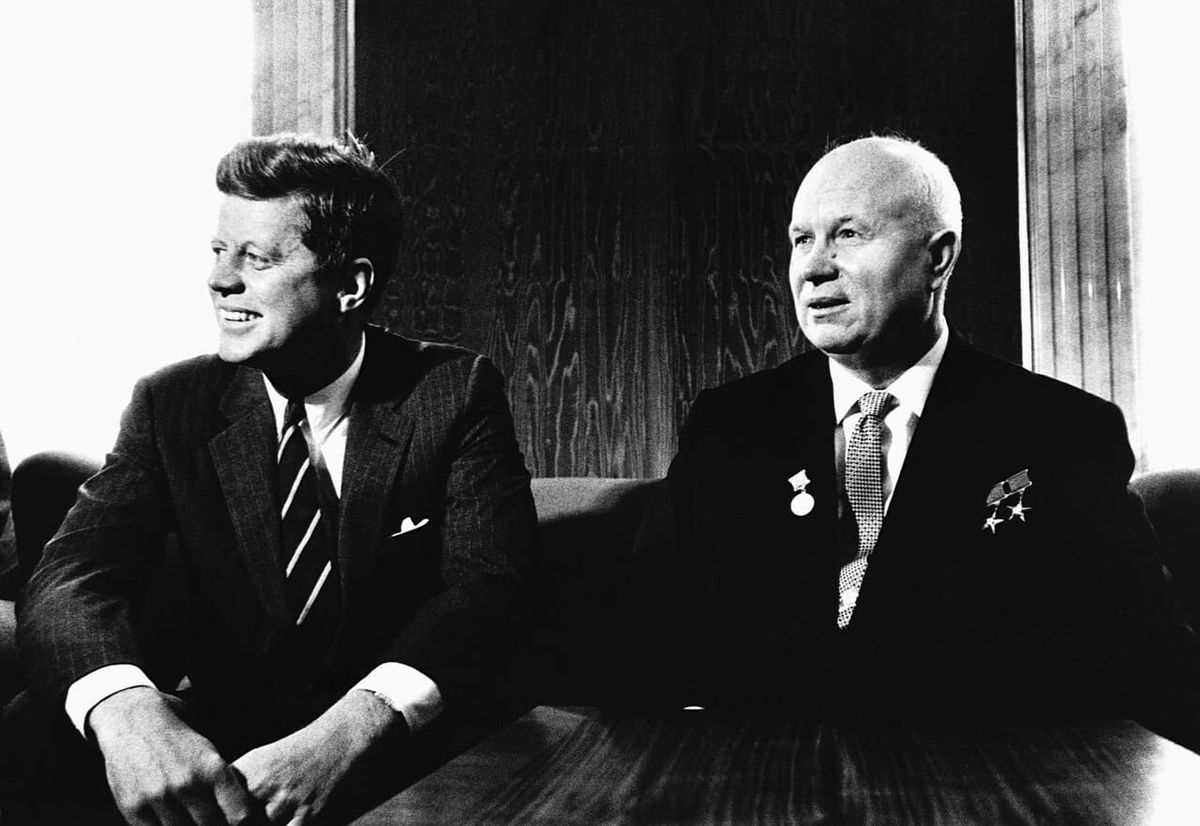
Featured image is John F. Kennedy and Nikita Khrushchev, by Stanley Tretick