
Editor's Notes: Media Consolidation Is More Dangerous Than Media Fragmentation
We need to strengthen truly liberal media institutions.
Like Imperial Japan before us, the United States has substituted tactical and operational planning for strategic thinking.

In late 1941, the leadership of the Imperial Japanese Army and Navy made a series of choices. Since 1937, they had been embroiled in a full-scale war with the Republic of China, over a million Japanese soldiers spread out across the Asian continent, locked in an endless war of pacification against an enemy that simply refused to surrender, no matter how many victories the Empire won. To maintain that campaign, they needed resources—oil in particular. But the US embargo imposed in August 1941 had cut their primary supply. To secure more, they needed to invade the Dutch East Indies. But this would likely mean war with the United States and United Kingdom, and it was unacceptable to the commanders of the IJN that the powerful striking forces of the Royal Navy and US Navy be allowed to set the pace of operations.
"Thus for Japan there was a powerful incentive to attempt the neutralization of American power at the outset of a conflict, particularly because the American position in the Philippines lay astride Japanese lines of communication between the homeland and the intended area of conquest. The Japanese did not dare risk leaving the Philippines unreduced in their rear…But the logic of the argument for attacking the Philippines led to another consideration that was important in its own right. The logic of the strategic situation dictated that Japan did not dare move southwards and leave the whole of her left flank, stretching across thousands of miles of sea, bared to an intact and alerted Pacific Fleet based at Pearl Harbor. The Pacific Fleet was the only force in the Pacific that could seriously contest Japan’s moves, and to strike an American possession without moving against the Americans per se was obviously illogical."
—Empires in the Balance: Japanese and Allied Pacific Strategies to April 1942, H.P. Willmott, Ch. 3
The chain of logic was impeccable—once you had accepted that relinquishing control of any of the Chinese conquests was intolerable, the only option was war with the United States, and once you accepted that, the best option was clearly a preemptive strike aimed at the US Pacific Fleet at Pearl Harbor. That this inarguable series of decisions led to the utter destruction of the Imperial Japanese state and its war aims is also, however, impossible to deny. The heart of this contradiction lies in one of the most famous cardinal sins of military strategy, the confusion of operations (the methods by which you intend to carry out a military campaign) for strategy (the political objectives for which the campaign is being fought). As historian Bret Devereaux explains:
"Perhaps the greatest example of this is the Japanese attack on Pearl Harbor; an operational consideration (the destruction of the US Pacific Fleet) and even the tactics necessary to achieve that operational objective, were elevated above the strategic consideration of 'should Japan, in the midst of an endless, probably unwinnable war against a third-rate power (the Republic of China) also go to war with a first-rate power (the United States) in order to free up oil-supplies for the first war.' Hara Tadaichi’s pithy summary is always worth quoting, 'We won a great tactical victory at Pearl Harbor and thereby lost the war.'"
The Imperial Japanese Navy had been planning for war against the United States since the 1920s, and it did a very good job of maximizing its advantages and minimizing its risks, given how outnumbered it was. In their initial operations against the Allied Powers in Southeast Asia and the Pacific, the Japanese inflicted one of the most rapid, decisive, and humiliating defeats in world history. And yet, as Willmott notes, “One could not ignore the simple fact that not a single operation planned after the start of the war met with success,” (Ch. 3). Brilliant tactical planning and execution did nothing to move Japan towards a political solution to the war. The focus on how to win had eclipsed any discussion of whether or not to fight at all.
Nothing exemplifies this better than the controversy over the Washington Naval Treaty of 1922, which limited British, American, and Japanese fleets to a 5:5:3 ratio. Leadership in the IJN was furious, and denounced it as treasonous because they saw it as impeding their plans for fleet expansion. Of course, Japan physically couldn’t build such a fleet, as the Japanese diplomats understood, and this balance of force was better than an all-out arms race, which the Empire would lose. But as the IJN waxed in influence and power, their demands won out, and in 1934, Japan renounced the treaty. The operational demands of the fleet had once again overtaken the political demands of geostrategic stability.
If there is a lesson from this bit of history, it’s that it is possible to achieve the objectives of your campaign and still lose the war—and you’re more likely to do so if you’re not thinking rigorously about why you’re fighting the war and what you want to gain from it. And so, perhaps unsurprisingly, this has seemed ever-more relevant as we enter the third month of Trump and Netanyahu’s misbegotten war on Iran.
As of now, there is a ceasefire in place, and negotiations ongoing to try and reach a settlement. It is difficult to say how likely these talks are to succeed, given that American and Israeli objectives have been so incoherent. At various times we have proclaimed that our goal is “destroying the Iranian nuclear program” or “regime change” or “securing freedom of navigation” or “degrading Iranian capabilities” or “stealing their oil”, but if you pay attention to the press releases and statements, a pattern does begin to emerge. We hear boasts about the number of combat sorties, lists of Iranian air and naval assets destroyed, reports on leaders assassinated, and estimates of Iranian missile launchers rendered inoperable or drones shot down.
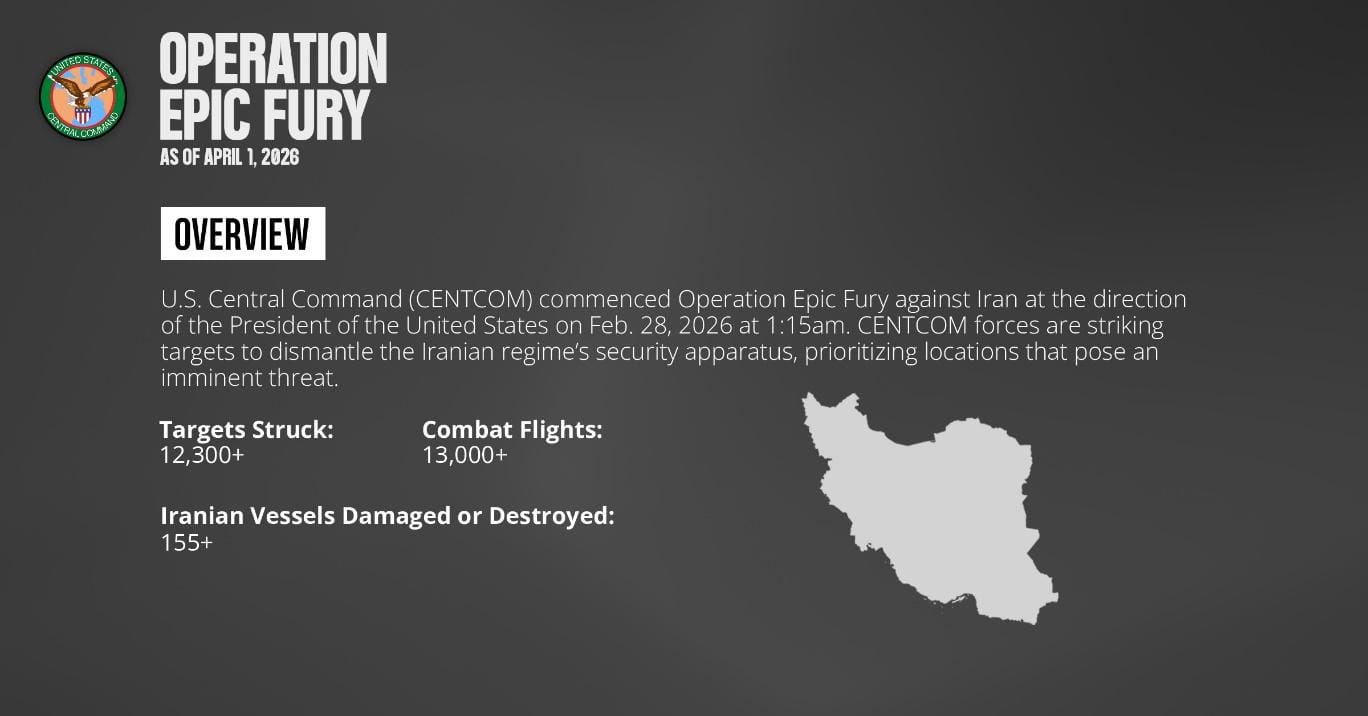
Karoline Leavitt announces that we will stop Iran from producing improvised explosive devices (IEDs), and Prime Minister Netanyahu, in his speech accepting the ceasefire, proclaims that “the State of Israel has achieved immense accomplishments”, and then defines them as “Iran is weaker than ever, and Israel is stronger than ever.” It is of little surprise that he follows that by assuring his citizens that “we still have goals to complete, and we will achieve them either by agreement or by the resumption of fighting.”
Destroying military assets, degrading combat capability, assassinating commanders—these are tactical and operational goals, not political ones. They are methods by which we use to reduce the enemy’s ability to resist our objectives, which are—what? Our campaign appears to be aimed solely at clearing the way for the next campaign, shaping the battlespace for more effective combat and superiority, without any consideration of what an actual political settlement or strategic objective might be. In President Trump’s erratic and irregular victory proclamations, he assures us that even if Iran rebuilds, we’ll “always be[] in a position where the U.S.A. can quickly and powerfully react to such a situation”.
Contrary to popular belief, “war” and “campaign” are not synonymous. If the US and Israel announce that we’ve achieved our objectives and end Operation Epic Fury, but no political settlement is reached or durable ceasefire negotiated, the war is not over. But you could be forgiven for not understanding that distinction, as coverage of this misbegotten adventure has completely elided that distinction. We are not thinking strategically, we are planning operationally. Why is that?
From Israel’s perspective, this perhaps makes sense. Israel, as a state, has been locked in a long struggle with most of its neighbors since 1948, interspersed with periods of intense violence and occasional detentes. Since 1967, the primary mission of the Israel Defense Force has been maintaining colonial control and pacification over the Occupied Territories, a mission that definitionally cannot end. In relation to Gaza, this became known as “mowing the grass”, a term Israeli security professionals used to describe the regular punitive expeditions launched against Hamas—Operation Cast Lead in 2008, Pillar of Defense in 2013, Protective Edge in 2014, etc.
But this is, as experts warned, an attempt to create “security without policy”, using the tools of violence for their own sake, rather than in the service of a broader goal.
"Violence in this context is a tool that can be used in order to forcibly change a political reality. You can clear an irregular force from a given geographic space in order to implement a new political agreement amongst those that inhabit that space. It isn’t just that you kill whatever combatant is there, it’s that you kill them in order to do something else. …
"This all gets me back to the topic of how Israel views the use of violence at an institutional level. When you’re just mechanistically going through the motions of endlessly engaging in punitive strikes like a form of State ritual, you forget to stop and ask what exactly you’re supposed to be using violence for. This sort of institutional culture also affects the range of options for what you actually see as a viable end state."
The 19th century Prussian military theorist Carl von Clausewitz famously wrote in On War (1832) that “war is the continuation of politics by other means.” The point of a military campaign is not to simply kill the enemy; it is to achieve a political goal. Clausewitz also described war as being subject to a “perfect trinity” consisting of:
"Primordial violence, hatred, and enmity, which are to be regarded as a blind natural force; of the play of chance and probability within which the creative spirit is free to roam; and of its element of subordination, as an instrument of policy, which makes it subject to reason alone."
To achieve victory, you must subject your plans and objectives to policy, which is to say reason—the triumph of the intellect over emotional satisfaction. But as Israeli military power has waxed in relation to its neighbors, we have seen the Israeli state fall back on the use of pure violence without an overarching objective more and more. In addition to its occupation of the West Bank, Gaza, East Jerusalem, and Golan Heights, Israel has since occupied large swaths of Southern Lebanon and Syria in recent years, attempting to create a “buffer zone” to maintain security. Israeli demands in both these cases have focused again on the tactical and operational—rather than securing a political settlement or final victory, the goal is to maintain freedom of action for ongoing and open-ended military campaigns. In negotiations with the new Syrian government following the fall of the Assad regime, Israel demanded access to Syrian airspace so as to continue attacking Iran. One is reminded of Paul von Hindenburg’s demand during WWI that Germany annex the Baltic States, “for the maneuvering of my left wing in the next war.”
For Israel, this year’s campaign against Iran is simply a continuation of their 2025 aerial campaign, and a prelude to the next round, in a war that has very little prospect of ending anytime soon. Already, Israeli politicians are talking about carrying the war to Turkey next, in an endless quest for “security” that can never be won. But what about the United States?
Israel, obviously, is not capable of maintaining a permanent state of war across the entire Middle East without American backing, but it has received this support, both implicitly and explicitly, and is now a co-belligerent with us in what I suppose we must call ‘The Third Gulf War’. But whereas the Middle East is of existential concern to Israel, at least three US presidential administrations have now been elected promising to “pivot” away from unwinnable sandpits and endless quagmires. So far, none have succeeded. To understand this, we must return to Imperial Japan, and examine the institution of the Kwantung Army.
The Kwantung Army was established in 1906 as a garrison force to protect the Kwantung Leased Territory—the former Port Arthur, ceded by Russia in the 1905 Treaty of Portsmouth after its defeat in the Russo-Japanese War—and Japanese interests in Manchuria. Isolated from home, with sweeping authority, and their own source of revenue from the opium trade, the Kwantung Army increasingly functioned fully independently from the central government in Tokyo. Civilian cabinets, unable to control the military in the age of so-called ‘government by assassination’, were forced to follow the lead of generals on the mainland, who could set policy by fait accompli, most famously in the Mukden Incident of 1931 and the subsequent occupation of Manchuria and establishment of the State of Manchukuo.
The comparison between the Kwantung Army and CENTCOM—US Central Command, the operational command responsible for the Middle East—is not a new one.
"The structural parallels between CENTCOM and the Kwantung Army are not merely historical curiosities; they reveal a deeper insight into how regional commands can evolve into autonomous centers of gravity that shape national strategy in ways that exceed their original mandates. Both institutions emerged in response to perceived strategic crises: the Kwantung Army from Japan’s concern over continental insecurity following the Russo-Japanese War, and CENTCOM from U.S. anxieties surrounding the collapse of Iran and the Soviet thrust into Afghanistan in the late 1970’s. In both cases, these commands were designed as regionally focused instruments of national policy. But over time, each developed a kind of institutional self-interest, projecting influence upward into national decision-making circles while monopolizing resources and attention."
Rather ominously, the above article, written following the Twelve Day War and Operation Midnight Hammer last year, goes on to warn the reader that
"Where the Kwantung Army ultimately led Japan into catastrophic overreach, CENTCOM has not produced disaster on the same scale, but its gravitational pull has contributed to the erosion of strategic clarity."
In Imperial Japan, the weakness of successive civilian governments and the traditional independence of the military establishment led to a situation where no overarching organ of government could enforce its political will upon the various military interest groups. Strategy or policy were abandoned because there was nobody to set such an agenda, and the tactical and operational demands of combat commands and service branches became paramount. In the United States, the danger is more diffuse but perhaps even more dangerous in the long run: apathy. Since the collapse of the Bush Administration’s neocon dreams, no US Administration has had a coherent or in-depth approach to the Middle East. Instead, through the last three presidencies, we’ve simply kicked the can down the road over and over again. In such a situation, it is inevitable that the interests and objectives of permanent institutions such as CENTCOM will come to dominate in lieu of a more functional foreign policy, and for an operational combat command, it’s not surprising that they focus on operations and combat.
Last year, in the runup to Operation Midnight Hammer, increasing scrutiny was brought to bear on General Erik Kurilla, commander of CENTCOM under both Biden and Trump, and his relationship to Israel. “He had better information about what they were up to and what they were seeing in their intelligence before we got it than anyone else in our government,” sources complained, and there was a palpable sense among observers that the direction of US policy was being influenced not by the White House, or even by the Pentagon, but by the nexus of American military interests on the ground, so to speak. In allowing CENTCOM effective autonomy, the US had inadvertently created an enduring and established interest, one whose gravitational weight has only been intensified by its increasing alignment to the Israeli government and the IDF, another institution with significant influence in Washington DC and an agenda of its own.
Foreign policy under both Trump Administrations has been beset by perennial problems of focus and coherence, driven by the whims of a deeply unstable and senile chief executive, and often determined by the opinions of whoever has last gotten the president’s ear. Amidst that chaos, CENTCOM’s ability to provide immediate options, resources, and operational plans have created the illusion of inevitability. Trump might have been just as happy invading Greenland or bombing Canada as he is avenging Operation Eagle Claw, but it is Iran where the strategic inertia has been gathering for years, and where the institutional interests conformed to his own proclivities. According to former Secretary of State John Kerry, Prime Minister Netanyahu had tried to convince Presidents Bush, Obama, and Biden to join in an attack on Iran. All three refused, but the idea remained an obsession among some Israeli and American security professionals, waiting for a president willing to gamble everything on it. The existence of this nexus of strategic inertia, resources, and institutional interests ended up pulling Trump in the direction of least resistance. As Karl Marx once wrote “Men make their own history, but they do not make it just as they please; they do not make it under circumstances chosen by themselves, but under circumstances directly encountered, given and transmitted from the past.” If all you have is a hammer, after all…
Which is how we have found ourselves locked in an utterly pointless war with Iran, fighting to secure the conditions to fight the next war, which will be fought to preserve the gains of this war, which was to establish a position of superiority in regards to the next one. The subordination of strategy to operations in Imperial Japan doomed the Empire, and plunged it into the apocalypse of the Pacific War. It is unlikely that American misadventures in the Persian Gulf will be quite so existential. But the damage is real, nevertheless. Much like Japan, we have rejected diplomatic agreements that might have avoided war, specifically because they might interfere in our ability to fight it. And much like Japan, we now find ourselves committed to an endless quagmire on the Asian mainland, where even outright military victory is unlikely to make up for the economic and diplomatic damage to our world position.
The US has the weight of industrial and military power to waste, if we want to. But even our reservoirs are not unlimited. As we move inexorably into a more multipolar world, it would behoove us to relearn how to think strategically and politically, rather than just fighting wars because that’s the easiest decision to make.
Featured image is "The Surrender of the Kwantung Army," CC-BY Attribution 4.0 Pavel Fedorovich Sudakov 1948.

Get a copy of The Reconstruction Papers while inventory lasts, and reserve a copy of next year’s issue.

Liberalism's problem isn't structural. Liberalism's problem is that we got out-hustled.

Anton Jäger’s "Hyperpolitics" is, at its best, late marginalia for "The End of History and the Last Man." At its worst, Jäger, like Fukuyama, is a prisoner of his political pieties.

Twenty-plus years on, it’s time they started adapting to the realities of the era.
Sign up for the newsletter and get our latest stories delivered straight to your inbox.
