The Pain Is the Plan
MAGA is actively seeking to immiserate the country in order to cement their power over the rest of us.

Economic policy under Donald Trump has been an attack on most of the articles of faith that guided the post-World War Two consensus. Trump’s tariffs, a policy he had long promised, were prior to their implementation treated as a kind of high-stakes bluff by many pundits because it seemed implausible that any U.S. president would do something so disastrous for global trade. At the same time, Trump and the rest of the GOP have been able to do something they’ve promised for more than a decade: aggressively slash what remains of the social safety net in the United States. Both moves are massive blows to impoverished, working-class, and even middle-class Americans.
Taken together, this is all a recipe for economic disaster. MAGA Republicans gutting the social safety net isn’t a surprise if you were paying attention in the 2010s, but attacking the global trade system is transparently self-defeating. It’s a net loss for the country, but that might be the point. The economic consequences aren’t a side effect of making the rich richer, or the result of ignorance on Republicans' part. For some of them, it increasingly feels like the pain is the plan: they’re actively seeking to immiserate the country in order to cement their power over the rest of us. There are many reasons the Trump administration valorizes factory work (it’s seen as more masculine, it taps into people’s nostalgia), but hard to miss is the fact that they actively hope people will stay in these jobs for decades at a time—in essence, that people will be trapped in them.
There have long been strains of this push-'em-down attitude in American life, and it’s even been given a name: "mudsill theory," from a speech given by South Carolina Senator James Henry Hammond in 1858. Seeking to justify slavery, Hammond claimed that “In all social systems there must be a class to do the menial duties, to perform the drudgery of life. That is, a class requiring but a low order of intellect and but little skill. Its requisites are vigor, docility, fidelity. Such a class you must have, or you would not have that other class which leads progress, civilization, and refinement. It constitutes the very mud-sill of society and of political government…” Even as it was intended as a barb against northern wage-labor, it’s still a striking insight into the views of the planter aristocracy and their need for a lower-tier population.
Variations of mudsill theory run through American life. At times it’s couched in more moralistic terms: it might make a virtue out of toil and the difficulty of being working-class. Recall Andrew Mellon’s puritanical attitude at the onset of the Great Depression, when he told President Herbert Hoover to “liquidate labor, liquidate stocks, liquidate the farmers, liquidate real estate… It will purge the rottenness out of the system. High costs of living and high living will come down. People will work harder, live a more moral life.” More recently, Russell Kirk argued in The Conservative Mind that aristocracy was “in part natural, and in part artificial; but in no state can it be eradicated…” before later adding that “the middle classes, by their example, convince the mass of people that aggrandizement is the object of existence. And once the masses embrace this conviction, they do not rest until the state is reorganized to furnish them with material gratification.”
Mudsill theory is not uniquely American, but understanding its global dimensions helps us to see how normal it is among would-be elites. Portugal under the dictator Antonio de Oliveira Salazar is an instructive example. Portugal spent nearly five decades under authoritarian rule under the Estado Novo regime, which formally began in 1933 (though it had its roots in a 1926 coup) and which persisted until the Carnation Revolution in 1974. Salazar’s Portugal was a deeply repressive place: the secret police, the PIDE, infiltrated every dissident political group in Portugal and its overseas territories. Opponents were tortured or assassinated and elections were rigged. The country was socially repressive as well: through the 1950s, you needed a license from the government in order to buy a cigarette lighter.
Portugal was also an exceptionally poor country: until the end of the Estado Novo government, it lagged behind every other state in western Europe economically and socially. Adult illiteracy was commonplace into the 1970s, but this wasn’t seen as a problem by many in the regime. “I consider more urgent the creation of elites than the necessity to teach people how to read,” Salazar said in 1932, and other regime figures went further. Querubim Guimaraes, another functionary in the Estado Novo, suggested that Portugal’s greatest periods of glory in the Age of Discovery had been accomplished with widespread illiteracy—why was it a problem now?
In other economic matters, Salazar was wary of seeing too much growth precisely because it would undermine the goals of the state in preserving traditional Portuguese society. When oil was discovered in Angola (then a settler colony), Salazar’s response was “What a pity!” Keeping the population strategically impoverished kept them in their correct place in society and preserved the privileged position of the elites: leaders in the Catholic Church, large landholders, large business owners, and a few highly educated individuals. In this worldview, there was a natural hierarchy that rewarded an aristocratic elite: its position relative to the mass of people was more important than the wild pursuit of wealth.
Salazar’s Catholicism might be completely foreign to somebody like Peter Thiel, but the respect for hierarchy and the desire to foster it using the state is nothing new. Economic libertarians like Friedrich Hayek were fond of Salazar; Hayek also sought to cast wealthy businessmen as a kind of better elite than old hereditary aristocracies. Thiel or Musk probably haven’t read Russell Kirk, but emotionally, they like the attitudes he represents. What we’ve arrived at today is old wine in new bottles, repackaged in such a way that it can work for the disparate threads of the MAGA coalition.
Today, we can see this kind of defense of hierarchy best in Silicon Valley. Marc Andreesen’s "Techno-Optimist Manifesto" places a kind of boundless optimism in the ability of technology to create supermen who will deliver the future to the rest of us: all we have to do is not place any limitations on them. Peter Thiel thinks that technology itself should be a substitute to politics, allowing people (like him) to do what they want while bypassing people. Elon Musk thinks democracy should be replaced with an insufferable council of “high status males.” An electoral alliance of these techbros with Christian Nationalists has been fraught in its way, but the latter share fundamentally anti-Democratic ideals and a clear preference for hierarchy.
One of the best takeaways those of us on the left or the center can hold is that tariffs, the annihilation of the safety net, aggressive tax cuts, and all of their other fiscal policies are not about enrichment as an end unto itself: they’re about impoverishment as a means to reinforce hierarchy. Democrats and anybody who opposes MAGA can simply attack their bad-faith attacks on democracy and liberalism as they are, which also means Democrats don’t need to meet MAGA in the middle or include their ideas going forward. As Samantha Hancox-Li wrote elsewhere for Liberal Currents, taxing billionaires is important less as a means to fund the welfare state than as a way to stop them from amassing far too much power. They’re making their intentions very, very clear.
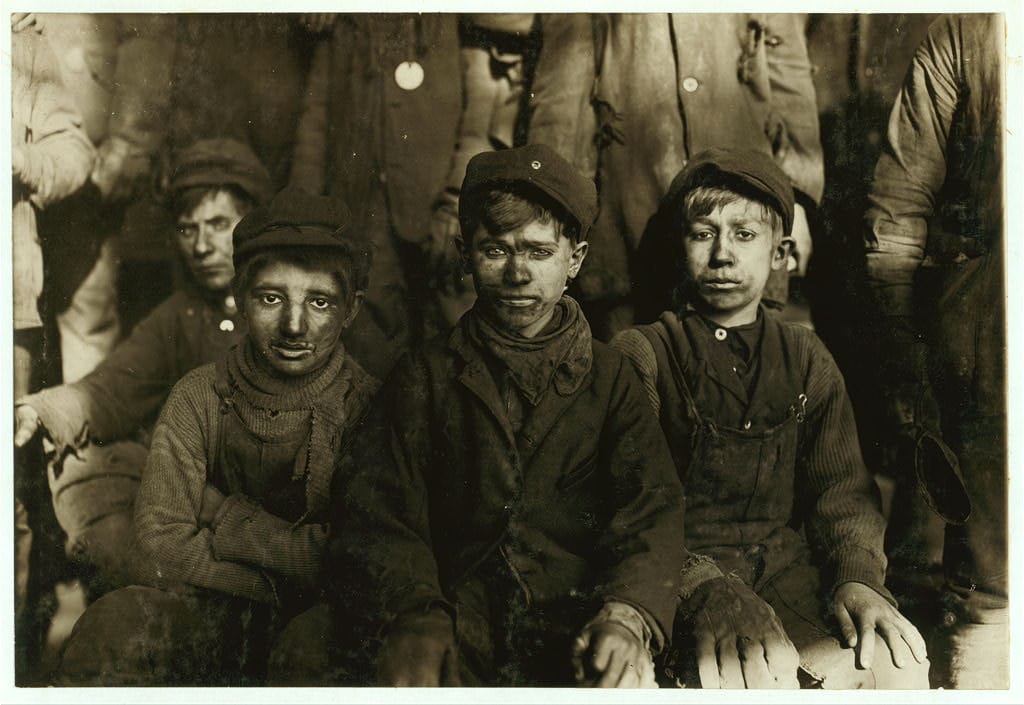
Featured image is Group of Breaker boys, by Lewis Wickes Hine