The Security Leviathan
The American path in state-building is heavily skewed towards security and control.
Following decades of unprecedented expansion in security, detention, and surveillance, the United States government’s competence in militancy and punishment is now so dominant that it threatens to eclipse its other activities and ambitions.
We are close to a point when, regardless of who is elected, the government will function like a hammer and every problem will look like a nail.
As a result, at this critical juncture, opposition to the Trump administration will have to decide whether to offer a strategic vision for the direction of the American state, or cast their movement as an objection to just one person, a particular agency, or a certain issue viewed in isolation and presented as aberrational.
Undeniably, delineating problems in narrow terms facilitates election victories, allowing opponents to attract as many Trump voters as possible by repudiating as little as possible.
And yet at a certain point, lodging only discrete, marginal objections distorts what is true.
After all, the defining singularity of the American political system is not any given strongman or the difficulty posed by robust immigration in a stagnant working-class economy. Other countries wrestle with these as well.
It is rather the distinctive American path in “state-building,” a term of art to describe the institutions and policies of government. In plain terms, force is the language of the American state. A government heavily weighted in favor of security and surveillance makes the choice of a strongman more terrifying, and the divisions over issues like immigration more painful and consequential.
And it does much more besides.
Considered from the zero-sum perspective of budgets, the direction of American policy becomes emphatically clear. Amid a policy debate among Democrats worried that they can no longer “build things,” proponents of conservative state-building host job fairs overrun with applicants and sponsor a detention-industrial complex unmatched in the developed world. As rural hospitals and schools close in places where work has disappeared, prisons built in these same communities employ guards who earn a secure salary with benefits. While ordinary Americans struggle to pay for health care and the Social Security Administration endures budget cuts that jeopardize the delivery of essential benefits, the United States spends more on its military budget than the next seven countries combined. In fact, legislators in Congress compete every year to find who can most exceed the Pentagon’s budget request–despite the fact that, unlike every other executive department, the Defense Department cannot pass an audit and account for the trillions it spends.
Security state-building supplies a dependable job in an age of precarity; opportunity in an era of downward mobility. It is poised at the ready and studded with capabilities, drawing reinforcement from its many components.
Our current crisis of immigration illustrates this well. The “war” on drugs and the prisons built to wage it make possible what Kristina Shull calls the “detention empire” of migrant custody. As the result of the war on terror, police equipped with access to cross-sectional data meant that, once recruited into immigration enforcement, local law enforcement could arrest undocumented migrants at breakneck speed–often for trivial infractions–a phenomenon Elliot Young terms “crimmigration.”
To oppose these developments by calling for the abolition of ICE, the Immigration and Customs Enforcement Agency–or more broadly, to depict our current moment strictly in partisan terms and animated solely by the force of racism–strikes me not as wrong, but as so incomplete as to be wholly inadequate.
Security state-building has deeper roots in our past and broader support in our political establishment. In wars waged against drugs and terror, the hostility to difference, including crude forces of racism, are assigned an ostensibly “problem-solving” mission, one that is capable of recruiting a diverse workforce to its cause. A person cannot point to a summit (like ICE), avid trailblazers (like the Trump administration), or tectonic plates (like racism), and claim to have surveyed a mountain.
The mountain is the decades of over-investment in, and the cross-pollination between, various strands of the security state.
Stepping back to view this empire of force and punishment, it is important to remember that the impressive scale of security state-building does not mean that its tools offer the only or most appropriate way to approach a problem.
As a rule, these policies and institutions are not evaluated according to whether they solve or even make progress on the problems they purport to address. Instead, security state-building is reviewed according to its routine activities, or policy “outputs,” allowing them to function and be funded without having to prove much at all.
Take the drug war as an example. Government evaluations of militant supply-side counternarcotics policy quietly point out the failure to evaluate spending for its effects on the drug supply, and research on the subject strongly suggests that such evaluations would not be favorable. (Enforcement actually encourages drug traffickers to evolve into more agile and innovative networks.) But no one inquires after the net or cumulative effect of seizures and arrests.
Without a destination in mind, it’s hard to know when, or whether, you’ve arrived. The failure to prioritize outcomes in evaluation leaves politicians with only procedural objections to extralegal killings in the Caribbean–or any other form of escalation along any other register of security state-building.
And escalation is a certain result. Force, when presented as an end in itself, makes an ideology out of a method and commits adherents to a path of belligerence. In the race to spend money without accountability to clearly identified goals, unchecked security state-building drowns out the voices of those disposed to treat force as methodology and tie it to meaningful endeavors, like splashing ships on par with China or restocking critical munitions to keep pace with modern warfare. Pursued without priorities and restraint, security state-building is not even good for the security state.
This pattern of escalation is most apparent in the recent decision of the Trump administration to go to war with Iran without securing authorization from Congress. The military objective most frequently cited by President Trump—depriving Iran of the materials and capability to manufacture nuclear weapons—had already been achieved by the multi-lateral diplomatic agreement on sanctions negotiated by President Obama, and later abandoned by Trump in his first term.
Truly, this is war for only war’s sake.
Such a grim picture puts us in mind of the admonitions issued by the founding fathers. Unbridled security state-building sustains networks of power and ways of thinking that resemble the praetorianism they feared. As students of ancient history, these men would see clearly that the real purpose of the war with Iran—or deploying the military to American cities, or masked agents engaged in pretextual stops to detain immigrants—is to furnish a spectacle, converting citizens who should participate in power into mere spectators of imperial force.
Without question, the failure to weigh security state-building against alternatives and according to outcomes represents our most significant departure from the constitutional compact. So far have we strayed, in fact, that is unlikely some neatly plotted, well-polling political position will correct our course.
Instead, we must speak as the founders did, in explicit terms about state-building that will serve our vision of justice and freedom. Most of all, we must hold spending accountable to outcomes in all varieties of state-building.
There is no better place to start than the Pentagon. In 2024, the think tank RAND noted that the United States lacks the independent oversight of defense spending that is the norm among allies. Doubtless other options exist to reorient and massively reduce spending on the military, but doing so should be regarded as the central problem of our politics.
It is time diagnose what ails us—not describe symptoms, but the disease itself: a security state-building project that dictates political realities for its citizens, as opposed to the reverse, the governing reality of a functioning republic.
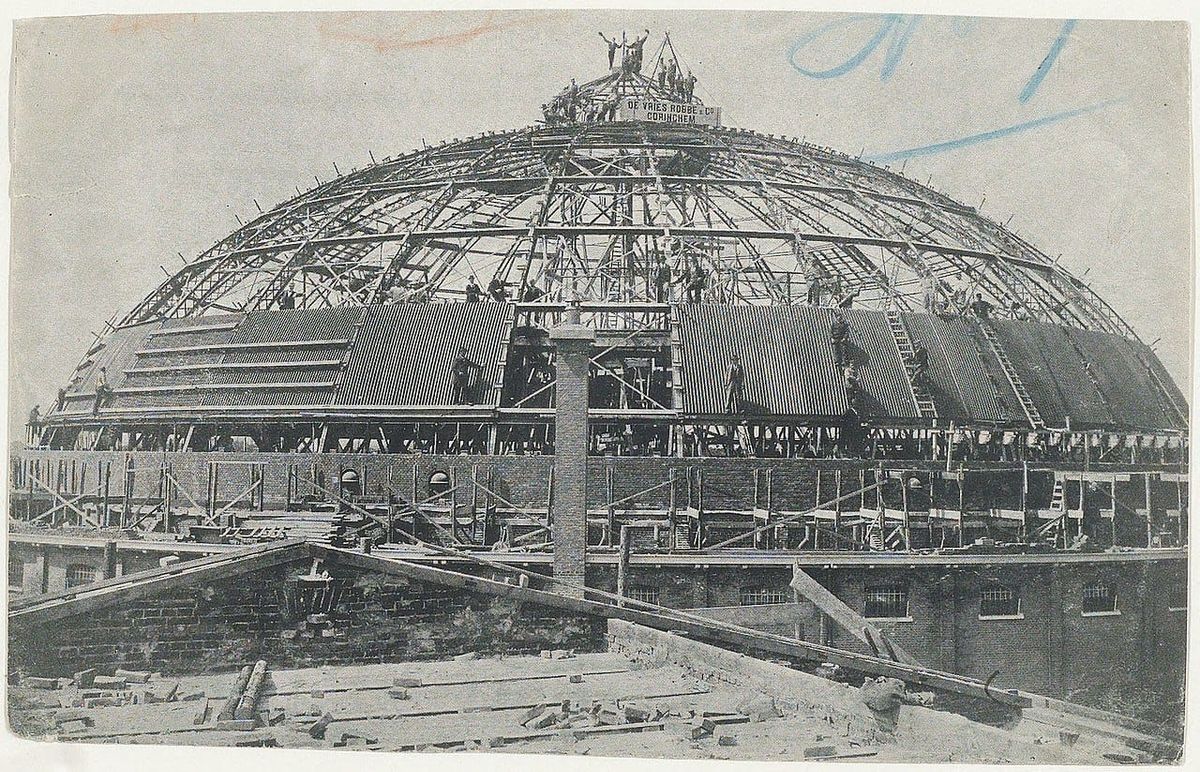
Featured image is the Koepelgevangenis in Haarlem under construction