The Spirit of the Laws
The Constitution is not in heaven. Without honorable and virtuous public officials, constitutional limits have no meaning.
Unfortunately, American voters are ‘‘learning the Constitution’s limited ability to mitigate the consequences of their choices,’’ says George Will, a long-time columnist for the Washington Post. ‘‘Neither the language of the law (constitutional or other), nor what are now shadows of norms, can substitute for what is indispensable: an occupant of the presidency whose constitutional conscience causes him or her to distinguish the proper from the merely possible.’’ If the president is unscrupulous and Congress appears inadequate to the task of holding the president accountable, then what can be done to rescue the republic from moral degeneration? There are many sensible answers to this question, but perhaps none more daunting to policy wonks than a call for civic and spiritual renewal that restores a respect for the moral worth of the liberal tradition.
As Benjamin Constant explains, ‘‘the inherent moral merit of the laws is, let us dare assert, far less important than the spirit with which a nation subjects itself to its laws and obeys them,’’ (Political Writings p. 75). When politicians fulfill their oath to uphold the Constitution, when lawyers faithfully exercise the duties of law, and civil servants proceed to do their work with impartiality, they often do so out of a sincere conviction in the moral greatness of their work. Danielle Sassoon, a New York federal prosecutor who rejected the president’s order to drop a corruption case against mayor Eric Adams, described her belief in ‘‘enforcing the law impartially, and that includes prosecuting a validly returned indictment regardless of whether its dismissal would be politically advantageous, to the defendant or those that appointed me.’’ A Harvard and Yale graduate with an impeccable conservative record (a member of the Federalist Society and a clerk for Judges J Harvie Wilkinson III and Antonin Scalia), she explained that both men ‘‘had instilled in me a sense of duty to contribute to the public good and uphold the rule of law, and a commitment to reasoned and thorough analysis.’’
This is not mere conceit. Those who choose to uphold the law in the face of extreme pressure from the executive to compromise, obfuscate, sell out, do so out of reverence for the laws of the country and the perceived awesomeness of the American constitution and its long line of storied defenders. One such venerated defender of the constitution was Daniel Webster. A product of Dartmouth, Webster argued that in the historic ‘‘contest for liberty, executive power has been regarded as a lion which must be caged.’’ Far from being ‘‘considered the natural protector of popular right,’’ he explained, ‘‘it has been dreaded, uniformly…as the great source of its danger.’’ Only the ‘‘watchfulness of executive power,’’ he further insisted, could keep this wild menace within safe bounds of the public.
If watchfulness is indeed the key word here, then it is imperative that public servants see it as their job to ‘keep an eye’ out for any sign of executive tempestuousness. When extremists plot to fill the White House with hyperpartisans who are first and foremost loyal to the president, rather than loyal to the Constitution, principled liberals must gear up to repel this assault on constitutional norms. In late October 2024, ProPublica published disturbing evidence of a careful and detailed plan by Russell Vought and his political acolytes to replace career bureaucrats with loyalists who would serve the president’s interests. Now heading the White House Office of Management and Budget (OMB), Vought sees it as his job to remove any administrative obstacle that might stand in the way of the president enacting his agenda. A ‘‘master of the arcane rules that get legislation passed or killed,’’ Vought proudly declared in a 2024 speech for the Center for Renewing America (a MAGA think thank), ‘‘I don’t want President Trump having to lose a moment of time having fights in the Oval Office about whether something is legal or doable or moral.’’
Yet, as some of the most exceptional liberal jurists have convincingly argued, whether a law is not merely legal but moral is very much a matter of concern to sound lawyers. It was Ronald Dworkin’s well-considered view, for example, that judges must ‘‘do our best, within the constraints of interpretation, to make our country’s fundamental law what our sense of justice would approve, not because we must sometimes compromise law with morality, but because that is exactly what the law, properly understood, itself requires,’’ (Justice for Hedgehogs p. 415). Because law-making and enforcement is a process with grave moral consequences, its formulation and dispensation cannot be arbitrary. Law, as Daniel Webster explained, is by its very nature rational. It is not a ‘‘transient sudden order…but something permanent, uniform and universal.’’
In the words of legal scholar Timothy Sandefur, the concept of law includes certain rational elements such as clear formal rules and procedures, without which a legislative enactment cannot be ‘‘law’’ in any real sense. He explains it this way: ‘‘Law is the use of government’s coercive powers in the service of some general principle; that is, under some intelligible theoretical regularity, and not based on the mere ipse dixit of the legislative body. Law is the use of coercion for public purposes, not for the personal interest of the lawmaking authority.’’
So understood the Trump administration’s disfigurement of both the letter and spirit of the law to fit the personal vanity and passing vendettas of the person who, let us remember, was originally appointed by the American founders to preside over the faithful execution of the law is itself a shameful repudiation of the elementary principles of American jurisprudence. Under normal circumstances, such a frontal assault on the historic legal norms of the republic should have galvanized the entire apparatus of law-making in America against a rogue executive and its disloyal elements within the administration. That open talk of ‘regime change’ and ‘insurrection’ has not brought down the swift legal fury of a variegated band of constitutionalists is a reproach in itself.
There are, of course, notable exceptions. The most remarkable piece of legal writing to come out of the Trump era so far is not the Mueller report or the New York County Grand Jury indictment, but a morally charged opinion delivered by Judge William G. Young of the District of Massachusetts. A Reagan-appointed jurist who earned his law degree at Harvard Law School, Judge Young’s damning 161-page opinion is not merely a rebuke of the Trump administration’s harassment, detention, and deportation of non-U.S. citizens, it is also an exposition of the historical reasons why such constitutional checks exists in the first place.
In response to a letter sent by an impudent troll asking the experienced judge what the opposition could possibly do to stop a president with tanks, Judge Young answered: ‘‘Alone, I have nothing but my sense of duty…Together, we…you and me—have our magnificent Constitution.’’ Almost carried away by feelings of solemnity, Judge Young confesses that ‘‘each day, I recognize (to paraphrase Lincoln again) that the brave men and women, living and dead, who have struggled in our Nation’s service have hallowed our Constitutional freedom far above my (or anyone’s) poor power to add or detract.’’
Such an elevated, quasi-religious view of the Constitution naturally lends itself, however imperfectly, to a defense of traditional norms of jurisprudence. Speaking of the observance of established laws, Constant noted that ‘‘If it cherishes them and observes them because they seem to it derived from a sacred source, the legacy of generations whose ghosts it venerates, then they fuse themselves intimately with its morality, they ennoble its character, and even when they are faulty, they produce greater virtue,’’ (Political Writings p. 75).
It was John Adams’s sincere hope that the American people would so fasten themselves to the noble principles of ancient republics. Absent a thorough moral education in the science of history, properly understood, Adams worried that even the most morally robust patriot would eventually fall into fatal moral disrepair. As early as 1776 Adams saw the threat of moral decadence as a potential source of the republic’s downfall. He complained to his beloved wife Abigail, ‘‘there is too much Corruption, even in this infant Age of our Republic. Virtue is not in Fashion. Vice is not infamous,’’ (Fears of a Setting Sun p. 104). A people with little to no ‘‘positive Passion for the public good, the public Interest,’’ was not fit for ordered liberty. What was required to create men and women of virtue, he discerned, was the edifying power of a civic religion, which he saw as ‘‘the only Foundations…of Republicanism and of all free Government,’’ (Fears of a Setting Sun p. 111).
In Adams’s mind, good governance was a two-step process. The imperfect nature of men required the separation of powers and associated checks and balances. These regulations then needed to be enforced by virtuous officials. Adams believed that the system that he and other American founders were erecting could only work under the policing of trustworthy vigils. Only under ‘‘a moral and religious people,’’ Adams famously insisted, could such a society flourish. ‘‘It is wholly inadequate to the government of any other,’’ (Fears of a Setting Sun p. 106). There was a time, especially during the period of war and constitutional debate that preceded his presidency, when Adams thought republican institutions would be sufficient to do the heavy work of raising morals and rebuking aspiring tyrants. Alas, as historian Dennis Rasmussen notes in Fears of A Setting Sun, this optimistic view receded after Adams’s visits to Europe. The sights and sounds of the Old World raised fresh doubts about the capacity of humans to engage in self-government: ‘‘I fear that human Nature will be found to be the same in America as it has been in Europe,’’ (Fears of a Setting Sun p. 110). Doubts aside, Adams never abandoned his faith in the necessity of a good constitutional design to challenge the monarchical bent of the executive branch.
Like Madison, Adams did not wholly rely on the religious inculcation of good morals to sustain the republic. Adams’s pessimistic view of human nature, born no doubt out of his unmatched study of the rise and fall of republics, meant that a president could not be trusted with undivided power. It was certainly the case that the president, along with all the other office holders and politicking men, were expected to be men of exceptional virtue, distinguished in their communities by wisdom, prudence, and good repute, but the Americans founders did not leave the safety of innocent men and women to the good motives of mortals. If and when these distinguished gentlemen of the republic abused their power, the law would be there to check them.
The problem with unlimited government, as Constant perceived it, was that it allowed powerful chieftains to act hors-la-loi, creatures that operate outside of the law. This undermined the principle of equality before the law, and spread injustice by allowing officials to act with impunity. When ‘‘individuals go astray, the laws are there to check them,’’ said Constant, but when the government goes wrong, ‘‘its mistakes are fortified with all the weight of the law.’’ Under such a regime, Constant concluded, ‘‘the errors of government are generalized, and condemn individuals to obedience,’’ (Commentary on Filangieri's Work p. 41). Only a moral people, educated from birth to see the executive power as a potential site of Caesarean tyranny could hope to remedy this form of injustice.
To adequately meet this challenge Adams encouraged the proliferation of the arts and the study of history and law. Adams’s core belief in the necessity of spiritual formation for civic excellence was evident in his draft of the 1779 Massachusetts Constitution. Because ‘‘wisdom, and knowledge, as well as virtue; diffused generally among the body of the people, [are] necessary for the preservation of their rights and liberties…it shall be the duty of legislators and magistrates, in all future periods of this Commonwealth, to cherish the interests of literature and the sciences, and all seminaries of them…to countenance and inculcate the principles of humanity and general benevolence, public and private charity, industry and frugality, honesty, punctuality in their dealings, sincerity, good humour, and all social affections, and generous sentiments among people,’’ (Fears of a Setting Sun p. 109).
Throughout its pedigreed history, the commonwealth of Massachusetts has produced an honorable record of public service, in due part to this government’s dedication to civic virtue. If the long-term goal of the resistance movement is to reproduce the courage of men and women of principle and constitutional conscience like Sassoon and Young, then the work of reconstruction that liberals will have to undertake once Trump is gone will inevitably have to be one of spiritual and moral formation: soulcraft.
As Benjamin Constant and George Will both clearly recognize, without honorable and virtuous public officials, constitutional limits will have their limits. This is not of course to suggest that legal blockades don’t work or don’t matter (they evidently do). The aforementioned is intended to remind liberals of all stripes that these mechanisms of restraint are most effective when individuals of good will and virtue are eager to enforce the rules of political conduct. Constitutional rules, Constant contended, must be maintained, sustained, and strengthened by a passion for civic virtue. This view of the role of both the vigilant citizen and public servant is intended to bolster, not negate, institutional restraints. When laws are set up to reduce the likelihood of state oppression, and the people are jealous to enforce a public respect for the rule of law, men and women go about their business in peace and children sleep better at night.
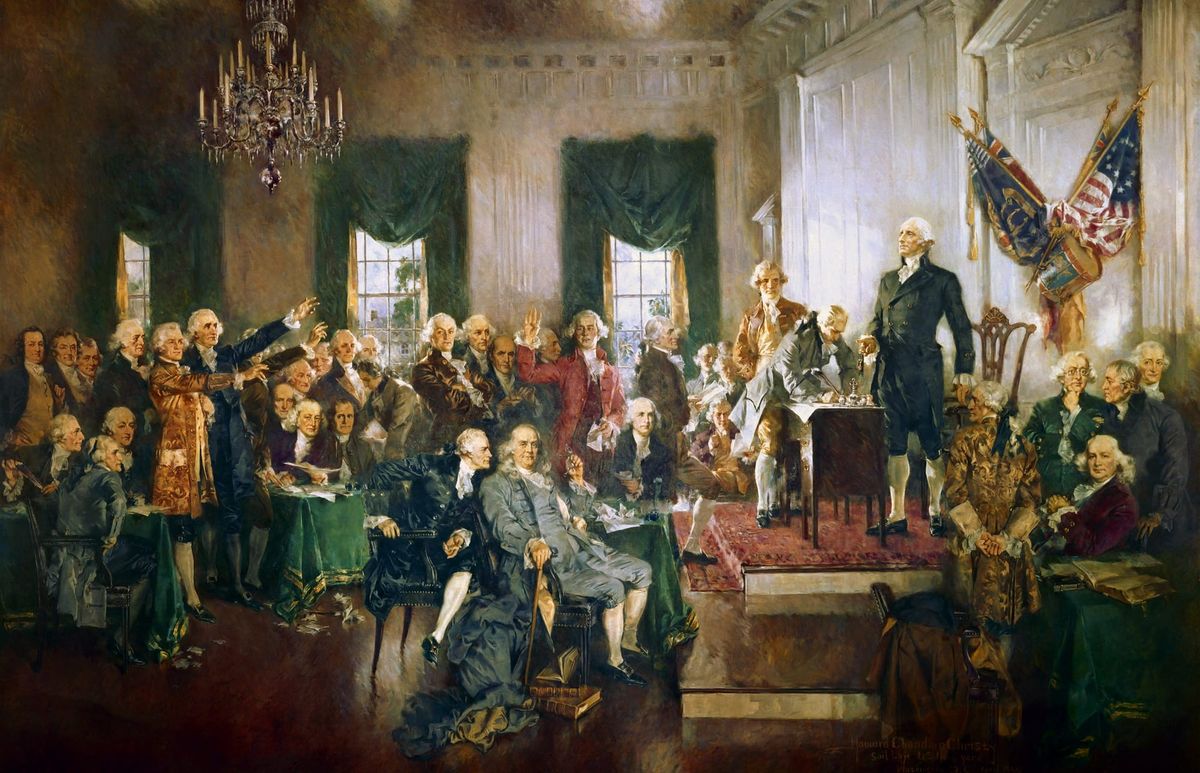
Featured image is "Scene at the Signing of the Constitution of the United States," Howard Chandler Christy 1940.