The Supreme Court Lives in Fox News' America
A Court that does not share a common factual world with the people it governs is untethered from democratic reality.
The Supreme Court has never been a democratic institution in any robust sense. From its inception, it has been insulated from popular pressure, staffed by elites, and oriented toward protecting property and hierarchy. For most of its history, it functioned as a brake on democratic change rather than an engine of it. And yet, over time, even this deeply conservative body proved somewhat responsive to shifts in public understanding. Its most infamous failures, such as Plessy v. Ferguson, were not undone by sudden moral awakenings among justices, but by a transformation in social reality that made the old order increasingly untenable. Brown v. Board of Education reflected not judicial heroism in isolation, but a Court belatedly catching up to a world that had already begun to move.
What most distinguishes the present Supreme Court is not merely its conservatism, or even its willingness to roll back settled rights. It is the degree to which the conservative majority appears severed from shared facts altogether. This is not accidental. The modern conservative legal movement, organized and disciplined through institutions like the Federalist Society, has spent decades constructing a parallel professional universe. Within it, judges are selected, rewarded, and elevated precisely because they resist evolving norms and remain ideologically pure. Generous funding, elite networking, and guaranteed career advancement have created a judiciary that does not need to persuade the public—or even understand it—in order to wield power.
That insulation would be incomplete without a corresponding transformation in the media environment. Conservative media did not simply emerge to reflect right-wing opinion; it actively reshaped it. Fox News, beginning in the 1990s, pioneered a model that went beyond partisan framing. It offered viewers a coherent alternate reality, one in which conservative grievances were always validated, liberal misconduct was omnipresent, and structural problems were either denied or blamed on convenient enemies. Over time, this model hardened. Facts that contradicted the narrative were not debated but excluded, while emotionally resonant stories—no matter how thinly sourced—were endlessly recycled.
As the conservative media ecosystem expanded to include talk radio, online outlets, and social media influencers even more detached from reality, the result was informational saturation. Viewers were not merely misinformed; they were comprehensively insulated. A Fox News audience member could watch hours of programming without encountering basic, widely reported facts that defined mainstream coverage elsewhere. This was not a bug of the system—it was the point.
Viewers are never shown sustained coverage of Donald Trump’s visible cognitive decline—his falling asleep during meetings, wandering away from foreign leaders, or appearing confused and disengaged in public settings—despite such incidents being widely documented elsewhere. They are not told about the massive corruption of the Trump administration, including the use of pardons and access as leverage for massive financial benefits tied to Trump’s crypto ventures. Nor are they confronted with the catastrophic human consequences of Trump’s unilateral shuttering of USAID, or that this and other unilateral funding cuts and effective department closures are blatantly unconstitutional. By systematically excluding stories that would portray Trump as corrupt, incapacitated, lawless, or lethal in his policy choices, Fox constructs a version of reality in which none of the most damning facts exist, leaving its audience unable to evaluate power as it is actually exercised.
This epistemic divide now plainly extends to the Supreme Court. Evidence of the justices’ immersion in conservative media occasionally surfaces during oral arguments. Neil Gorsuch’s reference to “P'Nut the Squirrel,” a symbol of a fleeting right-wing outrage cycle that barely registered beyond conservative media, was baffling to outside observers but instantly legible within that world. Samuel Alito’s hypotheticals often seem surreal until one recognizes them as echoes of Fox News segments or talk radio monologues rather than legal records.
More alarming is how this alternate reality shapes doctrine. In Kennedy v. Bremerton School District, Gorsuch’s opinion embraced the conservative fantasy of widespread Christian persecution. The case was framed as a vindictive campaign against a modest, private act of faith by a football coach. This required disregarding photographic and testimonial evidence showing a highly public, coercive prayer ritual at the center of a school-sponsored event. For anyone grounded in the factual record, the characterization was untenable. For someone steeped in years of programming about besieged Christians, it felt obvious.
The same pattern emerged when the Court intervened to restore Texas’s gerrymandered electoral maps. Conservative justices invoked the idea of the recent retaliatory Democratic gerrymander in California, despite that having no bearing at all on the fact that Texas’s gerrymander had been explicitly based on race, in line with direction from Trump’s DOJ. Aside from clearly demonstrating that the politics of the case was on their minds at least as much as the actual law, the justices probably didn’t even realize it was unusual. Republicans already had an undemocratic structural advantage in the House due to gerrymandering, but somehow conservatives have placed themselves as harried defenders of democracy, where their all-or-nothing tactics are framed as reluctant efforts meant to fix a system that Democrats had supposedly already rigged in their favor.
Increasingly, the Court has gone further, treating lower courts not as neutral fact-finders but as obstacles to be bypassed. When trial courts compile extensive records that conflict with the conservative justices’ assumptions, those findings are brushed aside, and the problem has gotten so bad that even usually deferential lower court judges have started to push back. The judiciary’s traditional claim to legitimacy—that it is bound by evidence and constrained by reality—erodes accordingly.
This helps explain the puzzlement surrounding Chief Justice John Roberts’s recent year-end report. Many on the left reacted with disbelief at his insistence that the constitutional order “remains stable and resilient” even as Trump shows absolute disdain for the Constitution and the Court enables it. Others projected onto him the hope that he was subtly signaling concern about authoritarianism, reading coded warnings into bland historical references. A simpler explanation is more disturbing: Roberts does not perceive the same danger. Immersed in the same media environment as his colleagues, he does not see Trumpism as a sustained assault on democracy. He sees criticism as overheated, institutions as fundamentally sound, and the courts as neutral guardians rather than active participants in democratic erosion and authoritarianism.
Nowhere are the consequences of this epistemic collapse clearer than in immigration enforcement. Conservative media has spent years depicting immigrants as criminals, invaders, and existential threats, while systematically ignoring the actual practices of Immigration and Customs Enforcement. Under Trump, ICE is shooting people in the street, engaging in extreme uses of force, conducting militarized raids, and holding people in extended detention without meaningful due process. Individuals were disappeared into remote facilities, denied access to counsel, and transferred across jurisdictions to frustrate court review. Even after providing identity documents, U.S. citizens have been violently detained and held for extended periods.
For viewers insulated from these realities, enforcement appeared abstract and justified. Within that frame, perhaps it is unsurprising that Brett Kavanaugh described citizens’ involvement with ICE as “brief encounter[s]" after which they will be "free to go" in Noem v. Vasquez Perdomo. Kavanaugh’s description was so dissonant with the daily violence caught on video that ICE arrests are often derisively called “Kavanaugh stops.” But if Kavanaugh relies on an outlet like Fox, he never would have seen the unhinged behavior of ICE agents on the ground.
A Supreme Court that does not share a common factual world with the people it governs is not merely conservative. It is untethered from democratic reality. When law is built atop myth, and adjudication proceeds from narrative rather than evidence, constitutional guarantees become contingent and fragile. The danger is not confined to any one doctrine or term. It lies in the normalization of a judiciary that no longer sees, hears, or understands the country as it actually exists—and therefore cannot meaningfully claim to judge it.
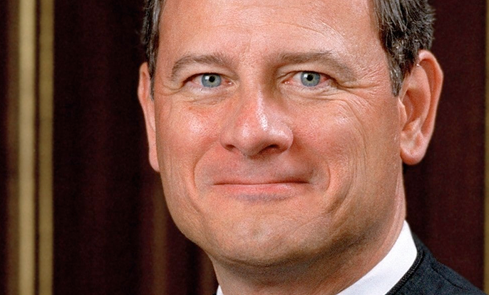
Featured image is " John G. Roberts, Jr., Chief Justice of the United States of America," Steve Petteway 2005.