The War That Still Haunts the United States
Remembering another war America was unable to extricate themselves from.
‘‘Lebanon is a harsh teacher,’’ wrote the political scientist William Quandt (The American Century and Beyond, p.574). President Ronald Reagan and his foreign policy advisors would learn this the hard way. In December 1981, Israel annexed the Golan Heights, then proceeded to invade Lebanon the next summer. Prime Minister Menachin Begin used the shooting of Israel Ambassador to Britain, Shlomo Argov, and the long-standing provocations of rocket-launching guerilla fighters along the Lebanese border, to wage war against the Palestinian Liberation Organization (P.L.O). The Israelis undertook a massive seven-week siege of western Lebanon, cutting off food, water, and electricity, and subjecting the populace to intense and unpredictable bombardment. The war resulted in the deaths of at least 6,775 Beirut residents, the imprisonment of thousands more, the killing of 364 IDF soldiers, and the tarnishing of Israel’s international reputation.
When confronted about the bombing of retreating Palestinians and other war crimes, Begin pushed back with indignation, ‘‘What kind of talk is this ‘penalizing’ Israel? Are we a banana republic?’’(The American Century and Beyond, p.573) Israel’s actions on the ground provided a clear answer: the invading army bombed massive structures with little to no regard for civilian lives. The historian Rashid Khalidi, now a professor at Columbia University, survived the siege of Beirut, but had a few close encounters. At one point he had stopped to drop off a friend in front of a building, and was well on his way back home, when all of a sudden he felt the roar of fighter jets sweeping past him:
I heard a huge explosion before me. Later I saw that the entire building was flattened, pancaked into a single mound of smoking rubble. The structure, which had been full of Palestinian refugees…At least one hundred people, probably more, were killed—most of them women and children. Days later, my friend told me that immediately after the air attack, just as he got into his car, shaken but unhurt, a car bomb exploded nearby, presumably having been set to kill the rescuers who were helping families trying to find their loved ones in the rubble. (The Hundred Years’ War on Palestine, p.148)
As the war between Israel and the PLO grew more brutal, at one point involving 15,000 guerillas from seventeen different sects in a city of 620,000 people, the U.S and other concerned players in the world of international diplomacy cobbled together a temporary ceasefire. Against the wishes of his Secretary of Defense (Casper W.Weinberger), President Ronald Reagan sent 800 marines to Lebanon in July of 1982 to support the peacekeeping mission. It did not take long for things to go from bad to worse. After a bomb killed Lebanese President-elect and Israeli ally, Bashir Gemayel, Begin authorized the dispatch of trained Christian militia to root out the remaining PLO members in West Beirut. The mission was a moral fiasco: at least 2,000 Palestinians were massacred, further inflaming violent passions. On October 23, 1982 a massive blast involving 12,000 tons of TNT, destroyed the marine headquarters in Lebanon, killing 241 people. This was the largest non-nuclear blast to date. Reagan called it, the ‘‘saddest day of my presidency, perhaps the saddest day of my life.’’(The American Century and Beyond, p.574)
Despite heated pressure to immediately evacuate the remaining military staff, it was not until two years later, in February of 1984, that the Marines were finally recalled. Foreign policy experts within the government bitterly lamented the fact that the administration had been drawn by the duplicity and defiance of the state of Israel into an impossible war in Lebanon, and were in the final analysis incapable of extricating themselves from the infuriating situation without a humiliating withdrawal. It was partly in response to this ‘‘foreign policy calamity’’ that Army Col. Colin Powell developed the so-called ‘Powell Doctrine’. The doctrine states that force should be employed only as a last resort, after all nonviolent means have been exhausted. War should be pursued with public support, a clear strategic objective, and an exit strategy. Finally, the army must make use of overwhelming decisive force to settle the conflict (The American Century and Beyond, p.576). The doctrine was popularized by Powell, Weinberger, and others in hopes of preventing another Vietnam or Beirut. Needless to say their plans did not quite work as expected.
The war in Lebanon holds lessons for today; lessons that the Iranian leadership is not likely to ignore given its relationship to history. According to Vali Nasr, an expert on Middle Eastern affairs, Iran’s ‘‘conception of national security has evolved since 1979 around a distinct and deeply held view of national interest and national security, rooted in both recent and not-so-recent history—legacies of colonialism, national humiliation, loss of territory and foreign intrigue, and then war with Iraq and confrontation with the United States.’’(Iran’s Grand Strategy, p.7) A regime that has been so deeply shaped by modern history will no doubt remember that President Reagan withdrew all U.S. forces from Lebanon after the Marine barracks came under attack. Reagan initially said that he would not be cowed by terrorism, but an attack of that magnitude and a death toll of that scale, was enough to change his mind. Matthew Levitt, a political scientist at the Washington Institute for Near Eastern Policy, reckons that Iran is ‘‘likely wagering that the American public and its politicians lack the stomach to withstand civilian losses, and that, should it successfully carry out a mass casualty event, the political cost of continuing the war will become prohibitive for Trump.’’
The trouble, of course, is that the reason why the Iranian regime is currently fighting for its survival is partly because it previously wagered that an act of terrorism in southern Israel might advance its geopolitical interests. On October 7th 2023, Hamas and its militant associates slaughtered 1,200 people and kidnapped 250 people on Israeli soil. Yahya Sinwar, the brain behind the operation, had hoped that with the backing of Iran he would expose fatal vulnerabilities within the Israeli regime, and shift the balance of power in the Middle East. Vali Nasr noted a year before the ayatollah’s killing that the supreme leader likely felt confident that the October 7th ‘‘imbroglio has taken away Israel’s aura of invincibility and put America on its heels in the region and more broadly the Global South.’’(Iran’s Grand Strategy, p.5) Thirty months later, Sinwar is dead and his gambit has not produced the sought-for results.
As Steve Hendrix writes in the Washington Post, rather than diminution ‘‘Israel stands indisputably as the military hegemon, its enemies demolished or decapitated. Saudi Arabia is emerging as a pivotal economic and political anchor…Palestinians, mourning 75,000 dead in a shattered Gaza and losing territory in the West Bank, seem marginalized—by everyone again…Iranian Supreme Leader Ali Khamenei was blown up in a joint U.S-Israel airstrike…the regime that bankrolled and armed ‘‘the axis of resistance’’ for four decades is on the edge of collapse—perhaps taking with it Hamas, Hezbollah, and the Houthis.’’ Talk ‘‘about a colossal miscalculation leading to catastrophic consequences,’’ added Chatham House’s Bilal Saab. ‘‘That cataclysmic event single-handedly changed the face of the Middle East.’’ Talk of the impending demise of the Iranian regime is exaggerated, but given the boomerang effect of the last major terrorist venture, the Iranian regime may wish to put this option aside for now.
The Islamic Republic may not be able to pull off a terrorist attack of the type the Arab resistance pulled off in 1982, or of the kind it funded in 2023, but it can pursue a desperate plan to devastate the global economy. It is clear to all impartial observers that Iran cannot match the dual power of the U.S. and Israeli military. Its best hope, therefore, is to extend the reach of this conflict and test the pain threshold of the business-minded executive in the White House. Vali Nasr contends that the Iranians believe this is a boxing match, and the U.S wants ‘‘to knock Iran out in the first round or second round. The biggest impact comes on day one: kill the supreme leader, kill military commanders, hit as many missile launchers as you can. Hit all the targets.’’ Iran on the other hand, ‘‘is trying to fight a fifteen-round bout, and it calculates that the longer this goes on, the more Israel and the U.S will be exhausted.’’ Iran correctly anticipates that this feeling of exhaustion is more likely to overwhelm the U.S if it finds itself incapable of avoiding a global economic meltdown over this war.
If Iran succeeds in convincing the educated world that the war might do just that, i.e. seriously damage some portion of the global economy and send humanity into an economic and political tailspin, then the extraordinary pressure of the global financial and political class might just be enough to precipitate an American withdrawal. There are already signs that this strategy might be working. The closure of the strait of Hormuz has unleashed a global upheaval that some experts believe might surpass the last two geopolitical shocks of the last half a century. In the 1970s the world lost about 5m barrels of oil per day. The Russia/Ukraine conflict of 2022 resulted in the loss of10m barrels a day. By comparison, ‘‘we have lost 11m barrels per day—more than two major oil shocks put together,’’ says Faith Birol, executive director of the International Energy Agency. His organization has described the current war in Iran as the ‘‘largest disruption in the history of the global oil market,’’ while The Economist calls the closure of the strait of Hormuz ‘‘the biggest shock to the global supply in the history of oil.’’ S&P Global Energy notes that in terms of disruption to the global oil supply, ‘‘no other historical episode comes close.’’
By choking the global economy, the Iranian regime has imposed a severe timetable on the American government, one that it may simply not be able to suitably manage. Chris Kreb, the former director of US Cybersecurity and Infrastructure, has outlined three time-clocks: an agriculture clock which runs in weeks, a food security clock which runs in months, and a geopolitical clock which runs in years. In regards to the first two, Kreb notes that soil in the northern hemisphere needs to be nourished so people in the Horn of Africa and other import-dependent nations can stave off famine. If the world wishes to avoid a humanitarian crisis, to add onto the already existing security and energy crises, this conflict will have to be resolved as quickly as possible. This puts pressure on the U.S. to either wind down its mission or come to the diplomatic table. The problem of course is that both Trump and his partners in the Middle East see a unique opportunity to make history.
The convergence of so many complicated factors has got markets and market people spooked. Katie Martin of the Financial Times reports that, ‘‘a senior bond trader in London admitted something unusual to me the other day: he’s scared. It takes a lot to spook really seasoned bankers who have survived more than their fair share of market crises and who know better than to panic. But the current market environment is deeply unnerving for him, not because the financial system is in free fall, but because it is not.’’ This is exactly the kind of terror that the Iranian regime will need to conjure at a massive scale if it is to survive this war: not a fear of physical injury, but of system-wide financial ruination. Sir Alex Younger, the former head of MI6, recently admitted in an interview for the Economist that the Iranian regime has been more resilient than expected, and currently holds an edge over its enemies: ‘‘they’ve understood the significance of the energy war and…globalized the conflict in a way that gives them some weapons.’’ All they have to do is continue applying these weapons until the U.S. buckles under pressure.
Some commentators may of course question whether Iran has the resources and morale to engage in a war of attrition with the United States. Here again, history may offer some guidance. As the historian Michael Mandelbaum explains, the Vietnamese war was decided by pain tolerance. The war was, in essence, an exercise in ‘competitive suffering’. The Vietnamese won the war because they were simply better sufferers than the Americans. As the Vietnamese revolutionary leader, Ho Chi Minh told a Frenchman in 1946, ‘‘You will kill ten of our men, but we will kill one of yours. And in the end it is you that will tire.’’(The Four Ages of American Foreign Policy, p.308) He was right: the American public did tire of war and ultimately withdrew their minimal support. In a short-term conflict with the U.S, Iran sees itself as better able to weather the storm. It has lived under sanctions and endured war for decades, and is at present fighting for its very survival in a war in which it commands the power to inflict pain, not just on the U.S. but on the world.
Speaking on the Mushal Hussein show, Vali Nasr used another sports metaphor ‘‘United States and Israel can dash a lot faster, but they are not really long distance runners.’’ The Iranian leadership may very well reason that history may repeat itself: at some point the U.S. will tire, as it has done in the past, and retreat (at least for now) from the field of battle and from any pressing ambition to topple the regime. If such a scenario unfolds then the Islamic Republic would have pulled off one of the most remarkable reversals in military history. The survival of the Islamic Republic would represent the failure of the Trump administration’s strategy of ‘maximum pressure’ in the face of Iranian resilience, and the ironic success of Iran’s own pursuit of maximal economic pressure on the U.S and its allies. So laid out, Iran’s path to victory seems pretty clear-cut. As Luke Gromen puts it in a recent newsletter, Iran does not need to defeat the U.S. Military; it just has to defeat the U.S. Treasury.
Economic warfare aside, the Iranian regime will also likely take comfort in the fact that despite falling under heavy bombardment, occupation, and supervision for more than 18 years, the anti-Israeli coalition in Lebanon and the wider Middle East did not break. The fight against the Israeli occupation of contested territory continues today, with Hezbollah featuring as a greatly diminished, but ever-present threat to Israeli security. Hezbollah opened a new front in the ongoing war when it fired rockets at Israel in solidarity with its chief backers in Iran. Israeli forces responded to those attacks with heavy bombardment and a ground offensive that has resulted in the deaths of nearly 1,100 people. Israel Katz, the Israeli defense minister, has announced that Israeli troops will follow up on these attacks with a prolonged occupation of southern Lebanon. It remains to be seen whether Israel will ultimately achieve its strategic objective. For now, the main target of this war has not been defeated. Despite the U.S and Israel’s total dominance of the military sphere in that region of the world, overwhelming force has seldom been enough to comfortably ward off lethal threats from militant activists. This is especially the case when war is conducted from above.
As Robert Pape has spent most of his academic career arguing: the weight of the historical evidence strongly indicates that regime change via tactical bombing simply does not work. This is not for lack of precision: more often than not (in fact upwards of 90% of time), bombs do indeed hit their targets. As a result, key military infrastructure is destroyed and senior officials are killed. The problem is that the shock and awe of high-intensity bombings, paired with the high completion rate, often creates the illusion of control. Even the best military minds start to believe that an escalation in the fighting will bring the enemy regime to the brink of collapse.
What military operatives often fail to see in such situations is that tactical success is not the same as strategic success. The ability to hit many targets at once, including locations where major enemies figures are hiding, does little to secure one’s strategic objective, especially if enemy groups and/or critical materials have already been dispersed. The most vivid illustration of this fact is the war in Vietnam. Before there was ‘‘Operation Fury’’ there was ‘‘Operation Rolling Thunder.’’(1965-1968) By 1967 the U.S. had dropped three times more tonnage worth of bombs on North Vietnam than it had used in World War II. Altogether, about 500,000 North Vietnamese died in U.S. bombing raids, and tens of thousands were injured by the use of napalm bombs and agent orange (The Cold War, p.332).
This overwhelming pressure did damage to key enemy infrastructure and produced tremendous bloodshed, but it did not annihilate enemy morale. Hanoi responded to American AirPower by spreading themselves out across Vietnam, thereby widening the scope of the conflict from rural battlefields to compact urban enclaves where American soldiers would have limited ability to maneuver and effectively target insurgents. As Vietnamese fighters slipped from their grasp, time and time again, and murdered assailants were swiftly replaced, the fighting endured, and the American death toll crept up. Frustrated, President Lyndon B. Johnson announced his retirement from politics, leaving a mess for the next occupant (The Cold War, p.335).
The reason why the Vietnamese Communists were able to withstand American bombardment was not because they were militarily fortified, but rather because they used the spread of the land to their advantage. This strategy is known as ‘horizontal escalation’. It occurs, ‘‘when a state widens the geographical and political scope of a conflict rather than intensifying it vertically in a single theatre.’’ As Pape notes, the lesson in Vietnam ‘‘was not that bombing failed tactically. It was that Hanoi escalated horizontally.’’ Iran has the opportunity to do the same. The bottom line is that regime change by bombing does not work. The fact of the matter, as Pape explains, is that in ‘‘over 40 instances of strategic bombing from World War I to the Gulf War in 1991, such barrages, whether concentrated and heavy or light and dispersed, never compelled civilians to take to the streets in any meaningful numbers to oppose government.’’
This uncomfortable historical truth is a warning to both the U.S. and Israel to avoid military bluster and executive over-confidence. Israel appears prepared to adjust its calculations, admitting that Iran’s regime won’t be toppled from a high altitude. As Prime Minister Benjamin Netanyahu has said, ‘‘You can’t do revolutions from the air…there has to be a ground component.’’ Unfortunately for the U.S, the need for extreme humility in the face of stark historical odds does not seem to have registered with the current administration. President Trump still promises to unleash air through the air, despite preparing to send some boots on the ground. As historian Max Hastings recently noted in a Bloomberg Opinion piece, there is a real danger that the Trump administration may have neglected the lessons of the Vietnam war. One of them being, ‘‘never underestimate your enemy in tenacity or resourcefulness, no matter how out-gunned.’’ The same principle should apply to Iran.
The war in Iran also marks the end of even the pretext of the Powell doctrine, or anything like it. As Richard Fontaine has noted in Foreign Affairs, ‘‘not a single conflict during Trump’s presidencies has been preceded by a campaign to win public support, and Congress has not voted to authorize any of them.’’ To make matters worse, the Trump administration ‘‘has also avoided articulating clear objectives for its use of force.’’ When the President and his top officials have spoken about the conflict, the relation between ends and means has been convoluted, ambiguous, and at times contradictory. It appears at times like the President did not put much initial thought into this major offensive, and is being overwhelmed in real-time by the emerging military difficulties and geopolitical complexities of the war.
Karim Sadjadpour, a policy analyst at the Carnegie endowment, describes President Trump as the ‘‘Jackson Pollock of foreign policy’’ orchestrating a ‘‘regime change by jazz improvisation.’’ Edward Luce of the Financial Times prefers to say that the President is waging a ‘‘war of whim.’’ When asked by a Fox News host if he had a definitive timeline for the war in Iran, President Trump replied that the war would end ‘‘when I feel it in my bones.’’ Robert Pape, for his part, considers the President to be a ‘‘black belt of the fifth degree,’’ when it ‘‘comes to domestic politics Mano a Mano.’’ The President ‘‘is really excellent at what he does…He took out that entire flank of Jeb Bush and company in 2016…like a surgeon.’’ That said, Pape added, ‘‘that’s not the same as strategy when it comes to political affairs or violence.’’ What is clear is that the foreign policy establishment generally views the President as completely out of his comfort zone when it comes to foreign affairs.
Janan Ganesh has describes our times as the Long 20th century: ‘‘It is hard to know exactly why. I am always inclined to cite the eternal power of geography. There are certain physical facts—bodies of water, deposits of gas—that technology was never going to transcend, except in the ultra-long term.’’ Missing from Ganesh’s list is history. One need not be a Hegelian to believe that history shapes the strategic vision of the world’s great powers and actors. As Vali Nasr observes in relation to Iran’s adaptive strategy, ‘‘Geography, culture, and most important, history looms large on those reactions…the trajectory that Iran has embarked on has to be understood against the background of the country’s historical memory.’’ (Iran’s Grand Strategy, p.11) Liberals would do well to heed this advice so not to be caught flat-footed by the raucous events of our present age.
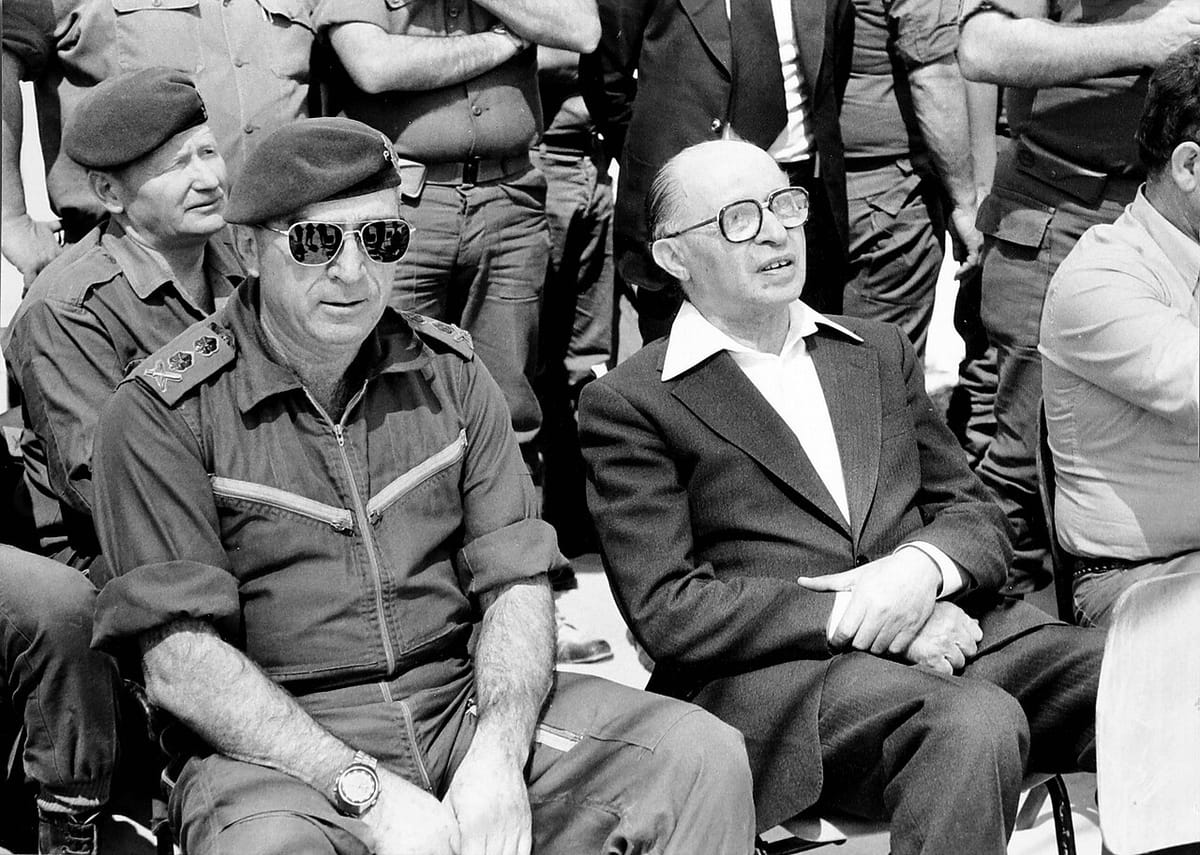
Featured image is Menachem Begin, Rafael Eitan, and Ephraim Hiram in the Golan Heights, by Binyamin Hiram