They Were All Our Ancestors
Nationalism chooses sides in the most awful family drama of all time. It sides with the evildoers, and never with their victims, and teaches you to do the same.

A few years ago, every amateur historian with a bit of European heritage was chuffed to learn that Charlemagne was almost certainly among his ancestors. If you doubt it, here’s a long and thorough FAQ that sets out what scientists have learned about human interrelatedness. Charlemagne is very likely among your ancestors, too.
The conversation usually doesn’t get much past the shock of the fact itself: Isn’t it weird to think that your ancestor was among the great conquerors of history? Wow, we’re all kinda special, aren’t we? As National Geographic put it, “Charlemagne for everyone!”
I want to say no. It’s not special. And not just because when everyone’s special, no one is. It fails much harder than that.
Thinking that you’re the privileged descendant of the conquerors has always been a key part of the mythology that every nation-state teaches to, and about, its favored ethnicity. Maybe you’re not a lineal descendant of the Founder Himself, but you’re still a part of a noble and honored bloodline. That’s why life is good for you, and perhaps why it’s hard for your neighbor. When the favored people claim the land that’s rightfully theirs, that’s progress:
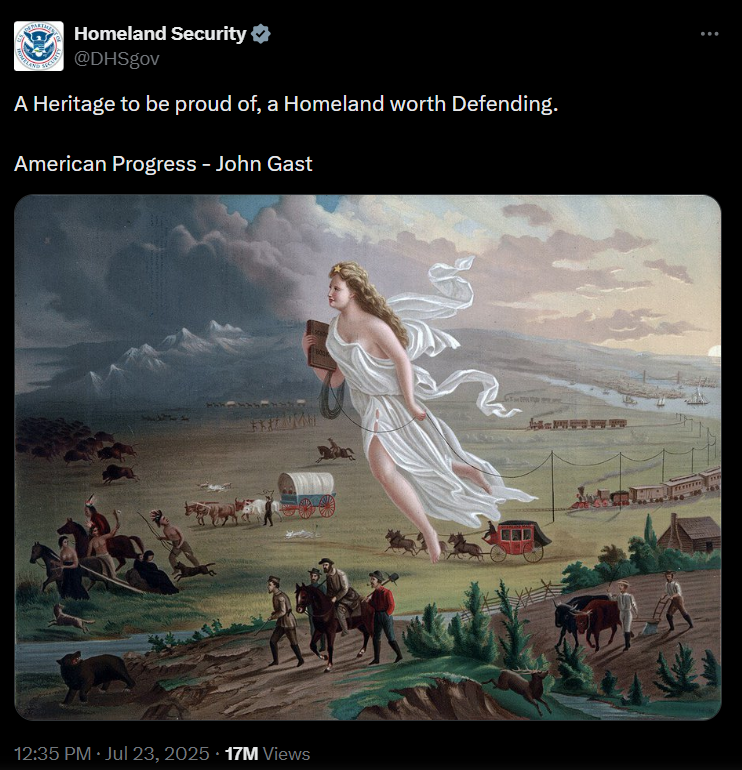
Everyone loves to think they’re the descendants of the original spear-toting, land-conquering Real Ones: Russia is a new Rome; the Russians are new Romans. So is France; so are the French; they’ve spun that myth too. Same for the United States, though arguably by now the story’s getting pretty messy.
Nation-states usually offer their dominant ethnicities a more or less a standard package of feel-good nationalism, with flags, costumes, and specific events swapped in as needed. The package reminds you of your ancestral heroes, and of the blood that you share with them. One people, one blood, one land. As history intended.
The bit about Charlemagne in particular? It’s a grace note lately added to a song we’ve been singing ever since the nation-state became a thing. In grad school, we’d call it a redemptive history: a story about the past in which a people may suffer a fall, and even a tribulation, but it all winds up for the best at the end, because it was so ordained from the beginning: We’ve got this, we’re gonna be okay. Remember our valorous ancestors. We will be redeemed.
Redemptive history sweeps aside and trivializes the conquered; it gives a spotlight to the conquerors. They’re the ones that history is really about. And by the conquerors’ lights, it always just so happens that history turned out okay, and it’s on the right track. There hardly seems to have been a massacre here at all.
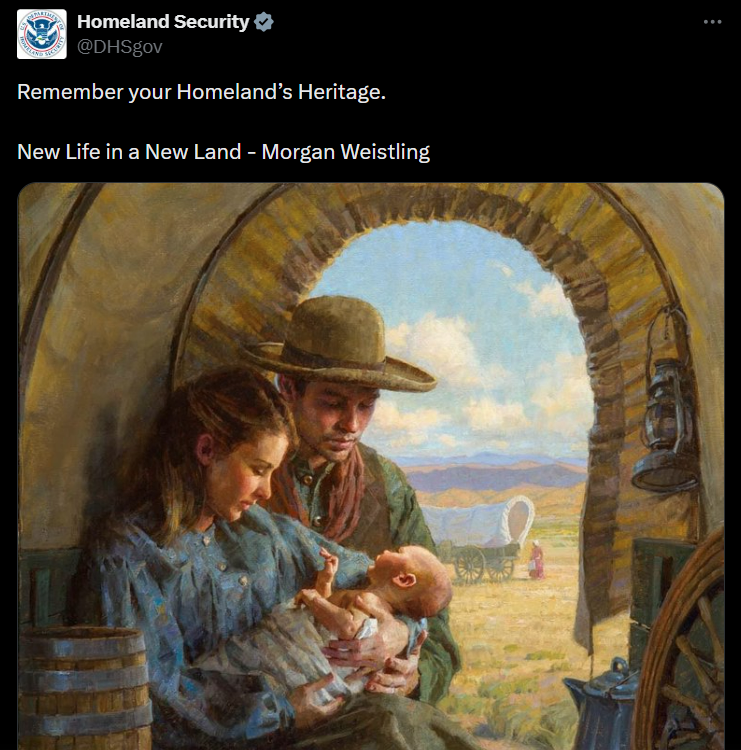
The belief that our ancestors conquered this place, and that their conquest was good, and that it remains morally and politically important—even as it vanishes from sight—is at the root of a lot of essentially fictional political theory. I wish it weren’t. The real world is both messier and more interesting.
The novelist Milan Kundera was right to call kitsch “the absolute denial of shit, in both the literal and the figurative senses of the word.” Kitschy propaganda sets up a weirdly incomplete, weirdly sanitized national origin story. About the only good thing to say for it is that we apparently enjoy it. In almost every language.
My dad once told me, with evident pride, that I came from a family of warriors. The recent history checks out; both of my grandfathers fought, bravely, for the Americans, in World War II. One of them even helped liberate a German POW camp. I can be proud of warriors like these. The trouble with my warrior ancestry starts further back—but only by a little, because my ancestors haven’t lived in America for all that long.
It’s hard to express the grimness of Poland’s history. The land where Poland now sits has always had stronger neighbors who don’t really believe that Poland, or the Poles, deserve to exist. Poland has often lost to them; when Europe is in crisis, it’s usually Poland’s fate to shed territory and people. Geography has not been kind to the Poles; no one in their right mind would volunteer to have Nazi Germany, Prussia, or the Russian Empire for neighbors.
But like every other state, “Poland” is an abstraction—a set of institutions, legal fictions, and questionable legislative procedures that gets knocked around, time and again, by force of arms. It need not exist at all, and for generations at a stretch, it didn’t. Those proud of the inner qualities of their ethnicity would do well to reflect that its success or failure usually doesn’t depend on any inner quality at all, but on contingencies of no importance, not even related to the genes, and with no moral lessons to teach. My ancestors’ nation-state disappeared, and yours can, too. Not for any reason that one can work on. Sometimes, a nation-state just gets murdered by a stronger one.
Most of the individual Poles, however, would live on. When Poland was partitioned, self-governance failed. Poland’s neighbors have often assumed the responsibility of governing the Poles. The Poles are not alone in this; subjugation is always and necessarily at least as common as conquest. None are undefeated when we speak history in full. Most ethnic groups spend years, generations, or centuries ruled, partly or in full, by exploitative strangers who hate them. Yes, even the Romans. Maybe it’s not so surprising that when a group finds itself the conquerors, it turns to kitsch. It blots out all the rest. It denies the shit parts of history.
But political theory would do well to remember that the prototype nation-state isn’t a territory that contains only its ancestral people, now made equal citizens, devising well-calibrated solutions from a position of philosophical neutrality. That type of polity has been very rare in history. No, the prototype nation-state oppresses a different group of people that are also living within the exact same territory. A political theory that was true to life would recognize that, and social contract theory usually doesn’t.
The one-people model is a theoretical simplification, like a frictionless surface: Rebuild a fully functional Poland; draw its borders around the Poles; give them self-government. What will they do? They’ll oppress the Jewish minority, which had been there all along, existing at a still lower level of social status, watching one set of hateful and hated rulers take the place of another. Conquest, not contract, is the theory more clearly drawn from life.
The theory that a nation is made of the descendants of a band of conquering heroes is still both popular and normative among nationalists. Like the social contract story that developed in its shadow, the theory of the conquering heroes is incomplete. It just about always resounds in the midst of an actually unfinished conquest, or in a situation of semi-permanent social inequality.
A liberal might say that inequality should be worked out in the terms of a social contract. But from the standpoint of the convinced nationalist, the nation-state is always essentially imperfect, always imperiled from within—and neither kitsch nor the stories about a contract can do much to help. The feeling of having been ripped off in a bad social contract, one that wrongly allowed for ethnic impurities, can even push nationalists to wage war internally, to finish the job the ancestors started, and to rid the land once and for all of the bad sort of people.

Reality is ethnically mixed by default. The real question is how well or badly specific states and other institutions reckon with this near-universal fact.
The French state imposed its language on many parts of Africa, but first it had to impose that language on the French themselves; many of them didn’t speak it as recently as the French Revolution. The early history of Britain is full of both conquest by foreigners and what we’d now call intra-British civil wars. Some of them were genocidal; the Harrying of the North (1069-70) may have killed a large majority of the population of Yorkshire. We in the present think we know the natural boundaries of the nations, but working them out was a matter of trial and error, and of the contingencies of dynastic marriage and war. It could all have ended very differently indeed. Are African-Americans heritage Americans? I don’t know, and I don’t care for that term. I find it a bit like asking: Is Yorkshire British? And why are we asking these questions, when the truth is that we’re all more closely related than we think?
A first glimpse of a lesson already emerges: It takes a lot of spilled blood to make a nation-state. Most of it isn’t noble. Some of it probably came from the people in your family tree. Most of it is eventually forgotten. (Wouldn’t it be glorious if some of that blood were yours?)

After a general slaughter, there comes the part the propaganda leaves out: the conquerors usually live beside the conquered. They may continue to oppress them, including by writing the conquered out of their stories and painting them out of the artwork. Few remember the Harrying of the North anymore; there’s a selection at work here. Today’s unified people are the descendants of both sides of the event—the victors, who ruled, and the conquered, who often survived in the aftermath. On the winner’s side is a rising statehood, which we’re educated to favor; the losers were of an ethnicity we’ve already forgotten.
What emerges after a conquest is a set of ethnic tensions that gradually evolves into a set of class tensions. In such a society, class and ethnicity are closely entangled, often for generations. Following the Norman Conquest, English kings and courtiers preferred to speak Norman French for many years thereafter, even giving rise to the high-register, specialized language of law French in the process. For many years, English was strictly for peasants.
But if you look just a bit before the Norman conquest, you’ll find that the French themselves aren’t a single ethnicity, either. They’re also the product of a series of conquests, from the Gauls, to the Romans, to the Franks. Each conquest left behind a kind of quasi-class-based, quasi-multiethnic polity that eventually coalesced into medieval France—still a society mostly of peasants, representing the conquered, if not always through lineal genetic descent, then certainly through laws that sustained an always analogous population. Atop the peasantry was a layer of nobility, a class that preserved the privileges that the conquerors had given to themselves, and that bore many of the trappings of the earlier ethnicity that they’d come from. These, the short tunics and the wide belts of the Franks, became the status markers of the new upper class. (Roman fashion never fully went away; in time, it evolved into clerical and monastic dress.)
In light of actually existing history, social contract theory appears bloodless. For Locke and Rousseau, everyone joins the band, not of the conquerors, but of the autonomous self-interested protectors of property. There are no conquered. All meet as equals in this state of supposed nature.
No social contract in the real world has ever unfolded thus. Nor should it. We remember Charlemagne for reasons of nationalism; we forget the many peasant revolts of the middle ages, which don’t fit the favored story so well. A parliament of all of our ancestors would of course include Charlemagne, but it might also be one of the shortest and nastiest affairs this side of Thomas Hobbes. Behind a veil of ignorance, who set up a Charlemagne? Who’d ask to be ruled by a small band of pillaging warlords? What about their spoiled children’s spoiled children? No one would want this, maybe not even Charlemagne himself.
Many of your non-Charlemagne ancestors probably hated an all too similar warlord in their own time. They feared him and suffered under him, and they tolerated him on two grounds—their culturally fostered attachment to the known, which makes acquiescing easier, and their fear that a different ruler would be even worse. If they’d known a bit more about the system they were embroiled in, it might have dissolved their rationalizations. Those peasants too were our ancestors. If we could tell them that we were doing just fine without any warlords or kings, they’d probably ask how they could do that. They’d want to do that, too.
As a foil to nationalism, a bloodless social contract might be an improvement, and it has been, but we can do even better. And we’ll do so by building a better idea of our actual ancestry, as difficult as it may be to look at.
The lesson here, in the simplest words, is as follows: They were all our ancestors. Oppressor and oppressed. They lived with one another, the conquerors and the conquered. Side by side. The reality of conquest is a moment of triumph, then weeks of rape and pillage, then generations of extractive toil and misery in a deeply unequal society. Sometimes, the dominant ethnicity gets anxious about it hasn’t fully purified itself. In times like that, the actions and the propaganda may look very different.

Liberalism often begins by noticing the shit parts of history. And then perhaps there comes a gradual loosening of the rules enacted after the conquest. Perhaps there will be ethnic mixing, cultural exchange, and better treatment for the oppressed, whose ways grow gradually indistinguishable from those of their former conquerors. If you’re really lucky, eventually all are seen as a part of the same nation. The children of the oppressed start telling themselves the myths of the oppressors, and no one necessarily knows the difference, and everyone has a family tree that’s mixed with everyone else’s.
I wish we were all lucky like that, but we’re not. Unequal societies can persist indefinitely. I wish the sanitized stories of ethnic unity, the stories that everyone seems to like, didn’t also point everyone at ethnic cleansing. But as we’re seeing, they do.
Western culture has hundreds of stories about the conquerors. We have a handful of usually younger stories about securing better treatment for the oppressed. Still, and once again—they were all our ancestors. When you say that you’ve inherited a triumph, you’re cherry picking. Your ancestors were always on both sides, my friend. Tell the stories of how we won our freedom from outsiders. But also tell the stories of how we freed some of us from the rest of us.
If the most wretched peasant of Charlemagne’s empire has any descendants now living, then we are all her children, too. That’s just how this genetic math works. And there were a lot more wretched-but-fertile peasants in Francia than there were paladins at the short-lived court of the emperor. When you make a family tree, you don’t get to pick only the winners. Reach back impartially, and we’re all from an exactly equal set of ancestors. That set was both tiny and surprisingly recent; our most recent single common ancestor, across all of humanity, may have lived just 3,500 years ago.
Delving into your ancestry will not reveal that you spring from a natural aristocracy. It will show that we have all been brothers, like it or not. We’re all more closely related than we know, and our family has been murdering its own.
I’d think a realization like that should send every nationalist running for the shelter of cosmopolitan liberalism. Here we will treat you as a man and a brother, no matter who you are, and nowhere else can promise that. Let’s build a polity that’s faithful to the memory of all of our ancestors.
The extraction of history’s notables, their elevation, and the disappearance of most of the real people from history—this is yet another crime against nearly all of your distant relatives. Here you are, centuries later, my dear nationalists, gratuitously cheering for the man who raped your great-to-the-nth grandmother, killed her children, killed her husband, and usurped the land that they lived on but never got to own.
Imagine again that parliament of our common ancestors. Imagine having to pass laws with their assent. This thought experiment, rather than with some half-baked idea of the old days, is how we should try to legislate sub specie aeternitatis: Every age is immediate to God, and that means so is every person.
Nationalism chooses sides in the most awful family drama of all time. It sides with the evildoers, and never with their victims, and it teaches you to do the same. There is nothing good, and nothing necessary, about telling history that way. A better history would recall to us our essential commonality, and it would point us away from most forms of cruelty to others.
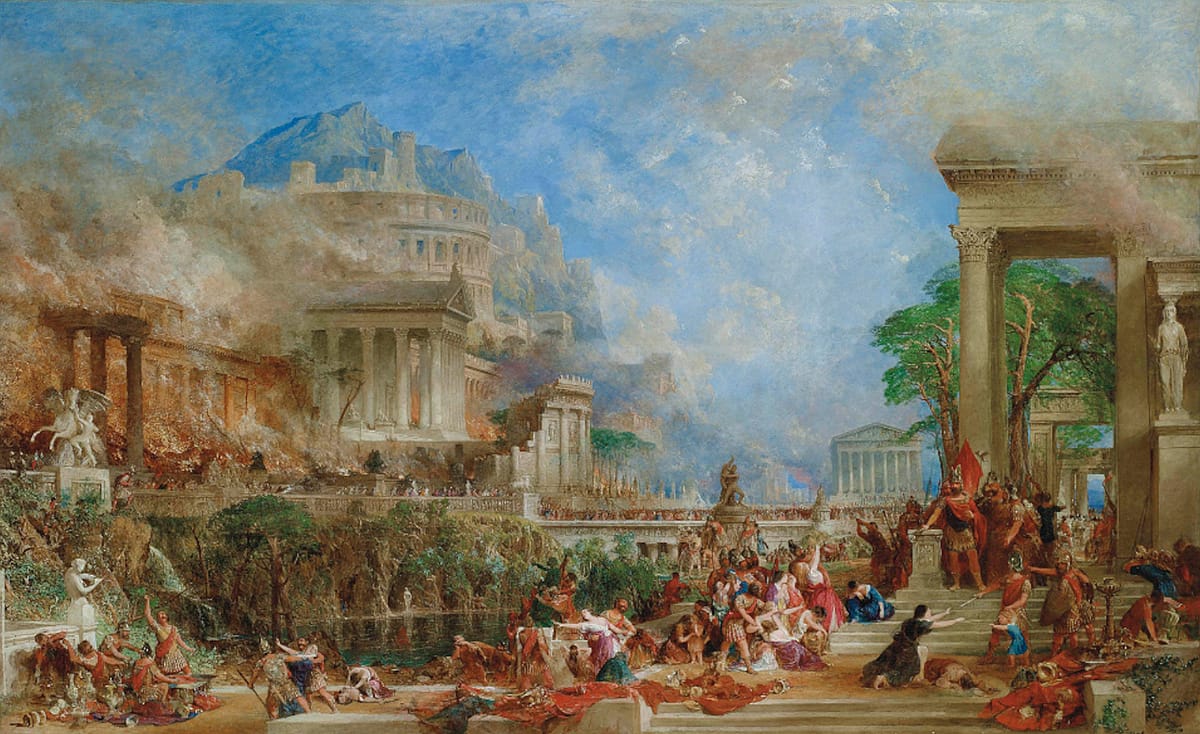
Featured image is "The Sack of Corinth," Thomas Allom 1872.