To the Moon
The Artemis moon mission provides a vision of a joyous, hopeful liberal future—one built on international cooperation, not war and hatred.

Artemis II Commander Reid Weisman: “You know I’m not one for hyperbole but it’s the only thing I can come up with. Just seeing Tycho there’s mountains to the north. You can see Copernicus, Reiner, Gamma, it’s just everything from the training but in three dimensions and absolutely unbelievable. This is incredible.”
NASA Mission Control Officer Jacki Mahaffey: [chuckle] “Copy, moon joy.”
On Friday, April 3, as I watched the nearly full moon rise over Seattle’s Broadway, it hit me. Sitting at a restaurant table with my girlfriend, I told her that I was very suddenly overcome with the sense that I was doing something I never thought I’d live to do: look at the Moon and think humans are going there right now. It was, I told her, something no one on Earth had been able to say since well before either of us were born.
Artemis II was on its way to the Moon, and an international crew that represented the best of us, in the strength of our diversity, were about to lead the world in a whole lot of moon joy.
Rare, unifying events are a strange suspension in time; like the Olympics, the world moves on around them, and yet there’s an ineffable sense of something wonderful happening out there somewhere. Some unique celestial alignment of moments, personalities, exquisite uniqueness, never seen before and perhaps never to be seen again. And you’re breathing the same air as those people making it happen.
One can be cynical about Artemis II and its historic dimensions, especially as it occurs against the backdrop of horrors in the Middle East, perpetrated by the same U.S. military that often produces our astronauts, using machines built by the same contractors that built various components of Artemis. All while domestic laws seem to be robbing some of us of the ability to contribute to projects like Artemis. Such a split screen of American-led glory and American-led horror was as much a recapitulation of Nixon’s America as anything else happening lately. As the U.S. commits atrocities in a needless war of choice, it also shows that other side of itself that remains capable of doing truly great things.
That split-screen has always been part of the American story, and each half is as true to the essence of America as the other. Yet Artemis, like her namesake Goddess, shone a light in the darkness that made me believe we might—just might—make meaningful progress on putting an end to that other, dark half of America: the United States of Confederates, fascists, Christian nationalists, and preening imperialists drunk on testosterone and Botox who hate all that is good not just about this country, but about humanity itself.
People like Trump, Pete Hegseth, and JD Vance say they represent the true spirit of America; all too often, some leftists are willing to agree with them, willing to say that all this country has to offer is misery, carnage, and death.
To cede this ground to the neo-fascists and say that they are right about this country, to say American horror is the reason we should never again try to explore space or celebrate it, is to let them win without even trying to fight on this most precious spiritual ground. It is to say that there can never again be a United States of America that is capable of working in concert with other nations, that cannot promote a vision of humanity that transcends borders and nationalisms.
For Artemis II—though it flew the American flag and sported the liveries of NASA—was also an international project. The Canadian flag hung in the aptly named Integrity capsule, and the Canadian Space Agency’s Jeremy Hansen served as mission specialist for the historic flight; the service module, with its iconic cruciform solar panels, was designed and built by the European Space Agency in Germany, and an ESA command centre in the Netherlands assisted with monitoring the mission.
This represents the best of humanity. A peaceful mission to explore and learn, executed with competence and joy by people from a range of backgrounds, and carried aloft on a spirit of international cooperation. It is a much-needed glimpse through these dark times of all we can be as a nation, but far more importantly, as a species.
To dismiss this as rank propaganda to cover up the true, genocidal face of America is to deny ourselves the enormous power of these symbols. Just as a well-executed protest or act of civil disobedience is meant to instantiate a better, more hopeful world in the present day, so too is a mission like Artemis II a living, breathing glimpse of how the whole world could be if we commit ourselves to it. Pilot Victor Glover became the first person of colour to go to the moon, engineer Christina Koch the first woman, and Hansen the first non-American, cheered on from the ground by technical teams that included a more representative swathe of humanity than ever before.
It is possible because it happened. It happened once; it can happen again.
For many watching Artemis II around the world, it was almost like a glimpse through a portal into a better timeline, an alternate universe where the myriad malefactions of Trump’s bloody populism were not metastasising through every part of our government like a late-stage cancer, infecting the body politic with a particularly stupid kind of evil. 2026 had been relentless from its first days, and Artemis II felt like the first and only thing to happen this year under the colour of the American flag with government sanction that was truly an unalloyed good.
This spirit predates Trump and will outlast him (just look at Hungary). It feels notable that Trump himself, so eager to impose himself everywhere and burn his brand onto everything that once was good, was a relative non-entity with this mission. Perhaps it’s because the Iran War speaks to what passes for his soul; the horror and carnage he has wrought at home and abroad speaks to his vision, such as it is. Mere destruction. He and his fellow travellers do not know what to do with hope and internationalism on the wings of public finance. Artemis II was too beautiful for Trump to own, belonged to us all too completely.
Beyond that, it’s a reminder that we can still do genuinely beautiful, complex, historic things that make the most of human ingenuity and passion. Artemis II was far from a disinterested endeavour, after all. The picture of Dr. Kelsey Young, the mission’s science director, rising from her seat, mouth agape as astronauts described seeing meteor strikes on the moon, is as iconic as it is characteristic.
In all that undisguised joy is a political programme for those willing to raise its standard. We can feel like this more often; we can feel like this more than once every few decades; we as human beings can unite the world in joy instead of in fear. If you want a positive political vision that’s not simply opposed to Trump and his fellow travellers, this has to be a part of it.
One of the indelible images for me is a Reuters snapshot by photographer Jose Luis Gonzales. Little children in Ciudad Juarez, Mexico, sat on the floor of the La Rodadora Museum watching a livestream of Artemis II’s launch, looking as excited as Dr. Young would be just a few days later, one child wearing a spacesuit costume and clutching what looks to be a ticket to outer space. These things can still excite the imagination, reminding us—as human beings—that better days may lie ahead.
We needed a reminder that such dreams have not been fully colonised and strip-mined by the likes of SpaceX or Blue Origin, that a public initiative can still do something like this, that civil servants and not just rich dilettantes can reach to the heavens and teach us all that this is still possible. Though NASA, ESA, and many other space agencies contract with the private sector, they produce public goods on our behalf. Every glorious photo taken by those astronauts (and countless others from stellar observatories, the ISS, and other missions) are public domain. The scientific knowledge in all its pricelessness is public. It belongs to us all.
In bleak times when the world’s crop of populists and neo-fascists offer only visions of blood and carnage, war and testosterone-soaked ethnonationalisms, fear and suspicion, the end of vital programs and the extinguishing of dreams, we need to say—louder than ever—that this vision of vast, complex, infrastructural and scientific achievements that belong to the public constitute the highest mission of liberal democracy, and that without the freedom it provides, none of it could be possible.
That’s the vision we have to offer. That we can inspire one another with huge peaceful projects that advance us as a people, as a species. That these dreams are not beyond us. That hope for a better, different future, is not beyond us.
It’s here now. It happened. We just need to make more of it.
To sink into cynicism about this moment is to squander its very real potential. If the armies of people who worked on Artemis remained committed to this project, we owe them and the world no less than putting our shoulders to the wheel and pressing forward. We can’t give up. Not when so much remains possible.
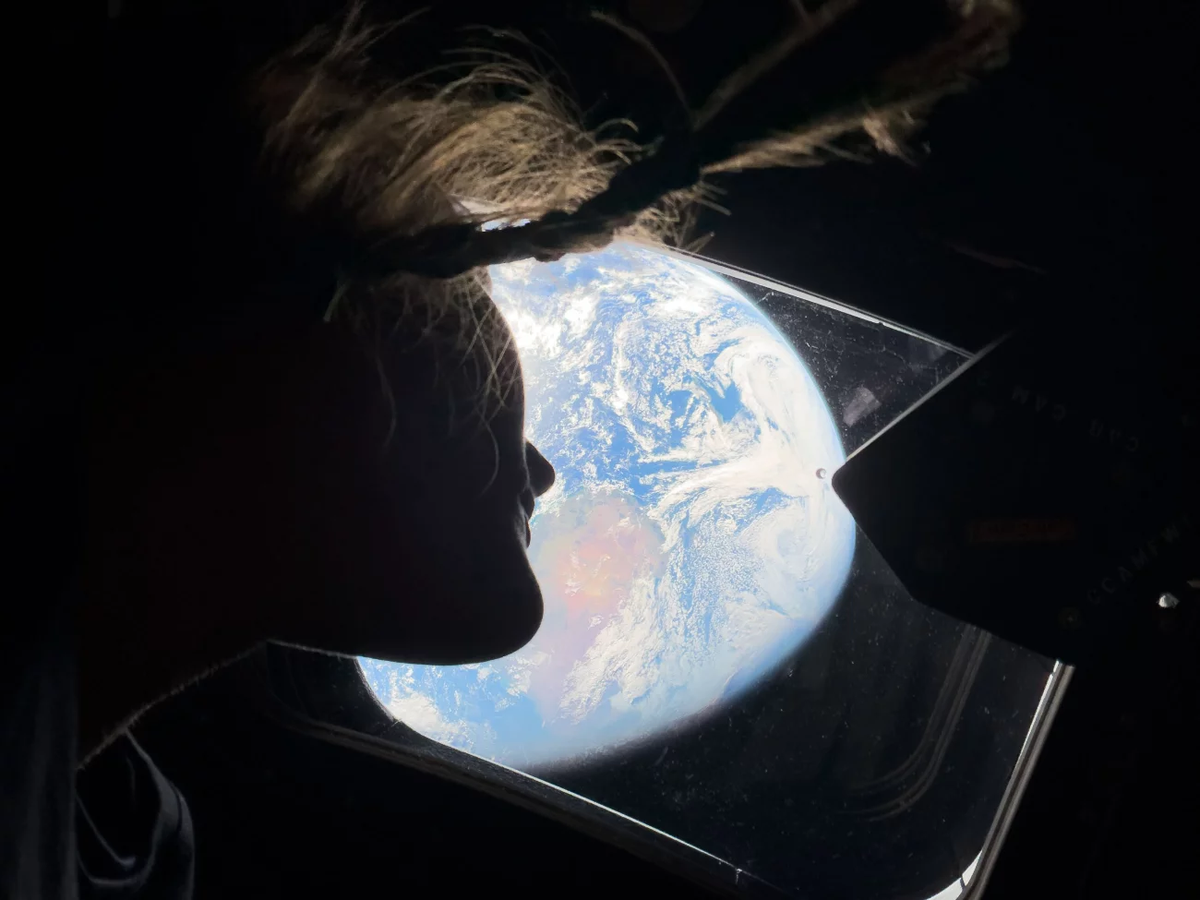
Space exploration, after all, is not about rejecting our one precious homeworld. Space exploration is about homecoming. The liberalism of moon joy could not be summarised better than by Christina Koch’s words upon Orion emerging from the dark side of the Moon: "We will explore," she said. "We will build. We will build ships. We will visit again. We will construct science outposts. We will drive rovers. We will do radio astronomy. We will found companies. We will bolster industry. We will inspire. But ultimately, we will always choose Earth. We will always choose each other."
Featured image is "Spaceship Earth," NASA 2026.