Trump's War on Christmas Is a War on Liberalism
After decades of make-believe, the Trump administration is promising an actual war on Christmas that would traumatize religious communities with armed state power.
On his first day in office, Donald Trump rescinded a long-standing policy restricting ICE raids at churches and other “sensitive” locations, such as schools and hospitals. This was met by immediate pushback, first from Catholic leaders, then Quakers, then many others. So far, it’s been mostly threats as far as churches are concerned, though faith leaders have been beaten, arrested, even shot with “less lethal” weapons, and church attendance has fallen significantly—by more than 50% in Spanish-speaking parishes in one Catholic diocese. But now there’s a plan to target Spanish-speaking churches nationwide during the holiday season, according to an independent media report based on interviews with three DOJ attorneys.
In response, a friend who is a high school teacher in a rural area put it like this:
Not being Catholic, but teaching at the parochial high school here, has given me a deeper understanding of the worship requirements for these kids and their families. To deliberately target mass services during holy weeks of obligation in the Catholic church is just so wrong, especially during Christmas services where the story of the holy family's travel under government edict is a central part of the story. Catholics are required to attend mass and go to confession for certain high holy days of obligation, and Christmas is definitely one of those periods. That is going to be a huge, huge deal with Catholic hierarchy if they follow through with this in this way.
It’s not just Catholics, of course. After decades of make-believe, this would be an actual war on Christmas that would traumatize religious communities with armed state power in a manner reminiscent of the traumatic European wars of religion.
There's a strong argument that modern liberalism is largely how Europe healed itself from that trauma, with religious freedom and prohibition of torture as two of the main elements. From this shift also came the idea that the state should be concerned with the secular well-being of its people, regardless of their personal religious convictions. A key milestone in ending that trauma was the Peace of Westphalia, which ended two of those wars and later came to be seen as laying the groundwork for aspects of the post-WWII liberal world order. There were certainly other factors in the emergence of modern liberalism, but recovering from the Wars of Religion was arguably a central one.
This isn’t to say that liberalism healed the wounds of that terrible time—one largely absent from American public memory. To the contrary, modern liberalism didn’t exist at the time. Rather, modern liberalism evolved out of the healing process, and the evolutionary process is itself central to liberalism. It emerged first as a set of practices, then as a way of making sense of them, but the two forever remained intertwined.
Three days after Trump rescinded protections on sensitive locations, leaders of three Catholic organizations blasted the rule change, saying in a joint statement, “we uphold the belief that all people are conceived with inherent dignity, reflecting the image of God,” that “the charitable services we provide are fundamental to who we are as Christians,” and that "turning places of care, healing and solace into places of fear and uncertainty... will not make our communities safer."
Vice President JD Vance tried to defend Trump’s policy by invoking a Catholic doctrine, ordo amoris, or “rightly-ordered love,” which he clearly didn’t understand. Pope Francis weighed in, not only to correct Vance’s misunderstanding, but also to urge a much more vigorous response by Catholic bishops, reaffirming the centrality of care for immigrants: “The Son of God, in becoming man, also chose to live the drama of immigration.”
If Catholics were the first to draw high-profile attention, Quakers were the first to file suit, just seven days after Trump’s executive order. Together, they signaled just how broad their stance was within the Christian community, from the most organized and hierarchical to the most democratic. They were anything but alone in recognizing Jesus as an immigrant child who identified with immigrants and all those in need (“I was a stranger and you invited me in.”) And so we’ve seen widespread religious opposition to the ICE raids, with lawsuits even joined by groups like the Hispanic Baptist Convention of Texas, representing more than a thousand churches that span a broad range of social and political views.
Nonetheless, ICE and other DHS immigration agencies are planning to dramatically increase ICE raids on churches. According to a report from This Week in Worcester, they “intend to implement a comprehensive plan to target Spanish-speaking churches across the country during the upcoming holiday season between Thanksgiving, November 27, and Christmas, December 25.” Independent journalist and documentary filmmaker John Keough interviewed three DOJ attorneys—two in New England and one in New York—who “spoke in depth about the plan being recently updated to include mosques and liberal synagogues in the wake of Zohran Mamdani’s recent win in the New York City mayor’s race.”
With Trump becoming increasingly erratic, there’s no telling if these plans will be carried out, but the results would clearly be catastrophic, and they’re well in line with what Trump’s administration has done so far.
There’s perhaps no better way to understand the contemporary anti-liberal project than as a return to the pre-liberal trauma of the wars of religion, in the worst of which a third of the population was killed. And there may be no better way to illuminate the liberal project conservatives wish to destroy than by recalling how it emerged out of healing from that trauma.
The European wars of religion—roughly 30 of them—spanned a period of two centuries from the 1520s to the 1710s. Religion was only one factor, of course, but it was always a central one, intertwined with who should rule, how they should rule, and how the political order should be justified. The two most prominent wars—the Thirty Years' War, which devastated Germany and killed one third of its population and the Eighty Years War in the Netherlands—were ended by the Peace of Westphalia in 1648, which largely put an end to the religious wars. It established a new international political order known as Westphalian sovereignty, the principle that each state has exclusive sovereignty over its territory.
The treaty settled the religious conflicts with the provision that subjects were no longer forced to follow the religion of their rulers and rulers were allowed to choose between Catholicism, Lutheranism, and Calvinism. This was both an immediately stabilizing and imperfect solution: many faiths remained unrecognized, and numerous restrictions persisted. But subsequent struggles were mostly civil rather than military, not rising to the level of war, and the level of religious coercion dropped dramatically.
Prior to this, matters had been “settled” by the Peace of Augsburg in 1555, which allowed rulers to choose either Lutheranism or Roman Catholicism (but not Calvinism) as the official religion of their state, with the principle "cuius regio, eius religio"—that the religion of the ruler determined the religion of all their subjects. In retrospect, it’s a way station to the Westphalian provisions. But things didn’t stop there, as desires for religious freedom broadly and new religious doctrines specifically led to ongoing pressures that eventually produced a much broader ethos of religious freedom.
As this process unfolded, many of those whose faiths weren’t officially recognized, or were actively suppressed, chose to leave where they lived—first migrating mostly within Europe, then increasingly to America. The Pilgrims, going first to Amsterdam in 1608, then to Plymouth Rock in 1620, typified in a very brief span a larger pattern that unfolded over centuries with a much wider and varied range of believers.
The differences between Europe and America can be illustrated by contrasting the provisions of the 1781 Patent of Toleration, issued by the Habsburg Emperor Joseph II, with the vastly more tolerant attitude of William Penn, founder of Pennsylvania. The Patent extended religious freedom to non-Catholic Christians, including Lutherans, Calvinists, and the Eastern Orthodox, legally permitting them to hold private religious exercises, but only in buildings that displayed no outward signs of worship. Wedding ceremonies remained reserved for the Catholic Church, while inter-faith marriages, though allowed, were strictly regulated. The Moravian Church, which predated the Reformation, remained suppressed.
William Penn’s dedication to religious freedom was substantially more expansive and modern. It reflected his own journey to Quakerism and encouraged the most diverse colonial era immigration in the Commonwealth of Pennsylvania. Moravians were welcomed, even as they were expelled from neighboring New York, along with various branches of Anabaptists, including Amish, Old Order Mennonites, Ephrata Cloister, and Brethren.
Most other colonies were less welcoming, yet diverse sects found footholds nonetheless. While state religions were the rule, so too was de facto religious pluralism. Sometimes violent conflicts erupted, but nothing remotely like what Europe had seen. Eventually, when the colonies freed themselves and formed a union, religious liberty was written into the Constitution.
Such was the lived experience of many ordinary colonists, even as various thinkers tried to make intellectual sense of these developments. Both John Locke's Letter Concerning Toleration and his Second Treatise on Government are regarded as classic texts in the liberal canon, but they represented the culmination of ideas developed by others before him, and are perhaps best understood as waystations in a longer evolution as well, grounded in his empirical philosophy and reflecting the world as he found it.
For pragmatic reasons, Locke had deep reservations about Catholics and excluded atheists entirely, since “Promises, covenants, and oaths, which are the bonds of human society, can have no hold upon an atheist.” In essence, his principle of religious tolerance could be summed up as tolerance for any church that affirmed tolerance of others, which remains a useful principle to this day but is hardly an exhaustive articulation of tolerance, as he himself seemed to realize.
Similarly, while Locke established the principle of government by the consent of the governed, it could take different forms: democracy, oligarchy and different forms of monarchy are all described as possibilities. At the same time, he argued that governments losing that consent could justifiably be resisted or overthrown. In short, Locke was exemplary as a thinker not just for the ideas he articulated, but because they reflected an evolving, pragmatic grappling with an evolving social world, which would bring forth new ideas surpassing his own. It is his effort at advancement, rather than his fixed achievement that makes him such a crucial figure in the liberal canon. And it’s the process of advancement, of evolution of thought and healing from the trauma of the European wars of religion, that represents a key element in the true core of the modern liberal project.
One key facet of that evolution was from pragmatism to principle. Tolerance initially gained traction simply as a pragmatic necessity, and the half-measures in the Habsburg Patent of Tolerance reflect the endurance of that pragmatic outlook. But arguments for tolerance as a matter of principle were increasingly advanced by those more or less left out, and Locke advanced such arguments to a level still relevant today. Others brought the principle further—particularly those who grounded it at the personal level, such as the Quakers. Thomas Jefferson, whose Virginia Statute for Religious Freedom became the model for the religious protections in the First Amendment, later said it was “meant to comprehend, within the mantle of its protection, the Jew and the Gentile, the Christian and Mahometan, the Hindoo, and Infidel of every denomination."
Jefferson’s vision remains foundational for American politics and culture. The freedom he articulated is a key reason that religious practice flourishes far more in America today than it does in Europe, where even with religious freedoms roughly comparable with ours, state religions still remain. For generations, conservatives have falsely attacked liberals as enemies of religion. There’s a certain superficial plausibility to this: liberals value individual rights and therefore protect a wide range of beliefs, including non-belief. Conservatives, who often link social order to religious orthodoxy, reflexively equate religion with orthodoxy, and thus see liberals’ religious tolerance as inherently threatening.
By now, this genre of rhetorical argument has been exposed as mere gaslighting. It’s not just the religious right’s support for Trump—a profane, ungodly person—but the whole trajectory of ceaseless change (peppered with repeated scandals) that those on the religious right have promoted as orthodoxy. Indeed, Trump’s most prominent and strategically important supporters—figures such as Lance Wallnau, Paula White, Dutch Sheets, etc.—come from the New Apostolic Reformation, whose teachings have long been regarded as heretical, even by mainstream Pentecostals.
Both liberalism and conservatism are continually evolving traditions. The question is what they’re evolving from and what they’re evolving toward. Although not the whole story, liberalism is in large part an evolution out of the dogmatic conflicts that threatened Europe’s destruction for nearly two centuries before America’s birth as a nation. And conservatism, for reasons that remain unclear, now appears to want to revisit and recreate the trauma that liberalism evolved to recover from. Nothing could make that clearer than the threat of targeting Spanish-speaking churches nationwide during the holiday season.
But even if that threat doesn’t materialize, the threat itself is a deeply damaging blow to the fabric of American life—not just to immigrant communities, but to all of us, and to all that America promises to be. That threat, that trauma, is what liberalism stands against. Freedom from state coercion isn’t just a noble, abstract principle. It’s a flesh-and-blood matter of basic security and human dignity. And defending that freedom is one of the defining fights of our time.
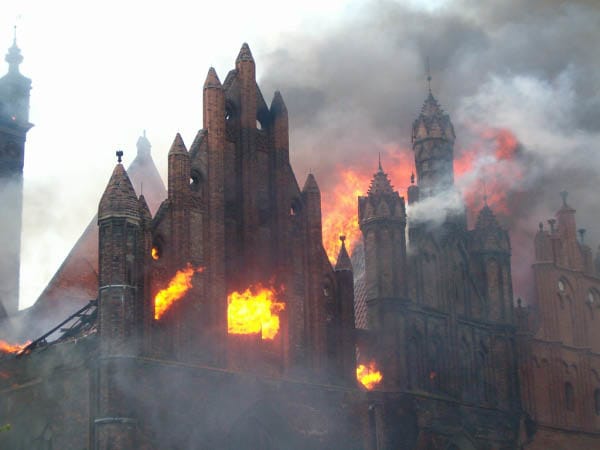
Featured image is St. Catherine church in Gdansk, by Miras