Upholding Liberal Education
Love of the world, not meaningless tests, must be the heart of liberal education.
The fault line of our current political landscape falls along educational lines, which should be a major focus for liberals, especially as MAGA Republicans made cuts to education budgets and the dismantling of academic freedom in universities major focuses of their agenda. Writing for Chalkbeat, Matt Barnum notes that Democrats have lost voter confidence on education, something which used to be a bread-and-butter issue for liberals. He states that “at a national level, Democrats have not offered a particularly clear message on K-12 education, unlike Trump.” No kidding. While I disagree with the idea that Trump maintains a coherent or clear message on education, there’s no question that Democrats have failed to offer a vision of a liberal education for the future of the country. This is not just bad for Democrats, but bad for the world as we have seen the country slip into chaos. If liberals want to see things change in 2028, they (and everyone else) should concern themselves more forcefully with the role of the liberal arts in educational institutions and invest to become the primary champion of books in the public square.
The miseducation of the country has had devastating effects. Liberals followed ideals of efficiency and production in schools, reducing students to numbers, rather than deeply considering the need for an education worthy of the name. Unfortunately, ceding the ground on education, liberals further established the early Republican focus on standardized testing and privatization, taking part in what William Pinar in his 2004 book What is Curriculum Theory? calls “education (de)form,” referring to education reform legislation which produced the era of standardized testing in both the Bush and Obama administrations.
A genuinely liberal education is about freedom, and not in some utilitarian or sophomoric sense of freedom as a rejection of form or boundaries. The indispensability of a liberal education is the freedom from being tied to the zeitgeist of one’s age or situation to love what is true, good, and beautiful, and to be initiated into the world while cultivating a love for it. Such a vision of education advances an inward concern as opposed to the more technical processes typically promoted in teacher education. In Hannah Arendt’s essay, “The Crisis of Education,” Arendt rejects “scientific” approaches to pedagogy that became and still are dominant in the field of education. She notes that education is “the point at which we decide whether we love the world enough to assume responsibility for it” and “to prepare [our kids] in advance for the task of renewing a common world.” Although a liberal education is about freedom, it does not produce a person unbounded by responsibility. Rather, a liberal education forms the person to extend themselves deeper into the world by affirming and loving it, and ultimately claiming responsibility for its transformation. Instead of this robust sense of education as the practice of freedom, education gets positioned as the fostering of retreat from the world.
Retreat from the world rather than drawing closer to it understands education as elitism. We should be, rather, cosmopolitan in the sense that W.E.B. Du Bois offered, suggesting that we draw closer to the world and allow ourselves to be open to the other which we might encounter in study. That is to say, in study we affirm the other so as to free ourselves from stasis of our own making, and remain open to what emerges to teach us. Du Bois states the following in his Souls of Black Folk (p. 76):
I sit with Shakespeare and he winces not. Across the color line I move arm in arm with Balzac and Dumas, where smiling men and welcoming women glide in gilded halls. From out the caves of evening that swing between the strong-limbed earth and the tracery of the stars, I summon Aristotle and Aurelius and what soul I will, and they come all graciously with no scorn nor condescension. So, wed with Truth, I dwell above the Veil [the color line].
He is not pointing to some abstract place called “education,” but describes an experience of the truth. Another way of saying that is that an experience of love, a longing for the depths and “unknown treasures of their inner life” cultivates the internal strength for the enduring challenges and violences of living. As such, his call for the cultivation of one’s inner life is precisely the sort of cosmopolitanism necessary for our day, one which is fraught with the perils of authoritarianism and corruption. How does one live in the wake of ICE raids and police brutality, a remnant of this country’s afterlife of slavery, and not draw upon the strength of so great a cloud of witnesses?
It’s easy to mute those witnesses when liberals give up the terrain of education and the value of books in favor of efficiency and metrics. In particular, standardized exams have, in a massive way, driven the reduction of education to nothing more than a credentialing service. Students find it increasingly more difficult to keep up with the standard of reading in colleges. Some students have never finished a book in its entirety. Due to the requirement of state standardized exams, many teachers, administrators, and county officials decided it was wasteful instructional time for whole books to be read, and opted for “excerpts” of those books. During my second year of teaching, I was forced to teach a textbook excerpt of The Odyssey wherein students answered questions at the end. It was the scene between Odysseus and Polyphemus. As great as that scene is, it’s hard for me to imagine learning about Odysseus and never seeing him near water. The reading did not reflect the vast greatness of the epic, or the early attempt of a human being to consider their own existential lostness. It was nothing other than an effort to get them prepared to answer certain types of questions on exams. How can students be excited about that? How can that be formative for student imaginations? The transactional framing of American public schools as the place in which one does nothing more than pass standardized exams has turned schools and universities into representations of credentialing centers.
Educational policy has led the way to this representation, especially due to the national anxieties which became translated into the public consciousness. In 1983, A Nation at Risk warned of a “rising tide of mediocrity,” an assessment formed out of selective and misleading interpretations which paved the way for No Child Left Behind in the 2000s. NCLB was an education reform legislation aimed at facilitating “standards-based” education and “high-stakes” accountability via state-mandated standardized testing. Initially, students took standardized tests a few times in their K-12 schooling. By 2006, the state mandated each student to transition to yearly standardized exams (of course, produced by multi-billion dollar companies). During the Obama years, the Race to the Top program helped shepherd the vision of yearly “accountability” into reality in the wake of the 2008 financial crash in order to dilute the strength of teachers unions and increase market competition via the privatization of schools. Nobody should, then, be surprised at the widespread representation of schools and universities as nothing more than another emergent market, leaving behind the real (and radical) transformation that takes place in classrooms among teachers and students.
Much of the liberal buy-in to market-strategies, privatization efforts, and standardized examinations have had—at best—neutral, if not adverse effects on public schools. There is little evidence to suggest that charter schools dramatically outperform traditional district schools. A 2023 Center for Research on Education Outcomes report out of California suggests that charter schools outperform public schools, but when you consider the data, the results are negligible, and even worse when you consider that public schools have a vastly greater population than charter schools and that they cannot game their student populations the way many charter schools do. That doesn’t mean that I am against charter schools per se. They are here, and as such, here to stay. I am against the undermining of a public education that roots itself to “accountability” discourses that allow private interests to create education in their image.
If it were true that standardized tests “create” accountability measures, one might look at the history of U.S. schooling and note that we are the most “accountable” generation of educators the country has ever seen. Yet, the gains which test proponents once imagined were marginal at best. Wayne Au, a notable curriculum scholar from the University of Washington Bothell, stated that despite the educational research which draws a connection between standardized test scores and socioeconomic status, policymakers and educational stakeholders continue to presume that scores express objective measurements of student and teacher success. The issue, Au suggests, is that stakeholders have convinced the public’s consciousness that standardized assessments exist free from the contexts surrounding them. In the 2022 second edition of his book, Unequal by Design, Au goes further, writing that what he calls “high stakes testing” actually are “fundamental to the reproduction of inequality” (p. 3). That is to say, those standardized assessments fail to account for social and economic differences in schools as well as society. Schools, as many educational scholars know and have written, are simply a window to the society which exists around them.
A critic might note that this all sounds very high-minded, even idealistic. Should we all go to the public square and dialogue about the nature of justice as if we were set in a Platonic dialogue? I would say this is all high-minded, yes, which is precisely what this issue deserves. But the critic is right to point out that while it is important to consider the liberal arts and a well-rounded education, students and future employees also need jobs and to make rent payments. I think this criticism is fair. However, in my mind, opening public schools away from narrow, scripted curriculums toward standardized exams toward a liberal education doesn’t have to be at odds with that goal. If one looks to the political and educational commitments the Finnish government has made in education, one sees that an open education can actually fulfill the goals of a social and democratic political economy. My students are always flummoxed to hear that much of the Finnish model took the ideas of an open education model from the U.S. We have the capacity to return to such a model and create structures of an education formative for one’s soul alongside the work toward future employment. The vast difference, of course, between the U.S. and Finland is their social-political apparatus which looks different: a national health service, a pension program, and social programs for maternal and paternal care, along with others. This system is upholding their education system; ours is breaking at the seams.
It doesn’t have to break. There is nothing wrong with helping students who want to move into trade work or who want to get into scientific-based careers or become lawyers, nurses, or do tech sales. However, we need more lawyers to read Plato and Nicholas of Cusa, and more people in technology who’ve read and considered Dante’s Divine Comedy. The promotion of future employment in technology (remember "STEM education"?) boomed during the pandemic, but saw 150,000 job cuts in 2024 and an additional 22,000 jobs last year. It’s become increasingly more difficult for those laid off to secure employment. Yet, AI is experiencing a boom, especially as the federal government brokered private infrastructure investment to the tune of $500 billion. One wonders whether public education, a field which is currently experiencing a teacher shortage, will also get such an investment for schools to flourish. If left to corporations and politicians, the answer seems to be certainly negative. In my mind, this is a political problem which the public must unite to fight. The training of students to become future employees can, in fact, happen while students read deeply and become formed by the transformative possibility of the liberal arts alongside potential employment aspirations. These are not ends which are necessarily at odds with one another.
The beauty of education is that transformation, as bell hooks reminds us, is always possible, and we are so much closer to the event of change than we realize. But such a moment of change cannot be possible if liberals are not willing to be the biggest champion of the liberal arts in educational institutions. As the current administration continues to do away with widespread education funding and research grants, people who care about freedom—the freedom to inquire about who we are and why we are in the world—can still read and promote reading both within our communities and in schools. Among independent private schools, such an emphasis on a liberal arts education already occurs, but for our public schools in the country, many seem to have given up on the idea that our children are worthy to think about the deepest questions. I could not disagree more, and actively fight for students to think with agency, not the constraints of “excerpts.” I want them to consider the world in as expansive a form as possible, and think the promotion of a liberal education serves to underscore the gift and responsibility we have to share reality with each other, even one filled with the tensions and challenges of the past and future.
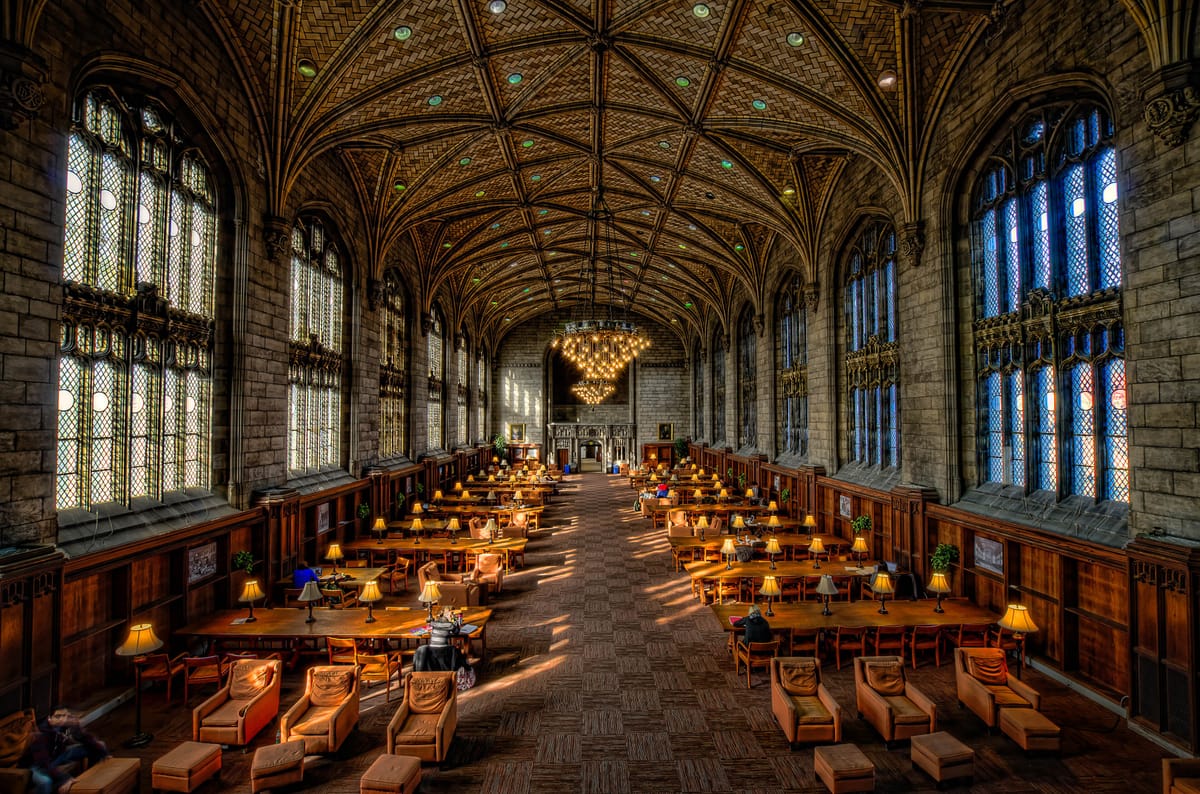
Featured image is "University of Chicago Harper Library," CC-BY 2.0 Rick Seidel 2012.