Victim on Trial: From Jennifer Levin to Renée Nicole Good
The Trump administration is deploying a time-tested playbook against women who were murdered.
In the late summer of 1986, nearly 40 years before Renée Nicole Good would be shot to death by an ICE agent, the killing of another young woman dominated the news. Her name was Jennifer Levin and she was an 18-year-old New Yorker one week shy of starting college. Her body was found in Central Park near dawn on August 26, strangled and partly disrobed. Within days, Robert Chambers, a 19-year-old who moved in the same circles as Levin, was arrested and charged with her murder.
At one titillating level, the Levin case served up everything that the dueling tabloid newspapers of New York, and even the august Times, could desire to drive newsstand sales: young, attractive teens from the Upper East Side milieu of prep schools, rich parents, underage drinking, and recreational drugs. The crime very quickly acquired its trademark title: the Preppy Murder Case. It went on to be irresistible fodder for longform magazine articles, a book, and a cable series.
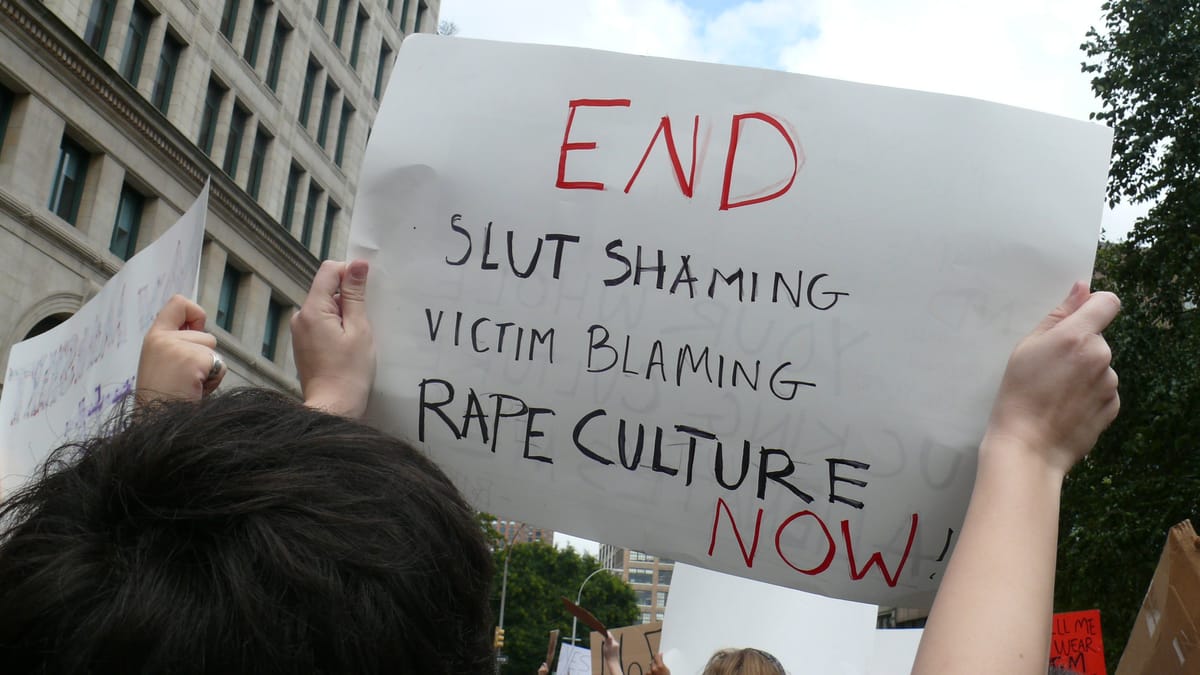
But in the months leading up to Chambers’ trial, and during the proceedings themselves, the case centered on a very specific kind of salaciousness—the effort by defense attorney, Jack Litman, and the complicit media to blame Levin for her own death. Leaks to tabloid reporters turned into headlines like “Wild Sex Killed Jenny,” “Sex Play ‘Got Rough,’” and “’She Raped Me.’”
During the legal proceedings, Litman continued the campaign of innuendo. He subpoenaed a date book in which Levin recorded her social life, and it was instantly and erroneously depicted as a “sex diary.” One of the defense witnesses whom Litman called testified about Levin purportedly being “physically assertive” and wanting to sleep with Chambers.
Just to be clinical about things, Litman introduced a theory that Levin had brought on the fatal attack by squeezing Chambers’s testicles during sex. Of course, the deceased Levin was unable to provide an alternative explanation accounting for the choke marks around her neck.
Sadly but not surprisingly, Litman’s distortion field worked. The jurors deadlocked without reaching a verdict on the murder charge and Chambers pleaded guilty to a lesser count of first-degree manslaughter, with a sentence of five to fifteen years. He emerged from prison to resume a civilian life of drug addiction and crime.
The Preppy Murder Case was hardly the first time a defense attorney or yellow journalists trafficked in blaming the victim. Litman made his career on the technique. Helen Benedict, a journalism professor with expertise in media coverage of sex crimes, traces the pattern all the way back to the Biblical character of Eve.
But it’s also more than plausible to say that because of the alignment of certain variables—the youth and attractiveness of victim and perpetrator, their affluent backgrounds, the trial’s location in the media capital of the world amid a circulation battle between the New York Post and the Daily News—the Levin case became the most indelible example of putting a female victim on trial.
Which is exactly why the case came to my mind soon after Renée Nicole Good’s execution by ICE officer Jonathan Ross. As a young reporter on the Metro desk of The New York Times, I did some coverage of the Levin murder case. When I joined the faculty of Columbia Journalism School in 1990, one of my colleagues was the aforementioned Helen Benedict, author of an authoritative book about journalism and sex crimes, Virgin or Vamp. And I have lived large portions of the last nine years in Minneapolis, bicycling occasionally through the same neighborhood where Good was slain.
Obviously, there are significant differences between the murders of Levin and Good. Levin died amid the most private and intimate of human acts. Good died while engaged in nonviolent political protest. Levin was a young, single woman, while Good was a 37-year-old married mother of three. Levin was straight, Good had come out as lesbian.
Even so, the blitzkrieg against Good by the Trump administration strikingly resembles the character assassination of Levin by Litman and his useful idiots in the media. Devoid of facts on their side, and contradicted by witness video of the shooting, Trump and his co-conspirators Karoline Leavitt, JD Vance, and Kristi Noem maligned Good as a “deranged lunatic” who “weaponized her vehicle” and “viciously ran over the ICE officer” in an act of “domestic terrorism.”
Both Renée Good and her wife Becca Good, who was beside her during the protest and the shooting, were portrayed as “professional agitators.” Even as the Department of Justice has refused to investigate Ross for the shooting, and Stephen Miller has declared “absolute immunity” for ICE agents, the FBI has announced a probe into Becca Good.
Surveying this landscape of lies, I am not the only observer hurtled back in time to 1986 and Jennifer Levin. In fact, I ran my hypothesis of the parallels by two experts in the litigation and media coverage of sex crimes, one of whom I had interviewed for a Times article then. While both these experts noted the same kind of differences that I did between the killings of Levin and Good, they also identified the grim, infuriating similarities.
“Jennifer Levin ‘deserved’ to be killed because of her sexual activity, and Renée Good is shot because of her views and arguable political activity and activism,” said Elizabeth M. Schneider, a professor emeritus at Brooklyn Law School, who has taught, litigated, and written widely about issues of gender discrimination and crime. “I thought of this connection right away when I heard about Renée's murder. Women in both settings are threatening to the polity, and ‘deserve’ to be killed.”
Benedict echoed and amplified those points in response to my email questions: “Misogynist tradition hates an independent, outspoken woman. Levin was vilified by some for being lively, going out to bars and parties—normal behavior for a girl her age in normal circumstances, but quickly turned against her to blame her for her own murder. In Good's case, the far-right cannot bear a woman who defies their misogyny by showing independence of thought, action and lifestyle.”
Slightly later in her written response to me, Benedict added: “Given that misogyny and homophobia go hand in hand among the far-right, of course the fact that they were a lesbian couple is being used against them. But even if Good wasn't gay, they would dig up something else to twist and use against her: divorcee, single mother, liberal, etc.”
Good’s whiteness presents some obstacles to victim-blaming, at least compared to the cases of Black and Brown protestors who have been shot by ICE in other episodes. Good’s femaleness, however, affords opportunities that wouldn’t be available with a male victim. The caricature by Trump and his surrogates of Renée Good as impulsively violent brings to mind the long history of disparaging women as “hysterical”—a word whose very etymology is gendered.
“The hysteria theme is relevant here,” Schneider said, “and I also think the fact of two women together, lesbians, who are mothers, as well, heightens the Trump/ICE anger at Renée, and their claim that she deserved to die. You have the intersection of police misconduct and anger/hatred of women.”
Benedict not only agreed with the analysis but placed it in broader historical perspective.
As any reader of feminist theory and history knows, outspoken women (and, for that matter, outspoken men and women of color) are commonly dismissed as mad,” she explained. “Sometimes they've been clapped in asylums or prisons, sometimes forcibly given hysterectomies or sedated with Valium, depending on the era. All the weapons the right is using against Good are ancient clichés, as old as Eve and her apple. For if we define the critic as mad, then we don't have to consider what that critic is actually saying about us, our society, our government, or our men.
Jack Litman died in 2010 at the age of 66. The Daily News and New York Post still publish, though as mere remnants of their former, mass-circulation selves. But with MAGA echo chambers on social media, propaganda podcasts such as Steve Bannon’s “War Room,” and pseudo-journalism outlets like Fox and One America, the effort to poison public opinion speeds along vectors exponentially more powerful and insidious than those of the 1980s. And public opinion, of course, includes those people who might sit as jurors to hear a case against Ross—if Minnesota state authorities can manage to bring one despite federal interference and obfuscation.
Robert Chambers was convicted of a felony and did prison time, yes, but not nearly what he would have on a murder conviction. He’s alive and well into middle age, unlike Jennifer Levin. The most terrible takeaway from the Jack Litman playbook, now repurposed by Donald Trump and his MAGA minions is that, all too often, it works.
Postscript: After this essay was completed and scheduled for publication, seventeen days after Good was murdered, and less than 24 hours after upwards of 50,000 people marched through Minneapolis in nonviolent protest as part of a general strike, ICE agents shot and killed again. And the MAGA smear machine once more flew into action. Before the victim had even been identified, the Department of Homeland Security claimed he was an “illegal alien” with a rap sheet of violent crimes, whose threat to fire at ICE officers forced them to use their guns in self-defense.
As with the murder of Renée Good, the emerging facts and witness video completely contradicted the DHS narrative. The victim this time was Alex Jeffrey Pretti, an intensive-care nurse. He had a license to carry a handgun, but videos showed him brandishing nothing at the ICE hit squad except a smartphone. Pretti was a white American citizen originally from that treacherous foreign country of Green Bay, Wisconsin.
Featured image is End Slut Shaming, by Charlotte Cooper