We Are Doing Things About It: Getting Accurate Information in Occupied Minneapolis
Minnesota’s playbook against DHS’s occupation shows how residents connect together to get their information needs met without the news media spectacle.

ICE murdered another person in Minneapolis.
I found out moments after my wife did. One of my wife’s neighborhood group chats alerted her to a new ICE-related shooting; I saw the tragic news at the top of my social media feed from the accounts that I trust, among many others.
Much of the country—those following the occupation in Minneapolis or just plugged into the news in general—learned of the tragedy within the next few hours from the special breaking coverage broadcasts on television, radio, and ongoing online stories.
Much of the country also learned from those same outlets that, just yesterday, Minnesota held a wildly successful first push at a general strike, with hundreds of businesses and people participating. Even more, during the off day, tens of thousands of residents braved lethal subzero temps to show up in solidarity to protest ICE’s racially motivated government-funded attack on the cities and its citizens.
In spite of the cold setting, Minneapolis carried the light of those who continue to support the American mythos in the face of rapidly advancing authoritarianism. And now, less than 24 hours later, we have witnessed another totally unnecessary murder, and another day of media spectacle.
I switched back and forth between the Minnesota Public Radio’s special coverage and CNN’s breaking news. Unlike the palpable rage from people in Minneapolis—how could this happen again, how could this happen on Eat Street in front of a hip donut shop, what is being done, how long will this go on, where are the national leaders—both news outlets provided a hefty dose of talking points from the ironically named Department of Homeland Security. Reporters, anchors, and analysts conveyed that the Administration was already hard at work calling into question the events on the ground, the motivations of the victim, the domestic terrorist status of someone shot to death for trying to protect a neighbor.
As surely as anyone vilified in an occupied location can attest, and as we in Minneapolis continue to learn, the disconnect between an occupiers’ narrative, particularly in news media, and the occupied’s reality is surreal. It reminded me of a recent anecdote:
My grandfather used to say “and Magda Goebbels made a great strudel” and I never knew what it meant until after he died my grandmother explained some magazine did a fluff interview with Magda Goebbels a few years before WW2 that included her strudel recipe and my grandfather, who hated the Nazis with the passion of 10,000 suns, thought it was an example of the media sanitizing evil people and he would use the phrase when someone asked him to overlook a bad person doing bad things and focus on the good.
And Magda Goebbels made a great strudel.
In that remembrance, writer Nick Rafter shared his grandfather’s purview of news media when it came to polishing up even the vilest of political profiles. The example, resonant enough that McSweeny’s provided a parody Goebbels’s recipe, responded to the effusive praise of a more recent Nazi: the eulogizing that followed the murder of racist provocateur Charlie Kirk. As the pinnacle of media spectacle, the multitude of ways that national news media provided narrative-driven coverage of his murder that were very, very much at odds with Kirk’s own profanely bigoted body of work.
Even before this most recent murder by ICE of a citizen helper, as occupied Minneapolis became the prime target for America’s transition into militarized authoritarianism, the city also became a target for news media spectacle.
Reading and watching the trove and tenor of coverage from, and about, occupied Minneapolis the past few weeks, I often have been reminded of the ‘great strudel’ quote.
The representations and rhetoric of the spectacle have been otherworldly—although, also painfully expected to anyone who has watched the news for the past 25 years with any critical lens whatsoever.
What’s unexpected, however, is that under occupation, I’ve also seen first-hand how our communities are gathering together, in a myriad of ways, for a better world. I’ve also seen how they’re forgoing the traditional forms of media and the corresponding spectacle for much more timely, useful, trustworthy, and actionable intelligence to connect with neighbors to take action and organize. I’ve seen neighbors band together for observations, food deliveries, parent patrols, and more, outside of any consideration for national news. The revolution will not be televised—but it might be figured out on the neighborhood signal chat.
Judge for yourself just how detached from reality the coverage of the Administration’s talking points, those so easily platformed and repeated, can be.
First, read how DHS Commander Greg Bovino’s ICE is tearing at the fabric of the community in some of the many first-person accounts of the occupation by way of local writers in Minneapolis or by way writers from NY Mag, or even my own first-person account.
These stories share the many observations, challenges, frustrations, and strange realities of trying to navigate the day-to-day of life in a city under paramilitary occupation. These accounts also share the many truths of people fighting back against the cosplaying racist goons that are kidnapping and trafficking people, some as young as five years old.
Now contrast those accounts with this soft focus profile on DHS Commander Greg Bovino in the region’s biggest news publication, the Minnesota Star Tribune, which paints Bovino as a hands-on leader working hard in the Northern cold to help arrest bad guys:
“Our operations are lawful,” Bovino said. “They’re targeted, and they’re focused on individuals who pose a serious threat to this community. They are not random and they are not political. They are about removing criminals who are actively harming Minneapolis neighborhoods for too long. Residents have been told that enforcing our nation’s immigration laws undermines public safety.”
Contrast the first-person accounts with this astounding 14 straight minutes of unchecked interview time by political reporter Esme Murphy of local CBS affiliate WCCO television news, which wraps up with:
Is there anything I haven't asked you, or any point that you would like to make that you feel you haven't made, you know, just or what people are getting wrong here? Whatever you want to say. I mean, you've done a great job, and we appreciate your time. I know you're very, very busy.
Contrast the first-person accounts with the Minnesota Public Radio report, in conjunction with Chicago Public Media, on the DHS Commander that features sections which would be right at home in a longer historic Life Magazine profile:
Bovino has said he was inspired to join the Border Patrol when he saw a movie called “The Border” that came out when he was just 11. Produced by a distant cousin of his mom, it starred Jack Nicholson and Harvey Keitel as agents.
But the young Bovino was crestfallen that the movie portrayed the agents as bad guys and said he was moved to join the Border Patrol in 1996 to show he was the opposite—a good border cop.
One has to wonder if Bovino would make a great strudel.
The coverage of the high profile DHS Commander showcases just a sliver of the traditional political economy of reporting from the larger local Minnesota news media ecosystem on their own occupation.
These select few local reporting examples also pale in comparison to the pageantry of national reporting, an incredible mass of coverage purportedly neutral, ideological or otherwise, now that ICE’s transgressions have broken through to the national watercooler discussion.
Even though the media spotlight tide may be momentarily turning thanks to the massive general strike and subzero protest on Friday, January 23rd, the overall news media coverage of the occupation and resistance in Minnesota thus far presents volumes of material for traditional media criticism.
There’s the false equivalencies of both-sidesism and the whataboutism, to the time-honored Townies-in-Diners profiles, to the decontextualization of the occupation from other struggles, to the purportedly apolitical View from Nowhere, to brazen copaganda pieces that would make even subject matter expert Alec Karakatsanis facepalm.
(In discussing Friday’s general strike for solidarity, CNN’s brave contrarian Jake Tapper even quibbled with local indie bookstore owner Jamie Schwesnedl when Schwesndel pointed out that the Whipple ICE detention facility at Fort Snelling, a military base originally used in Native American genocide, was concentration camp. No infraction too small for the spectacle, I guess.)
It’s no wonder, then, that communities like the ones in the Twin Cities have turned away from corporate and traditional news media and turned to each other for actionable information during the ICE occupation.
Residents throughout the Twin Cities have been countering the ICE occupation in a variety of ways that, on their own, may not seem all that extraordinary. Parents keep watch on their streets and schools. Neighbors are bringing food to people who can’t leave their homes. Small businesses donate goods and offer places to meet-up. Friends and families share their well-being and frustrations with loved ones with phone calls and Facetime around the country.
But the scale and complexity of community organizing in opposition to ICE, the creativity and its decentralized nature, have in fact been extraordinary.
Ana-Marie Cox, of The New Republic and an adopted resident of Minnesota who lived here for ten years, summed up the in-person efforts as many have:
I know people keep saying this but it’s hard to communicate the depth of active resistance here. Like, I’m on(sic) random cafes and people are checking in for observation shifts. Signs everywhere. Folks in visibility vests on the corners. It’s wild. Absolutely wild.
The growing decentralized resistances in Minneapolis—the Rebel Alliances, if you want, of Parent-Teacher Organizations to Faith Leadership groups to neighborhood groups like the “Mamas of Cedar-Riverside” and many more—have built up their own direct connections and sources that have formed interconnecting information-sharing networks outside of these highly controlled, authoritarian-adjacent news media institutions. My Lyft driver even recently mentioned to me that his Somali rideshare colleagues have a similar group chat to alert each other to ICE’s racial profiling check-points.
In a fully digitally mediated world of fake narratives and political spin, intentional one-to-one connections are incredibly subversive. And they’re enriching: During the past week, several parents in my own South Minneapolis neighborhood have had much-welcome moments of levity when someone with a codename tasked with food delivery pick-up realizes that the codename on the other end of the encrypted Signal chat is a longtime friend. These are the places that those of us in Minneapolis feel some hope, even if they’re small wins.
On the other side, wins come from the continuing counter-reality coming from the occupiers. Here’s Minnesota Representative and Republican House Whip Tom Emmer presenting a counter-reality narrative on CNN:
The people you're seeing in these videos, the vast majority of them I do not believe are from Minnesota. These are organized chaos agents, paid agitators. The vast majority of Minnesotans that are talking to me appreciate that law enforcement has arrived, and they are happy they're there.
Minnesota Public Radio, awaiting today’s City of Minneapolis press conference for the most recent killing by ICE, had to issue a disclaimer that everything on social media, including the direct video of the shooting, needs to be taken with a grain of salt, as do the statement the station will be delivering from the White House. The Trump Administration, in the purest form of spectacle, is what happens when “governing and content creation merge.”
As authoritarian scholar and best-selling author Sarah Kendzior points out,
Trump and Russian officials collude brazenly, and then they lie brazenly, and that audacity, paradoxically, is why I think a lot of Americans had trouble accepting that this is really happening.
But I have studied authoritarian regimes my whole life, and this is how they operate. Lies are a signal of power, and they want that lie big, because the purpose of a brazen lie is to say “We know that you know what we did, and we do not care, because there is nothing you can do about it.”
But there are things we can do about it.
In Minneapolis, we are doing things about it. Again, instead of following media spectacles, many leaders are literally on daily patrols with activists and dedicated organizations. Here were Minneapolis Council Person Soren Stevenson’s Instagram instructions on how to take off work for the January 23rd day of solidarity. Here is Minneapolis City Council Person Elliot Payne providing another daily dispatch on the uptick in ICE activity along a major cultural corridor in his ward. Here’s Minneapolis City Council Person Robin Wonsley speaking truth to power that residents are having to combat ICE without anything but platitudes from our national elected officials.
And our organizations and unofficial spokespeople are doing things about it. Here’s immigrants rights group Monarca, who not only coordinates immigrant protections on the ground, but shares essential information for resistors. Here’s MN ICE Watch, an account that crowdsources observers monitoring ICE agent activity. Here’s Unicorn Riot, a livestreaming group that came to local prominence during The Uprising after the MPD murder of George Floyd. Here’s Sabocat, a teacher-turned-influencer who shares news and the personal impacts of the occupation on her school district and students. Here's a local sex shop, Smitten Kitten, sharing a tidbit that ICE currently provides less training to their employees than Cheesecake Factory.
Even Aaron Rupar, the collector of cable news clip receipts for social media, has had enough of the media spectacle’s import over the realities of living in the occupation:
There has been an increasing sense in Minneapolis that we are on our own, that our elected representatives are unwilling and/or unable to take action to get these murderous Nazi thugs out of our community. I really hope that changes today. The time for pleading TV hits ended weeks ago.
Tonight, throughout the winter-chill neighborhoods and along the thoroughfares of Minneapolis, residents who felt overwhelmed, but still resilient, gathered together with candles as a vigil for Alex Pretti. Some brought their firepits to stay warm and for extra soft light.
Even though some groups occasionally sang, and some visited, the mood was mostly somber and reflective, with a quietude and connection that can be only found within an in-person gathering.
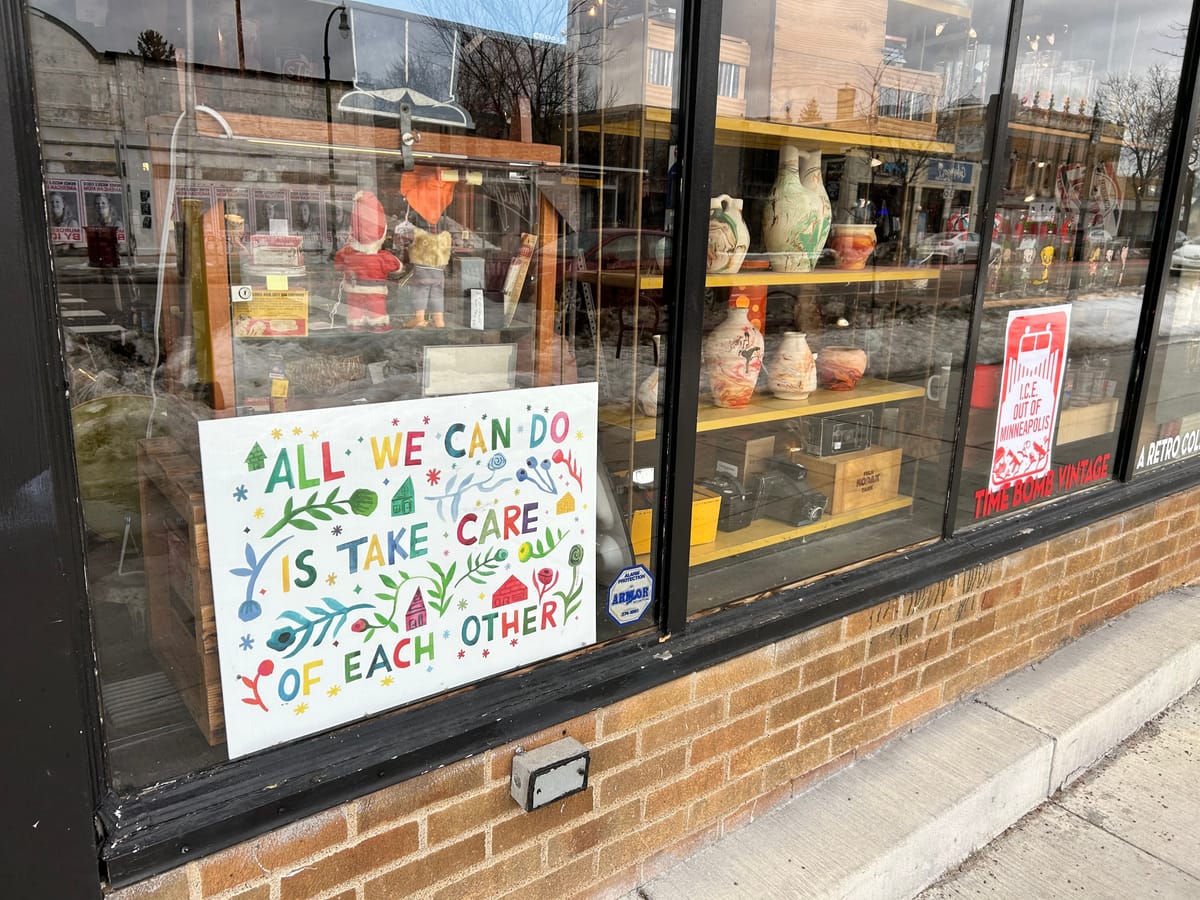
Featured image was taken by the author