
How to Escape the Land Trap
We’ve had the solution for over 150 years. Might we be ready to implement it?
Woke 2 is Woke 1 with an honest relation to power.

Woke 2 is a shitpost. Woke 2 is a meme. You see it drifting by on the timeline, unexplained. Yet to this empty signifier great import is attached. "Woke 2 is coming." People say this and what they mean is Godzilla is coming. Everyone knows what Woke 2 is. They know when they see it, instanter: an American flag borne through the tear gas, an incomprehensible rainbow-saturated meme explaining "you just lost to the woke agenda," eight million protesters shouting NO KINGS.
Yet no one can say what Woke 2 is. This is the question I propose to answer. A place to start: why do we even need a 2? Don't we have woke at home? If we want to inaugurate Woke 2, we should start by understanding Woke 1: what it did, why it worked, what it was right about—and why it fell apart. Only then can we start building something new.
Defining "woke culture" is a fraught enterprise. For one, even the phrase "woke culture" is something of a conservative sneer word. "Woke" was originally a colloquial phrase from AAVE, repurposed by conservatives as an all-purpose label for anything progressive they didn't like. Then, "woke" is hardly the first iteration—SJW, "social justice warrior," was the preferred sneer word of reaction during Gamergate. And of course the 90s had their own rants about "political correctness."
Indeed, it's a bit baffling to imagine what kind of political project could encompass everything conservatives seem to mean by it. MeToo. BLM. George Floyd. Corporate DEI trainings. Annoying people on the internet saying that Israel is the artery of empire. Pride flags at a microbrewery. Affirmative action at elite colleges. Trigger warnings at the start of web serials. An enormous diversity of policies, actions, ideologies. Is there even anything coherent there that we could call Woke 1?
The ideological diversity trips people up. When I was in high school we played a lot of Super Smash Brothers. We'd be sitting in someone's basement, the guy whose house this was would throw his controller and mutter "that's gay" as our other friend slapped him with Fox. It's hard to express how ubiquitous "gay" was as a generic derogation for anything you might not like, back then.
The other day a random bartender apologized to me for misgendering me. The world has changed, and more profoundly than people care to remember.
So here is my thesis. Woke 1 was not a political movement. Woke 1 was, first and foremost, a cultural movement. It succeeded at changing the culture, and for the better. Here is my first thesis: to understand Woke 1, we should look past the multifarious specificities it embraced, and ask how. How did it succeed qua cultural movement?
MeToo, famously, had not much in the way of a legislative agenda. But this isn't a knock against it. Cultural change can be enormously impactful. Just look at the queer rights movement. Its most important successes were not in law or policy, but culture.
After Stonewall, we rejected the Mattachine strategy (an almost conspiratorial inside strategy), and embraced a vigorously outside strategy. Visibility. Coming out. The strategy of coming out played to one of the key strengths of the queer rights movement, one that starkly separated us from other minorities religious or ethnic: we're everywhere. We just keep cropping up. We're in every state, every city, every family. The wall hasn't been built that can keep us out. So coming out worked incredibly well to change the narrative about us. We came out of the closet, and proved to the world that we weren't some secret cabal of pedophile perverts, but were just like all the rest of you: we wanted to be ourselves, live our lives, love who we love.
And so a single word that encapsulated the diverse movement: Pride. We began to win our policy victories because we had transformed the culture. Obergefell wasn't won in the courtroom; it was won in the streets, in the culture, in the decades of pride that left five Supreme Court justices with the gut deep feeling "yeah these people are alright."
Woke 1 adopted a different engine of cultural change, what I will call the "excavation." Take something that seems ordinary or unobjectionable, and then excavate a hidden connection with something we all agree is quite bad—most centrally, racism and sexism.
I remember being a graduate student in the early 2010s, entranced—as many of us were—with the usefulness of theories of structural or implicit racism. These promised to explain the persistence of inequality in a world where we all were, "of course," not racists. On top of that these ideas made for great research programs. Implicit association tests—a kind of psychological instrument which measures how readily a subject makes associations between concepts, such as a white face and "violent criminal"—were a tremendous engine of generating new papers. You could run IATs on almost anything, then rush to publish—"perhaps the endurance of wealth inequality is a result of real estate agents' subliminal associations between black skin and poverty." It was, in a phrase, a fruitful research program.
The genius of excavation is how it was an engine for mass participation, for social belonging, for ideological advancement. An excavation is not just an intellectual move, but a social one. By performing an excavation, you proved you were one of the good ones; anyone could do it; it worked to spread certain ideas like wildfire. Powerful ideas went viral.
Marxist theory explains this dynamic. Human beings crave status: this is what it means to say we are social animals. But status is an invisible thing, a deeper truth that can only be lossily signified in any given interaction. According to Marx, human culture is one of the core ways we signify status.
As Marx describes, status-seekers are hung up on a dilemma. We wish to demonstrate that we are members in good standing of a valued group; at the same time we wish to distinguish ourselves as outstanding members within that group.
The excavation works to satisfy both desiderata. In performing an excavation you confirm your commitment to the basic principles of equality and justice, even as you demonstrate (via the intellectual novelty of the excavation) that you stand out from the norm. And you invite others to do the same, either by agreeing with you or by performing their own excavations.
The woke excavation was a tremendous social engine in conditions of pervasive hypocrisy. At the end of the Long ‘90s, when the contradictions of a regime built on explicit disavowal of racial and sexual bigotry yet de facto still a white man's republic had come to a head, there was hypocrisy everywhere. Anita Sarkeesian, at the dawn of Woke 1, became an internet celebrity (and harassment target) for making the relatively simple point that maybe it's sexist that every single major game involves a buff protagonist and a hot lady.
So boom: we have ripe social conditions, we have a powerful move individuals can perform, we have an engine of tremendous cultural power. What happened next?
Everywhere there was a tremendous ferment. Woke 1 changed the world, in many ways for the better. Along the way it disseminated powerful theories to a mass audience that became conversant in concepts like implicit bias, intersectionality, world-system theory, and so on and on. Culture changed and changed faster than many thought possible. Woke 1 was a conquering tide that seemed for a time poised to sweep all before it, seemed for a time it might smash through all hierarchies of wealth and sex and race and build us a solved world. That, manifestly, did not happen. Why not? Once again we must ask about the revolution that wasn't.
Here is my thesis: Woke 1 was undone by its own success. The very engine that powered Woke 1 drove its dysfunctions. This manifests in three distinct ways: kitsch, cannibalism, and counterculture. I will discuss the intellectual legacy of Woke 1 in the next section, but first, we must understand why Woke 1 hit its limits as a social movement.
Start with kitsch. Marx predicts that cultural movements begin at elite levels and narrow circles—among early adopters, cultural entrepreneurs, trendsetters—and then spread out to larger and larger audiences through a process of status-seeking emulation. But this process also inevitably transforms the culture in question. The difficult parts of art get sanded off for mass consumption. That which goes down easy spreads more widely. In the final moment, we are left with kitsch: a cultural object reduced to its most basic elements, requiring little to no thought to adopt and appreciate.
So it is with the excavation. "You stubbed your toe. Do you know why? Capitalism." It is no longer necessary to have a theory of capitalism. Simply make a vague gesture in that direction, and voila: an excavation. "I bet you didn't know that."
Bsky's ubiquitous Disc Horse Bot is the epitome of kitsch woke, a simple mad-libs style chatbot whose tone and cadence are nevertheless unmistakable, and too often indistinguishable, from sincerely-produced social justice posting.
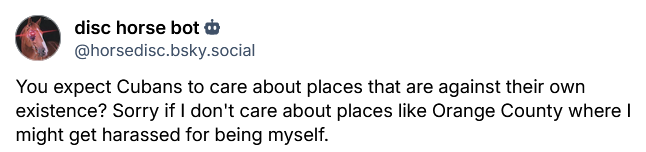
Woke 1 entered its kitsch era. On one level, this represents a marker of tremendous cultural success. On another, it is the death knell of a cultural movement. What is kitsch is no longer cool. It is boring. It is trite. Elites begin looking for new ways to distinguish themselves, and new trendsetters provide them.
One such way is cannibalism. You (white lady) thought it was enough to love noodles and dumplings and write a cookbook celebrating that culinary genre? Wrong. It's actually cultural appropriation, and racism, and the grievous legacy of colonialism to imagine that you might write such a book—indeed, you are actively stealing from the third world when you do so.
In other words, the gap between an excavation and callout culture is not so wide as one might like. These callouts sometimes targeted existing elites, who found them bewildering and alienating (and, for reasons I will get to in a moment, were largely able to shrug them off in the long term). Increasingly however they targeted trendsetters within wokeness itself. This is what I mean by cannibalism: turning the tools of woke culture against its own practitioners, destroying the people closest to you not merely because they are in reach, but because it's an effective way for you to demonstrate your own bona fides in that culture.
Here's the secret. It was precisely the engine that powered Woke 1 that consumed Woke 1. Excavations work by being surprising and outraging. That's why they're interesting. That's why they go viral. No one needs to be told that a bad thing is bad. People want to know that something that looks good is in fact bad. And what could be more surprising than learning that someone of your own social group—a moral and cultural leader, even—was themselves—problematic?
Woke 1 began to cannibalize itself at the elite level. You want to climb the ladder? Knife the person ahead of you.
This made Woke 1 a substantially less attractive value proposition to elites who held positions of real power, untethered to the ephemeral cultural swagger of Woke 1 personalities. It wasn't enough to be more or less good enough. People were gunning for you. They were going to find something problematic about you, whether you liked it or not. Being woke wasn't safe. Your status was under threat. And now we begin to approach the third end of Woke 1: counterculture.
Another movement was brewing. As Marx notes, one way to escape the cultural logic of a group is to simply form a new, different group with its own value systems and cultural signifiers. Just reject the premise. When someone calls you a sexist you say "yes, I believe there are differences between the sexes." When someone calls you a racist you say "yes, I believe there are scientific genetic differences in human populations." When someone calls you an authoritarian you say "yes, we need a strong man to clean this country up."
Consider this time capsule from the earliest days of Woke 1, "The Californian Ideology," which attempts to excavate a hidden connection between Californian techno-optimism and the exploitation of an oppressed underclass. It works hard at it, but today simply sputters out because its only criticism is "this is hypocritical." The modern techno-fascist simply embraces human inequality and government intervention, and shrugs at the charge.
Marxist theory predicts that, if you find it difficult to demonstrate status through one social group and one collection of status-signifiers, an alternative is to simply develop a new subculture with its own internal norms of status and success. We have seen this happen in two directions—both the Dark Woke of the reactionary right, and the reactionary centrists of the mainstream elite. As noted, the radical right learned to stop "hiding their power level," stop masquerading as committed to progressive notions of equality and justice, and simply reject the premise.
Meanwhile—as noted above—the various "liberal" elites alienated by Woke 1 found its wrath far easier to survive than Woke 1's practitioners did. They already had money and power and comfortable sinecures at the New York Times, the Atlantic, the Free Press. They were able to ride out the storm and begin formulating an alternative culture—an elite counterculture, one with its own norms of excellence and value, almost directly committed to standing against the "woke mob." (You will note how the development of these two subcultures resistant to the excavation social engine themselves reinforced the cannibalistic tendencies noted above.)
For all these reasons, the central condition that made the social engine of Woke 1 work—an era of pervasive hypocrisy—has come to a close. It was none other than Woke 1 that brought this era to an end. But like a wildfire burns out its own fuel, so too did Woke 1 dig its own grave here. There is less hypocrisy. The whole premise of the engine was that it reduced hypocrisy, and yet also it needed hypocrisy to live. Instead of an era of pervasive hypocrisy, we have arrived at an era where the battle lines are ever more sharply drawn. These days you call a Republican a sexist and he'll simply reply "yes." It is no longer necessary to be familiar with the esoteric symbology of the Order of the Nine Angles to recognize white supremacist ideology infecting American conservatives. Everything is in the open. They will just tell you; all that is required is a willingness to take seriously the words coming out of their mouths and not invent a different, more palatable thing you prefer them to have said.
We are no longer confronted with a social scene where an "excavation" feels exciting or necessary. The Department of Homeland Security is posting meme videos about how much they love deporting "criminal aliens." They made "deportation ASMR" to the sound of shuffling feet and clanking chains. There is no mystery at all here, no secret to be uncovered.
We are now confronted with a radically different social situation.
"A bleak picture, Dr. Samantha. But you said this was an essay about Woke 2."
It is. Wokeness is not over—sorry Republicans. But to understand Woke 2 we need to dwell, a bit longer, on Woke 1—and how the social dynamics just discussed influenced (and warped) its relation to power.
The progressive left has long had a difficult relation with power. But over the course of Woke 1 that relation became positively neurotic. As Jeff Klein satirized, "Once you accept that all positive changes will negatively affect some poor people, and negatively affecting any poor people isn't progressive, then you'll understand the cornerstone of progressivism is doing nothing."
After all, no one wants to be the target of an excavation uncovering their subterranean connection with injustice. At the same time—you need to stand out from the crowd, remember—"do nothing" was hardly radical enough to distinguish yourself. There was a constant pressure to adopt more radical ideas, phrases, policies.
These two pressures are not reconcilable.
Amia Srinivasan's The Right to Sex makes this dilemma totally explicit. On the one hand, she is all too aware of the pervasiveness of sexual violence. Combatting this is one of the core projects of feminism. Meanwhile, she also refuses the power of the state—"carceral feminism"—because "protecting women" has, all too often, been used as a reason to oppress racial minorities. She recognizes the dilemma—give her that at least—but provides absolutely no answer.
I should have said: these pressures are not honestly reconcilable. A common way out is of course a retreat into vaguery, slogans, ambiguity, and a general refusal to be pinned down on policy—as for instance in "Decolonization Is Not A Metaphor," which is forty pages long and never gets beyond metaphors.
This is the neurotic relation to power: we crave it but are terrified of it at the same time. We want things to "just happen" but we don't want to do them. We want the outcomes but we don't want the responsibility. The result is a kind of intellectual immaturity: a refusal to grapple with the difficulties of power and execution.
This is not merely an academic problem. Consider the popularity on the internet of "We should abolish the police…and replace them with armed community enforcement squads." This is a fundamentally neurotic relation to power: desperate for it yet unwilling to admit it. And the mess that resulted was on full display at CHAZ/CHOP, where the police were (for a few weeks) locally abolished, where they were replaced with armed community enforcement squads, and where those squads almost immediately shot two teenagers, killing one of them. Six years on, the murder remains unsolved. Were the police abolished, or simply replaced with a worse, less accountable version of themselves?
Meanwhile, in the face of the churning power of Woke 1, a number of elite liberals—burned by one callout or another, frustrated at what they saw as the progressive id on a self-destructive rampage—retreated into a kind of elite anti-politics. Matthew Yglesias states the theory quite bluntly:
"I know this is deeply unfashionable but IMO politics largely consists of two things:
— Pandering to the fickle views of the voters to try to win elections
— Handling a series of tedious technical issues that most people don't care about or understand well
Having strongly held views not helpful."
He puts the point less cynically, but one can see the yearning for such anti-politics in Ezra Klein's interview with Ta-Nehisi Coates—yearning for a time when politics was merely a set of technical problems to be managed via conference room, not a choice to be made between surging forces of an age.
Such practitioners at least try to wrestle with the burden of power and arrive at sensible policies for exercising it. As Orwell said in connection with Kipling, "The ruling power is always faced with the question, 'In such and such circumstances, what would you do?', whereas the opposition is not obliged to take responsibility or make any real decisions. Where it is a permanent and pensioned opposition, as in England, the quality of its thought deteriorates accordingly."
Their folly, of course, was imagining that you could do all this, and do it well, while having no convictions and (arguably worse) no honest connection with mass politics. Their disdain for wokeness left them unable to keep in touch with the only available mass power base.
Enter Trump II. The right, at the apex of power, controlling the House, the Senate, the Court, the Presidency—the right, exercising power, relentlessly, out of control, murdering Americans in the street, planting concentration camps across America, starving children and mothers around the world, a reckless war in Iran—suddenly, the absolute need to retake power presses itself on our consciousness. And not just the need to retake it and "go back to normal." The need to exercise it. To start the hard work of reconstructing what Trump is destroying.
This is the beginning of Woke 2.
What is Woke 2? An answer: Woke 2 is Woke 1 with an honest relation to power.
That's not quite right. Woke 1, as I have argued, was defined by its distinctive social engine, the excavation. But the excavation has run its course. You still meet people on the internet trying to do it, like IJA holdouts still launching raids from their spider-holes years after the surrender, but while unpleasant to encounter, their force is spent.
It is no longer enough—or even that useful frankly—to discover the hidden forces of reaction in the world. There just aren't that many hidden forces to find, because reaction has stopped hiding. What is necessary is to fight it.
Nevertheless, there are important lessons from Woke 1. In its best form, the social engine of Woke 1 was a welcoming invitation to participate, and in participating, live up to our own aspirations to decency, to fairness, and to freedom.
An honest relation to power means the direct pursuit of mass politics, not a retreat into hothouse clubhouse cooler-than-thou circlejerks. Woke 2 presents itself not as exclusionary, but as the fulfillment of broadly shared values. That means the embrace of Americana—American flags, American history, American aspiration. The better angels of our nature. As Ned Resnikoff puts it, Zohran Mamdani, No Kings, and the Minneapolis protests "have a bit of the same spirit: sensitive to popular taste in their prevailing iconography but uncompromising in their values and ambitions." Look to the memes: a little demented, a little funny, and entirely militant.
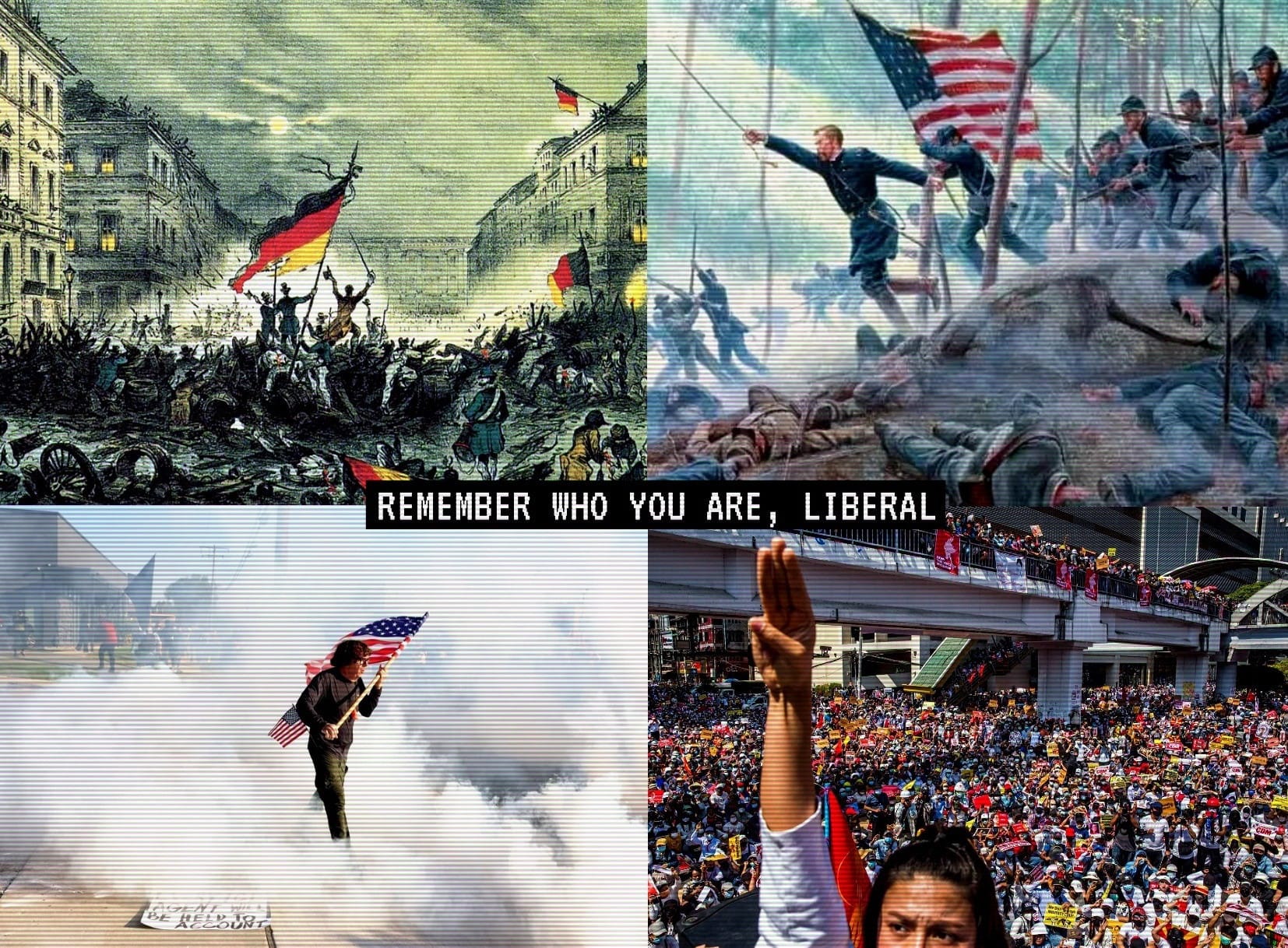
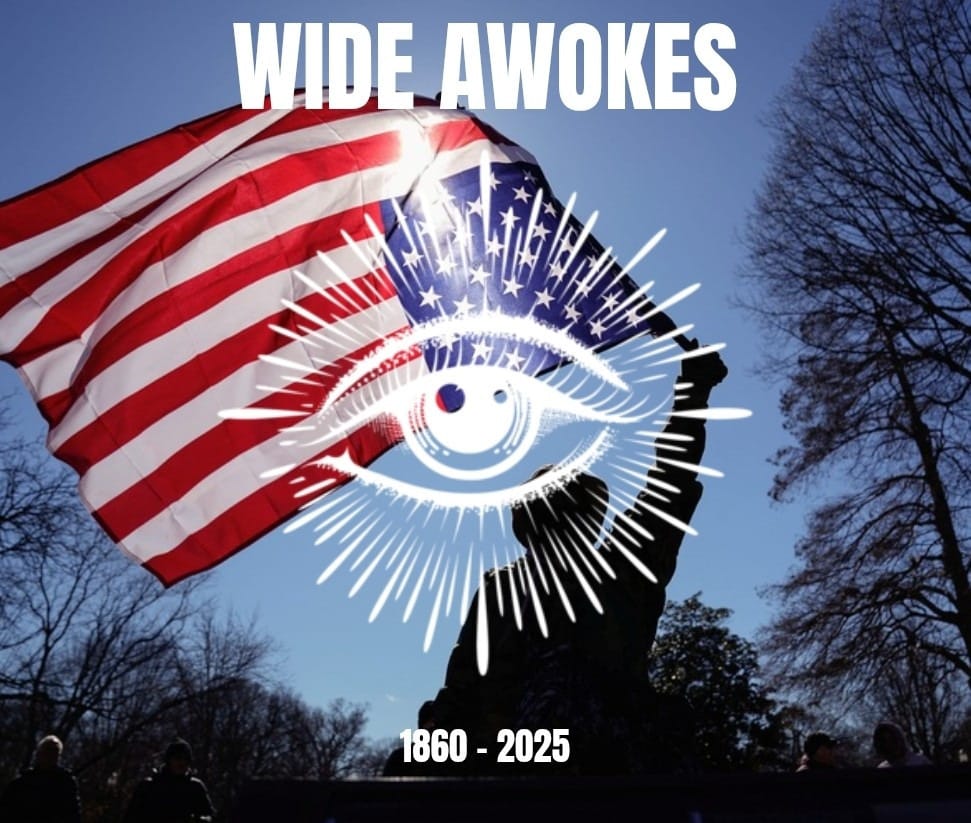
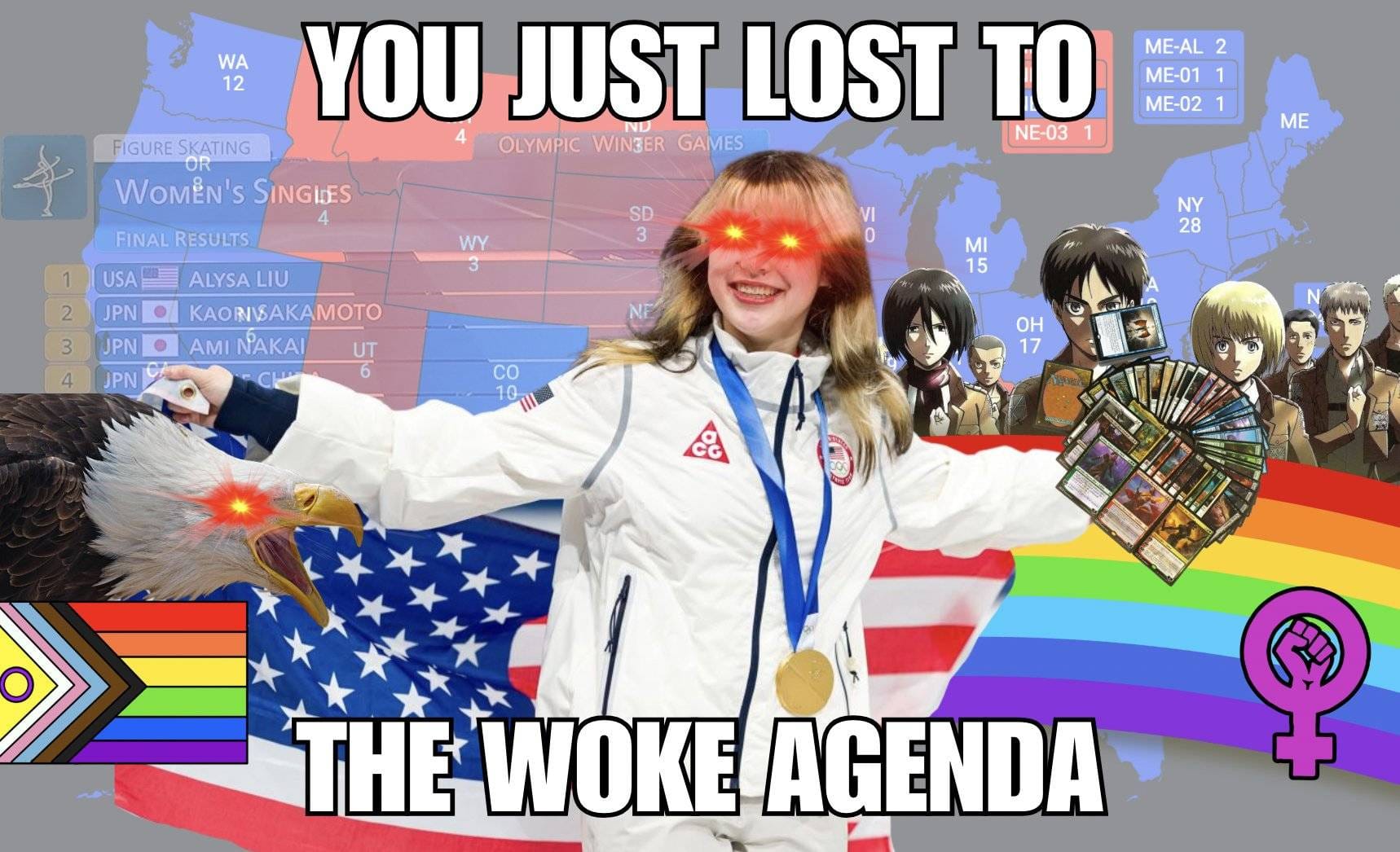
Woke 2 invites you to action.
An honest relation to power means having real, actionable demands for using state power to unfuck what has been broken. We do not need excavations: we need proposals. These proposals must be tethered to reality if they are to be successful.
We need to sort through the intellectual legacy of Woke 1—for there are genuine insights there!—but this means being willing to go against the consensus of the mob, to stop pretending that we can be all things to all people—see, for instance, Talia Bhatt's work taking an honest look at certain leftist idols. Woke 1 took something of a magpie's approach to ideology. We therefore are left standing on a ragged shoreline, trying to sort out what is worth hanging on to and what is an unfortunate bit of detritus swept in by the tide and best returned to the deep seas of academic discourse.
Woke 2 must build on Woke 1, while retooling itself for new social conditions. This means developing new social engines and new intellectual forces.
What we need now is to fight. What we need now are positive answers to the problems that Woke 1 unearthed but did not resolve. What we need is to embrace power and to embrace responsibility for the exercise of that power. This includes everything from the sewer socialism of Zohran Mamdani to the constitutional hardball of Virginia's recent successful gerrymander.
Being against stuff is easy. The orange man is indeed bad. Being for things is more difficult. So our task is difficult: that's life. We must reject the easy slopulism most clearly demonstrated in Gavin Newsom's AI-generated anti-Trump posts, full of angry posturing and signifying—nothing. Neither populism nor popularism is going to save us. Leadership will.
Featured image is Abraham Lincoln's political career through 1860

The white male supremacists of the Texas GOP embody what the national party has become.

Get a copy of The Reconstruction Papers while inventory lasts, and reserve a copy of next year’s issue.

Liberalism's problem isn't structural. Liberalism's problem is that we got out-hustled.

Anton Jäger’s "Hyperpolitics" is, at its best, late marginalia for "The End of History and the Last Man." At its worst, Jäger, like Fukuyama, is a prisoner of his political pieties.
Sign up for the newsletter and get our latest stories delivered straight to your inbox.
_(14594018200).jpg?ref=liberalcurrents.com)