What "Streets of Minneapolis" Tells Us About What Has Changed Since Trump's First Term
The shift in Bruce Springsteen's attitude towards Trump reflects a broader phenomenon.
What the early weeks of 2026 demonstrated is that the fever dream of Donald Trump's first year back in office was no fluke. In fact, he was just getting warmed up. First, the inexplicable decision to invade Venezuela and arrest Nicolas Maduro, then the extrajudicial murders of Alex Pretti and Renée Good. And that's not even getting to the bizarre threats to invade and conquer Greenland. Any thought that maybe Trump might calm down just a tad in his second year back in power has immediately gone out the window. We've got three years to go, and it's not going to get any easier. Multiple prominent celebrities have denounced ICE and Trump, with Billie Eilish and Hannah Einbinder both condemning them in recent acceptance speeches at the Golden Globes and Grammys, respectively. The first artist to respond with art directly inspired by the murders of Pretti and Good was music legend Bruce Springsteen.
The last week of January, Springsteen released "Streets of Minneapolis," his first original song in over five years, and a fiery screed condemning both the ICE agents that murdered Alex Pretti and Renée Good as well as the authoritarian President that put them on those streets to begin with. The song is notable for both its bluntness and its directness, mentioning Trump by name in its opening verse. While Springsteen's work has always been informed by politics, this is the most explicit he's ever been. 2007's Magic was inspired by the many disasters of the Bush administration and 2012's Wrecking Ball was inspired by the fallout of the 2008 financial crisis and the banks who received bailouts while others lost their homes. But on those albums, George W. Bush and Jamie Dimon are never explicitly mentioned. While Magic and Wrecking Ball are collections of stories inspired by catastrophic decisions made by people in power, "Streets of Minneapolis" is a direct middle finger to the President of the United States and the forces he sent into Minnesota. When he sings that the ICE agents were there to uphold the law "or so their story goes," the sarcasm in his voice is palpable, and suggests a man who entered the recording studio with pure rage running through his veins.
The song in Springsteen's catalog that most closely resembles "Streets of Minneapolis" is 2000's "American Skin (41 Shots)," which was written as a response to the shooting and killing of Amadou Diallo by four NYPD officers earlier that year. A song the President of the New York State Fraternal Order of Police responded to by calling Springsteen a homophobic slur. What's striking here is that "American Skin" is arguably more sympathetic to Diallo's killers than "Streets of Minneapolis" is to Pretti and Good's. The first verse of the song is told from the perspective of the officers and includes the line "you're kneeling over his body in the vestibule/praying for his life." Springsteen viewed Diallo's death as wrongful, and the result of the officers acting out fear, paranoia, and likely racism, but not as cold-blooded murder. The ICE goons who took down Pretti and Good are not offered the same benefit of the doubt—nor is there any reason to believe they should be.
What is especially notable is how much "Streets of Minneapolis" differs from Springsteen's output during the first Trump Administration. During Trump 1, Springsteen released two albums, 2019's Western Stars and 2020's Letter To You. Between those two albums, the only song that appears inspired by the rise of Trump is "Rainmaker," off Letter To You, a cautionary tale about turning to evil in times of desperation. "Sometimes people need to believe in something so bad they'll hire a rainmaker" goes the chorus. During the first Trump administration, there was massive infighting on the left over whether Trump's victory was caused by voters responding positively to his bigoted rhetoric or by economic anxieties that Hillary Clinton's campaign failed to adequately address. Here, the Boss seems to imply that it was the latter. At a time when anti-Trump sentiment was rampant, Springsteen went an alternate route, largely staying silent and implying that while yes, Trump was bad, it was years of failed policy that brought him to us.
In 2026, there's no time for that.
The difference between "Rainmaker" and "Streets of Minneapolis" is the difference between Trump 1 and Trump 2. During Trump's first Presidency, when there were serious people around to prevent Trump from pressing the "destroy the world" button, there was space to pity the poor MAGA voter who made the wrong choice, but only because the Democrats failed to adequately persuade him. Now, the guardrails are gone. Trump is surrounded by sycophants. Nicolas Maduro is in a prison with Diddy and Luigi Mangione. Alex Pretti and Renée Good lie dead in the street. The question of whether a Trump vote could be theoretically justified is no longer relevant because we're stuck living with the outcome of a second Trump victory; a nation that has descended into abject chaos. As a Springsteen fan, I feel compelled to clarify that I don't dislike "Rainmaker." At the time, it felt a bold choice that defied conventional thinking about how to respond to Trump. However, at this point, it feels like an artifact from a world that is long gone and not likely to return.
With Trump's approval ratings rapidly descending, it's becoming clear that Trump's second administration is not what a decent amount of Trump voters were hoping for. While there will always be a section of MAGA declaring that Trump's latest atrocity is What They Voted For, there's also a lot of centrist Trump voters who are experiencing massive buyer's remorse. In retrospect, it feels like there were two types of Trump voter in 2024; those who wanted a rerun of Trump 1 and those who wanted Trump Unleashed. The second group got what they wanted, while the first group are stuck living with the ramifications of a decision that will haunt them for the rest of their lives.
That being said, it's not just moderate Trump voters experiencing shock right now. Plenty of liberals and leftists didn't expect him to be this bad, likely because he had already been President once before and wasn't this bad. That's why the Resist Libs who warned about Project 2025 were largely considered to be alarmists in 2024. The majority of the electorate thought they were getting the version of Trump that oversaw Operation Warp Speed and had a cabinet that largely reigned him in. An electorate that was tired of being told that every election was The Most Important Of Their Lives failed to register the 2024 election as the emergency that it was, and now we're stuck with a nation holding on for dear life, desperately waiting for January 20, 2029 to arrive.
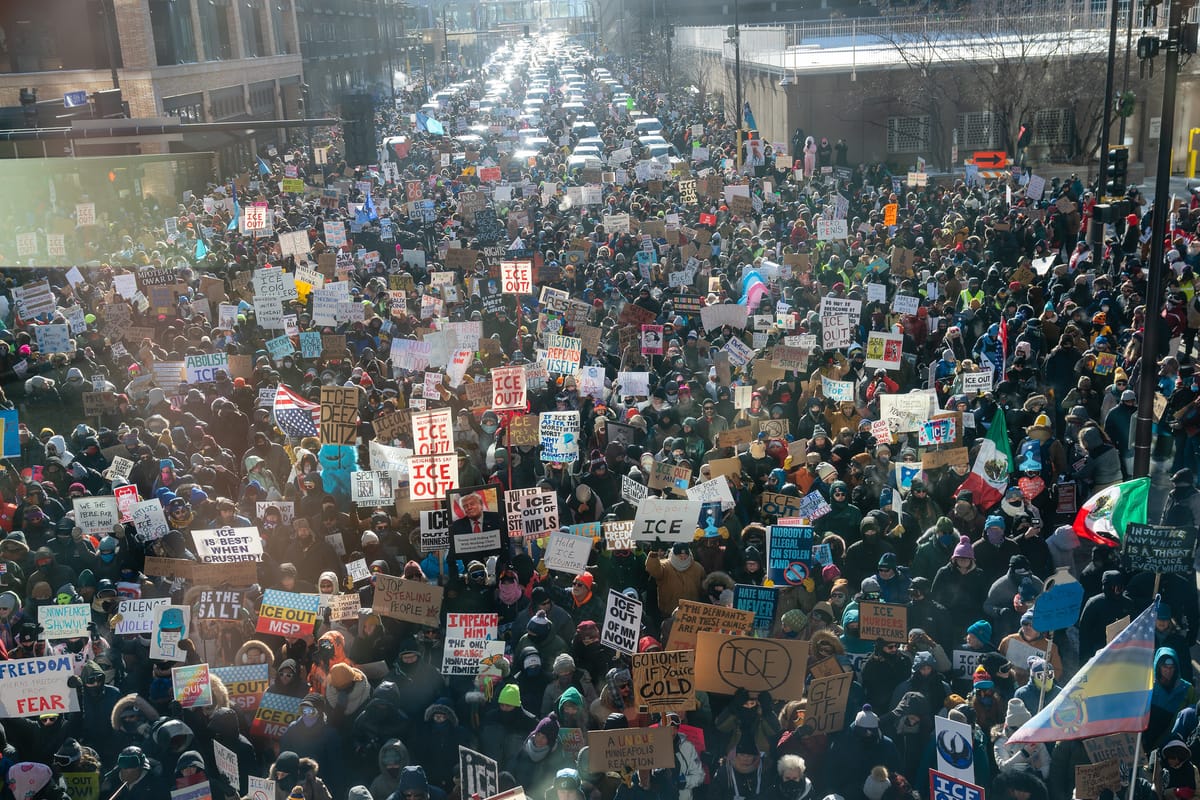
But "Streets of Minneapolis," as well as the protests that inspired it, reminds us that we don't have to take this lying down. When Trump defeated Kamala Harris, the left took a huge blow to its morale. Trump had won, and four years seemed impossibly long for our democracy to survive him. Now, the terrifying reality of Trump 2 has jolted the people out of their slump. There's righteous anger everywhere, and that anger is turning into organizing. ICE protests have sprung up all across the country, and the third No Kings rally on March 28th is practically guaranteed to be the largest one yet. Some may hem and haw about the effectiveness of these events, but they demonstrate something undeniable: Trump, for all his bluster, cannot crush the American spirit of dissent. Alex Pretti and Renée Good have left us, but the principles they fought for will live on. It is our duty to ensure that.
Featured image is Thousands of protesters march during the Ice Out of MN march in Minneapolis, by Lorie Shaull