With Friends Like These
To defend itself from Trump's thuggery, Canada must seek new friends.
What is friendship? A bond and social identity rooted in shared experiences. In the sacrifices we are willing to give for each other in the name of those shared experiences and sacrifices of the past. Twenty-five years ago, when flights across the continent were grounded during 9/11, Canadian towns sheltered thousands of Americans, and in cases like Gander, had done so to accommodate over half their population’s worth of arrivals. We gave the lives of 159 servicemembers in Afghanistan, remarkable men and women who valiantly joined the fight against al Qaeda out of solidarity with the victims of 9/11, people like Nichola Goddard and Daniel Greenslade. Denmark, too, was willing to spend blood and treasure out of friendship, goodwill, and a shared commitment to democracy forged following World War II. What greater act of friendship is there than to be willing to give life and limb for our friends?
That friendship shown to America has rewarded us just two decades later with an adversary threatening to kill us and our families, friends, and communities. Now, 59% of Canadians want to go to war in the event of an attack on us by the United States, and 46% of the country viewed America as an enemy even before the National Security Strategy’s proclamation of an American continental empire and Donald Trump’s threats against Arctic Europe.
American threats against our sovereignty have been present for some time. In 2023, Tucker Carlson used his position at Fox to advocate for the “liberation” of Canada from its democratically elected government. Then upon taking office, Trump sought to pressure Canadians to accept annexation and disenfranchisement as the “51st state.” Our previous political leadership made the unfortunate error of not taking these issues as seriously as they should have, taking for granted the stability of our century-long relationship.
The real turning point has been the National Security Strategy, released in the preceding weeks to the Greenland Crisis. By asserting a new civilizational identity, the American government sees itself in the same paradigm that Russia and China self-conceptualize. Likely written by Michael Anton, it emphasises that America sees itself as entitled to wage political warfare on its Western allies. They will “reward and encourage” far-right elements that push the GOP’s program in the name of “civilizational health” and “self-confidence,” which Anton understands as a sense of homogeneity rooted in linguistic, cultural, ethnic, and religious sameness. Canadian national identity is manifestly incompatible with this civilizational vision.
The preoccupation of the NSS’s proposed American political interference in the West is anti-immigration politics, and Canada, as a country with lofty population growth targets to fill its expansive geography, has principally sought to encourage large immigration flows. Ostensibly, this would be one pretense dubiously justifying American interference in our politics, alongside extant bogus claims that Canada and Arctic Europe are vulnerable to Russian and Chinese force projection. Instead, much as Russia fostered and leveraged the Californian independence movement to destabilize social cohesion and promote Russian interests in America, the State Department is currently engaging in talks with the far-right Albertan separatist movement to create an American client state out of Canada’s oilfields. This comparison to Russian active measures is salient, as Steve Bannon views Canada as America’s own “Ukraine.” Should we worry about our children being kidnapped? Of our own Buchas? The Joint Chiefs of Staff are being pressured into drawing up plans to invade and annex Greenland. How much longer will it be before those plans are drawn up for us? Much like Stalin’s 1926 declaration of a need for a “socialist encirclement” to counteract “capitalist encirclement,” Anton has declared the need for a continental “encirclement,” its own empire, with uninterrupted access to the resources of its neighbours. Ostensibly, it is to deny those resources to its rivals, but it is really nothing short of naked imperial plundering.
Canadian Prime Minister Mark Carney recently announced a renewed strategic partnership with the People’s Republic of China during a state delegation to Beijing, outlining a pragmatic return to the norms of 2018 in which Canada would allow Chinese electric vehicles to come to market at a most favourable nation tariff rate, in exchange for market access for Canadian energy, canola, beef, and seafood. This is a seismic shift in posture following a decade of strained relations, owing to issues of transnational repression, allegations of electoral interference, hackings, and kidnappings. To understand how drastic this change is, just six months before this delegation, the government announced it was forcing China’s surveillance giant Hikvision to close operations in Canada.
China and Canada both find themselves in the position of being subject to American economic warfare, and so naturally have a mutual interest in expanding relations. As a result, in the short-term, the government estimates it will increase export orders by $3 billion, and in the medium-term, Canada expects to additionally expand its exports to China by 50% by 2030. These are serious commitments that reflect a lack of confidence in the American relationship while taking advantage of an ascendant economic power’s rise, but any strategic partnership has limits due to divergent interests in Asia. Canada remains committed to the sovereignty of Taiwan and the many other countries with which China has irredentist territorial and maritime disputes, and trade will still be mostly focused on energy, resources, and agriculture, not complex intellectual property and manufacturing. Several of those countries, including Indonesia, the Philippines, and India, have either signed trade deals with Canada or are far along in negotiations as part of Carney’s efforts to expand trade relations beyond America. Furthermore, strategic dimensions to this partnership are economic and climatic, not military, minimizing Chinese leverage gained from economic integration. Remaining tension over Chinese political interference in Canada further limits the extent that relations between the two countries can be rehabilitated without unbearable political costs—a constraint of Carney’s “variable geometry.”
As a student at the University of Guelph, I saw firsthand in 2019 how students from Hong Kong faced transnational repression on campus by Chinese actors. Censorship of pro-independence messages and threats against activists were cause for great consternation as videos of nighttime confrontations hit the internet. I remember the night student protestors were photographed by Beijing loyalists and posted online for surveillance, so they and their families could be harassed back home. One girl broke down sobbing inconsolably, thinking her parents would be in danger. No reassurance I gave of her safety in Canada could offer her comfort. Make no mistake, I and many other Canadians have no illusions of the danger closer alignment with China poses to our political process (and make no mistake, it is very real), but recognize the strategic necessities of expanding our access to global markets and addressing climate change.
Our realignment towards revisionist powers has been forced by MAGA’s radical reformulation of American foreign policy and its immediate failures. The trade war against Canada has stagnated growth and placed countless jobs in the country at stake. As economic growth is compounding, America is effectively robbing my generation of prosperity we are otherwise entitled to, yet another generational crisis for a generation of Canadians that has gone through multiple already. As employees at Linamar, half of my family are entirely dependent on the automotive sector for work in one of the cities hit hardest by tariffs, and looking at potential medium-term job losses. This is not an abstraction of interests abroad; it’s a matter of putting food on the table for millions of Canadians struggling to get by.
So then, for Americans to decry Canada’s realignment with such self-righteous indignation is nothing short of absurd arrogance. How dare we not show gratitude for American “protection?” The paternalistic attitude, that of an abusive deadbeat, shown by America is all too similar to that used by Russia and China in their rhetoric towards Ukraine and Taiwan, respectively. MAGA is signalling that Alberta, or Ellesmere Island and the Arctic Archipelago, are to be our Donbass and Crimea, and views the best way of capturing Alberta to be empowering the white nationalist separatist movement, in part because of its shared “white” civilizational identity with MAGA. They openly brag that if Greenland falls, it is Canada and Iceland that will be next.
It is for this reason it is of paramount importance that we take maximal advantage of the crisis to form stronger relations with alternative security partners. Canada is a European country in values and culture, and we still have a strong interest in maintaining our Atlantic friendships. Deleveraging America from our supply chains, data, and exports can only go so far in isolation. Solidarity and a willingness to sacrifice for our Arctic partners will be necessary to repel American aggression. If we are not willing to work with longstanding friends and America’s structural adversaries to maximize our economic and physical security, we may as well accept Trump’s Anschluss as inevitable.
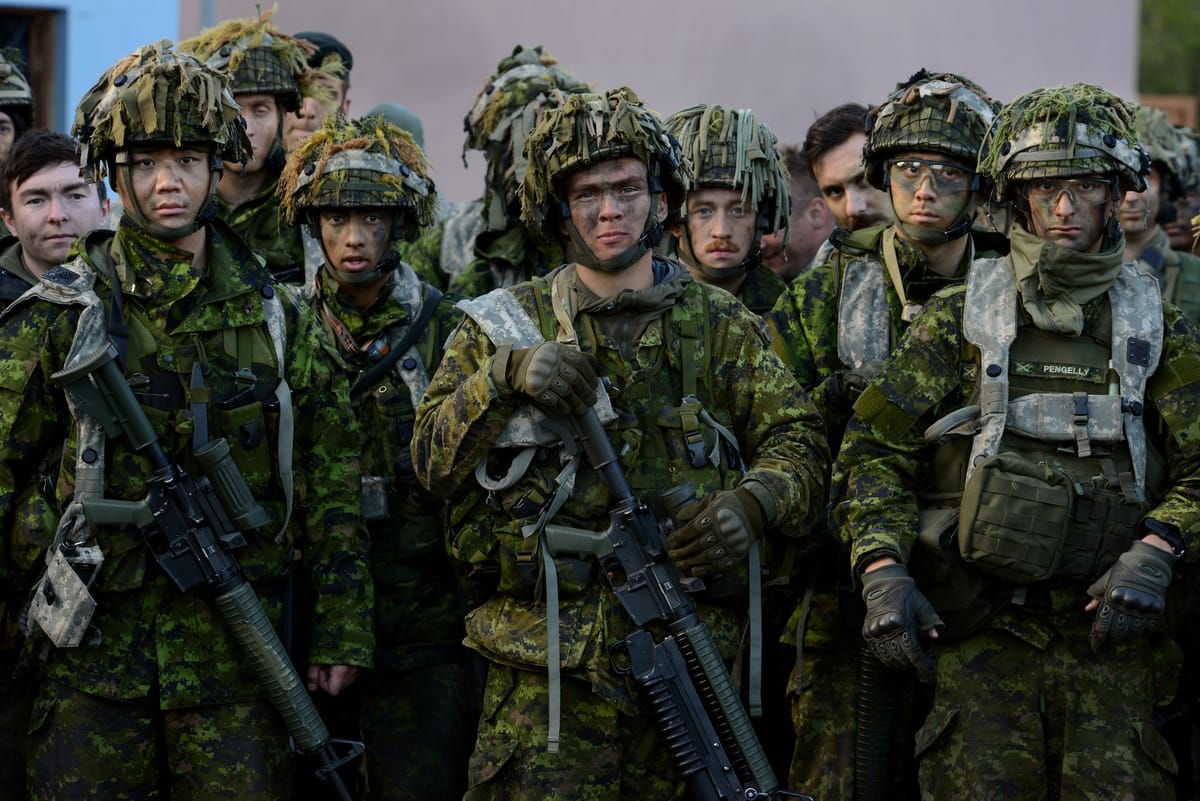
Featured image is Canadian Army Reservists assigned to the 39th Brigade Group, by Master Sgt. John Hughel