
How to Escape the Land Trap
We’ve had the solution for over 150 years. Might we be ready to implement it?
A gameplan for turning an overlooked federal agency into a flagship of liberal governance.

The main strategy of the second Trump administration has been total warfare against the institutions of liberal democracy. The regime’s list of targets includes everything from federal agencies like USAID and the Department of Education to private entities in the media and universities. “Postliberal” is not a sufficient description of the current right-wing administration. It is antiliberal. Not antiliberal in the American sense of opposing the Democratic party but in the sense of opposing the ideals and structures that govern our society: equality and the policies that promote it, rule of law and the agencies that enforce it, due process and the courts that protect it. It should be of no surprise that their ire has also fallen on the fuel source of liberal governance: taxation.
The Trump administration has crippled the IRS with severe budget cuts and haphazard workforce reductions under DOGE, leaving the agency in dire straits. After firing at least 20,000 workers last year, employees with no professional tax experience are being assigned to phone service lines and processing tax returns. According to a report by the Inspector General, phone line service goals have been lowered to 70 percent and nearly one in ten taxpayer assistance centers have been closed. As one employee said: “They are setting this agency up for failure for this tax season for sure … It’s going to make a bigger impact than people realize.” Recently the Trump administration’s attack on the IRS became very personal, with the President filing a ten billion dollar lawsuit against the agency over his leaked tax returns.
The purpose of this is two-fold. On one hand the sabotage of government functions is itself a reward for antiliberals, but on the other a weaker IRS fosters easier tax evasion and financial fraud for their rich and powerful friends. The Global High Wealth department of the IRS is a department designed specifically to audit wealthy individuals and corporations. Its staff was cut by over 40%. The total workforce reduction across the IRS is difficult to precisely calculate and still ongoing, but the Yale Budget Lab estimates that a 50% decrease in workforce could result in $400 billion in taxes going uncollected over the next decade. When factoring in indirect effects of increased noncompliance, the numbers climb as high as $2.4 trillion more taxes evaded.
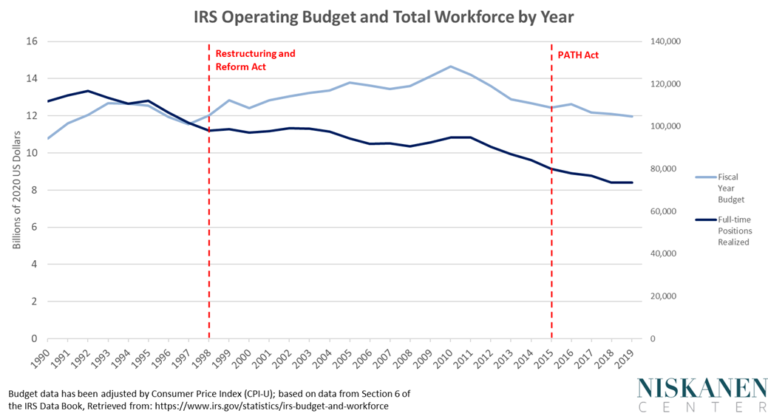
The IRS as an agency has been neglected since long before Trump’s attacks began. Before the COVID pandemic; funding had been on the decline for a decade and the workforce followed suit. In 2014 the IRS Advisory Council stated that the agency was “in the midst of an existential funding crisis.” Its budget then decreased for five straight years. This decline was briefly interrupted by President Biden’s Inflation Reduction Act, which allocated $80 billion over ten years to the agency, but subsequent legislation and executive action has more than undone these increases.
The anti-tax offensive is not just attacks on the tax police. There is a new wave of attacks on taxes themselves. The OBBBA legislative package contained sweeping extensions and increases to the TCJA tax cuts of Trump’s first term. According to the Tax Foundation, it is the sixth largest tax cut since 1940 and reduces taxes by $5 trillion over the next ten years. Included in OBBBA are many populist tax exceptions and carveouts, such as “no tax on tips” or “no tax on overtime.” The fiscal impacts of these policies in particular may be small, but the politics they speak to are part of a larger growing trend. These carveouts are not the same style of “broaden the base, lower the rates” policy and rhetoric of 2010s Republicans like Paul Ryan. “No tax on tips” is not a debate over the Laffer curve, it’s a rejection of taxation itself. Outside of national politics other Republican politicians are taking similar swings at the tax base. For instance, Governor DeSantis has been backing a plan to essentially eliminate property taxes in the state of Florida.
Unfortunately it seems that too many Democrats are buckling in the face of right-wing attacks on taxes. I first got worried when “no tax on tips” got bipartisan support on the 2024 campaign trail. It has since become clear that this was not an isolated incident; there are apparently many prominent Democrats who are eager to reveal their own tax cut proposals. The spree began in early March with Maryland Senator Chris Van Hollen revealing his Working Americans’ Tax Cut Act, which eliminates the federal income tax for those making under $46,000 and includes many tax breaks for those making up to $80,500. Then in the wake of the war in Iran and its impacts on oil and gas prices, Senator Mark Kelly stated his support for suspending the national gas tax. A few days later Senator Cory Booker one-upped Van Hollen with his own tax cut proposal, seeking to raise the standard household deduction to $75,000. Rep. Katie Porter came out in support of no state income tax for Californians making under $100,000. A candidate for Governor in Georgia is making no tax on teachers part of her policy platform.
These policies may be popular with voters but they are bad on the merits and on the politics. Tax revenue has already been gutted by OBBBA, debts are high from COVID relief, and there are no significant spending cuts in sight (especially as the costly war in Iran continues). Beyond the basic fiscal math, it is counter-productive to liberal goals to indulge the anti-tax politics of the right. As the Supreme Court put it in Bull v. United States, “taxes are the lifeblood of government.” If we believe that the government can and should improve the lives of its citizens and the world, it can only do so with the collective buy-in of taxation. The starting point for any Democratic politician should be reversing Trump’s tax cuts, not piling their own on.
If you get into a “who can cut taxes more” battle with the GOP, you’re going to lose because they are far more shameless and antagonistic to the idea of living in a functioning society. Don’t concede to their framing that taxes are nothing but a problem to be solved.
—James Medlock, founder of the tax positivity movement
I understand that running on raising taxes is likely an unattractive proposition for Democratic politicians, so here I propose an alternative. What if I told you it was possible to raise several hundred billion dollars in tax revenue without changing anything about tax rates? And what if this same policy materially improved the lives of tens of millions of working and middle class Americans? And what if this policy also helped to punish the criminals currently running our government?
Future liberal administrations should not seek to restore the IRS’ pre-Trump funding and workforce. They should seek to go far above and beyond, transforming the agency from an overlooked black sheep into a flagship for effective governance. Overhauling and supercharging the IRS will raise billions in new government revenue, make life easier for millions of American taxpayers, and help keep our society fair and equal under the law. It’s a win-win-win scenario.
One of the cliches that Trump campaigned on in 2016 was that he would “run the government like a business” as an allusion to his origins as a New York real estate mogul. Despite his actual record as a businessman being spotty at best, the slogan resonated well with voters who feel like the government is full of waste and mismanagement as compared to the efficient and streamlined private sector. If we engage with this argument—temporarily setting aside the object-level arguments of how wasteful the government actually is—there is an obvious answer for what the government should prioritize if it wants to mimic profit-driven firms. Ask any business major in the country what the priority in any business decision should be and I’m confident the most common answer is maximizing return on investment.
In terms of ROI the IRS is unbelievably, unimaginably profitable. In FY 2024 the IRS collected $5.1 trillion in revenue with an operating cost of just $18 billion. Averaged out that means it cost the government just $0.36 for each $100 of revenue collected, or roughly a 28,000% profit margin. If someone were to be appointed CEO of America Inc. their first thought would likely be to fund this department as much as fiscally and physically possible. The business metaphor starts to break down a bit when you remember that the IRS has a few advantages in the market, namely a legal obligation of its customers to pay, but the general principle that the government should prioritize revenue-maximizing policies when possible remains true.
Most political debates about government finances revolve around raising taxes to increase revenue or cutting spending to decrease costs while ignoring the multibillion dollar elephant in the room. There’s a joke I’ve heard from more than one econ professor in my time:
Two economists are walking down the street and pass by a hundred dollar bill without picking it up. A little while later one turns to the other and asks, “was that a hundred dollar bill on the ground?” To which the other replies, “nope, if it was someone would have picked it up already.”
In the case of tax enforcement there are a few hundred billion dollars lying on the sidewalk.
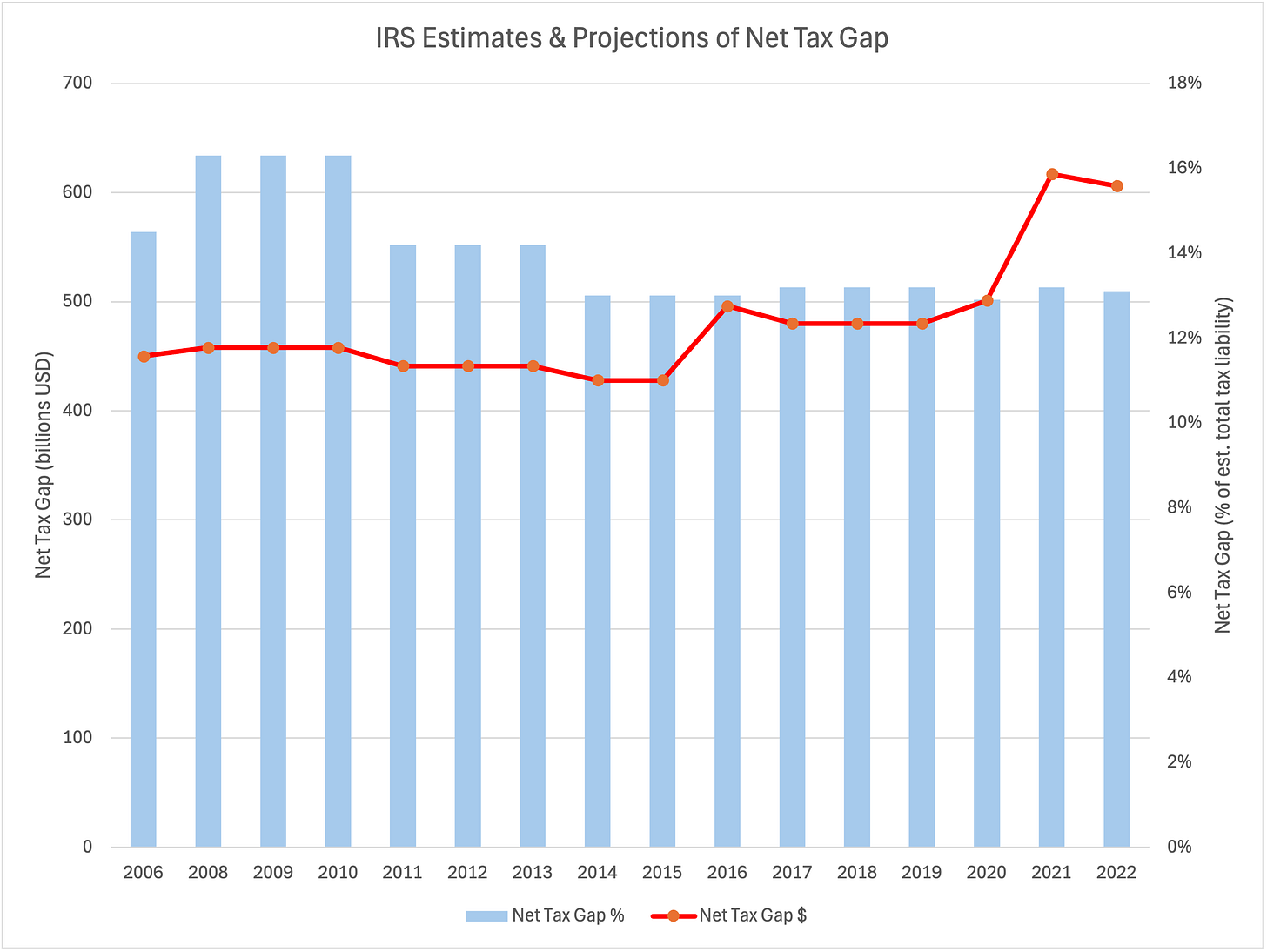
The IRS regularly publishes their own estimates and projections of the tax gap—the difference between the amount of taxes legally owed and the amount collected—and finds that anywhere from 10-12% of taxes are not collected, an estimated $600 billion in 2022. In fiscal terms this is a bit more than just a free lunch. If this $600 billion tax gap was collected as owed it would have closed nearly half of the 2022 budget’s $1.4 trillion deficit.
Estimates of the potential yield for increased IRS enforcement vary in size, but even conservative estimates show that current funding levels are far below optimal. The Congressional Budget Office published a 2024 report projecting the fiscal impacts of proposed IRS budget cuts in which their benchmark ROI for increased IRS enforcement spending is $6.40 for each additional dollar spent. This ROI is almost certainly an underestimate—it assumes diminishing returns and fails to incorporate indirect effects of IRS enforcement—but I will get into that more later. Furthermore, it projected significant net deficit increases for any size of budget cut.
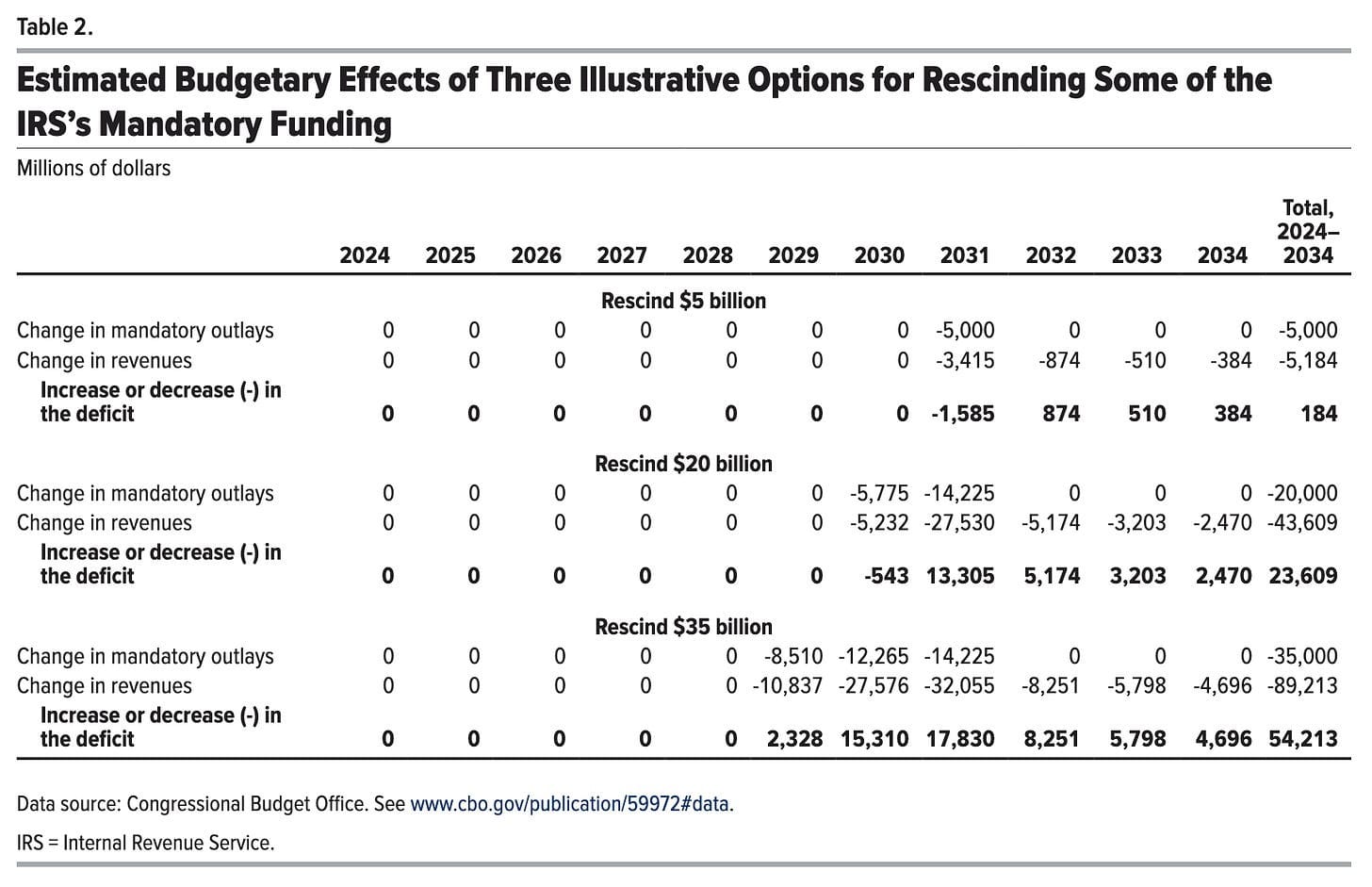
Economists Natasha Sarin and Lawrence Summers have published two working papers on the subject “Shrinking the Tax Gap: Approaches and Revenue Potential” and “Understanding the Revenue Potential of Tax Compliance Investment” that argue for more optimistic estimates. A 2020 CBO report projected that between $60 billion and $100 billion in additional revenue could be collected with an increase in IRS enforcement spending of $20 billion and $40 billion, respectively. Sarin and Summers believe that the CBO estimate is significantly underestimating potential returns for a variety of reasons including a lack of consideration for improved technology and incorrect assumptions about rapidly diminishing returns and provide a much bolder projection of up to $1 trillion over ten years.
Some of the specifics cited for highly profitable programs are such obvious common-sense policies that it raises questions why they weren’t already the standard. A return review program to screen tax returns for potential fraud before being paid out saved the government $6.5 billion while costing only $400 million to develop and around $100 million per year to operate. It is true that at some level of spending diminishing returns will kick in but when a program is returning over an order of magnitude more than it costs to run then it’s absolutely worth further investment. It quite literally costs less than nothing.
Economists love talking about unintended second-order effects of government policy, but in this case second-order effects are a benefit. One of Sarin and Summers' critiques of the CBO report is a lack of consideration for deterrence. Improved tax enforcement increases tax revenue in two ways: by identifying and collecting owed taxes and also by increasing the rate of voluntary compliance by incentivizing tax evaders to voluntarily comply at risk of facing financial (or potentially criminal) penalties for tax evasion. Determining the size of this indirect effect is difficult and research shows varied results based on many factors, but the effect is certainly not zero. For one example, a 2019 Treasury report cited by Sarin and Summers estimates that this indirect effect may be three times that of the direct effect.
Tax enforcement is only one part of the IRS budget and while it is the most important from the government’s point of view, it is the least important from a taxpayer’s. According to their Budget and Workforce report in 2024, the IRS spent $6.5 billion on enforcement and $4.1 billion on taxpayer services. Taxpayer services are the side of the IRS that the overwhelming majority of Americans interface with. This side of the agency is responsible for helping Americans file their taxes, process their tax returns, and manage their accounts with the government. The IRS was struggling to provide quality taxpayer service long before Trump’s recent attacks, which is why a mere return to the status quo is insufficient. Every year the Taxpayer Advocate Service within the IRS publishes a Congressional report on the biggest issues facing American taxpayers:
These problems are chronic and severe. From 2024 to 2025 the average processing time for amended business returns grew from 229 to 401 days. In 2017 the level of service for IRS phone lines fell to 47%, meaning more than half of callers gave up before reaching a human operator. In 2018 nearly one million taxpayers attempted to file their taxes electronically but were unable to; processing them on paper increases labor cost, error chance, and refund delays. A long history of insufficient budgets and low manpower has left the IRS woefully unable to match the quality of service regularly provided by other government agencies or private financial service companies. Things will only get worse as the Trump administration continues to slash budgets and stretch the workforce even thinner. As stated earlier this year’s tax season is likely to be one of the worst since the COVID pandemic, with untrained HR and IT workers being forced to answer phone lines and process tax returns.
Paying taxes is uniquely and unnecessarily burdensome in the United States, but it doesn’t have to be this way. In 2025 American taxpayers likely spent somewhere around $150 billion dollars in out-of-pocket costs to file their taxes, often to private companies like Intuit (more commonly known as TurboTax). Financial service companies like this have spent years lobbying the government to prevent the creation of a free tax filing service in the US. As part of President Biden’s Inflation Reduction Act the IRS was given a $15 million budget to begin a pilot Direct File program, a free service for Americans to do their taxes directly with the IRS instead of paying fees to middlemen—much to Intuit’s chagrin. This pilot program was an immediate success, far overshooting its goals by saving 140,000 Americans over $5 million in costs and received excellent customer reviews. As the Treasury explains:
Direct File customer service representatives (CSRs) handled tens of thousands of chats with an average wait time of one minute and an Average Handle Time of 9 minutes. 90 percent of survey respondents who used Customer Support rated their experience as excellent or above average.
Of course, President Trump is cancelling the program.
A top-shelf priority for future liberal administrations is the immediate revival of the Direct File program to deploy it nationwide as soon as possible, but this is just one example of an easy improvement that can restore faith in government. Many of the bad experiences Americans have with government are not the result of complex incentive structures but instead these simple issues that nobody has bothered to fix. It is embarrassing that one in ten IRS offices is completely unstaffed, or that the minimum goal for phone service is only 80%. All we lack is the political will and the budgetary equivalent of pocket change to fix it.
Finally, improving the IRS’ performance will serve to make our society more fair and equal. It is well documented that tax evasion is heavily skewed towards the upper end of the income distribution. This is both because richer people have more money to hide, but also because they have access to more sophisticated tax evasion strategies. As the IRS becomes less effective under Trump’s administration, those who stand to benefit the most are who you would expect: the 1%.
Tax evasion does not merely follow the same progressive distribution as taxes paid. The top 1% of income earners make up almost 30% of unpaid taxes, as compared to roughly 24% of all taxes paid. The following is a chart comparing the Institute on Taxation and Economic Policy’s estimates for share of taxes paid to the Yale Budget Lab’s estimates for share of unpaid taxes. (Note that ITEP’s estimates are for 2024 and Yale’s are for 2025, but year-to-year differences are unlikely to be significant.)
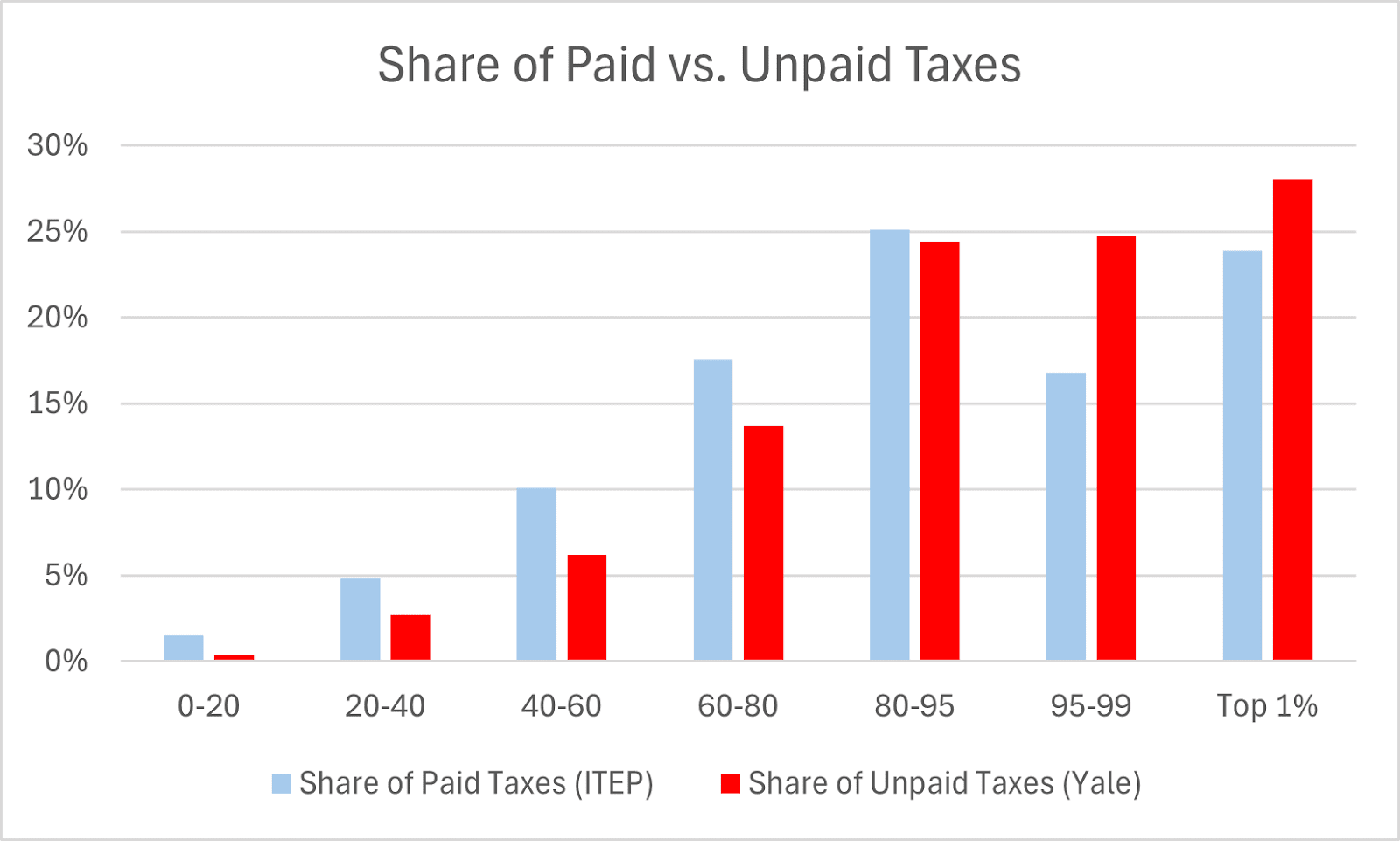
The majority of tax evasion happens at the highest end of the income distribution. Most above-average earners pay a higher share of taxes than their share of tax evasion; it is only those at the absolute highest end of income—the top 5% and 1%—that evade more taxes than they pay. When agitating against President Biden’s increases to the IRS budget, Republican lawmakers often fearmongered about tax collectors auditing typical working-class Americans. This did not manifest in reality, nor should we expect it to in the future. The return on investment for auditing 90th percentile earners is more than double that of below-median income earners. The rational assumption is that an increase in enforcement capacity would be focused on the highest ROI targets—this is the same assumption the CBO makes when projecting the fiscal impacts of IRS budget increases—and those high ROI targets are not your typical American.
Any economics-minded individuals reading this might have raised an eyebrow at my earlier claim that collecting these unpaid taxes represents free money, “a few hundred billion dollars lying on the sidewalk.” It is true that an increase in tax collection is in some sense an increase in the effective tax rate, which will have some associated impact on economic activity. Those unpaid tax dollars have to go somewhere after all. But to my less tax-positive friends out there I offer this: shrinking the tax gap goes both ways. What I mean by this is that every additional dollar raised by increased IRS enforcement is a dollar that was raised without any associated increase in the on-paper tax rate. If we collect more from tax evaders, that could allow us to, in theory, lower taxes for the vast majority of law-abiding, tax-paying citizens and firms while keeping government revenues constant. If you don’t like the sound of free money, how about the sound of free tax cuts?
Furthermore, the populist sentiment surging across all sides of the political spectrum is fueled by a sense that taxes are unfair. There is unfortunately a growing bipartisan consensus that something is wrong with taxes; those on the left think we need to cut taxes for typical Americans and tax billionaires on their wealth while the right thinks that American families are being unfairly taxed to fund an elaborate network of NGOs to enact the woke agenda. I am not positing that both sides are equally bad, but that this sentiment persists across the aisle. President Trump’s tariff regime has been justified with many arguments that echo those of left-wing protectionists like Bernie Sanders. Our tax code is becoming increasingly full of absurd carveouts and loopholes for popular groups: no taxes on tips, no taxes on Social Security, no taxes on boat loan interest payments. On the flip side it seems the only recent tax increase proposals are narrowly focused on taxing the wealth of the uber-wealthy.
This is incompatible with well-functioning liberal governance. Taxes are not a necessary evil, or a punishment we wield against people we don’t like, they are the collective dues we owe each other to live in a society. When people lose faith in that mutual obligation—whether justified or not—the social contract frays and might tear itself to shreds. Taxes cannot become another front line in the endless culture wars. I think there are lessons to be learned from the DOGE program on this. Communicating directly to the American people about how what’s happening with money is an extremely potent political weapon. By DOGE it was wielded dishonestly by right-wing liars and criminals to justify the shuttering of programs they disliked, most notably USAID—thereby condemning potentially millions of people to preventable death.
But this tool can potentially be wielded for good. The future I propose for the IRS is not just one with a bigger budget, but a much bigger voice. When Direct File gets revived and launched nationwide it should come with an accompanied ad campaign: do your taxes for free, thanks to the IRS. It is particularly infuriating when Intuit spends millions of dollars on Super Bowl commercials making fun of how annoying taxes are to pay. Wonder whose fault that is.
Every month the IRS should issue a press release of how much they collected in previously unpaid taxes. Make news stories out of particularly egregious criminals. Brag about taking down crypto scammers, drug dealers, and healthcare fraudsters. People need to see and hear about the successes of government if they are ever to trust it again.
What comes after this Presidency will define the future of our republic. Whatever you want to call it—a Second Reconstruction, Project 2029, Operation: Put All These People In Prison Forever—it will require massive political will and ambition to not just fix what was broken but rebuild something better in its place. A return to the status quo is unacceptable. We cannot alternate between attempted national suicide and cleaning up the mess every four to eight years. Flipping the fascism switch on and off again over and over just means eventually it’ll get stuck in the on position. Nor is the answer for an equally anti-establishment left attempting to harness populism for their own ends. The invention of liberal society is one of the greatest technological achievements in history and its abandonment would spell disaster for the 21st century.
Right now the American right is attacking the very foundations of liberal society and governance: equality under the law, due process, free and fair elections. Taxation is an underspoken but equally fundamental pillar of our civilization. The state can only enforce equality of the law, ensure due process, and oversee free and fair elections with the necessary resources to carry it out. In much the same way the Fourth Amendment protects your right to private property it is also protected by the taxes collected to pay officers to apprehend suspects and district attorneys to prosecute thieves. Those who seek to destroy liberal society know this, and that is why the IRS is under attack.
In the same way that weakening the IRS cripples our ability to govern, strengthening the IRS enables many other aspects of liberal governance. The more taxes are collected, the more money governments have to provide services to their citizens. The less burdensome it is to pay taxes, the more good faith citizens will extend to their government when it comes to providing said services. And when taxes are paid fairly and according to the law that serves to maintain the fabric of our mutual social contract. The IRS has a unique position as a government agency with immense surface area. Some 220 million Americans filed tax returns last year; basically every American adult interacts with the IRS at some point every year. This means that basically American adult has the chance to see what effective governance can look like, for the low low cost of free.
As an added bonus I’m pretty confident that plenty of the criminals running our government right now would not pass an audit. They caught Al Capone on tax evasion, after all.
Featured image is "Panorama view of the Internal Revenue Service Building," cropped. Photographs in the Carol M. Highsmith Archive, Library of Congress, Prints and Photographs Division.
Sign up for the newsletter and get our latest stories delivered straight to your inbox.