Also a Review of Habermas
Is Habermas a titan of recent philosophy or a stodgy academic lacking a burning political vision?

Most people who reach their 80s and 90s take up fishing. Jürgen Habermas published a three-volume history of philosophy that's one of the most significant works in a career full of them. More than just a philosopher, Habermas continues to generate a surprising amount of political controversy for an author whose books are littered with literary fire like: “the logic of inquiry, the interconnection of the three modes of inference represents the rules according to which we must proceed if the process of inquiry is to fulfill the purpose by which it is defined: namely of leading in the long run to true statements about reality” (48 word sentence drawn at random from Knowledge and Human Interests). During the Israel–Hamas war that began in 2023, Habermas drew considerable ire as the heir to the radically Marxist Frankfurt school who argued for moderating language when describing the destruction in Gaza. This was in sharp contrast to the early 2000s when Habermas was a left-wing darling for his stinging and prestigious rebukes of the Bush Administration’s war in Iraq. This was at a time when centrist media, by and large, lined up behind the invasion.
With a career spanning seven decades and touching nearly every corner of the humanities, any assessment of Habermas’s legacy is going to be complex. To some, Habermas is the greatest philosopher of our time. Nothing less than the heir to Kant, Hegel, and Rawls, offering a systematic defense of the Enlightenment project as stunning in its sweep as it is intimidating in its depth and rigor. At the very least, Habermas is the academic’s academic; the scholar prince who picks up prizes and awards at around the same speed as he masters disciplines and writes field-defining, multi-volume books. For others, Habermas is the court philosopher of the German center-left SPD, or perhaps at most the EU. A center-left liberal technocrat by any other name who defends a staid programme in even more staid prose. Worst of all he commits the crime of making philosophical thinking seem less like an exercise in burning political vision or spiritual edification and more like a race to be as boring as possible. For critics, Habermas is a dinosaur—the patron saint of social democratic moderation—still carrying the torch after the world has passed him and advancing arguments that seem ever more nostalgic.
The philosopher against profundity
Two new books work hard to make sense of these conflicting takes. Both have a disconsolate and severe quality to them, which is appropriate given their subject’s current state of mind. Philip Felsch’s The Philosopher: Habermas and Us canvases his legacy from a largely political perspective, focusing on his role in a post-Holocaust West Germany and “West” Germany. It is based largely on an interview with Habermas as well as a broader engagement with his primary writings and the secondary literature on his public life. Things Needed to Get Better is a book-length interview with Habermas published under his name but largely organized by Stefan Muller-Doohm and Roman Yos. It’s a much more academic book, focusing heavily on Habermas’s core theoretical contributions, influences, and seminal dialogues with figures like Adorno, Gadamer, Rorty, Rawls and more. Both are welcome contributions to the enormous oeuvre on Habermas, though neither tries to be comprehensive, let alone definitive.
Felsch’s Habermas and Us provides some welcome clarity on his political trajectory, alongside other helpful insights. Felsch emphasizes Habermas’s status as part of a lucky generation of Germans: Born early enough to have witnessed the horrors of Nazism firsthand but late enough to have escaped moral culpability. As Felsch puts it, the “Forty Fivers—the label that fits Habermas best—found themselves ideally prepared for the new beginning: too young to be seriously compromised but old enough to realize that an era had ended.” As someone who was intellectually engaged, Habermas reflected deeply not only on the content an anti-fascist philosophy must have, but on the role an anti-fascist philosopher must play in a democratic society. This was profoundly stamped by Habermas’s sense that many German philosophers, most infamously Heidegger, had severely compromised themselves by proudly siding with the Nazis and then vainly refusing to apologize for it.
In one of the more perceptive and original sections, Felsch notes how this permanently inoculated Habermas against the temptation to be a visionary or poetic thinker. Philosophers like Nietzsche, Heidegger, and Schmitt had offered bold, totalizing, and ultimately dictatorial worldviews. This is in line with an intellectual tradition that can be traced back to Plato; in The Philosophical Discourse of Modernity, Habermas still detects residues of it in a figure as otherwise admirable as Adorno. Politically this was dangerous since it led to the conceit that the philosopher, intellectual, or artist was entitled to stand outside of society and its deliberations and declare “thus I alone will it be otherwise.”
Philosophically, Habermas drew on a moderated Marxism to describe how this was simply unrealistic—men make history, not man. Even if that man wrote Being and Time. A failure of visionary types to realize that all thinking takes place through the medium of the language we inherit and share with others. With the turn away from the philosophy of the subject, which takes the individual and their consciousness to be the center of the world, we move to a “post-metaphysical” understanding of the world as an intersubjective construction. Truth, justice, and beauty aren’t something discovered and proclaimed by philosophers, intellectuals, and artists. They are debated and reasoned about by all of us. This also has a clearly universalistic quality to it; Habermas’s philosophy sheds particular attachments to self and Volk, moving upwards to include an ever bigger slice of humanity in its considerations. And proudly so. One paradox of this is that Habermas was happy to live in a provincialized West Germany precisely because that made it easier to be a citizen of the world. He was no longer part of a Germany that could aspire to global significance and bring about global destruction. As such, Forty-Fivers gave up being citizens of the ascendant reich and settled for being citizens of the world.
This led Habermas to call for “abolishing profundity.” As Felsch puts it, Habermas would not be a “producer of a Weltanschauung. With almost merciless resolution, he seems to have spurned the legacy of the aesthetic avant-gardes: no lofty, mystical theses, no suggestive images, no prophecies, long-term or short. In his eyes, such dishonest means were used only by irresponsible minds…” When I read the Theory of Communicative Action years ago, I found it unbelievably annoying. Before getting a single argument about communicative action, Habermas demanded more patience from his readers than anyone should feel entitled to. I was compelled to slog through his entire history of modern social theory and the secondary and tertiary literatures on it (according to Felsch, my feelings were hardly unique). I didn’t understand why Habermas wouldn’t just get to the point. But presenting material that way would run contrary to Habermas’s own philosophy, which dialogues with the great thinkers to reconstruct their insights while simultaneously historicizing itself to affirm the finitude of this very reconstruction. It is an approach that appropriately and modestly divests itself of subjectivity, making Habermas just one voice in the widest democratic chorus of the living and dead. It also showcases how, contra Burke’s conservative conclusions, a true democracy of the living and dead can only be one committed to equality. No one’s voices become authoritative, no one part of tradition determines the rest, no special privileges or power amplify your claims. We’re all left only with the plausibility of our claims to fall back on when neither our power or money speak for us anymore.
A philosopher of better
Books like Things Needed to Get Better are as close to a Habermas autobiography as we’re going to get, with long discussions about his influences, dialogues, and political stances. Appropriately much of it is about other people where it isn’t about grand ideas.
Habermas’s syncretic approach means the project internalizes an enormous array of seemingly very different authors, traditions, and approaches: Frankfurt School critical theory, American pragmatism à la Peirce, Rorty, and Brandom, contemporary linguistics and the philosophy of language, liberal and democratic political philosophy, German social theory and sociology, legal theoretical debates around positivism and natural law, and more. Surprisingly, the conclusion to the book even demonstrates a growing respect for, and dialogue with, anti-colonial and post-colonial thinking. The book also addresses figures and movements that influenced Habermas in a negative way. These include Heidegger and the thinkers of the German “conservative revolution,” his often acrimonious polemic against the “young conservatives” of French postmodernism, a deep wariness of all religious fundamentalisms—especially where tied to nationalism. All of these influences, and the dialogues and friendships associated with them, are canvassed in Things Needed to Get Better.
This results in a deeper book that will have narrower appeal than The Philosopher. For those of us who have been reading and thinking about Habermas since undergrad, Things Needed to Get Better provides considerable clarification on his influences and how they fit together. For anyone who thinks Habermas sounds as exciting as a walking library, this book is not for you.
I found it fascinating in a way that complicates Felsch’s read of Habermas as so pure a universalist he almost accomplishes a kind of authorial suicide followed by Buddhist samsara rising into the public sphere of discourse. The Habermas in Things Needed to Get Better is much more personable and alive than the one in The Philosopher. He comes across as the academic’s academic, yes, but a living and human one. Richard Rorty is not just the name of a pragmatist philosopher, as he might be to “the philosopher.” He was a friend who invited Habermas to “spontaneously, stop off at Princeton on his way home to discuss Knowledge and Human Interests in his seminar. That sealed the beginning of a lifelong friendship.” Going back to his mentorship under Adorno, Habermas describes feeling like a “bit of charlatan” when asked to produce theoretical introductions to empirical work. You can almost hear an echo of the once-young scholar's sigh of relief that he “completed this task to Adorno’s satisfaction”—who would want to disappoint a legend?
Bookish yet worldly
Felsch notes that writers like Barthes and Derrida may have theorized the “death of the author,” but, ironically, they were so consciously singular and eccentric that their approaches are recognizably their own. By contrast, Habermas worked very hard to divest himself of authorial presence and has often been accused of having little personality or presence in his writing. This means Habermas might have actually achieved death as an author because that is simply his nature, whereas others could only ever theorize and aspire to it.
But I don’t think that’s true, even if it may be what Habermas himself wanted. I mentioned that opinions on Habermas vary, yet this isn’t a case where the answer to whether he is a radical or reformist, a titanically original philosopher or a reheater of old arguments, lies somewhere in the middle. Habermas’s thought is too complex to be boiled down to a dialectics of the virtuous mean where the right answer to philosophical and political problems lies somewhere between extremes.
At the core of both books is a portrait of Habermas as a philosopher whose traumatizing experiences forged a strange beast: an ultra bookish and still ultra worldly thinker. This remains true of him no matter how many volumes he produces on Christian scholasticism. At the core of Habermas’s theory is a wariness of the ancient quest of philosophy and faith, Athens and Jerusalem, to apprehend a timeless trinitarian fusion of truth, justice, and beauty. From his standpoint, this aspiration, even if often capable of generating very noble heights, also inspires the most fanatical kinds of cruelty. After all, hell too was created by universal love. Moreover it was simply never going to reach the transcendent heights it aspired to, and it was more than a little vain to imagine a singular human genius could.
Habermas's response was to transform thinking into a shared enterprise that offers reasoned analysis and arguments with the goal of making the world a little bit better and humane. According to Felsch, Habermas apparently still considers himself something of a democratic socialist and on the left-wing of the German SPD. If that’s so, then it is a leftism shorn of the Christian residues of self-righteousness and fury. This can be a virtue in traumatized times, but I’m not sure it is in our increasingly dark one. Between the Scylla of banal nationalist fanaticism and the Charybdis of liberal hesitance and moderation there is the true course of righteous anger.
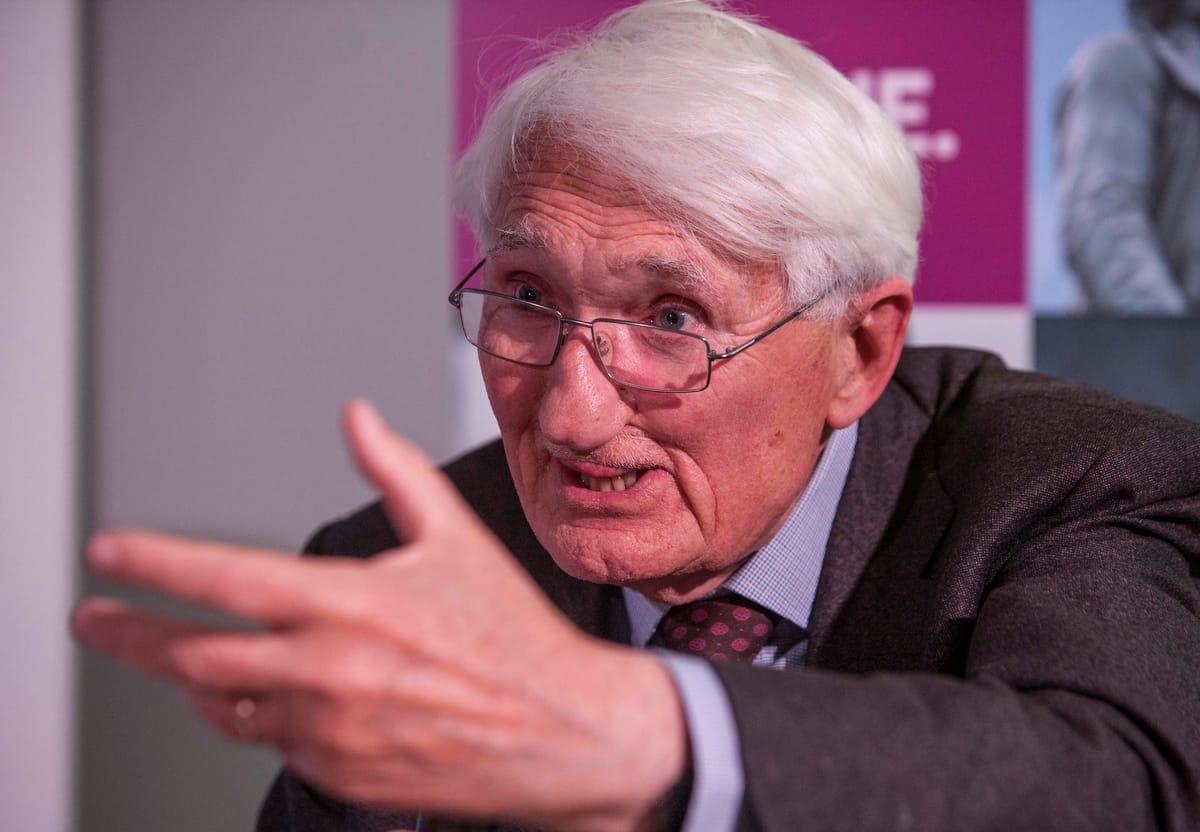
Featured image is Habermas, by Dudás Szabolcs