
Dystopian Prisons, Progressive Messaging, and the 2026 Midterms (Half the Answer #82, with Whitney Curry Wimbish)

Progressive messaging is so hot, the cynical opportunists are appropriating it for mass appeal. A combat surgeon returned from Gaza has found financial support in a pro-Palestine super PAC. Public pressure may prevent new ICE facilities. Journalist Whitney Curry Wimbish walks us through these and other recent stories she has worked on for The American Prospect.


Half the Answer can be heard on Spotify, on Apple, on YouTube, on Amazon, and elsewhere via its RSS feed.
Resources

 Whitney Curry Wimbish
 Erica Bryant
 Whitney Curry Wimbish
 Whitney Curry Wimbish
Transcript
**Whitney Curry Wimbish** [0:01]
And as I drank their cold liquid from each shell and washed it down with the crisp taste of the wine, I lost the empty feeling, and I began to be happy and to make plans.
**Whitney Curry Wimbish** [0:14]
That is what it's like to eat oysters.
**Whitney Curry Wimbish** [0:22]
You're showing—
**Caitlin M. Green** [0:30]
Well, blue skies are here again, Trent. I'm so excited it's happening. My husband is pissed because he hates it when it's hot, and I'm finally happy again. So that's our dynamic of our household. This is Half the Answer, where understanding a question is half the answer. I'm Caitlin Green. With me is Trent Nelson. And, as always, you've brought me a present—
**Trent R. Nelson** [0:51]
I have, and it's not just the blue skies, not just the sunny day. Yes, that is another musical reference for those who know the Allman Brothers, for sure. Well, Caitlin, I've also brought you the lovely Whitney Curry Wimbish. She's staff writer over with the American Prospect, and we are just so thrilled to have her. And she also is a co-writer for the Majority Report newsletter, which you can find when it's around. How about that, Whitney? Such a pleasure. Thank you for coming on, finding some time for us today. We're going to get all over, and unfortunately, that probably means starting off with some nasty, unfortunate stuff. But before we get into concentration camps and the other horrors of modern society, how are you today, Whitney?
**Whitney Curry Wimbish** [1:39]
I am good. It is. It's the kind of morning that I started out thinking like I really am going to just do it up for breakfast with the whole nine yards — potatoes, sausage, eggs, toast, jam, multiple cups of coffee — and so I feel like I could die happy now. Yeah, man, I got the garlic breath going. It's a really good time on Thursday. How about you guys? How are you? Thank you for having me on.
**Caitlin M. Green** [2:03]
Oh, yeah, that sounds good. Let's see, I had yogurt with granola, it was great. I do wish I'd had some potatoes, but that's fine, whatever. I'm just a little jealous. Yeah, he's in road trip mode, so he'll just hop in the car and go wherever.
**Trent R. Nelson** [2:20]
I'm on the espresso diet. Don't have to tell me twice, I'll be there. It's been — the first two parts of the Trent Grand National Tour have been successful. We'll have shirts, don't worry. But I'll be up on the East Coast for all of the East Coasters, and I'll even be in the Great Northwest as well. Maybe have a live Half the Answer. Who knows, yeah. So, of course, we'll have to evict the skeleton.
**Whitney Curry Wimbish** [2:26]
Well, you're welcome anytime. Yep, come on over. Do you think those two guys know each other, like the full skeleton and the skull? Yeah, he's the financial advisor. You got it, put your money in treasuries.
**Caitlin M. Green** [2:45]
It's amazing to see you finally in your own house again. Oh my gosh, wouldn't that be so fun? You can sit where the skeleton is. Do they know each other? I don't know. He predates him, so he's maybe the big brother, or the older sort of sage advisor to this one, who's kind of — he's a loose cannon, right? You never know where he's going to be, what he's going to do, and this one's always like, you got to calm down. And he's like, Bitcoin, baby.
**Trent R. Nelson** [3:15]
Well, Whitney, again, thank you for coming onto the program. You've done so much interesting writing recently, which I think we're going to get to as well. Well, we had Andrea Pitzer on not too long ago, and we spoke about concentration camps, and how the government already had some, but would like more. The horrors persist, and yet we do as well. In the time since, surely more information has come to light. There was recently a piece that the co-host of this program read, where it was described that the government would like to have the Amazon warehouses of prisons, right? Again, the horrors persist, yet we do as well. Whitney, what have you been thinking about? What have you found? What has your work produced in this way?
**Whitney Curry Wimbish** [4:55]
I think what my work has illustrated to me lately is that there is just an insane profit motive driving all of this. There has been some discussion in the news about how private prison company stock is fluctuating — it's going down, it's going up — and so stock might not be as sure of a bet as it seemed at first. But the stock price is not the same as revenue that a company is receiving, and the revenues that companies are bringing in, that the corporate entity, the board members, the CEO — all of those guys, they're getting paid regardless of what their stock is doing. And we are focused right now on GEO Group and CoreCivic, those are the two really big private prison contractors that the Trump administration and the previous administrations hired basically to run all sorts of outfits, all sorts of private prison outfits, not just immigration prisons, but all types.
But there are other smaller companies that are also in the same racket, and then there's an entire industry of service providers — people who are running the commissary, people who are doing the medical stuff, people who are doing all these other components within the concentration camps. All of those people are getting paid, and they're all getting paid with our money. And so the complicity that we're all kind of trapped in is just — it's pretty depressing.
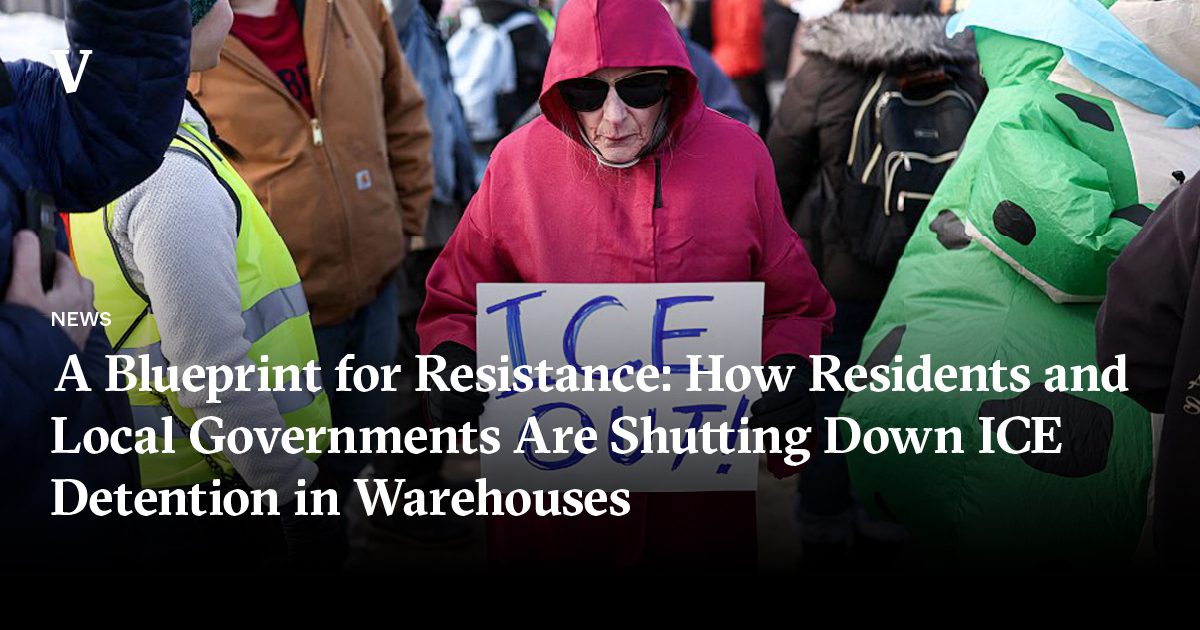
And I think that one thing that's giving me a little bit of hope is how much people are opposed to some of these newer efforts to really industrialize immigration terror. People are protesting warehouses being rezoned and retrofitted to be giant holding cells for people. They're standing outside their representatives' offices and screaming at them, and showing up to scream outside the buildings. And I think all of that matters. What do you guys think?
There was one kind of schematic that was circulating on social media not long ago that was for one of these warehouses, and it had a gun range in it. And people were kind of like — the existence of that is frightening, and why would you do that? But so many people were like, "Oh, look, it's a modern day slave ship. This is the exact same kind of configuration of just stashing people into these tiny spaces for profit." And I think the more people are understanding what this really means on a human level, the more people are showing up to their city council meetings, and they are saying, "You guys up here approving some of these buildings, approving whatever needs to happen for these buildings to exist — we're going to punish you by taking your job away if you approve this."
And I think that's really good. I don't think that there is the kind of culture of civic engagement that you would hope for, or I would hope for, in the United States, and I think that that's changing with this extreme situation that we are finding ourselves in.
**Caitlin M. Green** [9:41]
Yeah, what's also interesting, I think, is that there's the group of people who are upset morally because of the idea of stacking people in these sort of horrible conditions. There's also kind of a NIMBY faction of people who are like, I don't really know that I care that much about what happens to immigrants, but that thing should not be in my town, right? And so that's also a pretty powerful group as well. I think they'll go as far as to say, well, I don't want my children to have to see and hear what's happening over there. Right, but also great — if you can stop the thing from being built, cool.
**Trent R. Nelson** [10:22]
I mean, that's essentially what John Fetterman's statement was several months ago — that yeah, this isn't great, but also, have you thought about what it's going to do to our communities in terms of the undue burden of finances? It's like, you should really be maybe focusing more on the horrors that we're perpetuating against innocent people, instead of — right, whatever gets it done, yeah.
**Whitney Curry Wimbish** [11:00]
It reminds me a little bit of the objections to data centers that we're seeing, where people are like, this is a poor use of our resources. We're a small community, we do need jobs, that's true, but this is not the answer. And I think it's good that people are seeing the material impact of policy in their town and then being like, no, this is morally wrong but it's also going to wreck our town.
**Trent R. Nelson** [11:31]
Right, like we need jobs, but at what cost? We're going to super-eat the town of 14,000 people to death. We need sustainable jobs, and sustainable jobs come from sustainable infrastructure, sustainable professions, sustainable industries. And again, when you see the amount of energy that these data centers take — in some instances they're more than states are needing by themselves, in some cases countries — I mean, it's outlandish, and yet somehow it is what's going on.
**Caitlin M. Green** [11:43]
Right, I think — yep, now I'm super offended that you would say something like that. We're obviously very different and special. There's nowhere like here. Everyone knows that.
**Whitney Curry Wimbish** [12:11]
Yeah, America is not special. This is something that happens in countries, and we're a country.
**Whitney Curry Wimbish** [12:28]
I think American exceptionalism is — Trent and I were just talking about this. I think it has kind of poisoned people's brains here to be like, well, this can't be happening here, because we're so unique and so special. And it's like, no, we haven't been around that long, we're not unique or special, except for the fact that we think we are. And it's already happened here, because we were founded on genocide and human trafficking, and people like to act like that's some shocking statement, and it's just — that's what happened.
**Trent R. Nelson** [12:51]
Yes, it can happen here. It always happens anywhere. As we noted — we were just talking about that. Caitlin and I were just talking about that as well, with some production that she's making, which the world will get to see.
**Caitlin M. Green** [13:02]
Yeah, of all the different — it's just, we freak out every time we think a child might hear that America wasn't perfect, right? Because their poor little brains.
**Whitney Curry Wimbish** [13:10]
Like kids know. The kids know — they have to do active shooter drills. The idea that a kid doesn't know is silly. And I think people imagining that kids are not smart enough don't remember when they were a kid and they noticed that, oh, Dad is drunk, but he says he's good to drive. You remember what that was like. Everybody remembers adults lying and being — sorry, Caitlin said I'm not talking about you.
**Caitlin M. Green** [13:40]
Yeah, my dad listens to this podcast. I know you were always responsible.
**Trent R. Nelson** [14:06]
No, no, but—
**Trent R. Nelson** [14:12]
We love Caitlin's dad on this program. Shout out Mr. Marks. But yes, to be sure, I really think that that's all bullshit, though. I think that these people get so weirded out, not for the children's sake, but for their own fragile, actual minds' sake, right? They don't want to have to come to grips with the fact that all of these things are true, and that we don't live in a perfect world, we don't have a perfect country.
**Whitney Curry Wimbish** [14:49]
So your psychological analysis is that people are using their kids as psychological human shields? Yeah, I think so too. Kids can tell the difference. The kids can tell who is the good guy and who's the bad guy.
**Caitlin M. Green** [15:00]
Oh, yeah, basically emotional humans, because there's nothing more insulting to say to a little white child than, oh, if you hear about slavery or the genocide of indigenous people of North America, you're gonna think I'm talking about you personally, and you're gonna get so sad that you can't learn anymore. What do you mean? Have some faith in the kid — they can hear these things and be like, wow, that's awful. I sure wouldn't want anything like that happening in my name today. That's a pretty reasonable, logical leap that children make every single day, actually, and they can tell the difference between themselves and Andrew Jackson. I believe that.
**Trent R. Nelson** [15:33]
Yes, I think — yeah.
**Caitlin M. Green** [15:40]
Yeah, insane. Get him off of there. Get him off of there. I'm fully in favor — all the money should be animals and plants that are native to the Americas. I think that would be so cool. If we could have a moose and a bison, and some kind of — what tree do we have, sycamores or something — how cool would that be?
**Whitney Curry Wimbish** [16:00]
Yeah, Andrew Jackson is on money. It's crazy. Why is he on money? You know who does that? Scotland. Scotland has its own money, and it has adorable little animals on there. I would be really super in favor of some Alaska creepy crawlies like that. I grew up in Alaska, and I feel like Alaska is so known for its mountain goats, moose, bears, but there are some really incredibly beautiful moths and butterflies that are native to Alaska that are really special. And a lot of little aquatic little guys. I just think they're unsung. Yeah, get that guy off of money.
**Trent R. Nelson** [16:11]
We got all the trees. 1,000%. Well, we won't get into that. I'm sure there were deaths involved, but—
**Caitlin M. Green** [16:22]
It's moose.
**Caitlin M. Green** [16:37]
Oh yeah, they definitely deserve to be on the money more than Andrew Jackson does, 100%. Who have they ever murdered? Nobody, that's who. Put them on the money. I know. I just had to explain that to my six year old, and she was like, what? I was like, hey, you crazy animals, and she was like, I'm not an animal. And then I went full nerd mode, and I was like, actually, you're a primate, and you're part of it. It's all us. Yeah, circle of life.
**Whitney Curry Wimbish** [17:09]
So wait — who would be — so all animals, no people? I mean, people are animals, but non-person. Oh, that's so fun, because then you're like, oh, I'm part of nature. That's so reassuring. And no, when you croak, you're just gonna get whatever happens to nature happens to you.
**Caitlin M. Green** [17:32]
Oh, yeah. Well, that takes up a lot of slots, right? The animals from everywhere, so there's not going to be much room for a human, sure.
**Trent R. Nelson** [17:35]
That's brilliant. I think we're going to need representation from all of the regions of our land, so regions not states. Let's just have scenes — scenes that are representative of the regions with animals that might be there as well.
**Whitney Curry Wimbish** [18:05]
You know what else I think we should also put on there? Rocks.
**Whitney Curry Wimbish** [18:08]
Yeah, really good rocks.
**Caitlin M. Green** [18:11]
Oh, good rocks, yeah. Monument, some good formations, some southwestern rock formations.
**Whitney Curry Wimbish** [18:11]
Incredible rock collection, but it's up there.
**Caitlin M. Green** [18:22]
Yeah, it could look like anything. We probably have to pick something and stick with it. Oh, because we can just print money, and that always solves inflation.
**Whitney Curry Wimbish** [18:24]
Oh my gosh, like how they do stamps, like artists. We could have — oh gosh, that would be a counterfeiter's dream if money changed all the time. That's what we should move to. We just solved inflation, I think.
**Trent R. Nelson** [18:30]
Cue the always funny graphic. The gang just solved inflation.
**Whitney Curry Wimbish** [18:40]
Yeah, damn. So somebody, some angel investor needs to fund this to the tune of one billion dollars. We've got the valuation — for this project it's actually really high.
**Caitlin M. Green** [19:11]
Yeah, we just thought about it, and it's valued at a billion dollars. So, any VCs — it's so high. I'll just call all my old Palo Alto contacts and see who's available. Totally accomplished.
**Trent R. Nelson** [19:30]
Yeah, so as the country navigates concentration camps, navigates a conflict in Iran which persists even though the mission was successful — from what I read previously, question mark, question mark, question mark — well, while all of this is going on, don't know if our listeners or viewers know the midterms are coming as well. Whitney, you have written about a couple races recently as well. If I am correct, can you tell us a bit about what's cooking in Pennsylvania and New Jersey?
**Whitney Curry Wimbish** [20:00]
So today I published a story about a doctor. His name is Adam Hamway, he's in New Jersey 12, and that race is extremely crowded. I think there's like 12 candidates now. The ballot is going to say 13, because one dude dropped out recently, but it's too late to switch the ballot. This guy Hamway — he's got this really remarkable story. He's a surgeon, he was a combat surgeon, he saved Tammy Duckworth's life. She lost both her legs when her Black Hawk helicopter went down. I think it was 2004 in Iraq. She was going to lose an arm too, but this guy saved her from being a triple amputee.
And he has gone on to do these medical missions in disaster zones and war zones. He and I had this really nice conversation. He was really generous with his time a few weeks ago, telling me about what it was like working in Gaza. The situation that he described was really harrowing. He sent me some photos that are in the story that I published today — it's him just surrounded by these completely destroyed gray buildings. He was there trying to save people. He crossed with his international team from Egypt over the Rafah crossing when it was still open into Gaza. But once he got there, the Israeli government said you can't leave this same way and you can't leave the hospital, so he and his team were stuck there and bombs were falling all around them.
And he figured out a way to get some people out. He used his connection with Senator Duckworth, he pulled on connections with other international bodies to try to get people safe passage out of there. And the first deal was, okay, the Americans can leave, but everybody else can't. And he was like, all right, I'm not taking that deal. I'm not going to leave these folks behind. So he stayed with the rest of his team, and was eventually able to negotiate a deal to get everybody out, and they were able to get out. But while he was doing that, he described this increase of attacks around the hospital that to him felt like punishment for not leaving when he could have.
And so we just had this conversation about what it was like for him to be in the situation where he could die and try to do what he could in the time that he had and with the supplies that he had. And he was kind of like, well yeah, that's basically life in a microcosm — you do have a limited period of time, you can go at any instant, and being afraid is not a good excuse to do nothing. And so that was kind of the spirit that he's carrying with him. It was a really remarkable retelling, because when I asked him, were you afraid to die — really harrowing — and he was like, well, yeah, but I could also die driving down — it was just like, man, that is to me so practical and so matter of fact that it is just a really remarkable demonstration of bravery that is very blunt.
So that was what I wrote about this time around. He basically got a really big windfall of cash from this new super PAC called American Priorities, and they're kind of trying to counterbalance money that the Israel lobby spends on trying to influence American elections. American Priorities — they are spending 2 million bucks on this guy's race, and they're kind of doing that throughout the US, where they're picking out a progressive candidate and throwing money at them. They've got a pretty big war chest, and they're going to spend it.
**Caitlin M. Green** [23:50]
Yeah, what are you going to do—
**Trent R. Nelson** [23:59]
Right—
**Whitney Curry Wimbish** [24:10]
But the candidates that they're choosing, and a lot of the candidates that we write about at American Prospect, have this thing in common that I've noticed that is really similar to labor organizers, where they get a bunch of people really into their campaign, they get a pretty sizable group of volunteers to door knock, and they keep them engaged after they win a primary and after they win an election. Zohran Mamdani is a really good example of that model of getting elected here in New York.
But it's so different from the model that activists and volunteers and students were disappointed by in Barack Obama's campaign, because he also mobilized a ton of people, but then once he got to the White House, he was like, I got it from here, thank you, and didn't have anywhere for that energy and that solidarity that they had learned — they didn't have anywhere for that to go. And I think this kind of class of political candidates have learned from that, and they are like, ah, this is how we're going to build power long term. And really smart to do it like that, but I also think that if you are plugged into that, you are learning how to organize yourself, and you can take that to your job and unionize your job, because everything that these candidates are doing is what you have to do to unionize your workplace.
You have to have one on one conversations with people, you have to get a majority of people on board, you have to have a bunch of kind of tedious meetings, you have to learn your legal rights so that you can describe them to someone else. And then you also have to learn all the misinformation that is out there about your project, and have non-wonky clear rebuttals, so that people can be like, oh yeah, I am being manipulated by the boss or Andrew Cuomo, or — "It would hurt their feelings if I asked for a living wage, and for my husband to have paternity leave? That would hurt their feelings? They feel bad." Yeah, they'll be mad at you. They'll be mad at you.
**Caitlin M. Green** [25:00]
Not that job, so—
**Trent R. Nelson** [26:14]
Right—
**Trent R. Nelson** [26:30]
Right—
**Whitney Curry Wimbish** [27:00]
No, okay. I have two — well, I have numerous unpopular opinions, I'm guessing — but I have two that are especially unpopular to corporate entities. One: get paid every day. Payment at the completion of the work day. And the reason is because the more the company holds on to your money, the more interest they earn on it. You should be earning that interest. So pay me every day, or pay me my salary plus interest earned. That's the first unpopular opinion.
**Caitlin M. Green** [27:23]
Right, yeah. No, our company is just like a big family, and I don't want to betray my family. So — right. You can't do that. Come on, you guys, be reasonable. And it's so uncouth to share your salary with other people who work with you, because if they know what you make, then everything's very awkward. So please, never, ever — yeah, never talk to each other about what you're each making. That's your labor. I mean, because really, what are they doing? They're borrowing it from you by not paying you right away. Yeah, I don't know. I think it's terrible, because I am a corporation, so I'm very offended. Caitlin Corp.
**Trent R. Nelson** [27:38]
But again, it would just kill — it would kill them if I got to live a nice happy family life with my loved ones, for sure.
**Trent R. Nelson** [27:56]
Yeah. Let's go—
**Whitney Curry Wimbish** [28:10]
Yeah, and they're earning interest on it. Okay. Well, yeah, corporations are people, stop being so mean. Therefore — yeah, I took that math class too. It's just equal signs. The other — my other unpopular opinion is that you make a spreadsheet with everybody's salary on it, and you circulate it. This is also what the Freelancers Union does for freelancing rates, which I think is great, because you see that some publications will pay different rates for the same word count.
**Trent R. Nelson** [28:52]
It's not unpopular here, Whitney, so let's see if the second one can strike that. Right — corporations are people. Caitlin is a people. Therefore, Caitlin is a corporation.
**Caitlin M. Green** [29:20]
Yep, yeah, it's true. And as a musician, it's also really hard for us to know what's the right amount to be asking for for work, because we're communicating with different venues all the time, and we don't know what they're saying to the other musicians. So any open communication really helps, so that we can hear what other similar acts are charging, so we understand what we can ask for.
**Whitney Curry Wimbish** [30:10]
Wait, so you're a musician too? Oh, tell me all about it.
**Caitlin M. Green** [30:15]
Oh, well, I'm in a folk band, we're called the Wild Lilacs. We don't have a lot going on yet. We're starting a website soon, but we do have an Instagram page, so follow the Wild Lilacs.
**Whitney Curry Wimbish** [30:20]
Cool, I'm gonna look that up right now.
**Trent R. Nelson** [30:22]
Also shared — it's coming soon.
**Whitney Curry Wimbish** [30:32]
What instrument do you play? Are you singing? What's your thing?
**Caitlin M. Green** [30:40]
I play ukulele, and I play the piano, and I play the flute, and then I also sing, mostly sing. Yeah, I'll be honest, I am not that educated on folk music. I joined the band because I wanted to sing somewhere, and they were nice. So the kind of music that we sing, it kind of varies, because I'll come in being like, here's a pop song I want us to do, and they'll be like, okay, cool. And we'll put stuff in three part harmony, and we'll cutesy up the instrumentation. Like we do "I'm a Believer" by the Monkees, but we do it with a washboard.
**Whitney Curry Wimbish** [31:00]
Oh, that's so cool. What kind of folk music are we talking? Like pop music? That's so fun. You guys got a bassist? Because I play the bass too.
**Caitlin M. Green** [31:31]
Yeah, come play the bass with us, that'll be really cool. I saw it back there, and I was like, interesting.
**Trent R. Nelson** [31:31]
Oh, absolutely, absolutely. Well, Whitney, something you brought up earlier with Zohran Mamdani and his ability to maintain this sort of grassroots base, but maintain the passion within it, right? Do not allow for that steam to dissipate, or find a new contraption for it. That is something — when people ask, well, what can be taken from Zohran in a macro aspect, that's one of them. As well as — and I believe Samantha Hancocks Lee actually recently said this — do something, and go on social media and make a video talking about how you did it. Whether we're in a more conservative or more liberal district or municipality, these are things that we can take moving forward as strategy.
And to your point, Obama did have that misstep, but we look back and we look at folks like Roosevelt and folks like Kennedy — they understood that as well, that you've got to utilize that base that you've created that voted for you. You've got to now use it as a sort of cudgel to try to hammer home the fact that we just got all these votes. We have a mission and a plan, right?
**Caitlin M. Green** [33:20]
Back on task— Yeah, don't stop talking about it. Yep, and the tone is really important too — it's the volume and it's also the tone. It's very positive, right? Like when he did his press conference announcing the plastic bins — he was continuing the program of putting bins out instead of just putting bags on the street, which — New York City, what the fuck? Anyway, so they're doing the bins, but in order to publicize that, they filmed it from low down, as if it was a rat who was pissed off about all the trash going in the bin, and it was like POV — amazing, well done. The playfulness and the positivity while attacking real problems is so valuable.
**Whitney Curry Wimbish** [33:34]
Yeah, it's like a rat just got the worst news in his life. I think that's — I mean, you hear all the time when you're learning about how to organize your workplace — the labor notes organizers, the organizers you're working with, who that's their day job, they tell you all the time that you can't just come at people with complaints. You have to make this fun project about working together to fix something that everybody sees as a problem. And so that includes having these kind of policy-oriented conversations where it's tedious and people get annoyed with each other, and you have to really hammer out what you are asking for and what you're willing to accept. But you also have to make it fun — there has to be snacks there, you have to get together and grab a drink or a coffee, you have to—
**Caitlin M. Green** [34:45]
A little karaoke night, blow off the steam.
**Whitney Curry Wimbish** [34:46]
Yeah, you have to have some of that in this big project that takes quite a lot. And Mamdani did that throughout his campaign — he had a big scavenger hunt at one point. He had swag that you could earn by knocking on a certain number of doors and stuff like that. I think that's strategically really smart, and I think it's something that these candidates in different spots all over the country are borrowing.
**Trent R. Nelson** [34:52]
Humanity, yeah.
**Caitlin M. Green** [35:03]
Yeah, I think — you do a lot, so you're really busy. Yeah, the mental files are also gone, right?
**Whitney Curry Wimbish** [35:10]
One of the other stories that I wrote this week about some upcoming elections — what did you say? Oh, well, I come from a daily newspaper background, so I had a daily deadline back in the day. And when you learn how to do that — and for anybody who's in the news media who's new to the industry, you can learn how to do this at any time. There's not a time limit on it. Once you have that skill, you don't really lose it. You can kind of just crank it out, and yeah, it keeps it fun. But you might also have the thing that you and I have, Caitlin, where once you finish a story for the day, delete the files and go play D&D or something. Yeah, it's like, wait, what did I do yesterday?
**Caitlin M. Green** [35:50]
That is what it's like to eat oysters. I agree. Yeah. Yes, let's have some oysters. Amazing.
**Trent R. Nelson** [36:27]
That was Hemingway's great complaint about being a newsman — that every day it has to be a new day, you're not allowed to remember any of this stuff.
**Whitney Curry Wimbish** [36:35]
Man, that dude wrote, I think, one of my favorite lines in all of history, or all of literature, when he describes the taste of oysters in A Moveable Feast. Man, what a master. "As I ate the oysters with their strong taste of the sea and their faint metallic taste, that the cold white wine washed away, leaving only the sea taste and the succulent texture, and as I drank their cold liquid from each shell and washed it down with the crisp taste of the wine, I lost the empty feeling, and I began to be happy and to make plans." When we all hang out and share a couple dozen—
**Trent R. Nelson** [36:52]
Beautiful, so—
**Whitney Curry Wimbish** [37:23]
The other story that I wrote this week about upcoming elections is this fight in Pennsylvania's seventh district. And it also has a really explicit labor aspect to it, because this dude Ryan Crosswell — he was a Justice Department attorney who kind of quit in this dramatic way last year when his boss dropped the case against Eric Adams. He was like, no, I'm not doing that. And he said, no, I'm not doing that so hard that he also left the Republican Party. So he's running as a Democrat now, but he keeps saying that he's pro-worker. But he worked at one of the biggest union-busting law firms in America — the biggest union-busting law firm in America. And the cases, when I looked at the cases, there's some really egregious anti-worker stuff in there — protecting Walmart and Citigroup and all these big employers against workers who were like, yeah, I was sexually harassed every day, or I'm a 40 year old dude who — all my sales stuff got reassigned to this young lady.
His track record is just — man, it's kind of an egregious look. And he's running against a dude who is a leader in the firefighters union. So it's like this corporate defender versus union worker, but they're both saying that they're on the same side. And it's just kind of messy.
**Caitlin M. Green** [38:30]
Poor Walmart, who will speak for them. Well, okay, so you're at a door and there's two candidates, and one of them always lies, and one of them always tells the truth.
**Whitney Curry Wimbish** [39:20]
Yeah, well — sexually harassed at work forever, whatever it is.
**Trent R. Nelson** [39:52]
Every day, yeah, horrendous.
**Whitney Curry Wimbish** [40:00]
But I think it's kind of like — the more these progressive candidates get really clear and use a similar strategy that's explicit, and we can see what it is because you can replicate it and win, I think there are going to be more of these griftery types, centrist kind of status quo types being like, I'm going to borrow that same playbook.
**Caitlin M. Green** [40:10]
Yeah, I'm also that, I promise. Well, okay. So on the one hand, that's gross and horrible, and of course that was going to happen, right? But on the other hand, it's kind of heartening that that message looks good enough, looks effective enough to somebody who's pure grift, that they want to take it as their mechanism for winning. Hopefully it doesn't work.
**Trent R. Nelson** [40:42]
Right. Yeah—
**Whitney Curry Wimbish** [40:47]
Yeah, the only problem is that independent media is dying, and so there's not enough reporters to go around and be like, this one is real, this one is kind of a little bit sketchy. There's not enough folks. Which, so, that angel investor who's going to fund our earlier money printing thing should also come in and just throw a lot of money at independent media, such as the American Prospect.
**Caitlin M. Green** [41:00]
Yeah, just one little problem, the death of media. Yeah, our money thing, yeah, our money printing business.
**Trent R. Nelson** [41:22]
Absolutely, part of the play. Yeah, well, we are in the fight for that every single day, whether it's the American Prospect or Liberal Currents or The Handbasket or Assigned Media. I mean, I could go on.
**Caitlin M. Green** [41:30]
Yeah, for example. Oh, yeah, the bundling thing, right? I'm so curious to see how it turns out, because it has the potential to do something really great, which is lower the barrier to subscriptions, right? Because people, I think, are feeling overwhelmed by — I cannot be paying a chunk of money every single month to all of the various outlets that I like. I will not have food. So to have a bundling thing — does that seem smart? I'm excited to see if it turns out to have been smart.
**Whitney Curry Wimbish** [42:14]
What do you guys think about that model — The Handbasket and — I don't remember what her part is. Yeah, that seems like a really cool thing, right? I am excited too. I really hope that those guys kind of show a little bit about how the sausage is getting made, because I'm not a management side knowledge haver, so I don't know how you would kind of make that go. But I think if they felt like sharing, that would be super handy. They could even monetize it — they could monetize their service.
**Trent R. Nelson** [42:53]
I would love to have that as my title — management side knowledge haver. That is top notch, right there.
**Caitlin M. Green** [43:00]
Knowledge haver, yeah. We all do words really good. Everybody here is a really good word doer, so we don't need to worry about that. Have you ever considered reading audiobooks? Because I would listen to a whole book of you, that would be great.
**Whitney Curry Wimbish** [43:04]
Yeah, right. For a living. I'm sorry, journalism, sorry. Sorry.
**Trent R. Nelson** [43:06]
Real good.
**Whitney Curry Wimbish** [43:17]
Caitlin. Thank you so much. If anyone wants to hire me to read their audiobook, I would be delighted, but I won't do it for free.
**Caitlin M. Green** [43:40]
$4. How much do audiobook narrators — no, no, for dollars, not for all. Do it for dollars. The new — what — that is out of control. Corporations must be stopped. I can't. We need to break up the Mars Corporation.
**Whitney Curry Wimbish** [43:50]
I need $4. I need four. That's one regular Snickers, and then one of the new Passion Fruit Snickers, which is so good. I am saying it's so good. I had it. You got to go get it. No, dude, this is so good. It tastes so tropical. Peanut, caramel, passion fruit. I was really into it. No, well, my plan was I'm gonna go get another one of these tomorrow.
**Caitlin M. Green** [44:20]
Do you stop feeling empty and start making plans after you have one? I need to strategize about how I get another one.
**Trent R. Nelson** [44:25]
That is absolutely amazing. There you go. She should not be doing it. Passion Fruit Snickers, you say. Well, Whitney, we appreciate you so much. You'll be back on to tell us more about the horrors, and also some of the triumphs, like passion fruit candy bars and the like. And when we all get together on the Trent Grand National Tour, well, bass will be had, and oysters will be shucked. Can you tell us, before you have to depart, where they can read all of your wonderful work and read your newsletters that come out sometimes, and all of the great coverage that you do?
**Caitlin M. Green** [44:38]
Okay, cool. That's it, I'm—
**Whitney Curry Wimbish** [44:50]
Thank you so much. Yes, please visit prospect.org and majorityreportradio.com, and then in the left hand corner it says "The AM Quickie" — get the newsletter, and you can also get a hat.
**Caitlin M. Green** [45:22]
That's it. There you go. Well, that's just rude. Okay, that's very sexual. And I'm a mother, for God's sake. I can't be hearing these kinds of things. The quickie. I guess that's — it's against my religion. And no, no, just "the quickie." I'm emailing him right now about how you don't even know who you work for. Yeah, you have got to come defend your brand.
**Whitney Curry Wimbish** [45:38]
Wait, which part?
**Whitney Curry Wimbish** [45:42]
Oh, sorry.
**Trent R. Nelson** [46:00]
No, no, Caitlin, that's smart. Yeah, email him. You can come on and reply and rebuttal in person with me. You are supreme. We appreciate you so much, and we look forward to having you back on the program, to be sure. And, well, to be sure, for all of our listeners and viewers — you know that understanding a question is half of an answer, and this is, of course, Half the Answer, with your co-hosts Trent R. Nelson and Caitlin M. Green. And until we do this thing all over again, we'll catch you soon. Bye.
**Whitney Curry Wimbish** [46:02]
Listen to what just happened. You got to get that linguist under control.
Read next

At First ICE Loses, Then It Flies, Flies Again (Half the Answer #107, with Gillian Brockell)
ICE has been transporting people in inhumane conditions to countries to which they have no affiliation or connection.

Dreaming of a Blue Texas (Out of the Jaws #13, with Jesse Dollemore)
On apocalyptic thought in the evangelical community, the role of liberal media in the struggle against fascism, and more.

Liberal Currents Live: Rape Culture, Male Supremacism, and the MAGA Right
American politics is being structured around rape as a core pillar of Trumpism.

Don't Let John Roberts Fool You (Neon Liberalism #93, with Mike Sacks)
How we need to think about court reform in the future.