Imagining a 2028 Presidential Campaign for a Limited Presidency
Why we need a smaller presidency and a more powerful Congress.

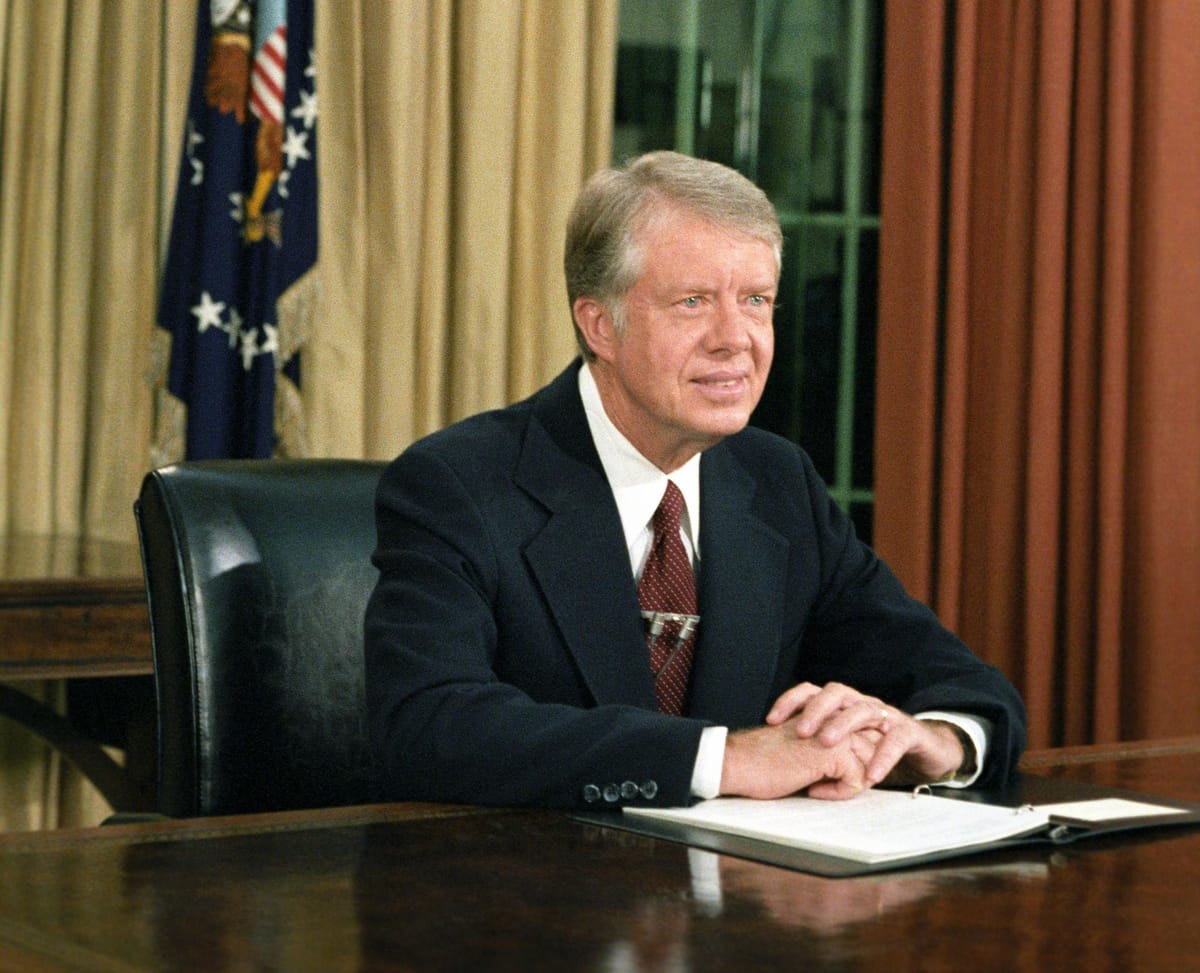
Jimmy Carter in 1977 cut the size of the White House staff by 30%. Coming just two years after Nixon’s resignation, Carter’s election coincided with a series of legislative reforms to tame the imperial presidency. Carter for a brief shining time seemed to embody that smaller presidency. He announced on his inauguration day that, “I would never permit my White House staff to try to run the major departments of government."
We’ve endured nine withering years of Trump’s America (including what we now realize was but a fleeting interregnum under Biden). The idea that the presidency should be an executive with cabinet secretaries and independent agencies constrained strictly to statute and the constitution seems distant.
Instead, the American imperial executive is led now by a few unaccountable staffers in the West Wing with the opaque character of a monarch’s courtiers. Trump is of a different character entirely than his predecessors to be sure, but the foundations of the imperial presidency have always been there. The office’s constitutionally limited character has been gradually degrading for decades.
We can’t go back to 1977, however, and those reforms were ultimately fleeting. Can we finally entrench small-r republican democracy?
Post Watergate reforms
“Watergate Babies”, the new Democratic legislators swept into office in 1974 and 1976, enacted a series of reforms meant to tame a White House that had grown unaccountable during both the Vietnam War and Nixon. Laws were passed like the Presidential Records Act, the Ethics in Government Act, the Foreign Intelligence Surveillance Act, Freedom of Information Act expansion, and the War Powers Act (passed during Nixon’s final months over his veto). The DOJ established rules to insulate it from the White House.
Kai Bird’s brilliant history of the Carter presidency, The Outlier, chronicles the hope of Carter in this post-Watergate milieu. Though he enjoyed what we now call a trifecta, he had poor relations with the Democrats’ factions from Ted Kennedy to southern conservatives. The energy crisis, roiled by Middle East wars, broke the spell of post-war prosperity. Finally, against the onslaught of the Soviet invasion of Afghanistan and the Iranian hostage crisis, Carter fell to the Reagan revolution.
The undoing of the limited Presidency began in earnest. Most of the leadership of the GOP in the 1970s, some of whom would rise to heights of power a few decades later, did not believe Nixon should have been forced from office. They never accepted the “consensus” narrative of Nixon’s betrayal of the country. Chief among them Dick Cheney, they made it their life’s work to gradually aggrandize the Presidency, at the expense of Congress and the people. With the breakdown of normal lawmaking caused by the new filibuster of the 21st century, 9/11, and the Iraq and Afghanistan wars, a gradual state of exception regarding the presidency’s extra-legal power was accepted as normal. George W. Bush, Obama, and Biden found it increasingly necessary to rule by executive order and to push the boundaries of statute.
Constraining the imperial presidency
There has long been a gulf between “Americanist” political scientists and constitutional law scholars on the one hand and comparative government specialists on the other. Americanists until very recently have largely never questioned the dogmas of our constitution—so called Madisonianism and the separation of powers.
Though still outside of the Overton Window of policy options amidst the daily grind of “flood the zone”, increasingly political science scholars are trying to move that window towards major statutory and constitutional changes to executive power and multiparty representation in Congress.
Recently I asked several political scientists and constitutional law scholars who’ve been prominent in this space what they thought we could do by law in 2029 to control the executive and expand Congress’ power.
David Faris is a political science professor at Roosevelt University who in 2018 wrote It’s Time to Fight Dirty which advocated for Supreme Court expansion and proportional representation, among other reforms.
“In 2017, people looked at me like I was insane when I suggested court enlargement, and today it is the default position of virtually every left and center-left observer of American politics,” Faris said.
Decrying the Supreme Court’s broad side against Congress’ clear intent when creating independent agencies, Faris proposes:
I would like to … pass [an] omnibus executive restraint law that includes a significantly enhanced and tightened War Powers Act, clear prohibitions on impoundment, a much sharper Hatch Act with real penalties, enforceable guardrails between DOJ, FBI and the White House, protections for independent agencies and clear, incontrovertible language about the executive's ability to dismantle congressionally authorized agencies by fiat.
Yale political scientist Kevin Elliott was a guest last year of Liberal Currents’ Neon Liberalism podcast and author of Democracy for Busy People (2023). He calls for proportional representation in the first hundred days of 2029, calling it,
… a selfless reform that will severely harm the Democratic Party by inviting the formation of a proper left party. So, advocating it as a democracy-saving reform has more than face validity given that it would be electorally costly to those who would have to be the agents of its imposition.
Regarding the presidency, Elliott opines that,
DOJ independence reform is very likely to be on the agenda after Trump leaves power, so those interested in taming the power of the contemporary presidency might as well get ahead of it now and try to frame it as part of a wider package of reforms to rebalance the powers of the federal government,” and, “ ... Trump's corrupt abuse of the pardon power suggests that a principle of 'no pardons except as recommended by a professionalized pardon-considering body' might be a good guide for reform.
Pardon reform would, arguably, require a potentially popular amendment to the constitution’s pardon clause.
Mark Copelovitch is a political science and public policy professor at the University of Wisconsin—Madison. Recently a guest on our Half the Answer podcast regarding Trump’s chaotic international policy, Copelovitch discussed a host of reforms. In terms of the first hundred days he says he’d go with, “DC statehood (and PR/USVI if they decide they want it), multiple new SCOTUS seats, closing the IEEPA/emergency law loopholes, John Lewis VRA, and ending the filibuster”.
He also reminds us that he, along with Faris and Jennifer Victor (below), are signatories of Protect Democracy’s 2022 letter calling on Congress to adopt proportional representation.
Jennifer Victor is a professor of political science at George Mason University. Victor asserts that when, “ … a political coalition that is opposed to the current powers comes into authority, it must be prepared to engage in multiple streams of action. To my mind, these might be categorized as accountability, repair, and reform.”
Along with some similar ideas to the other political scientists above, Victor also reminds us, as we have in these pages, that,
On the policy side, it will be equally as important to address the social and economic conditions that allowed antidemocratic appeal to spread. Public policy should be focused on reducing economic inequalities and equalizing access for healthcare, education, and dependent care.
Are statutes enough?
I asked Max Stearns, author of Parliamentary America, what he thought of proposals that are short of the constitutional amendments proposed in his book. Particularly such as statutory controls on the runaway imperial presidency, Stearns notes that,
While I would support statutory controls to the presidency as a reform post Trump, I go back to the subtitle of my book—The Least Radical Means. The incentive structures of Presidentialism are ultimately deeply flawed. Leaving the presidency under the constitution undisturbed won’t solve the problem.” He continues, “It seems difficult to believe that a future Democratic president—say, someone like AOC or Harris—would be inclined to give up many of the powers that Trump took for the institution under our existing constitutional scheme, whether or not defensible under the current Constitution.
There is a meme that professor Copelovitch, among others, likes to share about presidentialism that is titled Linz Was Right. This is a reference to political scientist Juan Linz’s influential 1990 paper The Perils of Presidentialism. It noted that presidential democracies are prone to dysfunction, gridlock, and instability compared to parliamentary systems. He made an exception for 1990 American presidentialism based on broad tent, centrist parties and strong norms. Factors that now seem gone with the wind.
A presidency of limits
As Stearns suggests, it is hard to imagine a Democrat running on a platform of limiting the presidency. A walk back from power is so extraordinary that it’s one of the more moving numbers from Lin Manuel-Miranda’s Hamilton. In One Last Time, George Washington says that he’s going to teach them (that is, us) how to say goodbye.
For we cannot hope to return to the republic as it was. (It didn’t work that great anyways). Without substantial reform in 2029 the end of the Trump presidency will be but a short reprieve. It’s important that as part of the necessary American Reconstruction we restrain presidential power and empower Congress. The thing about moving the Overton Window or passing constitutional amendments is that it seems impossible in normal times. It is impossible until, quite suddenly, it’s not.
Let’s work towards that republic so, to paraphrase Benjamin Franklin, we can keep it.
Featured image is President Jimmy Carter, courtesy of the Jimmy Carter Library