
Graft the Likes of Which the World Has Never Seen Before (Half the Answer #108, with Zach Everson)
Donald Trump made more than two billion dollars in the first year of his second term.
Israel acts like any other apartheid state, but receives a level of deference from the American government and press and public quite unlike any other.

In the summer of 2014, I attended a study abroad program at the University of Leiden, in the Netherlands, studying international criminal law in theory and practice. As part of this month-long course, in addition to observing the International Criminal Court in operation, we also heard a series of lectures by people engaged in various aspects of international law.
One was a woman who had worked as an investigator in places like Rwanda and the Democratic Republic of the Congo, gathering evidence of atrocities and crimes. She was discussing sexual violence, and how prevalent it was in conflict zones, almost inescapable. At one point, she cited Israel and Palestine as a rare example of a protracted conflict where there weren’t these kinds of reports of rape and sexual assault as policy—but then she paused, and corrected herself. No, she said, that wasn’t true, because Israel has prisons and detention centers, and so of course there’s rape happening there. You could just take that for granted, she said. Any prison system was the same.
I’ve been thinking about that anecdote lately, given the international eruption of fury and condemnation sparked by the New York Times’ publication of Nicholas Kristof’s column “The Silence That Meets the Rape of Palestinians” on May 11, 2026.
The column begins as follows:
It’s a simple proposition: Whatever our views of the Middle East conflict, we should be able to unite in condemning rape.
From there, he provides both firsthand accounts and an investigatory overview of the prevalence of sexual abuse of Palestinian detainees by Israeli security guards in prisons and detention centers. Kristof pleads with his readers to respond to Palestinian victims with the same horror and sympathy that we regularly extend to Israeli and Jewish victims of terrorist attacks, but unfortunately, that isn’t how his article has been received. The Israeli government has threatened to sue the Times over the piece, and there have been protests outside their offices from Jewish groups. Deborah Lipstadt, former Antisemitism Envoy in the Biden Administration, compared Nicholas Kristof to Julius Streicher, and writing in The Atlantic, David Frum condemned the article as “a new Blood Libel” that would endanger the Jewish people.
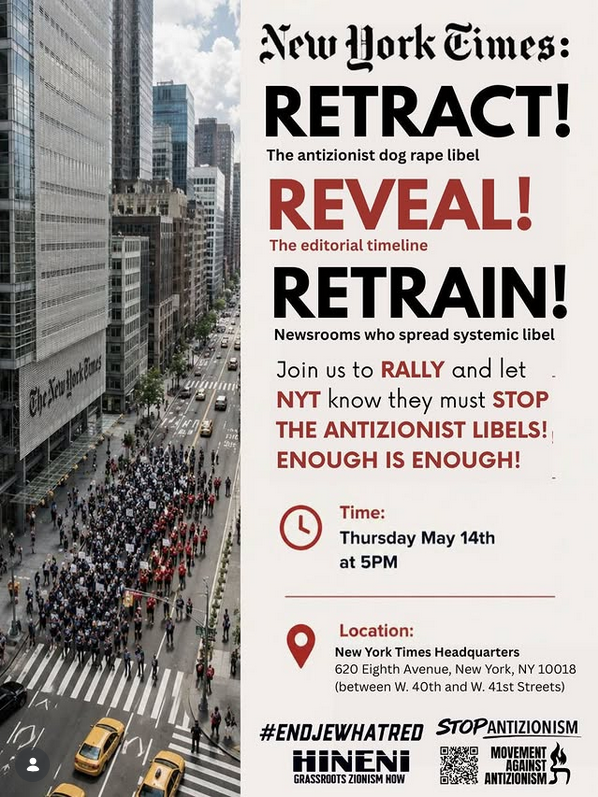
Frum’s article is admirably straightforward; he views the New York Times piece not as an investigation into conditions in a notoriously opaque and arbitrary prison system, but rather as simply part of the broader assault on World Jewry that began on 10/7 and continues to this day.
This is the backdrop for the vehement response that so many Jews and friends of Israel have had to a column by Nicholas Kristof in The New York Times last week, in which he alleged a systematic Israeli campaign of sexual violence against Palestinian prisoners and detainees. Anti-Semitic violence in the Western world is quickening in tempo and intensifying in lethality. Much of that violence can be blamed on anti-Jewish incitement that draws on the deepest foundations of anti-Jewish myth.
Frum begins his piece by discussing the attack on Temple Emanuel in March, his childhood synagogue in Toronto, and many other recent acts of antisemitic vandalism, harassment, and terrorism, and linking them together with Israel’s wars with Hamas, Hezbollah, and Iran, and any and all other criticism of or activism aimed at Israel into a singular campaign, aimed and operated by masterminds—one in which Kristof and his editors at the Times are, at best, unwitting tools of.
The slogan “Globalize the intifada” proposes a new mode of operations. Rather than wage a difficult and dangerous war against the highly armed Jews of Israel, the slogan urges anti-Zionists to target a more vulnerable population: the Jews of the diaspora.
Of course, “globalize the intifada” is not a new slogan, nor does it have any special tactical significance; it is one of many different chants, slogans, rhymes, mantras, or mottos that has been emblazoned on signs or shouted aloud, sometimes, by some people, over the years at various times and places, with various different meanings. I tend to agree with Mayor Zohran Mamdani that it is not a useful slogan, specifically because it is taken as a threat by so many Jews, but the assumption that it represents a deliberate strategy is emblematic of the paranoia and parochialism that defines Frum’s piece. I do not blame Frum for being paranoid, nor do I blame him for being parochial; it is entirely reasonable for American (or Canadian) Jews to interpret events primarily through the lens of how they impact their community, and the recent rise in antisemitic hate crimes has been terrifying, but that doesn’t mean that is the only lens possible, or the only one that deserves legitimate attention, or the most useful way to understand events.
Israel is a real, specific country in a real, material and temporal place—something that both its supporters and detractors tend to forget. It has a government and citizens and an army and a tax system, and it passes laws that shape the destinies of the millions of people who live under its rule, many of whom have no say in how those laws are decided. Frum and many other Jewish leaders take it for granted that Kristof’s piece is part of the broader campaign of delegitimization, a way to introduce new rhetorical weapons of attack into the discourse, a plan to distract from the release of Israel’s Civil Commission Report on sexual violence by Hamas (although the New York Times reported extensively on that as well). Frum waxes rhapsodic about the symbolic influence of the most explosive allegation in the article, the claim by a Palestinian journalist that guards used a dog to rape him while he was in custody.
Anti-Semitism has long trafficked in images of Jews as simultaneously uniquely cunning and uniquely disgusting. What could be more cunning and disgusting than training dogs to commit anal rape? The sexual abuse of men by animals transgresses the profoundest taboos protecting human dignity and purity. Those who believe Israelis and Jews capable of such an outrage might feel justified in wishing that such bestial monsters were wiped from the Earth—a shift from disgust to dehumanization to possible destruction that is well charted by social psychologists.
There is little interest here in the specific, the contextual, that beyond the implications and the semiotics, there is and was a real prison with real people somewhere.
The grim and awkward matter is, there is nothing particularly new about the allegations that Kristof records. The Israeli human rights organization B'Tselem published the reports “Welcome to Hell” and “Living Hell” in 2024 and 2026, documenting extensive use of torture and sexual abuse against Palestinian prisoners. Just several months before the release of Kristof’s article, Israel announced that it had dropped all charges against five soldiers who had been videotaped raping a Palestinian detainee at the Sde Teiman prison. Right-wing activists, including Minister of National Security Itamar Ben Gvir and Minister of Heritage Amichay Eliyahu had staged riots at several IDF bases in 2024 when the soldiers were first arrested. As of now, the only person punished for the entire affair has been former IDF Advocate-General Yifat Tomer-Yerushalmi, who has been dismissed from the service for leaking the video, and is currently facing criminal charges. Defense Minister Katz had described her actions as a “blood libel”.
Frum makes it clear that he considers testimony from Palestinians inherently suspect, but there is extensive documentation of this culture of abuse from Israeli and outside sources as well. Kristof cites the Committee to Protect Journalists and the Public Committee Against Torture in Israel. The Israeli organization of ex-soldiers, Breaking the Silence, has published firsthand testimony from soldiers at Sde Teiman and other detention centers. But we shouldn’t be surprised that there has been such a constant stream of allegations and evidence, because—contrary to what David Frum and the Israeli government imply—there is nothing unusual about this case.
Frum suggests that it is only the extraordinary bias against Israel and the Jewish people that led to the publication of this article, but as Kristof points out, mass rape and sexual abuse as a weapon of war is grimly commonplace; it is being reported in Ethiopia by the Tigray people, and Kristof himself has reported on it in Sudan. There were reports of systemic rape of children by the Bosnian Serb Army in 1992, and ongoing allegations about mass sexual assault of Uighur detainees in Xinjiang. Sexual abuse was prevalent in the US Japanese Internment Camps, and defined the Imperial Japanese Amy’s system of “comfort women”, which involved the sexual slavery of approximately 200,000 women and girls during the Pacific War. The sexual torture of prisoners was a persistent feature of the repression under Chilean dictator Augusto Pinochet, including the relatively-well documented use of dogs to rape prisoners by at least one Chilean police major. In 2001, Human Rights Watch issued “No Escape”, a 378-page report investigating the scale of sexual abuse in the modern US carceral system.
The issue here is not some indefinable evil present in the Israel psyche; it is the bleakly banal cruelty of humanity, which seems subject to convergent evolution. Prisons are places of control and hierarchy and arbitrary power, detention and prisoner camps outside the scope of civil law even more so, and so it seems unavoidable that we see the same corruption of the human spirit present wherever such structures are erected. In the West Bank, Palestinians are subject to “administrative detention” by Israeli authorities, without need for trial, and when military courts are convened, they often have a conviction rate of more than 99%. These courts, it should be noted, are for Palestinians only. Israeli settlers in the West Bank are guaranteed access to a civil trial in the Israeli judicial system. Since 10/7, the number of detentions have skyrocketed—to 20,000 in the West Bank alone—and Israel has routinely denied visits by the International Committee of the Red Cross.
Israel has been a colonial state since its inception. This is not a claim about legitimacy or indigeneity, or who the land between the River and the Sea really belongs to. It is a simple, factual claim, that since 1948, a defining feature of the Israeli state has been its rule over a large subject population, distinguished from the Jewish majority ethnically and religiously, and governed by military law outside the constraints of civil protection. Before 1967, it was the remaining population of “Green Line” Palestinians under martial law, since they were granted citizenship, the Palestinians of the West Bank and Gaza—not to mention the people of South Syria, under Israeli occupation since 2024, and the various regions of Lebanon subjected to intermittent Israeli control since the 1980s. You can certainly believe that this is necessary, that this is justified, that the survival of the Jewish people requires the maintenance of a garrison state and an apartheid regime, or that the whole ugly mess will be resolved by peace negotiations someday. That’s your prerogative. But that does not change the fact that Israel has been, and remains, a police state whose internal and external policies have always centered around the control of a subaltern population.
Chris Hayes’ 2017 book on the history and culture of American policing, A Colony in a Nation, explored the disparate systems of justice and civil order in different regions of the United States, documenting the ways in which African-American cities and neighborhoods are treated as hostile territory in need of control by an outside force. We understand full well the result of that; why should we be surprised to see an even more extreme example of the disparity in the West Bank, which has its own entirely separate and unequal legal system? Why should we pretend to not understand why classifying millions of people as subordinate, and placing them under an arbitrary system of rules designed to control them, not protect them, results in the full panoply of human cruelty and abuse? It would be more surprising if Israeli detention camps weren’t subject to sexual violence and abuse than if they were.
But I think David Frum knows all of this.
For all his nitpicking over sourcing and bias, I don’t believe Frum is a stupid man, and I don’t think he is really that interested in the treatment of Palestinian detainees either way. His piece in The Atlantic is quite straightforward, and makes it very clear that his primary objection is to the impact of Kristof's New York Times article, the influence it will have on discourse and public opinion, the way in which it will strengthen anti-Israel and antisemitic sentiment. Whether or not it is true, he doesn’t think it should have been written.
Knowingly or not, Frum is attempting here to apply the traditional rules of Jewish intra-communal discourse about Israel—a unwritten understanding that defending the Jewish State takes precedence over any other criticism or dispute. This kind of de facto gag rule isn’t without logic. This is not an abstract issue to many, or even most Jews. They have family in Israel. They have connections there. It is not an issue that they can be neutral about.
But the people on the other side of the line have families too, and they’re not interested in a set of narrative conventions created for our convenience. And as these people have gained more public prominence, it has become harder and harder for these conventions to be enforced, which explains much of the increasingly-hysterical tone of these discussions, as American Jewish leaders have proven helpless to stop the tide turning against their attempts to impose a cordon sanitaire, both inside and outside their communities. It is not unthinkable to “mention the affair” anymore, and for people like Frum, that’s terrifying.
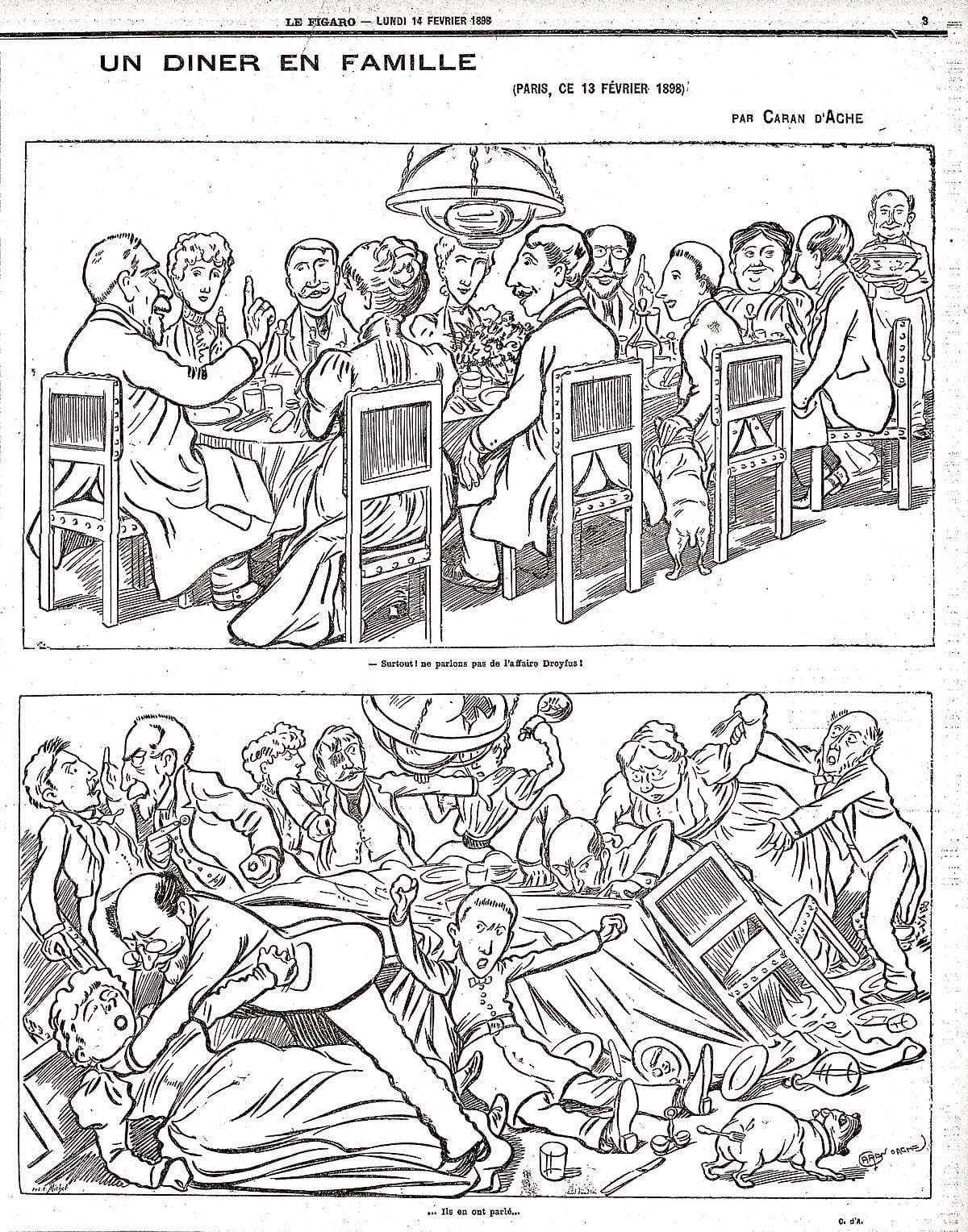
I have spoken before about the banality of Israel and Zionism, how in so many ways it is simply just another form of diaspora nationalism—no better and no worse. Frum’s paranoid sectarianism reminds me of a friend of my younger brother I talked to once—he would have been ten or eleven at the time, I think—earnestly telling me about how when he grew up he would go home to Sri Lanka and kill all the Tamil Tigers. Or the Azerbaijani victory parade I saw in 2020 after the Second Nagorno-Karabakh War, columns of trucks and vans and buses driving down the streets of NYC, covered in flags and lists of captured towns. Or the Serbian kid in my high school, who would angrily talk about how CNN made up all the atrocities against the Kosovars and the Croats, and they deserved whatever happened to them, anyways.
But of course, none of those views would get published in The Atlantic, would they? It is that salience that makes Israel such a poisonous issue in American politics, that one position in a bloody and intractable ethno-nationalist conflict routinely gets elevated to the heights of politics and culture, and treated as if their views are simply neutral and objective. Last week, the New York Times editorial board published a defense of Kristof’s column, addressing a number of concerns, and Kristof responded to his critics who have accused him of aiding and abetting antisemitism.
Doesn’t your reporting worsen the problem of antisemitism?
Kristof: This is a fair question, for antisemitism is a growing problem. I have wrestled with versions of this question my whole career. When journalists covered the Hamas terror attack of Oct. 7, 2023, we were aware that vivid coverage of Hamas atrocities risked aggravating Islamophobia. A week after the attack, a man in Chicago stabbed a 6-year-old Palestinian American boy to death, reportedly shouting that Muslims “must die.” The solution was not to soft-pedal coverage of Hamas. When I covered the Darfur genocide—committed by Arabs against several African ethnic groups—I knew my coverage might aggravate bigotry against Arabs.
The solution is not to look away. When you have interviewed rape survivors and seen their trauma and their courage in speaking up, you want to blow the whistle, whether in Sudan or the West Bank.
David Ben-Gurion, the founding father of Israel was often quoted as saying “when Israel has prostitutes and thieves, we'll be a state just like any other,” and I think it’s worth thinking about that seriously. Defenders of Israel often accuse its critics of having “double standards,” of holding Israel to a level that no other country is required to meet, but what we see so often in practice is the opposite; Israel acts like any other apartheid ethno-dictatorship, and receives a level of deference from the American government and press and public in turn that is simply unprecedented. You can believe, as I’m sure David Frum does, that all of this is necessary. That the Occupation and the two-tiered justice system and the endless punitive expeditions and counterinsurgency campaigns are needed to protect the Jewish people—but then you can’t complain when people see what they’re doing, and what you’re endorsing. What did you think a permanent military occupation would look like—vibes, papers, essays?
Zionism won. Israel is a state like any other. That’s the world we all live in now, for better and for worse, and that’s the reality we have to deal with. You may not care about what happens to Palestinians. That’s your prerogative. It’s a free country, and you’re an autonomous human being. But you cannot simply demand that nobody else care either.
The problem with dividing the world into friends and enemies is that the enemy still gets a vote.
Featured image is Ofer Prison, by Magister

The white male supremacists of the Texas GOP embody what the national party has become.

Get a copy of The Reconstruction Papers while inventory lasts, and reserve a copy of next year’s issue.

Liberalism's problem isn't structural. Liberalism's problem is that we got out-hustled.

Anton Jäger’s "Hyperpolitics" is, at its best, late marginalia for "The End of History and the Last Man." At its worst, Jäger, like Fukuyama, is a prisoner of his political pieties.
Sign up for the newsletter and get our latest stories delivered straight to your inbox.


