Liberalism or Inertia? Cass Sunstein's "Liberalism: In Defense of Freedom"
Sunstein’s book adopts a small-c conservative defensiveness that belies a now-requisite rejuvenating liberal imagination.

Conservatives enjoy the luxury of misapplying flowery Latin terms like ordo amoris to justify their Devil-take-the-hindmost philosophy. By contrast, being a liberal is a demanding thing. It means having to care about a lot: climate change, gender equality, right wing populism, and whatever Chuck Schumer and/or Hakeem Jeffries implosion has embarrassed us in the last hour. At its worst these sentiments can come across as self-righteous moralism, like chiding voters for being unwilling to give you their enthusiastic support in the face of an even worse alternative. At its best the breadth of liberal care is combined with a depth of ethical seriousness; an awareness of the demands concrete universalism makes on us.
All this makes offering cogent defenses of liberalism an important task in an illiberal epoch where gross injustices are now our daily bread. The most stirring contemporary defenses, like Elizabeth Anderson’s Hijacked, demonstrate a combined commitment to liberalism’s merits along with an honest understanding of where we have gone wrong. Unfortunately, many others adopt a small-c conservative defensiveness that belies a now-requisite rejuvenating imagination. Cass Sunstein’s Liberalism: In Defense of Freedom falls into this category.
An Orphean Liberalism
Sunstein is a Professor at Harvard University who has held numerous important posts, most notably in the Obama administration. His academic work has been voluminous and well received. Deservedly so—I’ve taught many of his books in my classes. Sunstein is perhaps best known for his “nudge” theory of libertarian paternalism, as unpacked in digestible books like Why Nudge? Blending law and economics, he attempts to show how governments can alter “choice architecture” to induce better choices on the part of citizens and consumers without direct coercion. For instance, by decreasing the volume of a unit of soda you can buy. You could still buy two units and speed up the diabetic process. But that unhealthy decision isn’t incentivized by ready availability. Sunstein is also an able popularizer of academic arguments. Short books like How to Interpret the Constitution provide valuable summaries of current debates and are admirably even-handed in discussing alternative views.
But scholarly politeness can sometimes become a lack of realistic judgement. Sunstein got into a lot of hot water for a recent New Yorker interview promoting Liberalism: In Defense of Freedom. He was digitally roasted for a few reasons. One was studiously avoiding talking about Trump and contemporary politics because, as Sunstein puts it, that “would date the book and cheapen the analysis if it was calling out the President or calling out some contemporary prominent person. But I think the more fundamental and more truthful answer is that talking about the President makes me grumpy and talking about John Stuart Mill or John Rawls makes me the opposite of grumpy.” But the main reason was Sunstein’s flustered responses to interviewer Isaac Chotiner, who pressed him on hard issues like advocating for human rights while defending the dictator-loving Reagan administration and ignoring Friedrich Hayek’s support for Augusto Pinochet’s coup and authoritarianism.
Sunstein also drew attention to his relationship with conservative justices on the Supreme Court. He acknowledged that it was “completely fair” to question the commitment of Clarence Thomas and Samuel Alito to even right wing liberal bonafides, though he believes they both lie within the liberal family. Sunstein plays down recent Supreme Court extremism by pointing out an unnamed “conservative judge” read the first few chapters of his book and claimed to believe in all of it. One wonders whether Sunstein himself is prepared to believe that. But nothing seemed to irk readers of Chotiner’s interview quite like Sunstein’s chummy relationship with the late Henry Kissinger. In a particularly cringe moment, Sunstein awkwardly defends his friendship with Kissinger by explaining that Kissinger was nothing but friendly when discussing Sunstein’s book on Star Wars. Maybe signing off on mass extermination in Cambodia looks a little less bad if Kissinger would condemn the Empire’s mass extermination on Ghorman.
This disastrous interview didn’t bode well for Sunstein’s book. The final product is quite a bit better, but still fails to rise to the moment. Like much of his work it’s a learned, well written, even-handed—if very Americanized—read on the liberal tradition. But this also gives the book a very Orphean feel. Rather than reflecting on why liberalism is failing, and how to rejuvenate it, Sunstein’s book is saturated with a nostalgic desire to resurrect an era of (neo)-liberal hegemony amenable to many on the right. This was an era that for many people was neither inspired or inspiring, which in part explains why they chose to reject it. Like MTV, the end of history era has definitively ended. Time to move on.
Sunsteinean centrism
Sunstein’s book opens with a manifesto of sorts, consisting of 85 points on what it means to be a liberal. On his reading, liberals believe in “six things: freedom, human rights, pluralism, security, the rule of law, and democracy. In fact, they believe in deliberative democracy, an approach that combines a commitment to reason-giving in the public sphere with a commitment to accountability” (1). All other liberal demands and convictions by and large flow from our commitment to these six things.
Readers will note that each is eminently contestable and somewhat vague. Liberals (not to mention illiberals) have disagreed with one another sharply about the nature of freedom. For Hayek, freedom largely meant the absence of human coercion on the choices an individual made. This conception of freedom precluded any concern for the range of choices available to someone. In The Constitution of Liberty Hayek claims that even if a rock climber has only one choice available to save her life, she was still “free” because no one was forcing her to do anything. Liberal socialists like J.S. Mill adopted a more holistic understanding of freedom, holding that we must facilitate the development of an individual's human capacities to enable their experiments in living.
Democracy is also contested within the liberal tradition. Some liberals regard it as a central, others as a more instrumental commitment. But almost all liberals reject a purely majoritarian conception of democracy. The great constitutional theorist Ronald Dworkin argued for a democratic “partnership” conception in Is Democracy Possible Here? Dworkin was a liberal egalitarian, and was deeply concerned that majoritarian democracy would be insufficiently respectful of equality. Illiberal majorities, such as whites in the Jim Crow south, might use their numerical clout to marginalize large numbers of people and abridge their rights. A partnership democracy could not countenance that. By contrast, Hayek tended to worry that majoritarian democracy would move in too egalitarian a direction. In Law, Legislation, and Liberty he suggested imposing limitations on legislative authority, especially to prevent popular movements from urging their representatives to interfere with the market. At his most anti-democratic Hayek even defended dictators like Pinochet, musing that he’d prefer a liberal dictator to a democratically elected socialist. In this choice between liberalism and capitalism, Hayek opted for the latter.
Sunstein is aware of this variation and acknowledges it, though he works hard to constrain the range of liberal possibilities (good and bad) to those that’d be acceptable to the American golfing class. This ignores what Sam Moyn points out in Liberalism Against Itself—that liberalism was born as a revolutionary creed determined to remake the world in line with the principles of liberty, equality, and solidarity for all. In Sunstein’s hands liberalism becomes above all a politely centrist doctrine that runs the gamut from a relatively neutered left liberalism (allegedly) exemplified by J.S. Mill and John Rawls to an equally neutered right liberalism exemplified by the most polite versions of Hayek and Mises. Sunstein explains the parameters as follows:
Mill and Hayek help define the liberal tradition, but in both temperament and orientation, they could not be further apart. Mill was a progressive, a social reformer, an optimist about change, in some ways a radical. He believed that, properly understood, liberalism calls for significant revisions in the existing economic order, which he saw as palpably unjust … Hayek was not exactly a conservative; in fact he was sharply critical of conservatism on the grounds that it was largely oppositional and did not offer an affirmative position. But he is a hero to many conservatives. One reason is that he generally venerated traditions and long-standing practices, seeing them as embodying the views and knowledge of countless people over long periods ... Understanding Hayek and Mill, and what unifies and separates them, is fundamental to understanding the liberal tradition. (41)
Sunstein makes no bones about which end of the liberal spectrum he prefers. In the opening of the book he declares “I love Hayek, but I love Mill more.” I share Sunstein’s good taste in romantic attractions. What makes this love triangle frustrating is, as so often with paramours, Sunstein sees Mill, Hayek, and many others as he wants them to be rather than how they were.
On the left end of things Sunstein acknowledges that “Mill cared deeply about social justice, and he came to embrace what he described as a form of socialism, above all because of the unfairness of ‘the present economic order of society.’ But his complex writing on that topic should hardly be seen as an endorsement of centralized government planning.” As the enormous number of qualifiers suggests, Sunstein seems quite embarrassed by Mill’s socialism. His own project reworks these Millian instincts into support for an FDR style “Second Bill of Rights”—the title of Sunstein’s thoughtful history The Second Bill of Rights: FDR’s Unfinished Revolution. The result would be a fairly reformed economic system, with the state provisioning access to basic resources like education, housing and health. Though to what extent and degree Sunstein is not clear.
This may be Sunstein’s program but it is not Mill’s. Sunstein seriously underplays the extent and depth of Mill’s socialist ambitions. In his Autobiography Mill described himself unambiguously as falling “under the general designation of Socialists.” In her seminal John Stuart Mill: Socialist Helen McCabe stresses just how radical these convictions went. Mill reached the conclusion in later editions of the Principles of Political Economy that capitalists were largely an economic and moral drain on society; even an antique relic of the aristocratic regimes liberals had launched revolutions to overturn. He called for widespread experiments with worker-managed firms—worker control of the means of production in other words. As Sunstein notes, he was critical of already emerging statist forms of socialism. But, influenced by the Saint-Simonians and others, Mill also reprimanded pro-capitalist liberals for failing to see how capitalism ran counter to many of their own sacrosanct principles. Most notably, defenders of capitalism often described wealth as a reward for hard work and contribution, neglecting that the hardest working and most essential workers were in the working class. By contrast, many (most) of the wealthy inherited their wealth and contributed far less that was essential to society. If Mill-style socialism were implemented tomorrow it would mean a near abolition of the capitalist class and a mass expansion of the welfare state guaranteeing education, health, and more.
The same moderate-washing tendency extends to Rawls. Sunstein commends Rawls’s arguments that we ought to emphasize that “lotteries are everywhere” in society. Sunstein approves Rawls’s claim that the kind of society we have ought not to be “distorted from the moral point of view, including what he calls the natural lottery, which refers to our genetic endowments such as intelligence and musical ability.” Behind the veil of ignorance in the original position we’d choose very different principles to orient society than any which simply allow the good things in life to flow to those lucky enough to be born naturally talented and/or privileged and the bad things in life to descend to those unlucky for morally arbitrary reasons. Sunstein even describes Rawls’s “prominent form of liberalism” which gives a “central position to the original position” as his “favorite.”
But Sunstein doesn’t mention that Rawls thought taking the implications of the original position seriously would require a transformative restructuring of society. In Justice as Fairness: A Restatement Rawls once more rejected the idea that liberal principles of justice could ever be adequately realized in a pure market society. But he also rejected the claim that they could be adequately realized under welfare-state capitalism. This is because, while superior to a pure market society, welfare state capitalism still permitted very high levels of inequality. Moreover, the high levels of inequality meant that much of economic and political life ended up being controlled by an oligarchic few. This was contrary to basic liberal convictions about the importance of equal citizenship and the fair value of political rights. This left what Rawls called “property owning democracy” or “liberal socialism” as the only two regimes that could possibly instantiate liberal justice.
In his Lectures on the History of Political Philosophy Rawls also made clear the depth of Marx’s influence on his work. This runs counter to Sunstein’s reductive dismissal of Marx as a “defining antiliberal theorist” and Marxists as a whole as “not liberals.” Rawls described Marx as “extraordinary, indeed heroic.” Rawls noted how his defenses of property owning democracy/liberal socialism tried to “meet the legitimate objections of the socialist tradition” and that it would be a “serious mistake” to ignore the importance and significance of “Marx’s socialist philosophy and economics.” In the Lectures Rawls described liberal socialism as an “illuminating and worthwhile view….” before unpacking what it would entail. Needless to say it would go beyond the state provisioning a modest number of public goods. Rawls insisted there would need to be a rough equality of property, firms would ideally be worker managed, and citizens would get “fair value” from their political rights.
I don’t raise these theoretical points to argue that Mill or Rawls are truer to liberalism than Sunstein. After several centuries the family of liberalisms is a big one. Sunstein can disagree with Mill’s and Rawls’s radicalism. My points are exegetical and ideological.
The exegetical point is that Sunstein mischaracterizes the liberal tradition by sanding down the radicalism of its left flank (and the right one, as I’ll get to). As Helena Rosenblatt recounts in The Lost History of Liberalism, by the 19th century many “proponents of the new liberalism admitted that they could be seen as preaching socialism, but they didn’t mind. In 1893 a leading liberal weekly in Britain wrote that ‘if it be Socialism to have generous and hopeful sentiments with regard to the lot of those who work … we are all Socialists in that sense.” (230) Moyn’s and Anderson’s aforementioned books are more encompassing in tracing how many liberals, in Europe and beyond, were often comfortable learning from socialism and Marxism and calling themselves socialists.
The ideological point is that by downplaying or marginalizing the range of left-liberal opinions which he considers beyond the pale, Sunstein seems to reject the possibility that a more transformative egalitarian politics, even a socialist politics, might still be a liberal politics. Even a resolutely liberal politics in the vein of two of its most esteemed philosophers. Instead his book works hard to contain liberal politics somewhere between Barack Obama and William F. Buckley. This not only forecloses a more radical liberal politics,it also betrays a lack of reflection on how right-wing forms of liberalism contributed to getting us into our present mess.
Once more on right-wing liberalism
Much as Sunstein politely sands down the radical left edges of liberalism, he does the same on its right-wing edges. In his interview with Isaac Chotiner, Sunstein is happy to include figures like Reagan and Buckley within the liberal canon of liberal, and even to run a little gentle cover for Kissinger. As he puts it a “liberal might think that Ronald Reagan was a great president and that Franklin Delano Roosevelt was an abomination; a liberal might think that Franklin Delano Roosevelt was a great president and that Ronald Reagan was an abomination.” He notes that much of the time, “Buckley sounded like a classical liberal, a follower of Hayek.” While Buckley “despised what he called Liberalism” most of his “propositions grow directly out of the liberal tradition. Was Buckley a liberal? Mostly.” (21-22). Chapter Two even opens with a long digression on a fan letter a young Sunstein wrote to Buckley:
He was dashing and funny. He was devastatingly clever. He was full of charm. He was mischievous. He seemed to know everything. And how the man could write! I subscribed to National Review, the magazine he founded.
Buckley was indeed a gifted writer and organizer. He also supported many policies and figures that liberals should find appalling.
In 1957 Buckley wrote an op-ed “Why the South Must Prevail” at the height of civil rights activism. He declared that whites were for the moment the advanced civilization and entitled to rule, even where blacks constituted a majority. Around the same time he wrote in the National Review that Spanish dictator Francisco Franco was “an authentic national hero.” In God and Man At Yale, one of the first and best of the “a conservative rails against higher education” polemics that would later become a minor literature, Buckley declared himself uninterested in educational neutrality. He insisted that the job of educators as far as Buckley was concerned was to teach true values. And “true” meant Buckley’s values. Liberal principles like Mill’s insistence that one learn many sides to an argument would have no place in this programme. As late as 1965 Buckley famously debated James Baldwin and defended disenfranchising poor uneducated blacks by explaining he favored doing the same to poor uneducated whites. During the 1980s AIDS epidemic, Buckley suggested that everyone “detected with AIDS should be tattooed in the upper forearm, to protect common-needle users, and on the buttocks, to prevent the victimization of other homosexuals.” Buckley went on to clarify that he wasn’t kidding.
Why include this digression on William Buckley? Because despite being a self-described left-liberal Sunstein at times seems more open minded about who gets to be included in the liberal/right wing nexus than on the liberal/left wing nexus. In Revisiting Karl Marx’s Critique of Liberalism Igor Shoikhedbrod reminds us that Marx began his career as a young liberal and to his dying day defended expanding rights to freedom of expression, assembly, and suffrage. Yet Marx and all Marxists and socialists are for Sunstein beyond the pale for even minimal commendations. By contrast Buckley, who fought against civil rights for blacks, feted mass murdering conservative authoritarians, denied the importance of educational neutrality, and called for state imposed tattooing of AIDS victims, gets to “mostly” be a part of the club. Ronald Reagan is floated as being a great liberal President, despite the fact that at the end of the Reagan-Bush years there were more people in jail in the United States than in the authoritarian Soviet Union. Why is this so?
My suspicion is that the ideological parameters of Sunstein’s story owes less to exegetical precision and more to the instinct for respectability and politeness I mentioned before. Reagan and Buckley were establishment figures par excellence. This means no matter how illiberal and radical their right wing policies were they are still owed a degree of deference that the left simply isn’t—even if many of the most thoughtful and principled liberals were and are attracted to left wing politics. Even the opening of Sunstein’s book gestures in this direction, as he tries to draw a symmetry between the threat the radical right and the radical left poses to liberalism.
More than at any time since World War II, liberalism is under pressure, even siege. On the right, some people have given up on liberalism. They hold it responsible for the collapse of the family and traditional values, rampant criminality, disrespect for authority, and widespread immorality. On the left, some people despise liberalism. They insist that it is old and exhausted and dying. They think that it lacks the resources to handle the problems posed by entrenched inequality, racism, sexism, corporate power, and environmental degradation. They refer to ‘neoliberalism’ with disdain. They do not respect the liberal political tradition.
Throughout the book Sunstein labors to imply that there is a respectable form of liberal conservatism that is disappearing. Why it disappeared is unclear of course, since as Sunstein explained, writing about Trump and Trumpism makes him grumpy. But this would require deeper soul searching about how the centrist neoliberalism of the past 30 years proved sufficiently uninspired in theory and practice to pave the way for Trump’s ascent. Moreover the attempted both-sidesism seems like a rear guard effort to convince country club Republicans to ditch MAGA and return to a respectable liberal conservatism which aligns with respectable, technocratic left wing liberals in rejecting increasingly popular politicians like Bernie Sanders, AOC, and their noisy, angry activist base.
This attempted symmetry ignores that it isn’t Sanders, AOC or Judith Butler who’ve called to overturn America’s constitutional order and replace it with illiberal authoritarianism. It’s right wingers weaned on the National Review who’ve declared that liberalism is “old and exhausted and dying” and committed themselves to undoing it. From longtime National Review writers and Hayek stans like Ben Shapiro to virtually the whole of the Republican party—they’ve all dutifully fallen into line with the MAGA agenda. That’s where they didn’t enthusiastically endorse MAGA to begin with.
This is important because it demonstrates an unwillingness on the part of polite centrist liberals to grapple with how we got here. Doing so would require examining the extremism that has been present in the American right for a long time; from Reagan throwing millions of people into jail while crusading against labor unions, to Bush era officials declaring that people in the “reality based community” were a bunch of dweebs that the strong men who truly made history could freely ignore. It would also require looking more deeply at the structural features of American society that have contributed to this moment: the rampant and worsening inequality, the concentration of power into the hands of oligarchs like Musk and Trump, the diminishing influence of ordinary people, the toxic and corrosive effects of a centrist-beloved meritocratic mythology liberals like Hayek and Rawls told us to grow out of. That’s just for starters. These are all things critical theorists like Wendy Brown warned us about decades ago, when she said the neoliberal epoch was giving way to an age of national populist, wall-building oligarchs. We seem fated to relearn their lessons again and again.
Conclusion
This review has been quite hard on Sunstein’s book, and I think it deserves it. But I won’t deny its considerable virtues. Liberalism: In Defense of Freedom is well written, knowledgeable, and lucid. Sunstein’s efforts to understand and persuade the other side are commendable, even if he should drop the nostalgia. There is much to be learned from Hayekian theory, and the relationship between liberalism, constitutionalism, and the rule of law. It was a pleasant book to read and I recommend it to readers on that basis.
But this is not the defense of liberalism we need right now. Sunstein’s liberalism is narrow, crouched, nostalgic, and if not defeated then chastened and even conciliatory. What liberalism needs is a sense of moral purpose and vitality; to rediscover its roots as a revolutionary creed committed to bringing liberty, equality, and solidarity to all. That’ll require a lot more than promising voters a first time home owners tax credit.
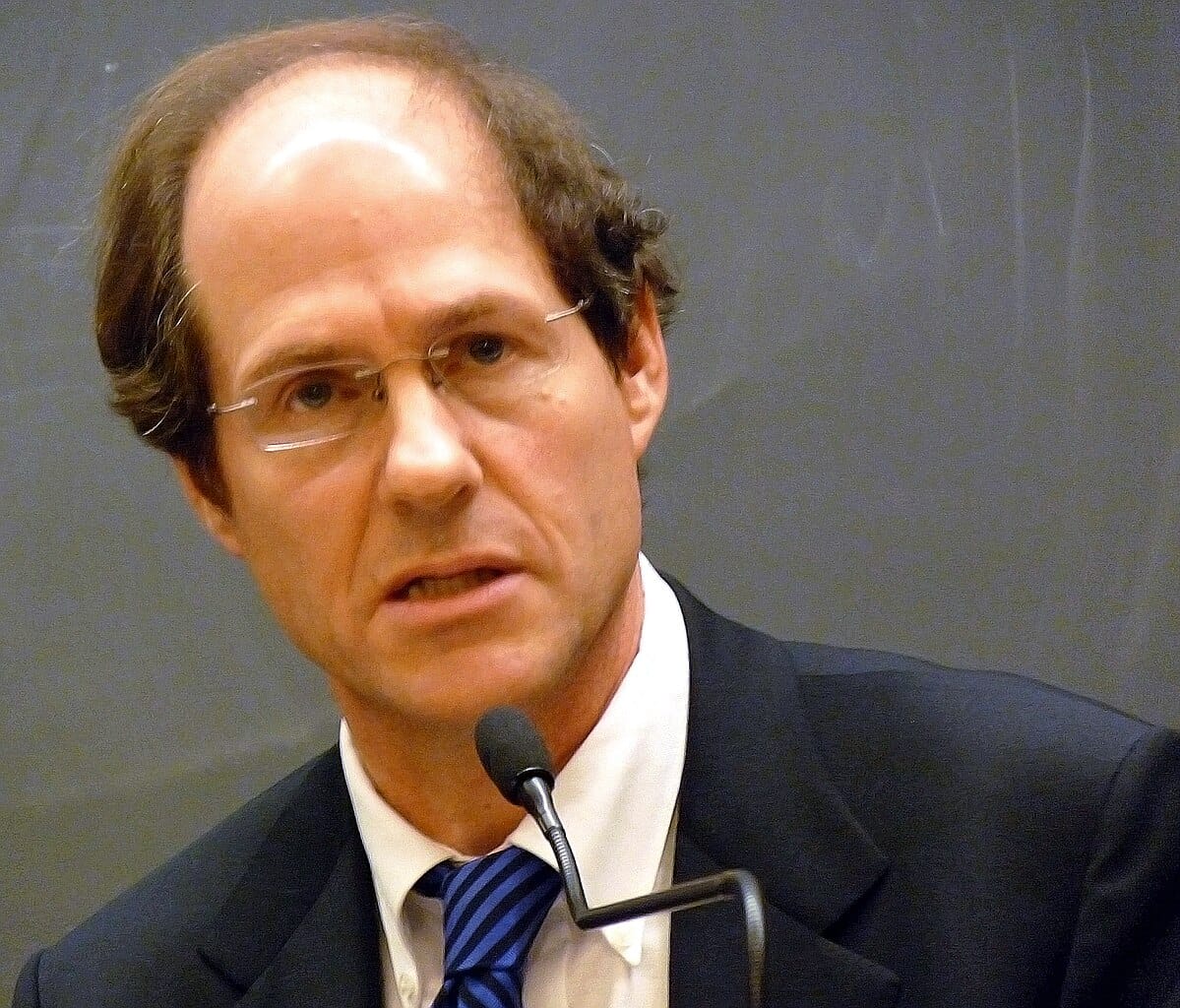
Featured image is Cass Sunstein, by Matthew W. Hutchins