Platner's Supporters, In Their Own Words
What is going on in Maine's Democratic Senate primary?

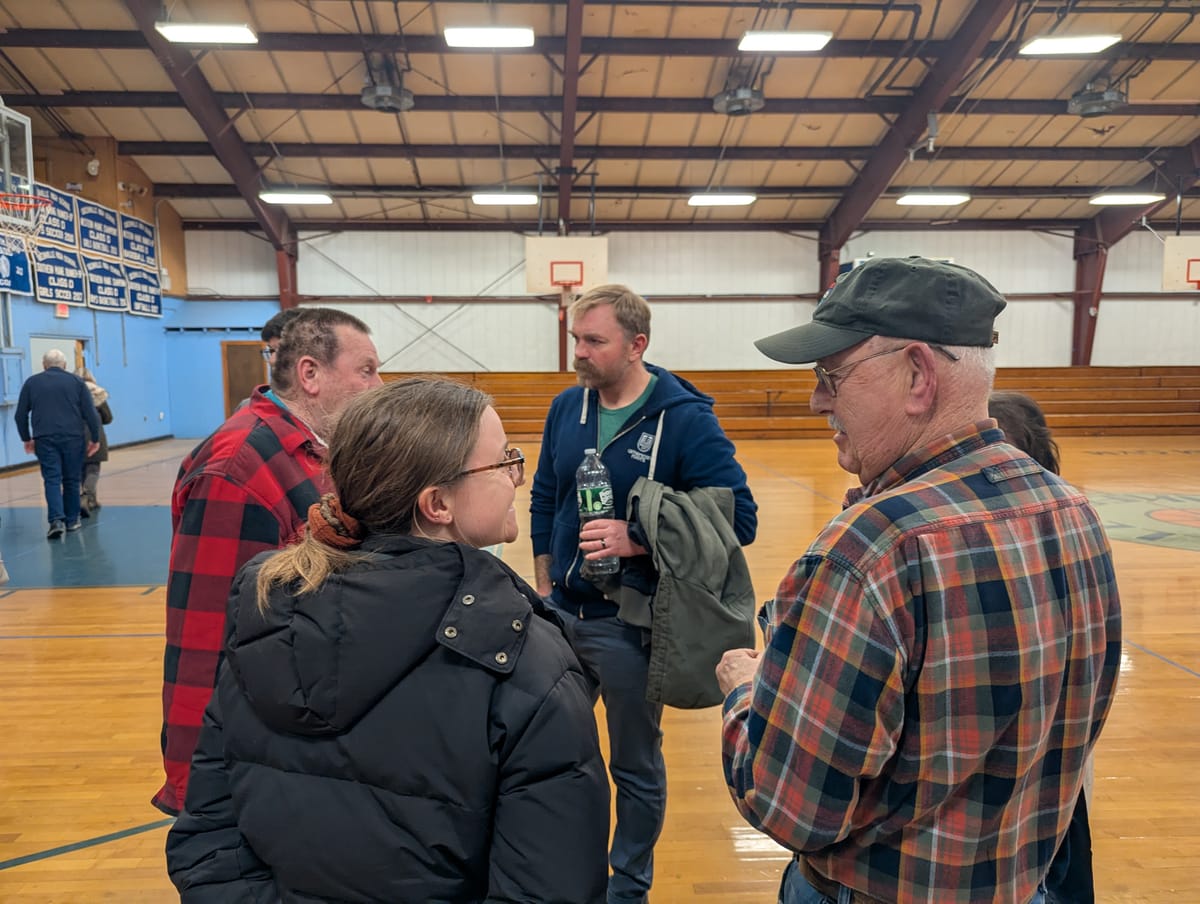
“I think Graham’s campaign is special because it isn’t so much about Graham,” Anthony Feldpausch told me at a Graham Platner town hall in Greenville, Maine. “You know, we’re trying to build a broad-based movement here to build lasting political power in the state, and that’s the only power that makes effective change.”
A union organizer who has lived in Maine his entire life, Feldpausch said he started volunteering for Platner’s Senate campaign in either October or late September. And when asked what separated Platner from two-term governor Janet Mills in his mind, he joked that the real difference is “37 years” (Mills is 78 and Platner is 41). Attendees struck similar notes at all three of the Platner town halls I attended earlier this month in Farmington, Jackman, and Greenville, bantering about Mills’ advanced age and talking about how Platner promotes local organizing. “If you don’t want to join us? Join a food pantry! Join Maine People’s Alliance, any community group,” Platner told the dozens of people attending the Greenville event. “It actually doesn’t matter what you do.”
Graham Platner, a political newcomer who foregrounds his past service in the Marines and current small oyster farming business, is a very different type of candidate than Janet Mills, his main opponent in the upcoming Democratic primary this June. The contrast between them, as Feldpausch joked about, is partly a result of the significant difference in age between the two prospective senators.
Before Mills officially entered the race, the primary seemed more crowded. With an early Bernie Sanders endorsement and $3.2 million in early fundraising from 80,000 donors, Platner was the biggest fish in the pond, but a one-on-one match wasn’t guaranteed. Then, the governor officially entered the race in October and the field suddenly cleared. Only three candidates managed to make it on the June primary ballot: Mills, Platner, and David Costello, who tried and spectacularly failed to oust Senator Angus King in 2024. Andrea LaFlamme, the activist who launched a campaign earlier this month after making headlines for protesting Susan Collins, did not qualify.
The Atlantic staff writer Mark Leibovich recently observed that Mills “would be the oldest freshman senator in history” if elected, calling Platner in comparison “a relative political infant.” Anahita Pajuhesh, a project manager born and raised in Maine, told me she’s supporting Platner because it’s time for a new generation of political leadership. Of course, she then quipped, “probably you know, partly that’s the discourse out there that I’m regurgitating.”
The far more grave factor separating the two candidates, though, is Platner’s history of concerning behavior from before running for office. Comments from a deleted Reddit account that Platner maintained include suggesting that men and women should not get inebriated if they are “so worried about [rape] to buy Kevlar underwear,” asking why Black people “don’t tip,” and calling himself a communist. Most worryingly, during an October appearance on the popular liberal podcast Pod Save America, Platner revealed he had gotten a chest tattoo of a design very similar to a Totenkopf, the symbol used by the Nazi Schutzstaffel. Matthew Kassel also reported for Jewish Insider that the host of a podcast Platner guested on earlier this year—and professed to be a long-time fan of—has spread antisemitic conspiracy theories.
However, the same archived Reddit history that included the insensitive remarks mentioned above also featured many other comments condemning fascism and right-wing authoritarianism in harsh, occasionally offensive, ways. “No quarter for fascists,” Platner commented on a 1994 photo of two South African neo-Nazis shortly before being killed by a cop, noting that “not a thing of value was lost” by their deaths. And as Branko Marcetic reported for the socialist magazine Jacobin, other comments showed Platner being a vocal supporter of the Black Lives Matter movement, worrying about the presence of organized Nazis in New England, and using crass language, including the r-slur, to describe Trump and other Republicans.
“It was my third deployment,” Platner told podcast host Tommy Vietor when discussing the tattoo. “We went ashore to Split, Croatia: myself and a few of the other machine gun squad leaders. And we got very inebriated and we decided to go get a tattoo, and we went to a tattoo parlor in Split, Croatia, and we chose a terrifying looking skull and crossbones off the wall because we were Marines.” Days after Platner appeared on Pod Save America, he covered up the chest piece with a Celtic dog design.
In interviews, including a recent one with Zeteo’s Andrew Perez, Platner has downplayed the tattoo’s similarity to Nazi iconography. When asked about it, he stated that the people he’s talked to have largely said, “Yeah, that’s a skull and crossbones,” including, he claimed, “a number of Jewish leaders” he spoke with in New York. Platner also linked the tattoo directly to his military service.
“The more they talk about it, the more I get to talk about the fact that I got that because I was a combat Marine,” he told Perez. “That’s why I had that. Susan Collins voted to send me to Iraq. It was the fighting I took part in, in Iraq, that resulted in me and other machine gunners getting a skull-and-crossbones tattoo.” Platner enlisted after Congress passed the Authorization for the Use of Military Force Against Iraq Resolution of 2002.
Mills, in both campaign ads and social media posts, has sought to capitalize on Platner’s condemnable past words and actions. The most recent ad released by the Mills campaign features four women reacting with horror to his 2013 comment on sexual assault and rape, apparently read by either AI or an impersonator, and ends on a shot of Platner shirtless with the Totenkopf-esque tattoo visible.
However, polling thus far suggests that the history of objectionable Reddit posts and covered-up Nazi tattoo are not disqualifying for likely voters in the upcoming Democratic primary, or in the November general election. A February poll conducted by the University of New Hampshire Survey Center found Platner’s lead amongst likely Democratic primary voters had actually increased in the months since October. The same poll also showed Platner performing markedly better than Mills in a head-to-head matchup against current Maine Senator and Republican Susan Collins. Plus, a more recent poll by the less credible polling firm Quantus Insights also found Platner with significant leads in both the primary and the general.
Both polls’ crosstabs show Platner performing quite well with younger voters—the UNH poll has him as the first choice of over 70 percent of polled voters below 65 years old—and attracting significantly more independent voters in hypothetical general election matchups against Collins than Mills would. The operator of a motel where I stayed, an older gentleman who joked about having mostly lost his French accent, said he has voted for Collins in the past but now plans on supporting Platner. Maine needs someone who won’t kiss up to Trump, plus Platner’s all-in for veterans, the man explained.
“Honestly, [the tattoo] gave me pause, you know, and I think it did for most people,” Democratic state Senate candidate Bob Sullenbarger said to me. “I’ve spent enough time with him and come to a view that he’s an earnest and honest guy, and that his intentions are solid. And I certainly know that I probably have things in my past I wish I hadn’t done, and nights when I had too much to drink. But I think most people, most people understand that.” Sullenbarger remains neutral on whether he will vote for Platner or Mills in June; both candidates, he noted, are supporting his own campaign.
Gus LaCasse, who opened both the Jackman and Greenville town halls playing music for the attendees, said that when he looks at Platner, he sees “someone who’s grown.” LaCasse told me he has known Platner since he was just twelve years old, and worked with Platner in the community organizing group Acadia Action well before the Senate campaign.
“Where he is now is a demonstration of the power of community and the power of being there for your neighbor,” LaCasse said. “You’re alone and isolated and in a bubble. It’s a really tough place to be, and it’s really disappointing. He said some things that, like, he’s not proud of. I don’t think they’re good. I disagree with the things from those posts, and I think some of them were just abhorrent, but I will say that he has grown.”
“I’ve known him for a while, and I’ve seen him grow,” LaCasse reflected. “I’ve seen the power that community can have in really holding people up and really making better people. And I think Graham has seen that, too. He looks back on his younger self. It's like, ‘Yeah, I made some dumb mistakes. I said some really hurtful things.’ And he’s owned it, and that’s the thing, too, that I’ll say that is really important, is the ownership and the intent to make amends on that. He’s a good man at heart, and it was a bad time.”
Every attendee and volunteer I talked to and asked about Platner’s Reddit posts or his covered up tattoo told me essentially a variation on this response. They disagreed with the posts and then they said that while it was a mistake, Platner has grown and changed since then. A handful explicitly compared his mistakes to their own experiences.
Suzannah Sinclair, a local painter who brought her daughter to the Greenville town hall, mentioned that she had gotten some tattoos in college she now regrets. “If we want younger people in politics, you’re going to get not just tattoos and Reddit posts,” she told me. “People have their entire lives online.”
Another woman who attended the town hall in Jackman said that the stories didn’t put her off “because he was very honest about it, he didn’t hide it, he didn’t sidestep it.” She’d explained to me that she supports Platner both because “he’s the first candidate in a long, long time” to really campaign in the more rural parts of the state and because “if we have a young person that is qualified, that can build that seniority, and we can have for a few terms, why should we elect a one-term candidate when we have a viable several term candidate?”
“[Platner] was in a dark place; a lot of military people come back with PTSD and they need treatment, and they need this,” she continued. “Society tends to throw people away like that. We don’t invest enough in mental health care and people are just labeled or discarded.”
Since Platner’s Reddit posts were first reported on, the candidate has not denied making any of the statements. Instead, he has sought to contextualize them in various ways. This does not always amount to an actual apology. For example, in the Pod Save America interview where his campaign revealed the tattoo, almost certainly in an attempt to preempt coverage by news outlets, Platner told Vietor that he asked why Black people “don’t tip” out of genuine curiosity and that it wasn’t “meant in any malicious way.” At the time, Platner was working as a bartender in D.C.
When asked about the comments on sexual assault, he responded more directly with “I didn’t know what I was talking about.” At the Greenville town hall, answering a question from a female veteran about Secretary of Defense Pete Hegseth’s “no more walking on eggshells” policy, Platner stated that Congress needs to pass legislation to treat allegations of sexual assault in the armed forces more seriously. “I actually thought that there wasn’t as much sexual assault in the military because I spent time in the combat grunt unit,” he recounted to the attendee. “Then I left and I went to college and I became friends with a bunch of women veterans at school. Every one of them had a story. Every one. And at that point I was like, ‘Oh yeah, this is a huge problem.’”“As I read through [the Reddit comments], I read things that I absolutely do not agree with. I read through and I see things, words and statements that I abhor,”
Platner averred in a video statement posted to his campaign socials. “I also see the trajectory of my life.” He attempted to describe the most offensive comments as a product of his time in the “very masculine world” of the infantry and resulting struggles with depression and PTSD. “Reconnecting with the community that I’m from, building real friendships, building real networks, real relationships with people, that helped cut my disillusion,” Platner said. “I went from thinking that people were bad to knowing that people are good.”
When I directly asked Platner about what it means that so many Mainers still support his campaign despite the Reddit posts and the tattoo, he told me he believes “a lot of Mainers fundamentally understand that all of us could change over time and become different people.”
“I think they were just kind of satisfied with my answers,” Platner continued. He said he thinks the campaign is having success with many Maine voters because his policies address people’s “material realities” and that “when you just engage with the real world that people live in, instead of trying to pretend it’s a different world, or pretend that our problems are somehow not the problems that we very obviously have, I think a lot of regular people are, like, ‘Oh, good.’”
Across the three town halls that I attended, Platner continually stressed two things: Americans need to remake a political and economic system that has been rigged against the working class; and only collective organizing, not just winning one election, can make that dream a reality.
“My entire life, I have heard from those in power that it was ridiculous to dream big, that it was fantastical, that it was a waste of time, it was never going to happen,” Platner thundered at one town hall. “And therefore, we should keep electing them: professionals at transactional politics in which the best you can ever hope for is some marginal win.”
“We will never get the future we deserve if we keep electing people who refuse to fight for it,” the candidate told a small crowd sitting in the bleachers of a community school gymnasium. “In many ways, we just need a fundamental change in philosophy. We need to be able to dream big again, and we cannot accept when those in power tell us that that’s absurd. Because it isn’t. Because we’ve done this before, and we have to do it again.”
Platner repeatedly, almost compulsively, refers to American history when describing his political vision and the policies he wants to be implemented. At two of the three town halls I observed, he described Frances Perkins, the first female cabinet member and FDR’s secretary of labor, as one of his heroes. At the third, he lambasted Robert Bork for reshaping antitrust law and thanked God that Bork’s nomination to the Supreme Court floundered. And while arguing that Mainers need to organize, not just send him to the Senate, Platner rattled off a list of past movements all meant to illustrate that only people in institutions working with organized people outside of those institutions can “move the ball down the road towards justice and equality.”
“We didn’t get an eight-hour work day and a 40-hour work week because somebody voted or sent another postcard to Congress,” Platner said in Farmington. “We got it because working people organized and fought for what they needed, in the streets, in the hills, and in the halls of power.
“The Civil Rights Act didn’t occur on a whim to LBJ,” he added. “Organizers and activists spent decades building power around this country, putting their lives on the line, being beaten, being murdered. But when the day came, they built enough power to push back against the institutions. That’s what got us the Civil Rights Act. Those are the legacies we need to look to now.”
He also uses this rhetorical mode to argue for the importance of dreaming big when Democrats win majorities and can begin recovering from the disasters of the second Trump administration. “When we face moral crises, the Americans who rose to the occasion did not simply protect what they already had, they always built a freer society,” Platner said. “During the 1860s with the dissolution of the Union and the fight against slavery, it wasn’t enough to go back to the antebellum world. They built something entirely new. They understood that to protect the rights of their children, they had to grant new rights different from the ones they had.”
Platner compared the present moment to the “crisis of capitalism” that confronted Roosevelt and necessitated the New Deal as well. “We find ourselves in that moment of moral crisis again. I firmly believe that we are fighting fascism,” he declared to widespread applause. “I firmly believe that Donald Trump and everyone around him wants to destroy democracy in this country. I believe that, but to protect this nation, we cannot simply go back to what we have. We have to build power to fight back. And we have to dream of a better future.”
At his town halls and in his campaign messaging, Platner offers a promise of a new national founding, a political transformation that could be measured on the same scale as Radical Reconstruction and the New Deal. If his supporters have come to believe the nation can (must) be remade, it’s no surprise that they can believe Platner has personally grown and changed.
Despite running in the Democratic primary, being perfectly comfortable calling Trump a fascist, and receiving plenty of support from highly partisan Democrats, Platner does maintain some rhetorical and real distance from the party itself. “If I am any kind of Democrat, I am a New Deal Democrat” is one Platner line that exemplifies both this balancing act and his use of historical allusions—a bit of rhetoric probably but not provably inspired by the 2023 Christopher Nolan film Oppenheimer.
During an interview on the Slate podcast “Death, Sex & Money,” Platner alleged that people close to his campaign had been told by the national party, specifically the Democratic Senatorial Campaign Committee, that it was “going to rip [Platner’s] life apart” when he chose to run. When I asked about this comment, Platner told me the DSCC pushback was “an indication of a power structure that at this point is far more interested in protecting itself, protecting its personal power, instead of having power for the sake of wielding it and doing something, which I think is why it’s having such a hard time fighting back against what I do think is rising fascism.”
“That same kind of thought process and the same kind of philosophy around politics is also why they feel that only they are the ones worthy of picking candidates in a state like Maine, instead of leaving it up to the actual primary process, to allow the people of Maine to pick who they want,” Platner continued. “I think it’s a fundamental mistrust of people which, if we’re going to beat fascism, we’re actually going to have to organize and mobilize people. Historically, that’s the best way to do it.”
Despite his concerns about the national party though, for being a first time candidate running against a current governor Platner has also received an impressive amount of support from the populist wing of the Democratic Party. Since launching his campaign last August, he has been formally endorsed by Senators Bernie Sanders, Ruben Gallego, Martin Heinrich, and Elizabeth Warren, as well as Congressman Ro Khanna and the United Auto Workers.
Platner is more than willing to talk about the Democratic politicians he admires when asked by voters at his town halls. On the stump, he highly praised Chris Murphy and Chris Van Hollen, inter alia, as well as Republican Senators Rand Paul and Josh Hawley for their stances on foreign policy and restricting stock trading by members of Congress respectively. Answering an audience question at the first town hall I attended, Platner lauded Van Hollen’s visit to CECOT to speak with Kilmar Abrego Garcia as the Maryland senator “utilizing his role as a senator in the way that the role needs to be utilized.”
Platner’s praise of senators who are willing to use their office in innovative ways to fight for working people appeared to match the mindset of the supporters at his town halls. Several people told me, or told Platner during the Q&A sessions, that what they really want is someone who is willing to go to Washington and fight the Trump administration, who can avoid being captured by what political commentators call “Senate brain” and will value results over procedure. At one town hall, Platner suggested Democrats ought to repeal the filibuster to enact a new War Powers Act only to then put the filibuster back in place. He also promised not to “vote for a single nominee” from the Trump White House.
An older man who said he served in the armed forces for twenty years told me he’d actually knocked doors for Mills when she was running for governor and acknowledged that Collins has helped bring federal funding to the state, but now he “just wants someone totally new, like [Platner] is.”
“It’s been there, done that, paid the price, you know? Give him a chance,” the veteran said. A much younger man who identified himself to me as a socialist formerly active in a local College Democrats chapter similarly said that “the Democratic Party really handled the past 10 years of opposition to Trump incredibly poorly,” especially the 2024 presidential campaign. He specified that he has been “really impressed with [Platner’s] stance on the genocide [in Gaza] going on.”
During the final town hall I attended, one audience member told Platner that “it drives me crazy that the Democrats down in Washington don’t fight.” He continued by saying, “I don’t know how Elissa Slotkin and Schumer and all these people are saying, ‘Well we gotta go, we gotta look at this, maybe we need to do it.’ Wrong answer! We have to fight the whole policy to start with.”
“You don’t go along with a process. If you go to Washington, don’t go along with the process,” the man implored Platner.
After going to Maine, I cannot believe that if Graham Platner does win the primary, and then the general election after that, it’ll be because somehow his supporters failed to see all the headlines about the tattoo or the Reddit posts or podcast appearances. They have seen the old posts and shirtless photos. They just believe that Platner is a different, better man now, who will be an advocate for real change in D.C. Talking with and listening to Platner’s supporters convinced me that, if he does win, it will be because of frustration that politicians like Jared Golden aren’t doing enough to resist Trump’s unconstitutional power grabs, and because—even though they may have happily voted for Mills in 2018 and 2022—many Maine Democrats don’t really love the idea of sending the oldest freshman senator in history to Washington.
Graham Platner is an untested politician with an unsavory past, but will readily promise to do radical things to resist the Trump administration, endorse taxing the rich, support sovereignty for the Wabanaki Nations, and happily call a fascist a fascist. Compared to “been there, done that, paid the price,” that apparently seems like an appealing choice for many Mainers.
Featured image is Graham Platner at campaign event, by Akshit Arora